Wide-Awakes Through the Windscreen
FACTS
By LOUIS N. RIDENOUR
IN the early days of the war, when a landing in Africa was big stuff, there was, by the standards of the time, a good deal of air transport across the South Atlantic. The shortest route across the South Atlantic is from Natal to Dakar, but the distance between these two places is considerable. Accordingly, it was regarded as a great stroke of luck that about halfway across the ocean, and a little to the south, there was an island called Ascension.
In peacetime this island was a British cable station, and had a total population of a few dozen, made up of cable company employees and their families. However, such was the importance of cutting down the dead load of gasoline carried by our aircraft crossing the South Atlantic that it was decided to build an airfield on the island, and to garrison the place with sufficient troops to take care of any Nazi attempt to capture it from the sea.
About three thousand engineer troops moved in, and in no time they had constructed a runway. Ascension is a volcanic island which is mostly crags and mountains, and the runway as it finally turned out had a great hump in the middle. If you landed short you were O.K., but if you overshot a little you were going downhill and had a hell of a time keeping out of the ocean. And the runway went between a couple of hills, so that when you came in on your final approach it looked as if you were flying into a cave. But there was a runway, and there was plenty of hundred-octane gas brought in by ships, and it was fine to be able to carry the added load that you could when you took only enough gas to make Ascension.
There was a song that went “If I don’t hit Ascension, my wife will get a pension,” but the place had a radio beam on it and the real problem wasn’t to hit it. In fact, the problem didn’t develop until a couple of months after the runway was finished. Everything had gone line until then. But one day there was a sort of dark cloud in the sky, and it resolved itself into more birds than you have ever seen. These birds, according to the cable company employees who had been there for some time and knew all about the natural phenomena, were sooty terns. It seems that the sooty tern, when he makes Ascension Island, is referred to as a “wide-awake.”
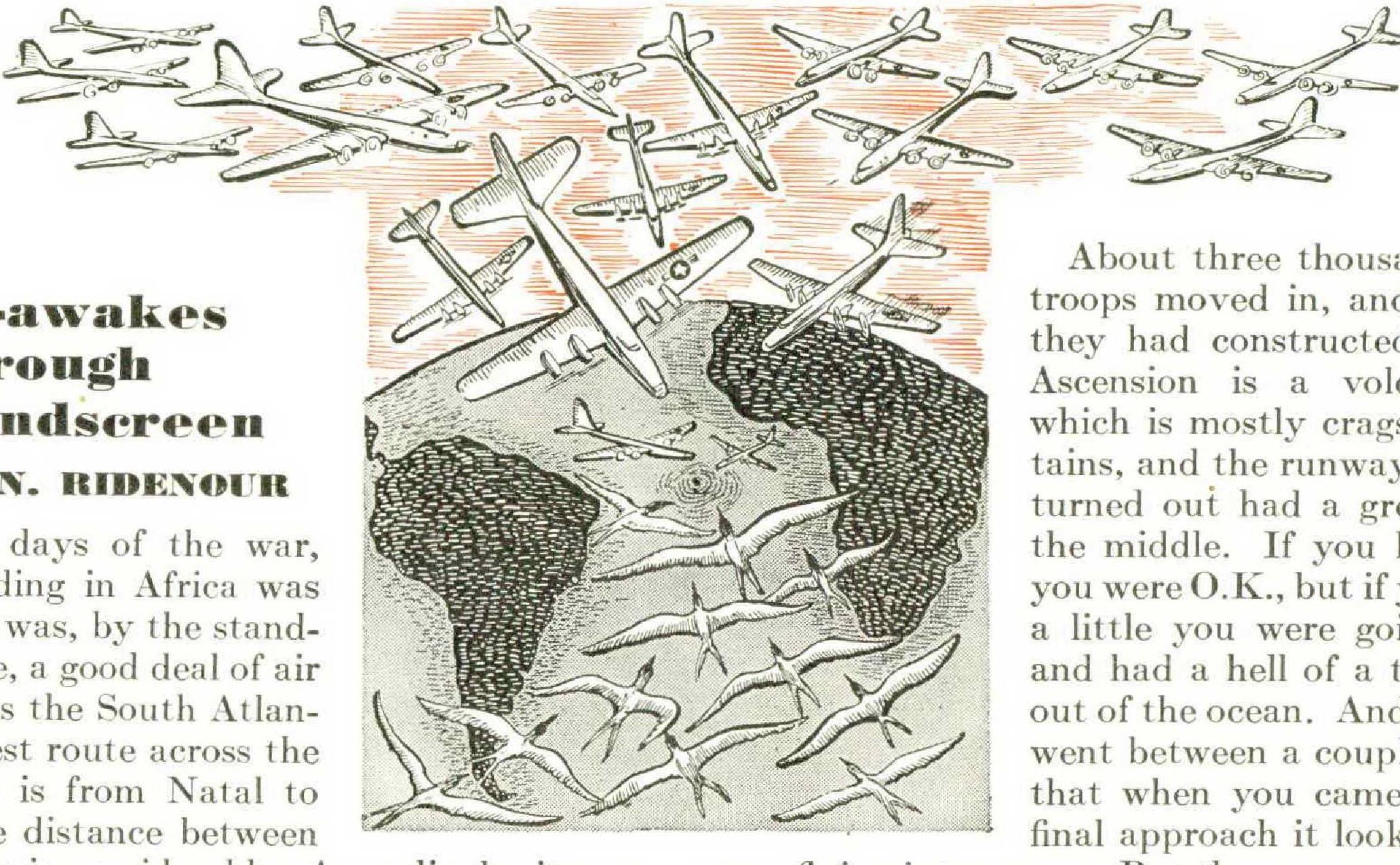
It is the practice of the wide-awake, or sooty tern, to come to Ascension to lay its egg, or eggs. Most wide-awakes lay one, but some lay two. Picking Ascension was a sort of masochistic procedure, for it is a pretty rough place. The Encyclopœdia Britannica says: “Steep ravines, lined with masses of lava and ending in small bays, are typical.”
You can imagine the surprise and delight of the mother wide-awakes when they glided in for a landing and found that new runway. Here was a level place, not a steep ravine lined with typical masses of lava. With one mind, the wide-awakes came in and landed on the runway, and there they stayed. They built nests, and some of them laid one egg and some of them laid two. In either case, they were mighty fond of those eggs.
From time to time, of course, airplanes came in too. But the runway, which had been made of lava a few weeks before, was now made of lava and wide-awakes’ nests. On every nest was a mother wide-awake who was determined not to forsake her egg until disaster clearly could no longer be avoided. You can see what happened. The mot her wide-awakes flew up just in time to come through the windshield right into the pilot’s face.
Well, as you know if you have ever landed an airplane, the last few seconds before the touchdown, when the plane is still flying, but only just, are the most important seconds of your whole career as an airman. And it is rather upsetting to get a bird in the face just as you are about to complete the prettiest landing your co-pilot ever saw. There is a lot of kidding at the expense of the Air Transport Command, but the B-17 boys never had any wideawakes through the windscreen in their rough missions over Hamburg or Emden.
Word of all this got back to the Pentagon, of course, and Headquarters, Army Air Forces, undertook to solve the problem. Their first move was to send down an ornithologist.
This ornithologist had a brother-in-law in the Department of Agriculture, and he remembered something his brother-in-law had said at dinner the week before. “When an insect pest gets out of hand,” the brother-in-law had remarked, “we look around for a natural enemy to keep it in check.” Birds were clearly the problem on Ascension, and the ornithologist thought about natural enemies of birds. “Cats!” he said to himself. “There are no cats on this island.”
So he sent signals back to Washington, asking for cats. His requests enjoyed a high priority, since the problem of the wide-awakes on Ascension was one of the toughest that Headquarters, Army Air Forces, had to deal with in those days. They sent all the available second lieutenants out after cats, and soon a B-24 full of cats was winging its way down through Trinidad, Belém, and Natal, to Ascension.
Mind you, this wasn’t the only approach to the wide-awake problem that the Army Air Forces had undertaken. On the basis that what can’t be cured must be endured, they had asked one of the great manufacturing companies to develop a windscreen which would be impervious to wide-awakes. With characteristic ingenuity, this company built a giant slingshot, and began to lob frying chickens at windshields made of various sorts of laminated plastic, in an effort to find something that would transmit light but not wide-awakes.
Well, the bomber full of cats landed presently on Ascension. And for a while it looked as if everything were going to turn out all right. The cats were killing wide-awakes by the dozen.
Unfortunately, there are also boobies on Ascension. The booby is a bird that cannot fly very well, but has an extremely strong beak and neck. The cats didn’t know any better than to tangle with the boobies, and presently the cals were all dead, with holes in their heads. And the mother wide-awakes were still waiting until the very last minute and then coming through the windscreen.
About this time, the first ornithologist was recalled. The Army Air Forces then turned to a friend of mine who is clearly a second-string birdman. They sent him down to Ascension in his own C-87, and he saw the problem at first hand; for when he came in to land, the wide-awakes waited until the last possible moment and then came in through the windshield. The large manufacturing company had not yet solved the problem of making an impervious windshield.
My friend has no brother-in-law, let alone a brother-in-law employed by the Department of Agriculture. Accordingly, he said nothing to himself about natural enemies. Instead, he noted that the difficulty arose from the fact that there were wideawakes on the runway. They were there, he reasoned, because their eggs were there. So he borrowed a platoon of soldiers and had them trample out the eggs in a fifty-yard square. The wide-awakes went away. Then he rounded up all the soldiers on the island and marched them down the runway with instructions to step on every egg they saw. When this was done, the wideawakes went away in sadness and my friend went away in triumph. The next year the wide-awakes that had been there before stayed away from the runway and laid their eggs in the typical ravines. No doubt, this would give a lot of pleasure to Darwin, if he were still alive. The great company shelved its slingshot, for there was now no wide-awake problem on Ascension.