Winter Beaches

By BAY JOSEPHS
THE first afternoon we put on our swimming things and started for the beach at Mar del Plata, the portero at the door looked at us with the kind of astonishment customarily reserved only for guests arriving with less than two trunks.
“But Señor, Señora,” he protested. “ already three in the afternoon. Three.”
With the aid of the diccionario españolinglés we explained that we realized the hour, that it was hot and that we were hotter, and that having traveled six hours and 250 kilometers from Buenos Aires we couldn’t imagine any more perfect time for a dip in the Atlantic.
“But three o’clock,” he repeated. “Nobody goes at this hour. Nobody. It isn’t done.”
Before el week-end was finished we learned a good many other things about Argentina’s leading strand. In true Argentine fashion, relaxation, fun, and informality are never allowed to get in the way of tradition at Mar del Plata. Though it is hot from November on—seasons being reversed below the equator — no one goes there until the last day of December. And once arrived, he finds other unwritten rules just as strict.
There is no long expanse of sand in the Jersey pattern, but a series of beaches, each with its own social standing, customs, and rules of conduct. Crowds fill Playa Popular all day long, but it is obvious that this is no sociedad, for they change to swim suits at home, bring lunches, and boil water for mate, the herb tea which true criollos drink round the clock, and even recline on the sand.
Playa de los Ingleses, or Beach of the English, is one step up. The afternoon rule is generally observed, the turnout is smaller, and there is an air of Brighton, even to the voices. Since Argentina’s vast British colony prefers the locale, it manages, by frigid looks if not by guards, to keep out almost everyone else, including the Yanquis.
The ultra-smart, however, would not dream of any other place than Playa Grande. And here the location of one’s beach cabaña, complete with little wicker chairs, name plate, and dressing table, is as much a symbol of acceptance as a social register listing. Placements are, in fact, in the hands of a Director who performs the same function at the Colón Opera in Buenos Aires. More than one Ambassador has remarked that his cabaña assignment is a better clue to the state of relations between the Palacio San Martín and his capital than the diplomatic double-talk of the foreign office.
These gayly colored cabañas fill half the vast crescent of beach. Beyond stretches an expanse of landscaped green, then a flagstone walk and rows of ultra-smart shops and awninged outdoor cafés, set on levels moving upward to an elaborate series of fountained swimming pools. Beyond these rises another area of landscaped hillocks. Hidden under the pools and hills are a series of underground garages connected with the beach by tunnels.
Marplatense mores place one’s arrival — accompanied by retainers to handle the offspring, beach things, and so on — at 11.00, one’s departure at 1.00 P.M. You sit on a chair or hammock, never on the sand. Among the elders, dodging a tan is as elaborate a process as getting one in Miami. The reason is the same as that which accounts for the absence of palm trees. Race-proud Argentines, always sensitive to implications that tropical trappings link them with darker-hued Latins from Brazil and Central America, have long avoided both the sun and the palms and have planted Mar del Plata with pines, sycamores, and almost everything else lest any stranger identify Argentines with “lesser” Good Neighbors.
The younger generation has, in recent years, begun to crack this time-honored fustiness. It buys as many lotions and creams as any two-weeks-withpay gringos and assiduously cultivates a nut-brown shade. It strips to outfits as brief as those worn by the Hollywood stars whose photos set the mode, and is undismayed by the annual pre-holiday urgings for more chaste raiment by the church and the authorities. And again reflecting Beverly Hills, it has begun planting palms.
A heavy lunch, replete with wines, then siesta until four and Mar del Plata awakens. Only within the decade have el golf, el tends, and other sports formerly associated with los ingleses locos begun to attract followers. For the vast majority of middle-class vacationists — and only in the Argentine is there a sizable bourgeoisie — they are still not done. Most devote the late afternoon to a ride along Avenida Constitución to Miramar, an elaborate tea featuring a sweet cake known as alfajores, and finally the twilight promenade along the Rambla.
This is the time when one sees and is seen, when Mar del Plata really asserts the prime reason for its existence. The crowds, dressed in their finest, windowshop the branches of the elegant Buenos Aires, Madrid, Paris, and London stores. Everyone drops in at the salons run by the newspapers of the capital and provinces, to leave messages or pick up mail. Then one does the rounds of the confiterías and bars for the pre-dinner copetín. Once more the classic holds. Even the newer places have clung to the gilt and plush motif of Mar del Plata’s oldest mecca, the Bristol.
Shrimps and other sea food, in which the resort abounds, may top the menus at lunch, but dinner returns to the Argentine tradition of meat - and then more meat. Few eat in restaurants; dining at one’s hotel, pension, or chalet is the rule. Again and again restaurateurs have failed to break this dictum. About the only exception is the Casino, where, despite prices which skyrocketed after V-J Day, one may still dine sumptuously on sirloin, chicken, and six other courses for the equivalent of an American dollar.
Casino profits have made possible this admitted “loss leader” and the magnificent Casino building itself. A lavishly furnished, red-brick structure, it runs four city blocks along the Rambla; includes a hotel, night clubs, and cafés, sports arenas and underground garages, a baby-tending service and other facilities, all designed to make the loss of your money as painless as possible. There’s even a collection of jewel shops to make easy the tradition that winners, to keep their luck, must buy at least one brooch, pin, or ring the very same evening.
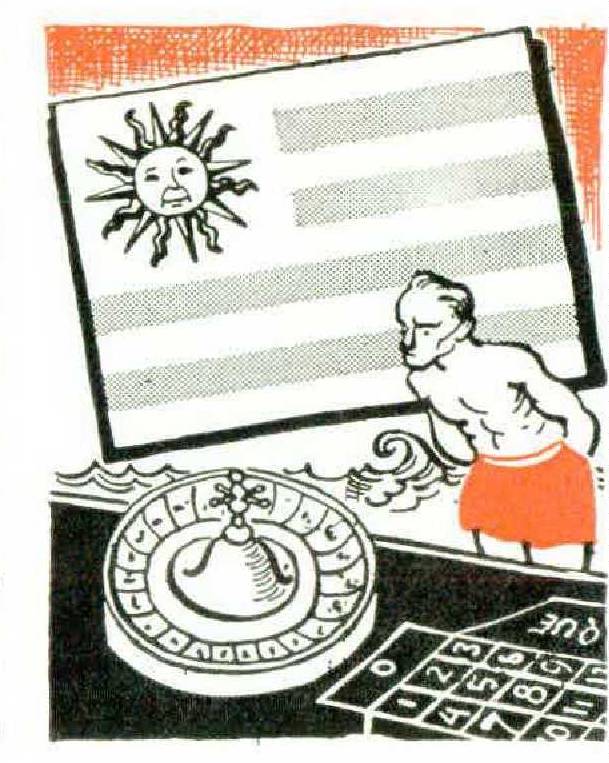
Fifty-six roulette tables, more than Monte Carlo had in its heyday, take bets from a peso (25 cents, U.S.) up. Eighty per cent of the play must be returned in winnings; five per cent goes to the Casino concessionaire; the rest is divided between the federal, provincial, and municipal governments, which use it for highways, health, building, and, as each succeeding administration says of its predecessors, “ for personal projects.”
Strangely enough, few of the polo-loving, highspending Argentine playboys whose gaming antics have entertained café society aficionados in the United States are visible at Mar del Plata, for once more tradition holds that such gambling is never done at home. Estancia-owning Argentines, limited or embarrassed by Mar del Plata’s not-done traditions, have long been the heaviest spenders at nearby Uruguay’s Riviera-like string of beaches.
There are twenty-five of them — and twenty-five casinos — extending along the eastern shore of the Río de la Plata from Montevideo to the Brazilian frontier, and they form the basis of Uruguay’s thirdlargest industry, tourists. The largest casinobeach is at Carrasco, a quiet, shady town reminiscent of Newport in its golden era; the smartest is at Punta del Este, the peninsula where the Atlantic and the Plata meet.
The contrast between Punta and Mar del Plata is sharp and immediate. Mar del Plata’s railroad terminus is classic Roman; Punta’s is glass-bricked modern. Mar del Plata’s hotels emphasize gilded, crystalchandelier elegance; Punta’s stress clean lines, balconies, and color. Mar del Plata’s Casino frowns on informality; Punta’s nightly offers champagne to the most attractive señorita in los shorts.
Morning is beach time in Punta. But lunches are later, siestas shorter, and in place of the promenade, everyone hies to the Bosque, an enchanting pine forest planted on the dunes some fifty years ago. Trails for horses, cycling, and carriages lead to tea places where you dance until dark, then dine out in any one of a dozen candle-lit places overlooking the sea or the yacht-filled harbor.
About the only obligatory routine is stopping at the kiosks, where you search for your picture on bulletin boards marked Today, Yesterday, and Before That. Barefooted photographers roam through Punta’s meeting places snapping pictures and handing out cards telling where prints may be seen later. The temptation to look, buy, and mail home those pictures showing you at the Casino with a heavy pile of chips is universal.
Punta’s casinos, one in the Nogaro, the other at the Miguez, are small. Though stakes are frequently higher than anywhere else in Latin America, the business of winning or losing is gay. Suicides as melodramatic as the lyrics of an Argentine tango are not infrequent at Mar del Plata. They are unknown at Punta. One hears as much French as Spanish and sees the same crowd which formerly headquartered at Nice. And everybody knows the story of la Marqnesa this or la Duquesa that who, with other titled Euro pea ns, thoughtfully acquired Paraguayan citizenship through purchase of properties automatically granting this privilege, and spent the war years following the Latin beach and casino circuit.
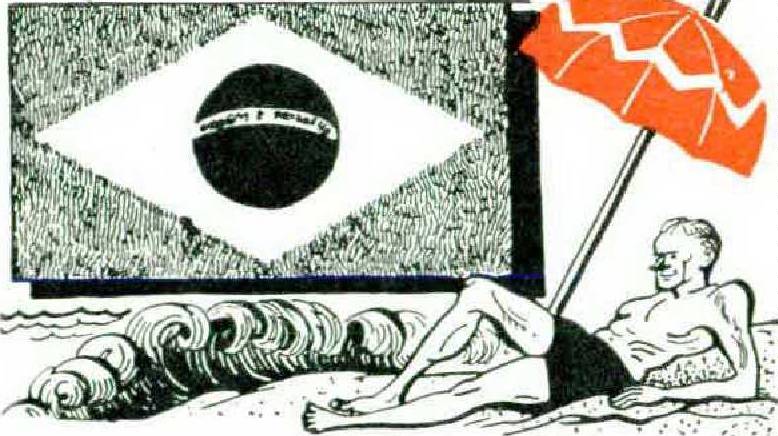
There is also much Portuguese — spoken with great animation by Brazilians, who, like the Argentine playboys, frequently prefer to do their gambling away from home. Rio de Janeiro’s incomparable, mountain-ringed beach setting is, as a result, less frequented by the Cariocas of the Brazilian capital than by visitors from abroad and industrialists down from São Paulo and other interior cities.
Like Chicago’s Lake Shore Drive dwellers who go elsewhere for their swims, many Cariocas simply don’t bother to walk across the Avenida Beira Mar, which runs along the half-moon of beach-ringed Guanabara Bay. They prefer the less crowded beaches of Petropolis and its well-publicized $13,000,000 spa, Quitandinha, or Uruguay, six hours distant by plane.
Since capital and resort are so intertwined at Rio, its sole standard Latin beach life feature is the casino. Recently closed by Presidential order but now fighting for their lives, the Urea, Copacabaña, and Atlantico are fabulous million-dollar palaces whose taxes provided a tenth to a fifth of the government’s $600,000,000 income. As in Mar del Plata, all three long used the lure of night clubs with elaborate dinners and even more elaborate shows at inexpensive prices. An abundance of war money made this unnecessary, however; prices are now higher than in Manhattan, and the norteamericano, anxious for a look at something really Brazilian, is likely to find the festivities a decided let-down, for any resemblance between authentic Brazilian entertainment and Carmen Miranda is purely coincidental.
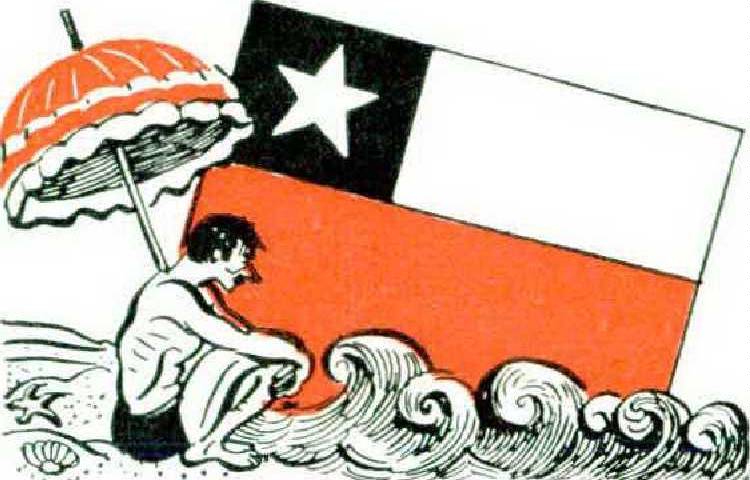
Because it is farthest from most of the hemisphere and from Europe, Chile’s top watering place, Vina del Mar, is perhaps the least changed of Latin beaches. An interurban train ride from the busy, South Pacific port of Valparaiso; a pretzel-twisted, four-hour train or car journey from Santiago, Vina has an idyllic, slow-paced charm that suggests what southern California — whose cloudless sunshine it matches — might have been like in other hands.
Those Vina cottages which Los Angeles County would term Spanish are, in fact, here called californiano. There the resemblance ends. Nothing is built in the shape of anything else. There isn’t a gift shoppe or a guided tour for miles. And the drowsy central plaza is ringed with hitching posts, where venerable, top-hatted coachmen wait to drive you to your favorite cove.
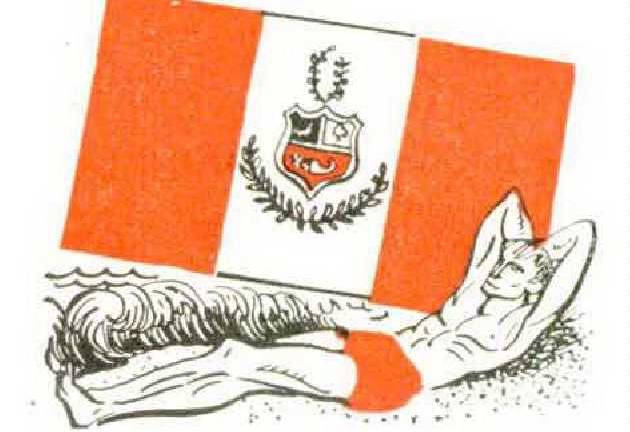
The Casino draws crowds with an art gallery instead of anight club. WhatChileans call the he le-fe, or high life, is found in the Nitrate Institute’s gardens, where the country’s leading export is used to fertilize experimental flowers. International activity centers at the O’Higgins. There Bolivians, Argentines, Paraguayans, and Peruvians have, under favorable exchange, been able to live in Swiss-managed hotel luxury unduplicated elsewhere in the Americas, at rates which have made some permanent voluntary exiles from home.
The visitor heading north from Viña begins to encounter the first of the Latin reflections of United States seaside resorts at San Miguel, Miraflores, and the other Peruvian beaches an hour’s ride from Lima. Vendors hawk such exotic importations as ays krim (spelled that way on the signboards); painted seashells, pennants, and knickknacks, and within the past year, a weight guesser. Amusement piers and rocking chairs may come next.
The same north-of-the-bordcr influence is also being observed at the beaches around the Caribbean. In Cartagena, Colombia, one of America’s oldest cities, a United States chain has taken over the leading inn, done it up with Grand Rapids Spanish, air-conditioning, and blue-plate specials, and is preparing for the visiting turistas. Barranquilla, three hours away by new highway, also recently opened an americano-patterned hotel, beach club, and assorted attractions. And Panama, preparing for a post-war resumption of Canal cruises, has launched a campaign to sell its beaches, game fishing grounds, and jungle jaunts, Indian village visits, and planned entertainment.
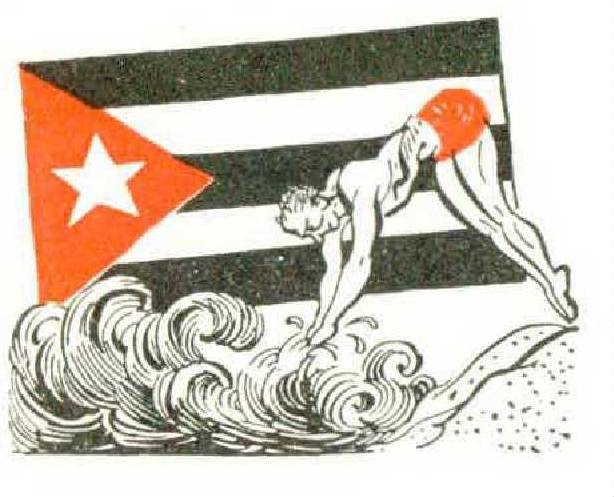
Cubans who have seen the same kind of thing developing around Varadero on the north coast of Matanzas Province have become apprehensive. Drawn by its pure-white sand and extraordinary blue waters— thirty minutes by air and four hours by car from Havana — many of Cuba’s wealthiest families began building palatial homes there in the early thirties, quietly using them in summer and saying nothing about it to anybody.
Americans who have recently found Florida more and more crowded began discovering Varadero an ideal winter place. The secret is no longer hidden. Subdivisioners have already planted their sights. Real-estate offices have opened, their salesmen stressing the “chance of a lifetime” opportunities. And the first dine-and-dance spot, Kastillito, — “No cover charge ever,” — has hung out its neon and is doing business.
No one knows where it will end. But Cubans have already issued a warning: If their Play a Azul gets one rolling chair, one hot dog, or one piece of saltwater taffy, they’re going to wrap them up in one big package weighted down with several tons of sand and ship it, collect, to Washington with whatever remains of the Good Neighbor policy.