All About Love
RAOUL SIMPKINS is the pseudonym of an Atlantic author who sends us from time to time various oddities of life in present-day France.
by RAOUL SIMPKINS
THROUGHOUT the world the Frenchman is hailed automatically as “the great lovaire.” No one else need apply. A subtle knowledge of “lurve” is one of France’s most valuable invisible exports. The dollar drive is sparked by such old reliables as “gay lovaire” Maurice Chevalier and “sad lovaire” Charles Boyer.
None other than best-selling novelist-historian André Maurois has been conducting over the French national radio network a weekly series of free advice on “lurve” — its joys and pitfalls — all done in playlet form.
So let’s listen in to the experts. Our great lovaire, Philip, is still unattached as class opens. He is discovered, bathing-suited, lying at the side of his friend Marise on the beach.
MARISE: HOW strange you are, Philip. For the past fortnight you have been courting me — and yet not courting me. You squeeze me. You try to kiss me, and you say nothing to me.
PHILIP: What do you want me to say? It is not words that I need.
MARISE: Then we are different. Me, I need words. What do I want you to say? At least that you love me. You make the gestures of love and yet you do not utter the word itself. Why?
PHILIP: Because it halts on my very
lips. Because it strikes me as old hat. Because I don‘t know what it means. I find you pretty and well-balanced. The chassis has a nice line to it.
They bat it back and forth for a while. Then: —
MARISE: Tenez—me I want to kiss you when you say certain things.
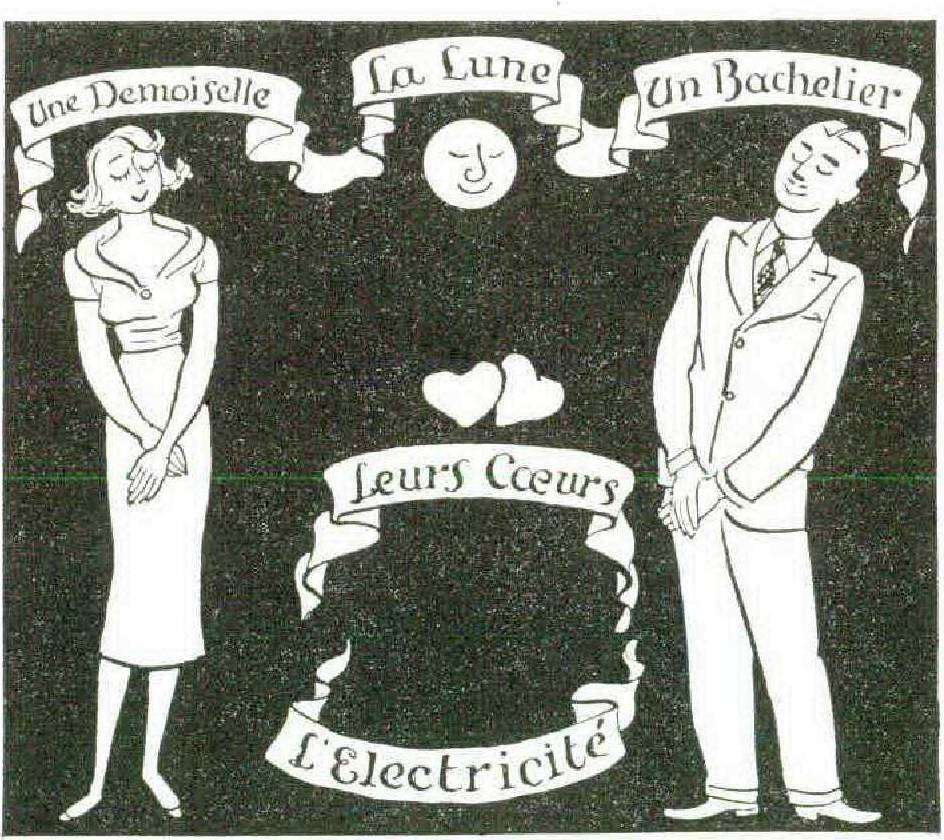
PHILIP (pricking up his ears): What things?
MARISE: Well, when you talk enthusiastically about your job, your plans. That day when you talked of Africa, those immense forests which you described as “living coal” — that was magnificent. Naturally I didn’t understand it all, but I was filled with admiration.
PHILIP: Oh, yes. My little résumé about the natural hydrocarbonates — you appreciated it! Yet you listened in silence. I said to myself “I bore her.”
Now she’s sending him. He makes a quick switch from the hydrocarbonates:—
PHILIP: TO see your body so near mine gives me such an emotional thrill that this morning, breasting the waves, I thought I would faint.
MARISE: Oh, fierce Philip! Adorable Philip! You see that you can say some ravishing things when you let yourself go!
But watch it! After a rapid travelogue from Marise (“ . . . New York—her drugstores, her skyscratchers, Harlem— Charleston ...all that must possess a poetry of its own . . .”) Philip is rash enough to ejaculate: “Come with me to see it, Marise!” Wrong! Instantly Marise murmurs: “Hélàs, never my family would it permit me to travel with a gatçon who was not my husband.”
Adds Professor Maurois trenchantly, “Un silence.” Philip is a dead duck— he proposes.
The honeymoon — how not to do it, according to the Professor.
PHILIP (in the train after the wedding): Who was that old fool at the reception who kept repeating, “Make her happy, my young friend, make her happy”?
MARISE (coldly): That was Uncle Cyprian, the husband of Aunt Céline. A most remarkable character — why, he used to be Professor of Constitutional Law at the University of Caracas.
There follows a nasty series of exchanges about the hats worn at the wedding by the two lots of female relations. It all ends in sobs.
Here’s the right way. As the train gathers speed the young things embrace:— PHILIP: My darling, if you continue to say such pretty things my lips will never leave yours.
MARISE: I‘m not afraid. I like longdrawn-out kisses, style Hollywood. One closes one’s eyes —
PHILIP (puzzled): Why?
MARISE: In order the better to savor them. (They kiss again.) Ah, perfect!
PHILIP: Oh, ho, there will be better ones still. We will set up a kissing house together. I say, darling, your parents were charming — so youthful-looking.
In the next scene things have soured. It is a week later and the young couple’s travel agency, clearly unreliable, has landed them in a dismal station hotel, smack up against a busy main line.
MARISE (sadly): Be patient with me. For the past eight nights I have had barely a wink of sleep.
PHILIP: And what about me? How can I sleep with all these trains clanging past?
MARISE:You have slept. You snored.
More sharp exchanges, and then great lovaire Philip is misguided enough to avow that he has brought along some of his office work with him.
MARISE: YOU have brought work? On cmr honeymoon? Oh, Philip . . .
PHILIP (flaring up): Yes! I have three highly important files in my valise!
Forthwith Philip pulls a. bulging dossier from the valise, a chair up to the table, and gets down to it. The trains roar past, and inevitably more sobs are heard from Marise on the bed. But after some chitchat about Chopin’s nocturnes Philip goes over and takes I\ la rise in his arms.
MARISE: I feel a little better. Some air, perhaps. Seated beneath the trees with you I would be happy. And it would allow the servants a chance to tidy up this room. Allons, mon chéri . ..
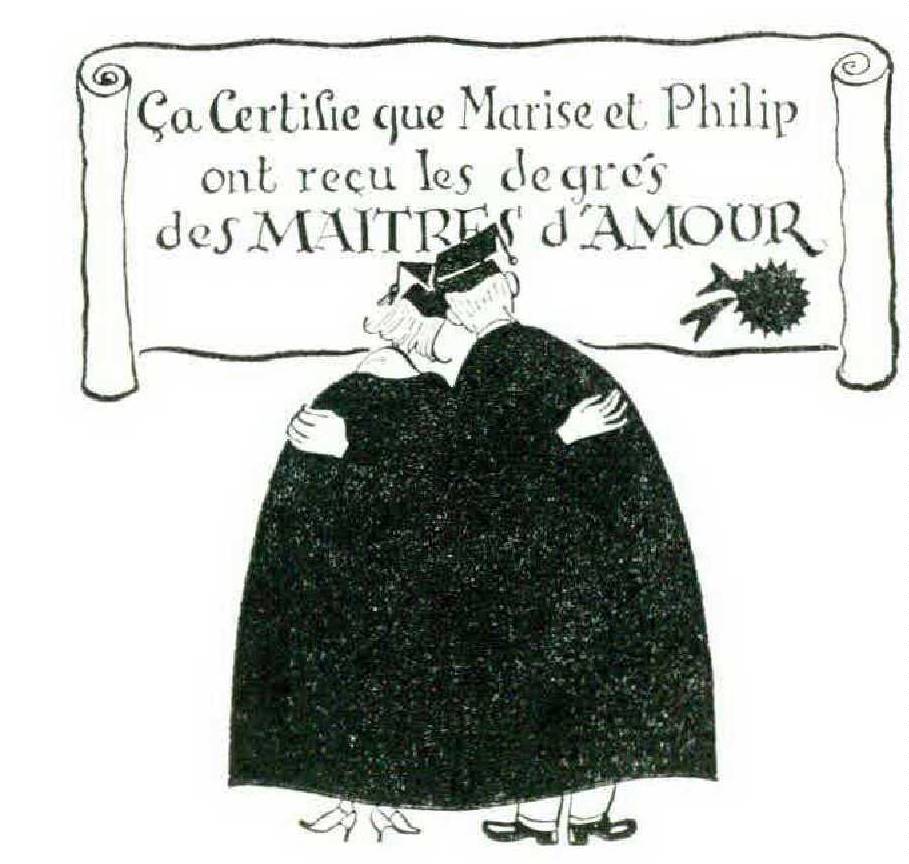
The honeymoon over, they settle down in that “kissing house” we heard about, but in no time the little woman is going on at Philip about his table manners. (“You don’t chew enough. The doctor told me your unfortunate stomach is overloaded.”) Finally she gets Philip to lie down so that she can feel his liver.
PHILIP: Hey! That hurt!
MARISE: Tut. I barely touched you. Obviously you’re in bad shape.
And we‘ve come a long way from the fascination caused by the hydrocarbonates, for Marise says pettishly, “Once your day’s work is done, must you embark on a heavy discussion with poor little me about the strikes in Finland or the oil deposits of Iraq? What do you know of Finland or Iraq? Nothing.”
Having established that great lovaire Philip’s stomach is overloaded, Marise proceeds thus to hit him below the belt.
Comes the bedroom scene! Here at least the great lovaire will surely assert himself?
MARISE: Don’t fling your clothes untidily into the corners of the room. . . . Now what are you up to? Not opening the window!
PHILIP: YOU know that I require fresh air.
MARISE: Yes, but it happens to be November, and I don’t want to catch pneumonia. All right then, I‘ll put on an extra blanket.
PHILIP: But only on your side of the bed.
Things totter along in fairly grim style but great lovaire Philip is dead game. Sensing, after some years of it, that the marriage has somehow got into a rut, he decides to spring a pleasant surprise on the little woman. So the front-door bell rings one night. Marise answers and runs back into the drawing room, a huge basket of flowers in her arms.
MARISE: Oh, Philip, who can have sent these? It’s not my birthday. There’s no card . . .
PHILIP: You can‘t guess?
MARISE: Why no. Can you?
PHILIP (archly): I know.
MRARISE: You can‘t mean — that you sent expensive flowers in the dead of the winter . . . without any reason . . .
She bursts into hysterical tears. “Oh, Philip,” she cries, “you must have been unfaithful to me!”
Somberly the Professor adds: “ You understand, gentlemen, the mistake in technique which the husband has committed. All commentary seems superfluous.”
Vive l’amour!