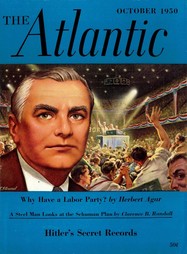
October 1950
In This Issue
Explore the October 1950 print edition below. Or to discover more writing from the pages of The Atlantic, browse the full archive.
Articles
Winning the Nobel Prize
“In retrospect, one wonders if the Prize Awards in Literature have actually carried out what Nobel had in mind when he wrote his will.”
The Atlantic Report on the World Today: London
The Atlantic Report on the World Today: The United Nations
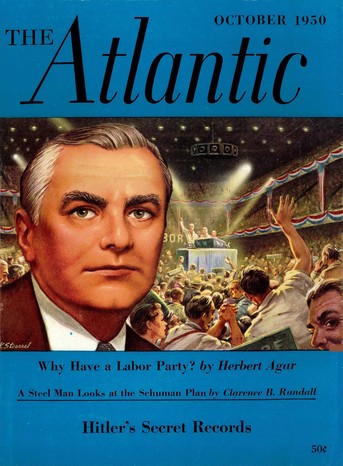
Why Have a Labor Party?
Very clear and very fundamental in his thinking about this huge federation of the United States, held together by our political talent for compromise, HERBERT AGARis the author of The People’s Choice, which won the Pulitzer Prize in American History for 1934, and of Price of Union, his most recent and farsighted book, published by Houghton Mifflin last March. Mr. Agar was educated at Columbia and Princeton, where he took his Ph.D. in 1922; he is a veteran of both World Wars. He edited the Louisville Courier-Journal from 1940 to 1942 and was special assistant to the American Ambassador in London from 1943 to 1946.
Hitler's Secret Records: Unpublished Stenographic Reports of Hitler's Talks With His Generals
Germany’s spectacular victories in Europe in 1940-1941 convinced Hitler that in his grasp of military and strategic questions he teas far superior to his generals. When Halder, Chief of Staff, differed with him by insisting that the armies be withdrawn from Stalingrad, Haider was dismissed. Such differences prompted Hitler to have male stenographers present at both daily conferences in his headquarters. The minutes of these conferences, with their intimate record of Hitler’s intuition and ignorance, totaled sixty million words; the charred, fragmentary remains of the only surviving set were retrieved by Sergeant George Allen of the 101st Airborne Division.FELIX GILBERT,Professor of History at Bryn Mawr, has edited these secret records, which will be published by the Oxford University Press under the title Hitler Directs His War.
A Steel Man Looks at the Schuman Plan
The Schuman Plan is the boldest, most hopeful proposal for Franco-German coöperation that has been made since 1870. But on what business philosophy shall the plan be developed? Will it follow the cartel controls which uere repugnant to us in Germany? Will it protect the competition and enterprise to which we and the Benelux nations are accustomed but of which the British Labor Party disapproves? These questions are vital to American industry. They are here presented by CLARENCE B. R ANDALL, who served as Steel Consultant to ECA in Paris in 1948 and who in April, 1949, became the President of Inland Steel after twenty-four years in its service.
Finish, Good Lady
Born on Long Island in 1917, and educated at Groton, Yale, and the University of Virginia Law School, Louis AUCHIINOLOSS enjoys all the activities of a New York lawyer and still manages to reserve time for his steady writing. His first novel, The Indifferent Children, was published in 1947, and his second is now in progress. His long short story, “Maud,” won an Atlantic “First” Award in 1949.
The Atlantic Report on the World Today: Washington
The Eagle
The Tiger
The Mole
Walter Richard Sickert
In the fifth volume of his autobiography, which is to be published this month under the title Noble Essences, SIR OSBERT SITWELLhas drawn for us the portraits of artists and authors, for the most part men older than himself who were his friends as he entered literature just after the First World War. The group included such bright spirits as Lytton Strachey, Arnold Bennett, Wilfred Owen, Ronald Firbank:, Ada Leverson, Max Beerbolvn. and that remarkable painter, Richard Sickert.
Can Hollywood Take Over Television?
Playwright, author, and CRITIC, GILBERT SELDES, who made a hit with his early book The Seven Lively Arts, and again with his play Lysistrata, published in the Atlantic in 1937 a farsighted article entitled “The ʽErrors’ of Television. ” That article led to his being appointed director of television programs for CBS, and he was identified with that network and the development of television until 1945. The article which follows is drawn from his new book, The Great Audience, which is to be published by Viking Press this month.
Dean Swift as a Human Being
An Irish author and poet long resident in Dublin, an ex-Senator of the Irish Free State, an intimate of George Moore, W . B. Y eats, and Janies Joyce, OLIVER ST. JOHN GOGARTY has cast his shadow in Joyce‘s Ulysses and shafts of his wit in many a volume of his reminiscences. He talks about Dean Swift as if he knew him, and his explanation of the Dean’s somewhat odd behavior is to be found in the very human essay which follows.
The Doctors' Lobby
Medical care is for the people, not for the doctors, says JAMES HOWARD MEANS, M.D., and skyrocketing costs can be reduced and better service provided by private enterprise only if the American Medical Association — organized medicine — takes a more open-minded and constructive view. Dr. Means is not a socialist; for the past twenty-seven years he has been Professor of Clinical Medicine at Harvard University and Chief of the Medical Services at the Massachusetts General Hospital.
The Problem of a Common Language
Britain‘s most distinguished dramatist, whose plays, letters, and postcards have delighted people the world over, GEORGE BERNARD SHAW is just a little wiser and older than the Atlantic, and continues to be one of its liveliest contributors. He was born in Dublin in July, 1856; captured London twenty years later; in 1881 he became the leading spirit of the Fabian Society; and in 1925 he received the Nobel Prize for Literature.
Atropos
The Artists to See
This is the first of a series of articles on Painting and Sculpture. Contributors to it will comment on the major exhibitions, the one-man shows, the controversies, and the books which feed the interest of those to whom the fine arts are a burning issue. Critics, connoisseurs, curators, and artists will take part. Each will be encouraged to speak out with the candor, the affirmation, and the magnificent prejudices of his particular camp. To open the series we turn to MACKINLEY HELM, the Boston collector, an authority on modern Mexican painters, and the biographer of John Marin. His home is an intimate museum of paintings, the expression of a taste diverse and decided. Next month we shall hear from Fishe Kimball, Director of the Philadelphia Museum of Art.
The Far Lands
The Changing Tide in America
The shift which has occurred in America since 1920, writes JAMES H. POWERS, is as deep. wide, and significant as any since the Renaissance or the Industrial Revolution. Foreign Editor of the Boston Globe, Mr. Powers has written many farsighted editorials during the twenty-seven years in which he has shared the mantle of “Uncle Dudley.”Educated in the Needham public schools and at Boston University, he is a frequent contributor to the Atlantic and is the author of Years of Tumult (1918-1932).
The Peripatetic Reviewer
Books: The Editors Like
Reader's Choice
Champion Road
Man's Freedom
Long the Imperial Way
The Art of Teaching
Collected Stories of William Faulkner
This Month
All About Love
RAOUL SIMPKINS is the pseudonym of an Atlantic author who sends us from time to time various oddities of life in present-day France.
The Simplex
SMITH HEMPSTONE OLIVER is Associate Curator, Section of Land Transportation, at the Smithsonian Institution, where a notable example of the Simplex is on display.
Old Farmer's Almanac
Idyl of the p.s. Corp
Home Delivery