The Simplex
SMITH HEMPSTONE OLIVER is Associate Curator, Section of Land Transportation, at the Smithsonian Institution, where a notable example of the Simplex is on display.
by SMITH HEMPSTONE OLIVER
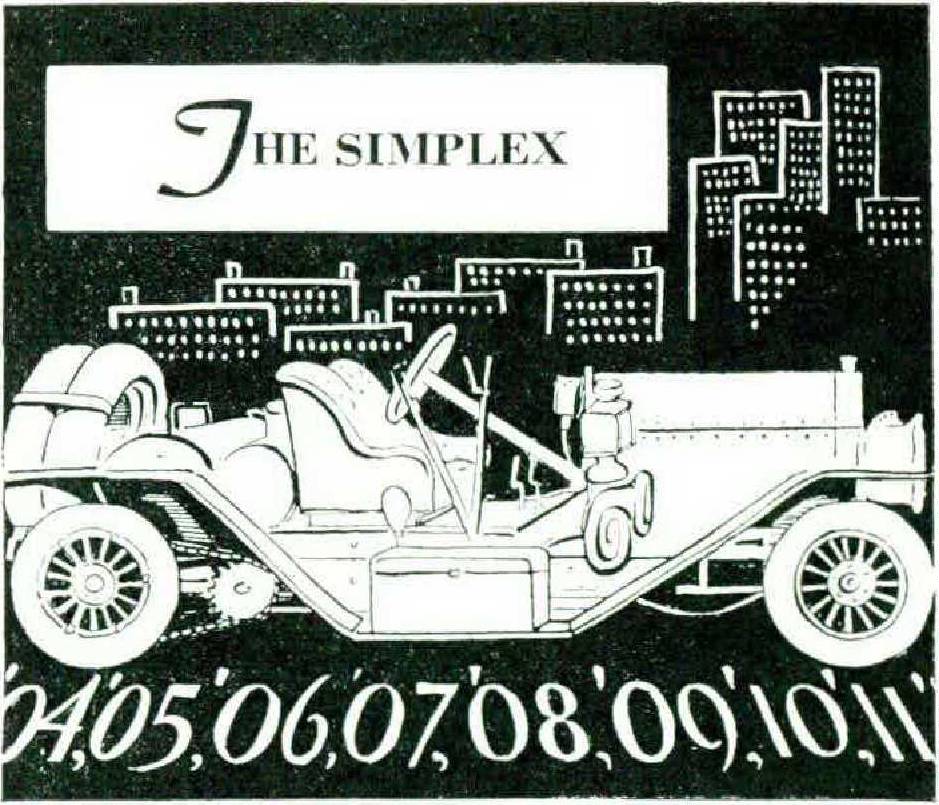
THE name Simplex has been given to many products in the last fifty years, but probably the most famous of its bearers has been an automobile an automobile that represented in its day all that a motorist could possibly desire, and which was every bit as good as the finest European cars of that time. Today among the cognoscenti of the history of the automobile, the name creates nostalgic memories, sometimes combined with chills of the spine as thrilling rides are mentally relived and tales of that, great driver, George Robertson, are related.
This famous car, representing the best that could be built in this country shortly after the beginning of the century, was the brain child of A. D. Proctor Smith and his brother-in-law, Carleton R. Mabley, heads of the firm of Smith and Alabley of New York City. This firm, in 1904, was the sole importer of the renowned Fiat, Renault, Panhard, and Mercedes cars, and was well qualified to design and construct its own version of the automobile.
The product, known as the Smith and Mabley Simplex, was offered to the public in 1904 in two models, the 18-horsepower type AA and the 30horsepower type BA. The reason for the decision to build from its own design was conservatively given in the company’s sales literature, and reads in part as follows: “In presenting our type (AA) SAMITH & MABLEY motor car, we make our first public bow as manufacturers, not having, during our connection with the automobile business, been able to find a car made in America which we could feel justified in attaching our name to, or even send from our salesrooms, with the quality and guarantee naturally implied thereby.“
Within a short time — in 1907 to be exact — the 50-horsepower chaindrive model was on the market, and such well-known personages as Howard Gould, J. H. Flagler, and Richard Croker were included among the owners. The best in custom-built, bodies was in evidence, Quinby,
Holbrook, Demurest, Brewster, and Healey all sharing in the honor in the ensuing years. Many of the chassis and engine parts were made of Krupp nickel-chrome steel imported from Essen, Germany.
The engine of the 50-horsepower version was of the 4-cylinder, 4-cycle, 2-block, T-head type, with a bore and stroke of 5¾ inches by 5¾ inches, giving the immense piston displacement of 597 cubic inches. Actually, about 70 brake horsepower was developed. The complete chassis weighed about 2000 pounds and cost $5500 at the factory. The factory was, incidentally, on the river‘s edge on the south side of East 83rd Street in New York City. The offices, showroom, and garage were at 1765 Broadway, between 56th and 57th Streets.
Smith and Mabley were forced into bankruptcy by the panic of 1907, and their entire business was then acquired by Herman Broesel, a successful New York businessman, textile importer, and banker, who had been financially interested in the firm for several years. Under Broesel‘s guiding band the Simplex, as the car came to be called, became even more famous, and the 90-horsepower model with a bore and stroke of 6 1/10 inches by 5¾ inches was subsequently added to the line. A total of about 235 complete chain-drive chassis were manufactured in 1907, while a few extra engines were produced to power the Simplex speedboats, a side line of the business.
The following years saw Simplex become a great success in the automobile racing field, both on dirt tracks and in road races. George Robertson became a name on the lips of as many people as murmur that of Ted Williams today. Other Simplex race drivers and mechanicians were Al Poole, Glen Ethridge, Joe Tracy, Frank Lescault , and Louis Disbrow.
The 24-hour race at Brighton Beach, New York, on October 2 and 3, 1908, w as won by Robertson and Lescault. The similar race the following year was won on July 30 and 31 by Robertson and Poole, while the National Stock Car Championship was won by Robertson and Ethridge at Lowell, Massachusetts, on September 8 that year. The same team won the Fairmount Park road race in Philadelphia on October 9. The round-the-clock race at Brighton Beach was again won by Simplex, on May 13 and 14, 1910. Various hillclimbing contests were won by Simplex at the hands of young Carl Broesel, E. H. Inman, G. W, Quintard, Gerard Lambert, and, of course, Robertson.
One of the widely publicized victories was that of Robertson on July 23, 1910, at Brighton Beach, when he defeated Ralph De Palma in a special 5-mile match race. Robertson was driving the Simplex “Zip,“ a very light car equipped with a 90horsepower engine, and said to be the only left-hand-drive Simplex built. De Palma was at the wheel of the impressive Fiat “Cyclone,” and managed to maintain a slight lead from the start until, at the last minute, the Simplex took over and won a much heralded victory. The “Zip“ subsequently underwent considerable face lifting, and with a pointed radiator, a new body, and a set of wire wheels was driven for years by Disbrow .
All of which brings us to the year 1912, at which time t he entire output of the factory was sold in advance for about twelve months. The sales catalogue for that year listed three models, of which one was the shaftdrive 38-horsepower chassis with a 4-cylinder engine of 4⅞ inches by 6½ inches bore and stroke, priced at $4000. The complete vehicle cost from $4850 to $6500, depending on the type and size of body furnished. The ever popular Simplex 50 was priced at $4500 for the chassis and $5400 to $7000 for the entire ear. The 90 chassis listed for $5350, bodies extra. All three of these models were provided with demountable rims and acetylene self-starters, while the 50 and 90 retained their singing chain drives. These two models, when equipped with the lighter bodies and the higher gearing, were easily capable of 80 miles an hour on the open road. Every car was guaranteed for a period of 365 days.
By the end of 1912 approximately 800 Simplex automobiles had been constructed since the founding of the business. Factories of the Simplex Automobile Company were located both in New York City and New Brunswick, New Jersey, and the main office was at 240 West 59th Street. New York.
The next several years saw quite a few changes. Herman Broesel had died in June, 1912, and his two sons, Herman, Jr., and Carl, were carrying on the business. The car was being produced only at New Brunswick, and the 50-horsepower model was available with either an enclosed chain drive as series E-3, or with a shaft drive as series E, each chassis selling for $4600, The engine of the 50 was changed with respect to bore and stroke, the new dimensions being 5⅜ by 6½ inches. No other make of passenger car was being produced with chain drive, incidentally. The shaft-drive 38 was retained as series E-l, the chassis selling for $4100. Rushmore electric self-starters were equipped on all models, a feature instituted in 1913.
The 75-horsepower model, of which only a few were built, was offered
at the same price formerly charged for the big 90. This model had an engine with the same bore and stroke as the 50, but which was supplied with much larger valves. Other features in the design of this engine made it a more powerful model than the 50: hence its numerical designation. Most of these 75’s were fitted with beautiful pointed radiators, and the engine was located about a foot farther back in the frame, with respect to the front axle, than was the engine of the 50.
This period saw the acquisition of the company by the Wall Street firm of Lockhart, Goodrich and Smith, and the replacement of Edward Franquist, the chief engineer, by Henry M. Crane of the Crane Motor Car Company of Bayonne, New Jersey. In 1915 the 6-cylinder Simplex, known as the Crane model, was offered as a companion car to the 4-cylinder models, all being built in New Brunswick. It was powered with a 2-block, L-head engine of Crane’s own design. This engine had a bore and stroke of 4⅜ by 6¾inches, and was rated at 46 horsepower but developed considerably more. These chassis were all lefthand-drive, and listed at. $5000. They were guaranteed for life while in the possession of the original purchaser, an unheard-of thing today.
Because of the drastic change in design the Crane model bore no resemblance at all to its predecessors, but it enjoyed the same reputation and justified it in every respect. In 1916 the 4-cylinder cars were no longer being offered, and the Crane Simplex was the sole product for the next several years. Production of automobiles was halted when America entered World War I, and the construction of airplane engines took its place.
Today, some forty years later, several dozen of these pedigreed machines, ranging from about 1909 to 1917, are still in the hands of loving owners, several having covered over 300,000 miles. And of equal interest is the fact that George Robertson, Al Poole, Glen Ethridge, Frank Lescault, Joe Tracy, and the Broesel brothers are still alive. Perhaps the spirit and strength of those fine old Simplex cars are in them too.