Score This, Giuseppe!
SCOTT CORBETT, who mured from Missouri to live in East Dennis on Cape Cod, is the author of a pleasant book about his new surroundings, We Chose Cape Cod. Another musical piece by him will appear in the near future.
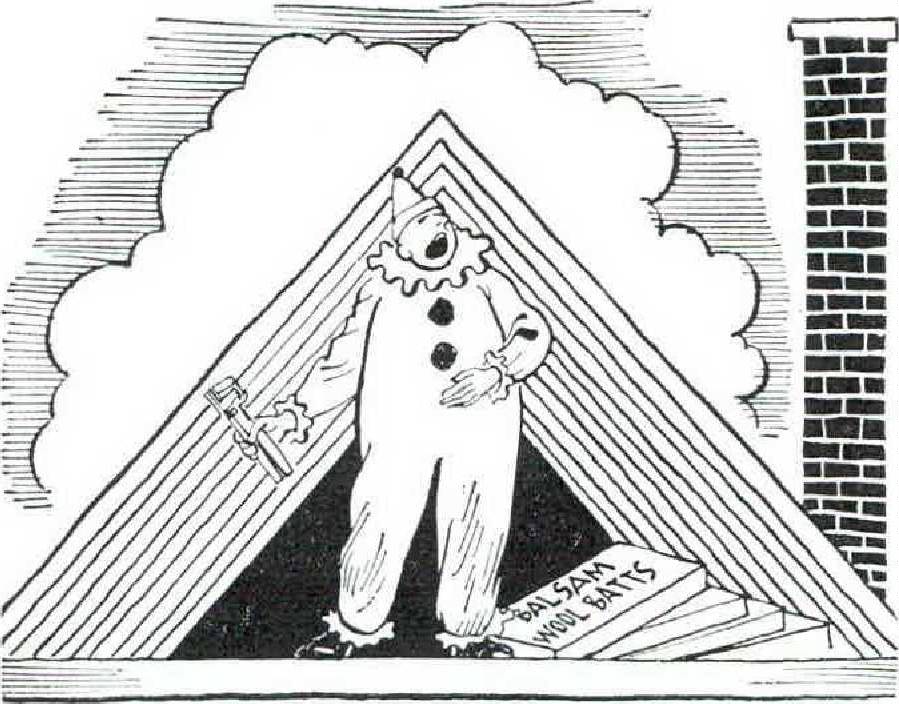
by SCOTT CORBETT
ONE thing I have never understood is how workmen in the building trades can go about their business so calmly.
Whenever I build or install anything, every moment, is charged with drama. No Italian tenor was ever more excitable than I, ever lived more intensely, felt more keenly, suffered more miserably. Talk about running the gamut of the emotions! Compared with the four-lane jobs I run up and down on, the average gamut is a mere mouse trail.
When I had finished insulating our attic recently, I realized that what, had happened was too big to be material for a mere Great American Novel. It had a sweep to it and a violently tragic quality which were made to order for opera. All I had to do was get it set to some somber, brooding music shot through with flashes of fire, and the Metropolitan Opera House would be the next stop. Was ever situation more fraught with overtones of that great theme, the tragic struggle of Man against Fate? I can see it clearly now as a gripping, tragic opera, Una Muova Falsitta (“One False Move”).
After a brief, morbid overture, the curtain rises to disclose a gloomy attic. A trap door is pushed up (the Metropolitan could light this thing beautifully) and the tenor, Don Scotto, climbs cautiously up into the attic carrying a single light bulb on an extension cord. His light discloses several rolls of balsam wool insulation and some tools he has previously brought up.
He looks around the vast reaches of the dismal attic and sings tho touching aria, I attico aparechi tutte enormi (“This job looks tougher now than it did when I let that salesman sell me the insulation”). Fora moment he is despairing, but then he plucks up his courage and sings the jaunty Bravado me non deserto che dice magazino (“ Remember that article in Beautiful Homes that told how easy it was”) and he sets to work.
Almost before he has started, however, his wife, Donna Elisabeta, thrusts her head through the trap door. In a brilliant coloratura showpiece she announces, Don Roberto telefono importa (”He says it’s important”). A passionate duet follows in which Don Scotto refuses to stop and climb down to talk to Don Roberto, while Donna Elisabeta insists he should. When he threatens to stab her with a pair of tin snips she flees, and then Don Scotto, repentant, rushes down through the trap door and is heard falling off the stepladder as the curtain descends.
After a brief overture reminiscent of the opening one, except that it probes even more deeply into the wellsprings of human misery, the curtain rises on Act Two. Back once more in the attic, Don Scotto broods darkly on Don Roberto’s telephone call, which was not really as important as he pretended. Then, once again, he sets to work.
What follows is all action. It cries out for wild and exciting music with plenty of cymbals and kettledrums. Don Scotto lays boards on the crossbeams and inches forward on his stomach, under the rafters, straining forward to fasten the far end of a strip of insulation with his staple gun. Sweat pours off his forehead, his jaw works, his lips move in silent prayer (O Dio mi bendo silento!). His eyes blaze with excitement as he presses his gun against the insulation batt flange, then grow wide with horror as he makes a grim discovery — he is out of ammunition! And the box of st aples is out of reach. He has to inch back to them and reload lying on his side. His voice breaks as he sings the plaintive Buorno non e necesario! (“Why was I born?”).
At ibis moment, Don Roberto arrives outside with a henchman, Don Basso. They are heard chaffing Donna Elisabeta, and Don Roberto begins the mocking I pagliacci credo savecchi? (“Is that clown trying to save money again by doing it himself?”). Don Scotto soon hurls defiance at Don Roberto out the attic window and the four voices blend in a quartet which is unquestionably the high poinl of the opera.
Then Don Roberto and his follower depart, and Don Scotto vows vengeance in the terrible Trumpeto I Uno! (“Next time we play bridge I’ll trump his ace”).
Remember that all this is no mere contrived and implausible libretto such as most operas are burdened with. It is substantially, to all intents and purposes, exactly what happened to me.
The great moment, of course, the rush of tragedy which had been impending all along, came in that inslant when my foot finally slipped off a beam and went through the thin ceiling below. (Una muova falsitta!) I reeled back from the horrid sight of the guestroom floor as seen from the attic, and my final anguished cry (the curtain would of course fall at this point) was alone enough to inspire any composer.
Verdi did this sort of thing awfully well. I wish that he were still around where I could get hold of him.