Schwann's Black Diamonds
THEY SHALL HAVE MUSIC
by JOHN M. CONLY
JOHN M. CONLYis a former New York and Washington newspaper man, now editor of High Fidelity Magazine. “ They Shall Have Music" is a quarterly feature in the Atlantic.
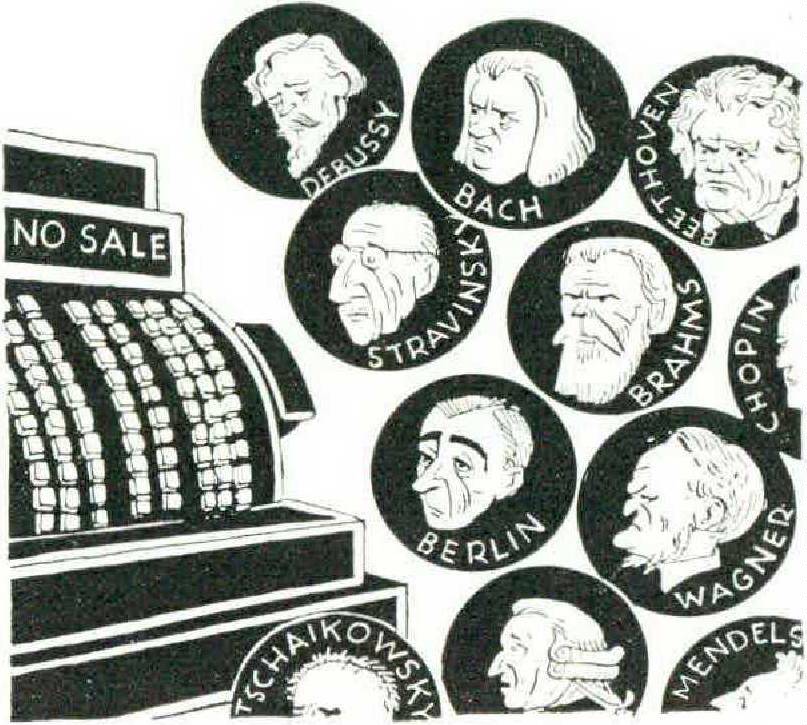
MARCH was a month of black diamonds. This statement will be meaningless — if intriguing — to most people, but not to t hose who conscientiously peruse the Schwann Long Playing Record Catalog. In the Schwann Catalog, which is just what its title implies, a star in the margin opposite an entry means that the recording is a new one, listed for the first time. A black diamond in the same position means that the recording is being discontinued by its manufacturer. In the March issue, there were 1186 black diamonds. A lot of records were fated to disappear.
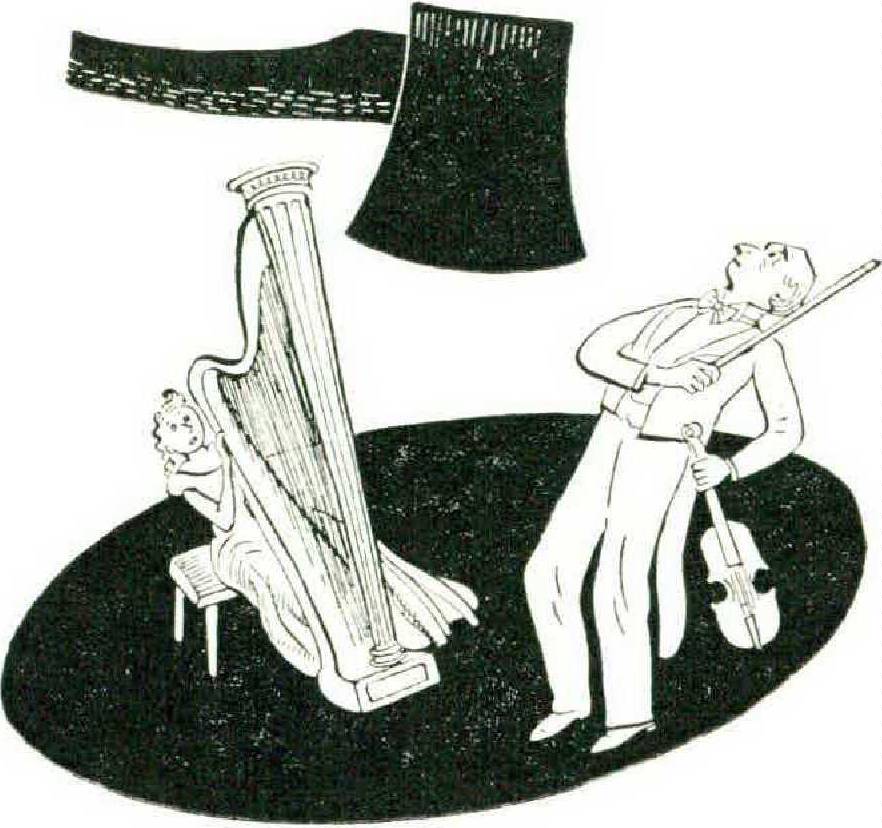
Most of this havoc stemmed from the two biggest record companies, RCA Victor and Columbia, and chiefly affected three categories of records. RCA Victor plied the ax most sweepinglyon its LCT (“Collector’s Treasury”) series, comprising reprints of notable past performances, largely operatic. It also depleted the ranks of its LHMV series, recordings of some stature and special appeal from the catalogue of IIMV in England, marketed here in competition with RCA Viclor’s domestic-featured issues, but with the handicap of a one-dullar price differential. (Which is to say, to get Edwin Fischer playing the Appassionata Sonata, you had to pay a dollar more than for Rubinstein.) Columbia’s winnowing was concentrated mainly on its ten-inch LPs.
It is not my intent to censure the companies, at all, for these deletions.
If a great opera company or symphony orchest ra coyly reveals a mammoth deficit at year’s end, the board of directors rallies to the aid of the manager and in unison they call upon the public for contributions. If a great recording linn shows a similar loss, the corporation officers likewise summon the responsible executive; but when begets there, all they do is ask him why—and in no very jocular tone. Under the circumstances, recording managements should receive great credit for what artistic responsibility they do show, and they show no mean amount.
Not all the delet ions are necessarily permanent. RCA Victor and IIMV lately severed their fifty-year-old exchange relationship (the culling of LHMVs has nothing to do with this; it. is purely a matter of sales figures), and some of the HMV performances may reappear under another label. As for the Collector’s Treasury items, although their sales had dropped, indicating to RCA that the Old Guard of collectors had been satiated, there was such outcry at the excisions that the company promptly projected a poll of reviewers to discover what, recordings should be reinstated. Columbia’s curtailment of its ten-inch library was simply a result of the lesson, learned the hard way, that ten-inch records do not sell, whatever their merits. Nobody knows why. Many of the better items on the teninch list will exist again as partial contents of twelve-inch disks, remastered and brightened in sound — but not all.
Further, perhaps because decimation is habit-forming, Columbia cut into its twelve-inch list and Victor into its standard domestic LM series, both making some expunclions I find a little hard to understand, but perhaps only because I have not seen the relevant snles-sheets.
Let us consider the last first, since they are the musical items least likely ever to reappear. My interest here (and yours perhaps, if the idea intrigues you) is that now, for the first time since 1948 when the long-play record came on the scene, there suddenly exists a supply of collector’s items on microgroove.
1 shall be eclectic, going through the lists, since I cannot possibly evaluate more than a thousand recordings.
To any reader who truly feels the collector’s urge, I suggest getting hold, through his record dealer, of a March 1956 Schwann Catalog and scrutinizing it. Even those musical offerings likely to reappear later in re-pressings may be more attractive in their original LP presentation. For instance, on Victor ten-inch LM-122, being retired, there is the Menuhin-Munch version of Bruch’s Violin Concerto No. 1. The same performance remains available on twelve-inch LM1797, but coupled with Mendelssohn’s Fourth Symphony, which you may not want — particularly since it will cost you an extra dollar.
Menuhin figures in another Victor LM withdrawal, too; the Bart ok Sonata for Unaccompanied Violin (LM-1087), backed by the Prokofieff Sonata in F minor. The Ba.rt.6k I especially liked, and I am not sure that Menuhin would do it. as well again.
Going down the list alphabetically, we find slated for extinction the Koussevitzky-Boston album of the Beethoven Ninth Symphony. This is widely conceded to have been a somewhat substandard job by all concerned, but ardent BSO enthusiasts may want, it nonetheless. Brahms’ Sonata No. 3 by Rubinstein (LM-1189) might also seem a surprising deletion, but Rubinstein has said he wants to re-record certain of the things he made some time ago. Something that certainly won t be recorded again, at least by the same artists, is Chausson’s Poem of Love and the Sea by Gladys Swarthout, Monteux, and the RCA Victor Symphony Orchest ra, which I thought delightful, though sundry critics more learned about singing technique disagreed. Chausson’s B-flat Symphony, incidentally, has almost been cleaned off the LP roster by the recent scything. Three of four versions vanished: one Columbia (Mitropoulos), one Victor-Bluebird (Frederick Stock, in reprint), and one Victor LM, a Monteux-San Francisco version that I thought was narrowly the best available, though its sound was thin and elderly.
By no means thin and elderly is the sound in another Monteux-San Francisco performance currently receiving the black diamond treat men, that of Debussy’s Trois Images pour Orchestra (LM-1197). This record came out in 1950 but sonically it is still rich and dreamily transparent. Apart from which, the performance seems to me incontestably the best there is or is likely to be. I have not hing against the competition — Van Beinum for Epic, Ansermot for London — except for Monteux’s greater cordial interest in Debussy’s source-tunes (“We’ll Lay the Keel-Row,” for instance). What makes one interpretation better than another? LM-1197 is worth shopping for.
So is either of two recordings of Mahler’s Songs of a Wayfarer that are being discontinued. One is that by Blanche Thebom, Sir Adrian Boult, and an unidentified orchestra that sounds like the London Philharmonic (RCA Victor LAI-1203, backed by a. Hugo Wolf recital), and the other that by Carol Brice, Fritz Reiner, and the Pittsburgh Symphony (Columbia ML4108, with Bach arias on the overside). This pair impressed me as the best two renditions of the Mahler cycle — easily overriding two newer versions — and of the two, I would pick the Brice as the more gripping, maybe unique. Here again I am affirming my amateur status in judgment of singing, but the late Serge Koussevitzky was as much impressed as I, so I won’t apologize. The recording was better on 78s than it is on LP, but it is quite manageable in the lat ter form.
Except to ardent admirers of Adolph Busch, I don’t know that I would recommend a search for the Bach Double Concerto by Busch and Frances Magnes on Columbia ML4002. I think it the best playing yet put on microgroove, but the sound is ancient and tinny. Almost the same description can be applied to the Beethoven Kreutzer Sonata played by Busch and Rudolf Serkin (Columbia. ML-4007), though the sonic shortcomings are less obtrusive here — and Toscanini used to go to Town Hall to hear these artists in this work. (I saw him there.) Another Columbia Beethoven record is less excusably forced into obsolescence: the performance on ML-4335 by Jacob Lateiner (just out of his teens at the time) of the last piano sonata, Opus III, is an astonishing feat which survives live years later as the most nearly adequate rendition of this ult imnte masterpiece of musical introspection. (The RCA Victor reprint of Schnabel’s Beethoven Society performance was taped off-pitch from a master disk audibly damaged. Lateiner himself now records for Westminster, which already has in its catalogue an Opus 111 by Kurt Appelbaum, describable as worthy.)
Not everyone likes the dartingly witty music of Francis Poulenc; but I do, so I am glad I own a copy of the Columbia twelve-inch disk, ML-4333, whereon the composer-pianist accompanies baritone Pierre Bernac in Poulenc’s Banalitéx and Chansons villageoises, and, on the reverse, in Pavel’s Histoires naturellcs. Delightful — but, I suppose, not commercial, or Columbia wouldn’t be dropping it. Pick it up if you can.
If you care to descend briefly from the empyrean to Broadway, you might like to pick up also an originalcast musical comedy album for which I have bad a soft spot since I first heard it in 1952, and which is now in receipt of a black diamond. This is RCA Victor’s Wish You Were Here, the saga of Camp Kare-free in the Catskills, a good recording of a score not only very witty but oddly touching, Another non-classical item ii would sadden me. to be without is Stan Freeman’s jazz-harpsichord recital, unfortunately titled Come On-a Stan’s House, on ten-inch Columbia CL-6193. Faseinating!
(Columbia assures us that the cream of the classical ten-inch crop is to reappear in various couplings on twelve-inch disks, remastered to the now standard Record Industry Association equalization curve, and with enhanced dynamics. I am sure this will indeed happen in some cases: the complete Bach string and keyboard sonatas played by Alexander Schneider, violin, and Ralph Kirkpat rick, harpsichord, certainly will not simply vanish. Neither will the famous performance of Bnrtok’s Contrasts and Rhapsody No. 1 by Joseph Szigeti, Benny Coodman, and the composer himself (ML-2213. in case you want it in the ten-inch economy size). And I expect it will remain possible to buy the Szigeti-Beecham Mendelssohn Concerto, in some form other than ML-2217.
About some other titles in the list l am less sure and more concerned. For example, what about Patricia Travers’ and Otto Herz’s playing of Charles Ives’ Second Violin Sonata, on Columbia ML-2169, with Roger Sessions’ charming Duo? Is this commercially worth remastering? There are two other versions of the Ives, one of them being a rather gala Mercury production. It features Rafael Druian, a superb technician who gets all the notes in. But it is Miss Travers who gets in the old fiddler, pictured in the “Barn Dance" movement, who tries to play other tunes but always comes hack to The Battle Cry of Freedom. If I (meaning you) came across ML-2169, I’d buy it.
What, too, about Edith Sitwell’s performance in the Walton-Sit well Façade (ML-2047) ? This is confronted by a newer, twelve-inch London version offering Dr. Edith again and Peter Pears — not as good as the earlier Columbia, but perhaps more salable (though costlier!).
I should not rely heavily, either, on the reappearance of Schumann’s Dichterliebe in the performance by Pierre Bernac and Robert Casadesus on ML-2210. When a recording of something like this is retired, the temptation of the artists-and-repertoire director is to make a fresh one, perhaps to propel other artists newly signed up. I know of no other artists likely to show the almost psychiatric insight that Bernac and Casadesus show here. It may not be pretty, but it ‘s art.
The culling of the Victor LHMV and LCT lists is less alarming, though it embodies some inconvenience to serious record-buyers. The LHMVs still will be available by import from HMV proper, but I do not know that I would go to that trouble to get Rafael Kubelik’s reading of the Dvorak Fourth Symphony. I think it the best (all things considered) there is now available, but it is still something short of perfection. The Cortot. Debussy Preludes (Book I) are rather marvelous—but not quite, I think, so marvelous as Gieseking’s. Something I do intend to keep my eye out for is Beecham’s Handel-Beecham suite, The Great Elopement, and I should also not mind finding a copy of Schnabel’s Schubert Impromptus (Op. 90, Op. 142). Keep in mind that an imported English HMV costs a little more than a Victor LHMV, though it may be a better pressing.
Of the Victor “Collector’s Treasury” deletions I think it is wasteful to talk. By tho time this appears in print, I am sure the black diamonds will have faded from, say, Toscanini’s marvelously lyrical BBC recording of the Beethoven Sixth, and the Cavalleria Husticana conducted by Mascagni and featuring Gigli. Not to mention the Lohengrin, Parsifal, and Siegfried excerpts recorded by Kirsten Flagstad. But there is one LCT 1 am warmly devoted to that I am almost sure won’t reappear, and that is Virgil Thomson’s and Gert rude Stein’s Four Saints in Three Acts, a recording that has given me, I think, as much entertainment as any I’ve ever owned. LCT-1139: no libretto, unfort unately.
Perhaps the deletion, from any list, that intrigued me most was that of RCA Victor LM-1769. I can’t decide whether it was, in 1956, very logical or very odd. The title: Adlai Stevenson— Campaign Speeches. Is there a Republican in the woodpile?
Record Reviews
Beethoven: Nine Symphonies (Arturo Toscanini conducting NBC Symphony Orchestra; with vocal soloists and RCA Victor Chorale in No. 9; RCA Victor LM-6901: seven 12” boxed). These are complete reprocessings from the original tapes. Absent from their sound is the “enhancement” — artificial electronic echo and the like— applied to the disk versions that appeared in 1953 as a Limited Edition and were issued subsequently as single disks. Present is a degree of dynamic range (from ppp to fff) not possible in the 1952 First and Ninth and in the even earlier Eroica. The Eroica especially, in its newest guise, is a revelation: big, clean, surging, and vigorous. The next greatest change is perceptible in the Second and Sixth; the least in the Eighth and Ninth. The Fourth, Fifth, and Seventh remain inadequate as recordings: the weakness was in the original tapes. The sides in LM-6901, which sells at a standard $27 (the Limited Edition was $55), are arranged in sequence for automatic changer. Whether they will be rearranged for issuance as singles, I could not find out, but I suspect that they will.
Hindemith: Symphonic Suite, Mathis der Maler; Symphonic Dances (Paul Hindemith conducting Berlin Philharmonic Orchestra; Decca DL-9818: 12”). So far as I know, the Symphonic Dances are new to microgroove, and they are well worth having, forming really almost a fullfledged symphony, thoughtful and not in the least balletic. The suite from Matthias the Painter (when do we get the whole opera?) is standard concert fare. This performance probably is definitive, though very similar to that by Ormandy for Columbia. The engineering is wholly admirable.
Schubert: Symphony No, 6 with Grieg: “In Autumn,” Op. II; Norwegian Romance with Variations, Op. 51 (Sir Thomas Beecham conducting Royal Philharmonic Orchestra; Angel 35339: 12”). There has not been a satisfactory Schubert Sixth on microgroove; now there is one unlikely ever to be topped — an entrancing, endearing performance in lustrous sound. The Grieg works, minor but charming, benefit likewise from the matchless Beecham touch.