The Nun and the Dramatist: George Bernard Shaw to the Abbess of Stanbrook
At the time of her death in 1953, it was said of Dame Laurentia McLachlan, theABBESS OF STANBROOK, that '‘she gave herself to everyone who needed her help; she was a person without frontiers.”How true this was can he seen in the correspondence between her and GEORGE BERNARD SHAW, edited by the nuns at the Abbey and published here for the first time. Rarely has such a contest of letters or conflict of views formed the basis of so long and so lasting a friendship. The correspondence, which is printed bv permission of the present Abbess, the Public Trustee, and the Society of Authors, will form part of a booK, In a Great Tradition.
George Bernard Shaw to the Abbess of Stanbrook
AT THE close of Vespers on the afternoon of September 5, 1884, an eighteen-year-old girl clad in rich bridal attire knelt on the altar steps in the sanctuary of the church of Stanbrook Abbey in Worcestershire, before the Right Reverend W illiam Clifford, Bishop of Clifton, and the following dialogue took place: — “What is it thou askest?” “The mercy of God and the grace of the holy habit.”
“Dost thou ask it with thy whole heart?”
“ Yes, my Lord, I do.”
“May God grant thee perseverance, my daughter.” The Bishop then proceeded to shear off her long hair. A few minutes later, divested of silks and ornaments and habited in a plain wide-sleeved tunic of rough serge, she knelt once more before him to be formally clot bed with the girdle, scapular, and white veil betokening Sister Laurentia’s official reception into t he t hirtecn-centuries-old Order of St. Benedict.
In it London on the evening of that same day, in the presence of an earnest gathering of high-minded Socialists at 17 Osnaburgh Street a twenty-eightyear-old “raw aggressive Dubliner,” to quote H. G. Wells, “with a thin flame-coloured beard beneath his white, illuminated face ” was duly enrolled under the name George Bernard Shaw as a member of the Fabian Society, then eight, months old.
Greater contrast can scarcely be imagined than between the girl who withdrew into the fastness of the cloister to live a life of subjection and poverty according to the counsels of the gospel of Christ, and the man who went forth into the world to proclaim a doctrine of justice, brotherhood, and equality according to the gospel of Karl Marx. That their paths should ever cross seemed inconceivable.
More than twenty years later, on May 29, 1907, Sydney Cockerell wrote to Dame Laurentia: “My dissipations have begun again. Yesterday at the Bodleian from about 10 till 4. Then to town . . . to a lecture by Bernard Shaw on ‘Socialism and the Middle Classes’ — and very good it was. 1 wonder whether G.U.S.’s fame has got as far as Stanbrook, and whether he is there regarded as an imp of the devil — I have known him for many years and regard him not only as one of the cleverest (that is nothing) but as one of the best and honestesi of living Englishmen.”
“I have never heard of Mr. Bernard Shaw,” she replied, “but perhaps others in the house have. I don’t like to think that a person whom you regard with respect should be to us as a limb of the evil one! ”
Sydney Cockerell first made Bernard Shaw’s acquaintance in 1889; in 1891 and 1894 he traveled with him in Italy among a party of members of the Art-Workers’" Guild; and during the early years of the twentieth century he watched Shaw’s growing fame as a dramatist whose brilliant and provocative dialogue, besides reflecting current problems of science, religion, and economics, was also re-creating and revolutionizing the English theater in a manner unknown since the seventeenth century. The Vedrenne-Barker productions of Shaw’s most outstanding plays at the Court Theatre between 1904 and 1907 had won European recognition for Shaw’s dramatic genius.
Copyright 1956, by The Atlantic Monthly Company, Boston 16, Mass. All rights reserved.
It was neither the Socialist reformer, however, nor the dramatist of genius in Shaw, but the man of unimpeachable honesty and integrity who commanded Sydney Cockerell’s loyalty and devotion. Feeling by instinct that spirit would answer spirit, it was this man whom he hoped one day to bring into contact with Dame Laurent ia. But howto get one whom all London was lionizing to the parlor of a strictly enclosed convent of nuns in the remote English village of Callow End?
Callow End lies in the broad Severn valley about four miles south of Worcester and a mile from the main route between Worcester and Malvern. With its orchards and hopyards, its slight sprinkling of picturesque half-timbered houses amid a medley of nondescript modern brick dwellings; with its little school, its post office, and its two inns, the village straggles along the winding road to Uptonon-Severn. In spite of having absorbed its near neighbors, Pixham and Stanbrook, Callow End is in reality no more than an overgrown hamlet, dependent upon the parish of Powick a mile away. It possesses no official entity and no ancient church. Yet one notable landmark Callow End does possess — the pile of Victorian Gothic buildings known as Stanbrook Abbey.
Love of the countryside would never have drawn Bernard Shaw to Worcestershire; it was the society of kindred spirits which proved the magnet that led early in the nineteen-twenties to his paying a yearly visit to Malvern, where his familiar figure was often to be seen striding over the hills, deep in discussion with Edward Elgar, Harley GranvilleBarker, and Sir Barry Jackson, and it was to Malvern he repaired after his London triumph in the spring of 1924. On March 26 of that year, the New Theatre, London, produced St. Joan. The play was discussed everywhere, and was hailed with delight by both Catholics and Protestants as the masterpiece it undoubtedly was. Sydney Cockerell had been present at the first night but made no comment on it in a letter to Dame Laurent ia: he waited for her to make the first move.
“I hear Bernard Shaw has written a play about St. Joan,” she wrote on March 28. “Someone told me he said she was the first protestant! An odd kind of protestant — she was always appealing to the Pope.”
Immediately he wrote offering to lend her the text of the play; and a fortnight later she returned it, innocently giving him the opportunity for which he had longed ever since he knew her.
“I return St. Joan with very many thanks,” she wrote on April 15; “it is a wonderful play, reaching in its simplicity (which must have cost much labour) a high degree of art. Joan herself is beautifully portrayed. Like you I should like to make some alterations, though probably not the same passages. Mr. Shaw’s aspect of the trial does not please me. But I suppose it was only by presuming right intentions on the part of the court, that he could work in the ‘Protestant’ idea. It doesn’t seem historically right to me, and Joan more than once appealed from the court to Rome and a Council. There are gems of wit everywhere. ‘ What is the use of eommonsense?’ for instance, and Joan’s ‘There is danger everywhere except in Heaven.’ The author is not tender of the English! What could be better than ‘How can what an Englishman believes be heresy?' ”
On the morning of April 24, Dame Laurent ia received a letter from Mrs. Shaw formally enclosing two visiting cards: —
Malvern Hotel, Malvern
To Dame Laurentia McLachlan
DEAR MADAM
Our friend Sydney Cockerell has urged us very strongly to call upon you.
We feel a little diffident about doing so, and hope you will not think us intrusive. But it would be a great pleasure to see you.
“We” of course means my husband and myself! Yours sincerely
C. F. SHAW
Without awaiting a reply, both visitors arrived in the afternoon of the same day. No account of the hour’s interview has been recorded. However, a brief note found after Dame Laurentia’s death, appended to her collection of Bernard Shaw’s letters, is illuminating: —
S.C.C. told me that after Shaw’s first visit he received an enthusiastic report of it, and he asked Shaw when he was coming again. “Never,” said G.B.S. . . . Then he reflected and asked, “How long has she been there?” “Nearly fifty years.” “Oh, that alters the case. I’ll go whenever 1 can.” He thought I had come in ready made from the world, but when he found that whatever I am is the result of my life here he was impressed. This gives me confidence to hope that God may use me for this soul’s salvation. If it were only a matter of his liking me I should think little of it, but it seems that the life here, and therefore the Church, does attract him. God give me grace to help this poor wanderer so richly gifted by you.
On July 9 of the same year, Shaw proposed another visit: “We are just off for a trip in Scotland (how I wish I were enclosed, and never had to pack or not know at what hotel to lay my head!), and we may return south by way of Worcester, in which case we shall certainly blow in — if that is a proper way to visit an Abbey.”
A few months later, on October 1, Shaw made Dame Laurentia a gift of a copy of St. Joan complete with the Preface which as yet she had not seen, since it formed an independent essay written only in May, 1924, some time after the play itself had been produced. “ I am in possession of my own St. Joan,” she wrote to Sydney Cockerell, “adorned with the inscription ‘To Sister Laurentia from Brother Bernard’! Mr. Shaw is becoming quite monastic. I have thanked him and said that if I thought I had anything to say after reading the Preface, I should ask leave to say it.”
Much of the Preface could not but win Dame Laurentia’s wholehearted approval. She was not likely to quarrel with Shaw’s assertion that “there is no Rationalism so rationalistic as Catholic Rationalism.” As a Catholic she was as free as he was to believe or disbelieve in private revelations, to which only a purely human or probable authority is attached; and no Catholic should ever be deceived into thinking that the saints and angels of St. Joan’s or any other saint’s visions, clothed in rich garments and visible to the eye in bodies which they do not in reality possess, are anything but symbols whose appearance accords with the ideas of the person who sees them, or those of the painters of his day. One of the greatest visions—that of the four living creatures round about the throne in the Apocalypse—has largely been borrowed by St. John from the prophet Ezekiel, who himself adapted the image from the gigantic bas-reliefs of the Assyrian palaces familiar to the eyes of every Jew during the Captivity. God transmits His light through the mists of familiar surroundings and individual outlook, and revelations have to be understood in a spiritual sense. It was precisely because St. Joan herself took her visions too literally that she misinterpreted their real significance. With so much Dame Laurentia was in agreement. But when Shaw went on to urge that Catholicism was not Catholic enough, since the Church’s blunders deter Freethinkers from joining it and a Church which has no place for Freethinkers has neither future in modern culture nor belief in the validity of its own doctrines, Dame Laurentia immediately challenged him to define what he meant by Freethought. She suspected that his Freethought was synonymous with false thought — truth alone makes a man free.
Unfortunately her letters to Bernard Shaw cannot now be recovered, and in only two inst ances did she keep rough drafts. The gist of her letter of thanks for t he gift of St. Joan may, however, be gathered from one she wrote on January 2, 1925, to Sydney Cockerell. Although in point of time it was written after G.B.S.’s letter, it will be necessary to transcribe it first in order to appreciate his references: —
The enclosed came on Christmas Day from Brother Bernard — a remarkable letter which pleases me greatly in spite of its heresies. . . . The first paragraph of the second sheet [the paragraph beginning “I am quite aware . . .”] refers to my remark about the Church’s objection to Freethinking. I said that to my mind no thinker was so free as a Catholic — the limitations being in the direction of good sense and ensuring right thinking, that it is not freedom to be able to think contrary to objective truth. . . . Then I could not resist quoting a remark made to me a few days before by Dom Boure, the French monk who lives here. Speaking of these things and Protestantism, he said: “Ma Mere, le protestantisme demolit la ccrvelle”! I thought I could not deprive Brother Bernard of that fine thought. The reference to the Book of Wisdom means that I had referred him to that Book, viii, 9-15, for the passage chosen as a lesson on St. Joan’s feast. I think you will agree that the choice could scarcely be bettered. I shall not bother Br. B. again, but when he next shakes my bars I shall make some further remarks.
Her letter to Shaw had been accompanied with a copy of a small book entitled The Godly Instructions and Prayers of Blessed Thomas More Written in the Tower of London 1535 recently printed at Stanbrook in preparation for the tercentenary of the monastery’s foundation. His reply, the first letter of a series extending over a period of twenty-six years until his death in 1950, is here given in its entirety.
10 Adelphi Terrace
MY DEAR SISTER LAURENTIA
In reading heathen literature like mine you must always allow for the special meaning given by the Church to the word supernatural. Also you must remember that I am addressing an audience not exclusively Catholic, including not only Protestants and Modernists of all sorts, but also Indians and Orientals whose religion has an iconography entirely different to the Christian one. Whether God makes different iconographies for different peoples, or whether he lets us all make our own iconography, it is clear that to a pious Hindoo or Moslem St. Michael and St. Catherine mean nothing, just as to a Worcester dairymaid Allah and Brahma mean nothing. Christ in His metaphor of the tares and the wheat, has given us a very plain warning to let Allah and Brahma and Vishnu alone, as if our rash missionaries pluck them out of the Arab and Hindu soul, they will pluck all the religion out of that soul as well. This explains why missionary converts are usually undesirables.
It was therefore necessary for me to present Joan’s visions in such a way as to make them completely independent of the iconography attached to her religion. But I did not therefore deprive the visions of their miraculous character. If she had been horn at the other side of the Lral mountains she would have seen, not St. Michael, but Mahomet or Buddha or Vishnu or Lao-tse. She would perhaps have spat at the blessed Michael just as, being what she was, a Western Christian, she would have spat at “the accurst Mahound.”God adapts his method of revelation to the powers and faculties and knowledge of his creatures. We cannot, for instance, believe that God would have mocked Joan with a wrilten revelation which she could not read; yet that would not be a more inconsiderate proceeding than sending a messenger in whose existence she did not believe. The divine inspiration lakes the path of least resistance; and whet her you believe that the messengers are real persons or illusions—and I have to leave this an open question to retain thi’ interest of the modernists, who would otherwise reject the inspiration with the objectivity of the vision in the same violent regurgitation — ihe inspiration loses none of its divinity either way.
This does not please the many Catholics who are not really catholic at all, as they cling consciously or unconsciously to the doctrine of exclusive salvation, which carries w ith it the doctrine of exclusive revelation; but if I wrote in terms of this doctrine I should, from iheir point of view, be calling, not sinners, but the righteous to salvation; and my book would reach no further than the penny lives of the saints which they sell in the Churches in Ireland. I want my sound to go out into all lands.
I am quite aware that Catholicism has produced much more audacious philosophic speculation than Protestantism. What is more, there is no nationalism so rationalistic as Catholic Rationalism. When t he monk said that Protestantism dostroys the brain I think he meant that Protestantism leads men to break through the limits of reason, just ;is the mathematicians did when, finding they could get no further with possible quantities, they assumed impossible ones like the square root of minus Y.
I exhausted rationalism when I got to the end of my second novel at the age of twenty-four, and should have come to a dead stop if 1 had not proceeded to purely mystical assumptions. J thus perhaps destroyed my brain; but inspiration filled up the void; and I got on better than ever. I suspect. that monk’s orthodoxy. “ Cucullus non facit monachum.”
I am delighted to learn that my St. Joan is yours also. It sets my mind completely at ease: I know now that I have done the trick. The passage from the Book of Wisdom amazed me. For having chosen it may all the sins of the Church be forgiven!
Thanks for the St. Thomas More book, which is excellently printed. Some bits of it are very good; but the Psalm part of it is a mere literary exercise, quite out of character with his personal attitude towards his enemies. To make a clean breast of it to you, I do not like the Psalms: they seem to me to be the classic examples of fool’s comfort. Comforting people by telling them what they would like to believe when both parties know that it is not true is sometimes humane, and always to be let off with a light penance as bet ween two frail mortals; but it should not be admitted to the canon. I like Wisdom ever so much bet ter.
I must stop, or I shall begin by kicking my cloven hoof too obviously for your dignity and peace; bul I mean well, and find great solace in writing to you instead of to all the worldly people whose letters are howling to be answered.
On the 26th we sail to Madeira for six weeks or thereabouts. When we are next touring your neighbourhood I shall again shake your bars and look longingly at ihe freedom at the other side of them.
Faithfully
G. BERNARD SHAW
But if Bernard Shaw was deaf to the appeal of the Psalms, he showed himself surprisingly alive to the implications of the contemplative life and to the freedom paradoxically symbolized by the double iron grille. Chesterton said of him: “There is always somel hing about him which suggests that in a sweeter and more solid civilization he would have been a great saint. He would have been a saint of a sternly ascetic, perhaps of a sternly negative type. But he has this strange note of the saint in him: that he is literally unworldly.” Indeed, one is led to wonder how far the man who discarded the George of his Christian name and became the Brother Bernard of Dame Laurent ia’s letters was secretly influenced by admiration for his namesake, the Abbot of Clairvaux, in his choice of a vegetarian regime Cistercian in its austerity, his love of our Lady, and the government of his thought by what he termed “mystical assumptions.”The coolness and effrontetery originating from his extremshyness, the love of shocking lion-hunters wilh outrageous remarks, and — most Irish of all his traits—the levity with which he disguised his deepest feelings found no place before Dame Laurentia. Brilliant, disconcerting, and dynamic he could not help being; yet his fundamental humility, tact, and quick understanding became more and more apparent, in his relations with her as the years passed.
When the Malvern Festival was inaugurated in 1929 with the product ion of The Apple Cart, Sydney Cockerell accompanied Shaw on one of his visits to Stanbrook on August 22nd, and confessed that on that occasion he saw a G.B.S. almost unknown to him. “I never saw him so abashed by anyone but William Morris,” he remarked many years later to a member of the community. “With Morris and your dear Abbess he was on his good behavior and seemed to admit that he was in the presence of a being superior to himself.”
In September, 1930, Shaw paid an unexpected visit to Stan brook to find that Dame Laurentia in was ill and could not see him. Next day he wrote: —
I am greatly concerned lest I should have “put a thought” on you yesterday. I was wondering whether I should not break in on you at the wrong moment, as your duties and devotions must be many. And suddenly came the thought that you might be ill. As far as I can guess, it was at about that unlucky moment that you felt ill and went to bed. But if I was the act ive party in the transact ion you must have recovered instantly and violently; for all my wishes and whatever corresponds in a heathen like me to prayers have set with an overwhelming tide in that direction since your understudy told me what had happened. But I prefer to believe that you were the telepathist and I the recipient. Make them tell me how you are; for there are so few people in the world that matter particularly that, being old (75) and selfish, I cannot refrain from selfishly crying “Abstain thee from felicity awhile.” . . .
I fancy some meddlesome saint or other has made you ill to make your friends feel how much your friendship means to them. As the trick has succeeded terribly well in my case, please send your understudy to pray to St. Meddlesome to drop it.
Ever your
BROTHER BERNARD
Some months later he set out on his journey to the Holy Land, Egypt, and Italy. To a letter from Dame Laurent ia wishing him Godspeed and asking for a little stone from Jerusalem, he sent a note on March 15, 1931, to assure her he had not forgotten her petition: “Just a hurried line in the middle of my packing as I leave Jerusalem for Nazareth. Later on I will write fully about my pilgrimage and the extraordinary difficulty in finding a real relic for you in this City of Destruction where relics are thrust on you for sale (by Jews) at every corner.
I shall not get back to the ship until Thursday the 19th. Then, if the sea is propitious, I shall have time to write. Meanwhile the enclosed leaves are real as far as they go.”
Two days later the promise to write a real letter was splendidly fulfilled. Accompanied by two snapshots of Jerusalem and Bethlehem not too happily focused, and by a portrait of the writer on board ship with his fellow-traveler, Dean Inge, entitled “The Temptation: The Devil and the Dean of St. Paul’s. Marseilles. March 4, 1931,” the letter, written on green paper selected presumably in honor of St. Patrick, occupies thirteen sheets roughly nine inches by six in measurement. The chief, if not the only, record of Bernard Shaw’s impressions of his tour throughout the Holy Land, this very personal document is a masterpiece of exact observation from start to finish.
Such a perfectly sincere letter strives after no effect, yet is notably pervaded with an extraordinary feeling for Christian tradition. The writer shows himself as sensitive to visual impressions and religious emotions as the most orthodox could wish.
et the letter bears evidence of inward conflict. The reader is sometimes touchingly reminded of St. Paul’s words to the Athenians regarding God’s purpose in creating the human race: “That they should seek God, if haply groping after him they might find him.” In a significant passage, Shaw relates how as he stood on Mount Olivet on the traditional spot of our Lord’s ascension into heaven, his ultralogical intellect warred against his religious instincts. Unconsciously perhaps, the man who set such store by “mystical assumptions” would have been glad to believe, but the fierce logician in him could not become a humble child and accept faith when he met it.
DEAR SISTER LAURENTIA
This Holy Land is in a queer situation from the Crusader’s point of view, which is officially your point of view. The British representative in Jerusalem is also the representative, precisely, of Pontius Pilate; and when Communist Messiahs turn up, as they actually do from time to time under Russian influences, he is bound to handle the ease on Pilatical lines. What would any medieval Christian saint — or say Richard Coeur de Lion — say if miraculously resuscitated in Jerusalem today? Saladin and the followers of the accurst Mahound vanquished at last by the Christian British Empire. The circumcised crucifiers of Christ scattered through the ghettos of Europe. The Cross triumphant over all the Promised Land, over Christ’s birthplace, over his sepulchre, over the Mount of the Beatitudes and over the bloodstained plain (which Christ overlooked from that Mount) on which Saladin smashed the last effort of the Crusaders to resist him, over Galilee and Samaria, Bethlehem, Nazareth, Capernaum, over the waters on which he walked and the hillsides from which he preached, over Nain and Cana and Bethany, over Jordan in which he was baptized, and the unknown Golgotha on which he was duly executed according to the official routine by the predecessor of Mr. Keith Roach.
So far, praised be God, Richard would say, probably adding a stentorian Hep, hep, hep!
But when Richard was further informed that the use England had made of its victory was to hand over all that sacred territory to the descendants and co-religionists of Saladin and to those of Annas and Caiphas, having promised it to both for their help in the war, and that Pontius now had his hands full with the job of keeping the peace between them, he would surely either start a new crusade or return to his tomb in disgust with a world gone entirely mad.
I ask myself whether I shall persuade Sister Laurentia to get a hundred days indulgence, a tailor-made short skirt, gaiter boots, a Fair Isle pullover, a smart waterproof, a field glass and camera, a brown sun umbrella lined with red, and a Revelation suit ease, and hasten hither to see for herself what she has imagined at St an brook. I leave the question unanswered; but I will tell you what might happen to you because it has happened to me.
You would enter the Holy Land at night under a strong impression made on you in Egypt, not by the Tutankhamen trash which the tourists are now mobbing, but by something seen under the pyramids. A pyramid is just as big as its royal builder is old; and it is always finished. If he dies a baby, there is his monument ready for him, like this:

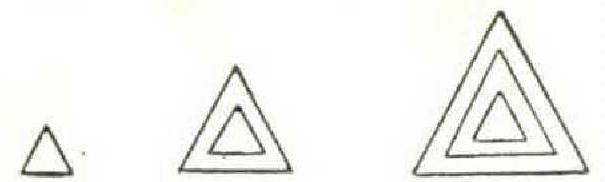
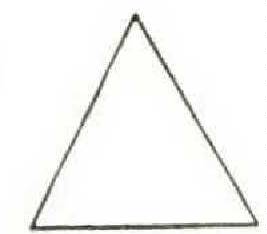
If he grows up, his tomb grows with him
and so on, if he lives
as long as Cheops, to
There was
a redhaired queen who made a tomb for herself and her daughters, deep under tons of pyramid and rock, and set two great artists, Rahay a painter and Yentaf a sculptor, to work in it. Whether the redhaired one and her brood were very line ladies, or whether the two fine artists made fine ladies of them I do not know; but when you see that row of sculptured women come alive in a hundred candle power electric sunlight without a shadow of death or fear on their shining faces and pleasantly courteous eyes or a line or contour in their whole bodies that is not exquisite, and when you turn to their magnificently designed portraits on the wall, the impression you receive is beyond description in our lower language, as of an order of beings completely redeemed from sin and vulgarity and all the plagues of our degradation, and yet not in the least geniuses, as Michael Angelo would have made them, but girls whom you might enlist for Stanbrook without expecting them to excel in doing as well as in being. You might question their vocation on the ground that they seem to have no religion nor to need any, having achieved excellence and being contenl to leave it at that; but the impression would be all the more astonishing. And that to those who served them fifty tons of solid stone seemed as easy to move and handle as a little water in a spoon, gets far beyond our miracles which are wondered at as miracles and taken as divine testimonies, and lifts us into a region in which the miraculous is no longer miraculous but gigantically normal, and immortality a thing to be achieved in a turn the hand.
l.’nder such impressions you find yourself in the Holy Land by night, with strange new constellations all over the sky and the old ones all topsy turvy, but with the stars soft and large and down quite close overhead in a sky which you feel to be of a deep and lovely blue. When the light comes you have left the land of Egypt with its endlessly fiat. Delta utterly behind, and are in a hilly country, with patches of cultivation wrested from the omnipresent stones, which you instantly recognize with a strange emotion which intensifies when you see a small boy coming down one of I he patches, and presently, when he has passed away, a bigger boy of about thirteen, beginning to think, and at last, when he too lias vanished, a young man, very grave and somewhat troubled, all three being dressed just as Christ dressed. (Here I break off. to resume on the night of the 20th, between Cyprus and Rhodes, at sea). The appearance of a. woman with an infant in her arms takes on the quality of a vision. On this first hour you do not improve. It gives you the feeling that here Christ lived and grew up, and that here. Mary bore him and reared him, and that there is no land on earth quite like it.
Later on the guides try to be more exact. This, they tell you, is the stable in the inn. This is the carpenter’s shop. This is the upper chamber where the Last Supper was served. You know lhat they are romancing — that there is not a scrap of evidence for the possible identifications and that no inn or stable ever existed in a natural cavern in the limestone rock without light or fresh air. In Nazareth you know that Mary used the well in the street because there was (and is) no other well in the town to use; but the water she drew is gone, and the new water, with laps affixed by the British mandatory Government, is anybody’s and everybody’s water. Everything else in Nazareth except its natural beauty as a hill town is a fraud, meanly commemorated by an unattractive and unimpressive church. But for these frauds every stone in Nazareth would be sacred with possibilities. Because one muddy bend of the Jordan is labelled as the spot on which the dove descended, the whole river is desecrated to make trade for the stall that sells the mud in bottles. I swam in the lake of Tiberius with a pleasant sense that this, at least, was Christ’s lake on which nobody could stake out the track on which he walked or the site from which the miraculous draught of fishes was hauled. It is better to have Christ everywhere than somewhere, especially where he probably wasnt.
The hills rise almost into mountains over the train to Jerusalem, which winds between them so sinuously that you can see its tail irom the window. When you arrive you are surprised: the place has a flourishing modern suburban air, and the new fashionable villa-land is mentioned as The New Jerusalem. When your very modern hotel has completed your disenchantment you make for the old Jerusalem and the church of the Holy Sepulchre. And the only possible comment on it is that of Dean Inge (he is with us on this trip) “Why seek ye ihe living among the dead? He is not here.”(When Dean Inge says the right thing it is so very right that he is privileged to say a hundred wrong things that dont matter). A sort of case can be made for the sepulchre: it is at least possible that what remains of the chamber in the rock after its smashing up by the Moslem persecutions may be the family vault of Joseph of Arimathea; but when on the same floor a few yards off they show you Calvary (not a hill) with the sockets of the three crosses, it is irresistibly revealed to you that Saint Helena was a humbug who, when the court was ordered to turn Christian, was quite determined to outshine the Queen of Heaven by a galaxy of visions and miracles that would show the world that Roman queens would enter the new temples as goddesses and not as Syrian peasants cradling their infants in mangers. I know that sort of woman almost as well as you must. I have seen her court in the mosaics of Ravenna, where the attempt of the imperial court ladies to look pious is ludicrously unsuccessful.
The church of the Holy Sepulchre, to eyes accustomed to western architecture of the same period, is a second rate affair; and the squabbles of the sects over their “rights" in it are not edifying. I duly squeezed myself into the sepulchre, and tipped ihe queerly robed priest who touched my hands with oil to the extent of five piastres, looking as credulous as I could so as not to hurt, his feelings; but my thought was that you would be disappointed. For tHe rest of the day I damned Jerusalem up hill and down dale; and when they took me to the Mount of Olives (practically oliveless) and showed me the famous view of the city my only comment was “Just like Buxton.”But one’s appreciation is more complex than that. When you stand on the stone from which the Ascension took place you feel at the same moment everything that the legend means you to feel and a purely comic amusement at the notion of Jesus going up to the highest attainable point as a takingoff place for his celestial flight. Your faith and your tourist’s observation jostle one another in the queerest fashion.
Next day I discovered Jerusalem. I went to the great plain of stone on which the Temple stood, and on which the Mosque of Omar (who didn’t build it) stands. And there I found the charm and sanctity of Jerusalem. Christ has been worshipped in both the mosques; Omar was a man after God’s own heart; and Mahomet’s horse sprang to heaven with him from the great rock which the mosque of Omar enshrines, and which is a nobly beautiful building in spite of the utterly anachronistic Corinthian capitals of the red pillars of granite which bother one all over the Holy Land, and which are so Roman and common. The Kaiser gilt the Corinthian heavily so that thejr might hit you harder in ihe eye. Mahomet respected Christ and taught his followers to do the same; and it is perhaps the failure of the Christians to respect Mahomet equally that makes Islam and Israel more impressive in the east than Christendom. Still, the history of the place is such a record of iconoclasms, massacres, persecutions, spoliations, demolitions, and delendings (in Cato’s sense) by Turks, Romans, and any conqueror who happened to come along, that the only general verdict possible is that of the King of Brobdingnag. God must feel sick when he looks at Jerusalem. I fancy he consoles himself by turning to Stanbrook.
You asked me for a relic from Calvary. But St. Helena’s Calvary is only a spot on a church pavement, jealously guarded, and with nothing removable about it. Where the real Calvary is nobody knows; for the hills outside the city are innumerable. The alleged Via Dolorosa I traversed in a motor car hooting furiously at the children to get out of the way. The practorium can be reasonably identified as in the palace of Herod, which Titus kept as a fortress for his garrison when he as nearly as possible left not one stone on another of the rest of the city; but as you cannot tell where Calvary was you cannot tell the way from the practorium to it.
So off I went to Bethlehem, a beautifully situated hill town; and from the threshold of the Church of the Nativity I picked up a little stone, a scrap of the limestone rock which certainly existed when the feet of Jesus pattered about on it and the feet of Mary pursued him to keep him in order; for he was a most inconsiderate boy when his family was concerned, as you would realize if you travelled over the distance (at least a day’s journey without a Rolls Royce) his mother had to go back to look for him when he gave her the slip to stay and argue with the doctors of divinity. In fact I picked up two little stones; one to be thrown blindfold among the others in Stanbrook garden so that there may always be a stone from Bethlehem there, though nobody will know which it is and be tempted to steal it, and the other for your own self, You shall have them when I return, unless I perish on the way, in which case I shall present myself at the heavenly gate with a stone in each hand, and St. Peter will stand at attention and salute the stones (incidentally saluting ME) when he has unlocked the gate and flung it open before me. At least he would it it were ever locked, which I dont believe.
I have been writing all this in scraps; but there must be an end to everything, even to a letter to you; besides, I finished with the Holy Land at Patmos three days ago, the intervening two days having been spent among heathen idols in and around Athens. For climbing up that frightfully stony road to the top of the mountain where the Greek monastery stands I shall claim indulgence for every sin I ever committed and a few hundred which I still hope to commit. The man who wrote the Book of Revelations, who was not the John of the fourth gospel (the Dean assures me that his Greek was disgracefully ungrammatical) ought to have married St. Helena. I know he was a drug addict, as all the wickednesses of which he accuses God, all the imaginary horrors, all the passings of a thousand years in a second and the visions of universes breaking into three pieces, arc the regular symptoms of drug action and delirium tremens. The book is a disgrace to the Bible and should never have been admitted to the canon.
I began this on the 17th March and it is now the 26th You can spend a week of your scanty leisure in reading it, and then sell the manuscript to Cockerell for the Fitzwilliam and endow a chapel to St. Bernard at Stanbrook with the proceeds. The writing of it has been very restful to the soul of your brother affectionately
G. BERNARD SHAW
“Brother Bernard’s is a splendid document,” was Dame Laurentia’s brief comment, “the least merit being its brilliancy. I believe his criticisms are such as I should have made myself if I had been there, and his appreciations seem to me to be most just. The tenderness of some passages is beautiful and reveals, I imagine, the soul of the real G.B.S.”
On June 12 he forwarded one of the two stones to which his letter refers with the cryptic remark: “This is for the garden. Your particular one will come later: the delay is not my fault; and the explanation will be satisfactory.”
Meanwhile Dame Laurent ia was Quite seriously ill; overwork had affected both heart and blood pressure, and the doctor ordered complete rest. In September, therefore, a letter arrived to ask her if she were able to receive a visit as the Shaws were in Malvern for the Festival: —
Unless your unenclosed lady who opens the door for me telephones to the contrary before twelve tomorrow, we will call on our way back from Cheltenham. If at that moment you are tired and cannot bear us, it will not upset any of our arrangements: it will only shatter my hopes. I have just been in Russia —the oddesl place you can imagine. They have thrown God out by the door; and he has come in again by all the windows in the shape of the most tremendous Catholicism. I hope they strapped you down in bed and kept the door locked until your overwork had been cured by a spell of thorough laziness. Your affectionate Brother Bernard.
On the Saturday appointed, Mr. and Mrs. Shaw arrived, bearing with them the stone from Bethlehem intended to serve as Dame Laurent ia’s personal memento. To her delighted amazement she was presented with an exquisite example of the silversmith’s art, almost a foot in height, constructed on the model of a medieval reliquary and cunningly devised to focus attention upon the small object enshrined, for which its own beauty is but a setting.
Dame Laurent ia was enchanted with the beauty of the gift, and a fortnight later showed it to Sydney Cockerell. Noticing that it lacked any mark of its donor’s identity, he suggested that it should bear an inscription to indicate its origin. Dame Laurent ia accordingly wrote and asked Bernard Shaw to supply a text, assuring him at the same time that he had the gratitude and prayers of the whole community. Her request met with the following reply: —
London, Oct. 25, 1931
DEAR SISTER LAURENTIA
. . . Why can it not be a secret between us and Our Lady and her little boy?
What the devil — saving your cloth —could we put on it?
Cockerell writes a good hand. Get him a nice bit of parchment and let him inscribe it with a record of ihc circumstances for the Abbey archives, if he must provide gossip for antiquarian posterity.
We couldn’t put our names on it—could we? It seems to me something perfectly awful.
“An inscription explaining its purpose”! If we could explain its purpose we could explain the universe. I couldn’t. C’ould you? If Cockerell thinks he can . . . let him try, and submit the result to the Pope.
Dear Sister: our finger prints are on it, and Heaven knows whose footprints may be on the stone. Isn’t that enough? Or am I all wrong about it? faithfully and fraternally
BROTHER BERNARD
P.S. I don’t mind being prayed for. When I play with my wireless set I realize that all the sounds in the world are in my room; for I catch them as I alter the wave length receiver — German, French, Italian and unknown tongues. The ether is full of prayers too; and I suppose if I were God I could tune in to them all. Nobody can tell what influence these prayers have. If the ether is full of impulses of good will to me so much the better for me: it would be shockingly unscientific, to doubt it. So let the sisters give me all the prayers they can spare; and don’t forget me in yours.
(To be concluded)