July 1956
In This Issue
Explore the July 1956 print edition below. Or to discover more writing from the pages of The Atlantic, browse the full archive.
Articles
How the Legionnaires Were Duped
A graduate of Clark University who served as a navigator in air sea rescue during the war, BEN H. BAGDIKIAN has been a reporter and columnist on one of New England's ablest newspapers, the Providence Journal, since 1947. In April of this year he received a Sidney Hillman Foundation award for a series of articles on the national effects of the internal security program; and he is now in Europe, where, as an Ogden Reid Fellow, he is engaged in a year's study of the party press.
Seato
Spain
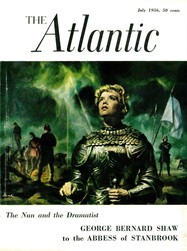
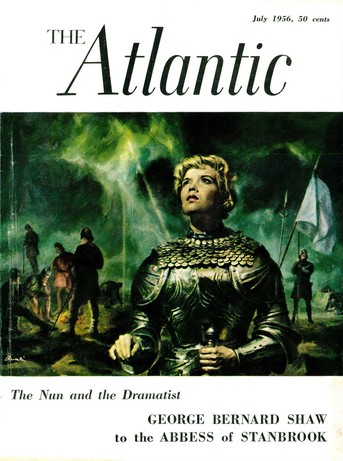
The Nun and the Dramatist: George Bernard Shaw to the Abbess of Stanbrook
At the time of her death in 1953, it was said of Dame Laurentia McLachlan, theABBESS OF STANBROOK, that '‘she gave herself to everyone who needed her help; she was a person without frontiers.”How true this was can he seen in the correspondence between her and GEORGE BERNARD SHAW, edited by the nuns at the Abbey and published here for the first time. Rarely has such a contest of letters or conflict of views formed the basis of so long and so lasting a friendship. The correspondence, which is printed bv permission of the present Abbess, the Public Trustee, and the Society of Authors, will form part of a booK, In a Great Tradition.
Fourth of July in Paris
CARLTON LAKE is the Paris art correspondent for the Christian Science Monitor. For the past several years he has been living on the He St.-Louis in a venerable Louis XVI house. From this charming vantage point, he has been able to observe and chronicle the entertaining idiosyncrasies of the Parisians — American no less than French — on both the Left and Right banks of the Seine.
The Atlantic Report on the World Today: Washington
Nothing Down and a Trip to Bermuda
With the advent of the 1957 models only a few months distant, automobile dealers are once again scrambling to find customers for the remaining '56 cars. New or used, the cars must be moved. Some of the inducements through which the dealer sets out to woo the haver and at the same time protect his own margin of profit are analyzed in the article that follows. HARTLEY HOWE has written extensively in the scientific field, and this is his first article to appear in the Atlantic.
A Madrigal: For Judith
Terry Bindle
An engineer who studied at Harvard and the University of Tulsa, JOSEPH wHITEHILL two years ago turned to full-time writing. Moved by his Navy memories and by his respect for the work of Joseph Conrad, Mr. Whitehill wrote a sea story called “Able Baker’ which won an Atlantic '"’First" award and was reprinted in the 0. Henry Prize Stories, 1956. The following narrative is another high point in the life of Able Baker.
Marine Housekeeping
What one sees through the portholes of the Marine Studios a few miles south of St. Augustine on the East Coast of Florida is the subject of Window in the Sea, by RALPH NADING HILL, which Rinehart will publish in the fall. In this second of two installments, Mr. Hill discloses some of the extraordinary techniques of maintenance and feeding developed by the Oceanarium, and describes how diverse specimens live together without mutual destruction. Mr. Hill is the author of several books about river boats and his own native state of Vermont.
Morning Draws Near
The Challenge of High-Speed Flying
If pilots have only split seconds for correcting a collision course at today 's fantastic speeds in the air, how can military and commercial flying be protected Jrom the ever-growing hazard of the mid-air crash? It takes a minimum of three seconds for the pilot to see and react to danger, and this interval at speeds ranging from 600 mph to the supersonic devours a half mile and more of distance. COLONEL H. G. MOSELEY, a Flight Surgeon, is Chief of the Aero-Medical Safety Division in the U. S. Air Force’s Directorate of Flight Safety Research.
The Credit Line
A veteran who served in the Infantry in Italy daring World War II, RICHARD YOUNG THURMAN is a graduate of Utah State Agricultural College, For the past three years he has been doing editorial work for a trade magazine and he is now living in Seattle, Washington. This story of the trials and tribulations of a bill collector marks Mr. Thurman’s first appearance in the Atlantic.
Immigrants Who Go Back
Professor of History ot Harvard and an authority on the blood streams that have poured into this country. OSCAR HANDLIN went to Europe last summer to work on his new book. While there, he kept an eye out for those Americans — the twice-uprooted—who had left the homeland to find their fortunes in the New World and then returned. What does the village make of these lost sons? Ire they as disruptive in their return as in their departure? Professor Handlin’s book The Uprooted won the Pulitzer Prize for History in 1952.
Trees and Men
English novelist and master of the short story, H. E. BATES has had a loyal readership both here and abroad. In his best work, nature is a force hauntingly present, wherever the story takes place. This is particularly true of his must recent novel. The Sleepless Moon, and of his new collection of short stories, The Daffodil Sky, to be published this month by AtlanticLittle, Brown. In the following essay he tells how he reclaimed a grove of chestnuts, beeches, and oaks, which had been ravished by time, weather, and the greed of men.
The Peripatetic Reviewer
Books: The Editors Like
Reader's Choice
Accent on Living
The Perfect Polyglot
Oh, It's Love, Etc
Looking for Firewood
The Need of Dread
R. G. G. PRICE has contributed a great variety of light writing and criticism to Punchin recent years.
An Eye for an Eye
Lost, Stolen, Strayed
Schwann's Black Diamonds