Liverpool Is Brooklyn King Size
A native of New York City, SHEPARD RIFKIN has worked a wide variety of jobs, ranging from tugboat-man and chimney sweep to bookstore manager and editor of a small vanity press. Writing has been his lifelong ambition, and he has studied on fellowships at the MacDowell Colony and at Yaddo. His first novel in hard covers will be published by Knopf.
I WENT to a party recently, and someone put on some old records. They weren’t much, and I was listening to a partially polluted psychoanalyst say that he hated Irish whisky because the last time that he had kissed a girl she had been drinking it and her feet were dirty. Suddenly, through the laughter and the conversation, I became aware of a record. It was Whispering Grass, and the Ink Spots were singing it. And I went back eleven years to a blind pig in Liverpool.
You know how some songs make you think of a spring night kissing a girl under purple lilac sodden with rain? And other songs, of unheeded jukeboxes on summer islands? Liverpool is what comes to me every time I hear Whispering Grass. It’s an old song, and they don’t play it much any more, but once in a while they do, and no matter what I am doing I listen, I am sure, with one of those smiles which are so irritating to others, because it means that a secret is happening which is not being shared. There is no girl connected with Whispering Grass except a dirty Irish one, but the evening when I heard it still has a bitterness which is sharp as ever; it fills all the necessary requirements for a stone, a leaf, a door.
I was a merchant seaman then. Our beat-up Liberty had just crawled into Liverpool after a six-knot convoy across a December North Atlantic in which that great gray cat played with a rather scared gray mouse named the Joel R. Poinsett. I think it was Joel P. Poinsett’s fourth scurry, and in one twenty-four-hour period she made thirty miles all out. But she slid out from under the paw in twenty-two days and scrunched, relieved, against a dock. The paw was going to get her on the return trip, however.
I ran, not walked, to a nice pub on Lime Street and asked for some Scotch. It was just before closing. The barmaid came from Glasgow, and she leaned across the bar and burred at me. “I’m the only Scotch you’ll find here,” she said, sounding like an electric fan into which someone had just thrust a wooden spatula. “We get one bottle a night, and it goes vurra fast. Time!”
On my way out I moodily bumped into an R A.F. lieutenant. He touched my elbow and said, “I know a place.”
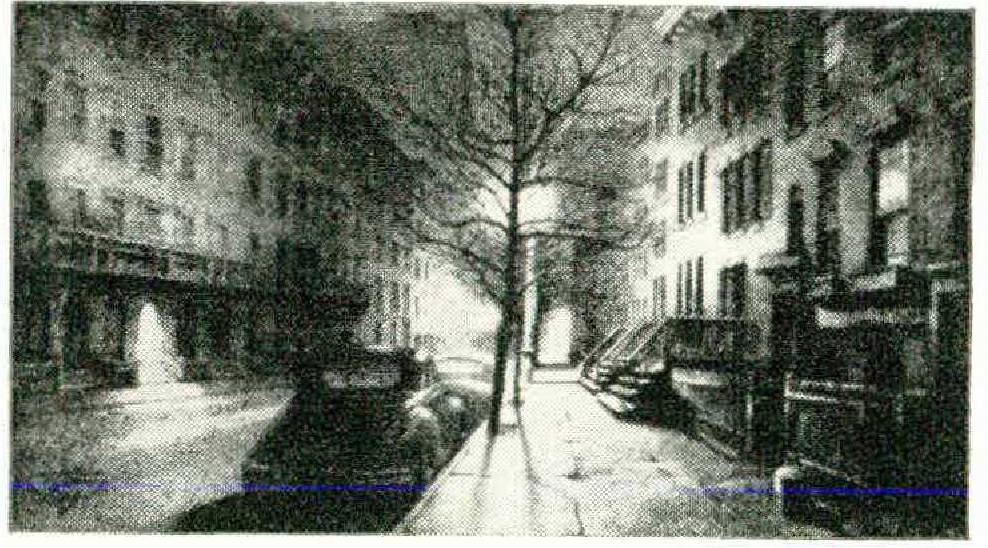
We took a tram, and we went pretty far, and we got off. Liverpool is Brooklyn, king size, and those miles of red brick houses with iron railings sprouting in front of them like shiny black cabbages in the night mist march dully to the coast, down along the continental shelf, westward along the abyssal deep, and emerge, dripping and unchanged, in Bensonhurst.
We got off and walked a block. The lieutenant knocked on a door, and after a few seconds a panel slid open. We were being examined by a sour female eye. Then the panel slammed shut, the door opened, and a woman’s voice said, angrily, “Well, come in!”
We walked into a bare room with one naked bulb hanging from the ceiling. There were two wooden benches along one wall; they were filled with Greek merchant seamen. They were drunk and shouting, naturally, Greek. I had studied classical Greek and could recite one of Sappho’s poems and the first ten lines of the Iliad, but I didn’t understand what they were saying. The woman who had opened the door was a shivering Irish girl of twenty or so. “This way, this way!” she said, furious, and we followed her to one corner of the room. A plank had been laid across two empty nail kegs, and on the plank was a bottle of brandy and one dirty glass.
The girl wore an old dress with a few small holes and a thin sweater with her elbows sticking out where the wool was frayed. The pockets of her sweater bulged with dirty handkerchiefs, and she kept blowing her nose and shoving the handkerchiefs back in the pockets. “Well?” she said.
“I’ll have one of those,” I said, awed by her intransigency and no-nonsense attitude.
She poured out a shot and kept her hand on the glass, defying me to touch it. “D’you want one too?” she snarled at my friend.
“Er — yes,” he said, cowed.
“That’ll be a pound fee the two, then. She didn’t take her hand off till she got the pound.
I gave her a pound, and she shoved it down the front of her dress. Then she pulled a dirty, soggy handkerchief out of her pocket and blew her nose, hard. Then she poured out another shot into the same glass. I sipped some and handed the glass to my friend; we kept it going back and forth. While we alternately sipped the terrible stuff, I looked at her legs. I always looked at the legs of girls in every country. Hers were bare and red and covered with goose flesh. They were typical English winter legs. She glared at me, and I promptly looked away.
There was an old victrola near the benches where the Greeks were sitting, and it was the kind you had to wind by hand. It was playing Greek records. After a while I got tired of the sad, Arab-like wails, and I looked through the pile of worn and scratched records lying on a chair next to the victrola. In the whole pile there was one that wasn’t Greek. It was Whispering Grass, and the Ink Spots started to ask. “Green grass, why do you whisper?” and I felt homesick for a while, and the Greeks smiled patiently and waited till it was over, and then they put on the rest of the Greek records, stood up, and began to dance with one another in the heavy peasant dances of Greece.
SOMEONE on my left began talking to me. He was French, one of that lost band of merchant seamen - the Dutch, the Norwegians, the Greeks, and the French — the ones who could not go home till the war ended. For them their ship, the one they happened to be on when the decision was made to go over to the Allies, became their home. You met them in Carapito or Aruba or Halifax. Somehow they all seemed to have the same quietness, the same calm coating-over of despair that would suddenly break away like ice in the spring whenever they got drunk, and they would fight, weeping, and savagely. It was bad enough being an American and away from home four or five months at a time with the ever-present anticipation of a dive-bombing or a torpedoing, but we knew it wouldn’t be longer, and then we’d be home. We got mail, besides. These guys hadn’t been home for years, had had no word of home for years, and didn’t know when they’d be home again.
Once in a bar in Curaçao I saw two crew members of a Free French tanker fighting. It was a brief fight and got stopped quickly by the American tanker crew I was with, but what will haunt me for years was the sight of one of them lying on his back on the floor: the other one was kneeling above him and slugging him, the man on the floor lay unresisting, and as he wiped the blood running out of his mouth he was crying and saying, “Pourquoi? Pourquoi?” It was a question addressed, I suppose, to God.
The Frenchman in Liverpool was very drunk. He said he and his friend, who was admiring my key chain, which had cost me a dollar and a half back in New York, had been torpedoed off the West African coast, had got on a raft, naked, and the raft had drifted safely out of the burning high octane, had drifted during the night onto the coast, and they fell asleep on the beach, exhausted.
The next morning they got up, walked along the beach under the tropic sun for hours, trying to shield themselves with seaweed and palm fronds. They were the only survivors; the rest died when the boilers exploded, or were fried to death. They found no water. Late in the afternoon they discovered a trail leading inland. They lollowed it for two or three miles till they came to a clearing, where they saw the American flag flying. It was some sort of Protestant mission. No one was around. They staggered up the steps, sunburned badly, scratched by the undergrowth, and their tongues swollen. They knocked on the door. A lady missionary opened the door, took a look, screamed, and fainted. They slapped her awake, kneeling beside her on the veranda, and her brother came out, saw them, and went for his gun.
But it all ended happily, and with his help they made their way to Dakar and another French ship. But what angered the man who was telling me the story was that the woman had fainted. He couldn’t stand that. “We came out of the sea, blisters big as cookies all over our backs and shoulders, our feet cut on the coral, no water, no food, our friends fried, and the first thing that bitch did was to faint!” He brooded about it, laughing, but too close to tears, and his friend realized it and told him to shut up. I gave him my key chain because he seemed to like it so much, and he pulled off the tiny gold Cross of Lorraine that most of the Free French wore and gave it to me.
It was a tiny, lovely little thing. It would be a line souvenir of a man who swam, naked, onto Africa and made a lady missionary faint, and I put it on my lapel. Then I said good-by to the French and the Greeks and the English and the Irish girl. She was looking into her dirty handkerchief and didn’t bother to answer, and I stepped out.
The night was clear and damp, and the trams had stopped running. The town was under blackout regulations, and I was lost. I had miles to go, and there was no one in the streets. But I knew the docks were to the west, and I could see the North Star stuck among the chimneys, and I made it all right, picking my way through the bomb rubble that crammed the waterfront area; the air was full of the smell of old bricks that belongs to European cities.
We sailed lor the States two days later, and two hundred miles off Cape Race, Newfoundland, we were torpedoed at four in the morning in a snowstorm. I left with my wallet and toothbrush, and only after we had been picked off our raft by a British freighter, which thereby risked a torpedo itself, and which was named, suitably, the Empire Chivalry. did I realize that I had left my Cross of Lorraine behind.
So there it rests, still in my locker (the suit to winch it was pinned has rotted away long ago), shining a bit, a few hundred fathoms down, the only thing of the night I could touch.
But if I lost the Cross of Lorraine, I can come at that night another way, and Whispering Grass makes it flood over me with all its poignancy, sticking out at the elbows, asking “Pourquoi? Pourquoi?”, and mixed with the thumping dance of the Greek sailors.