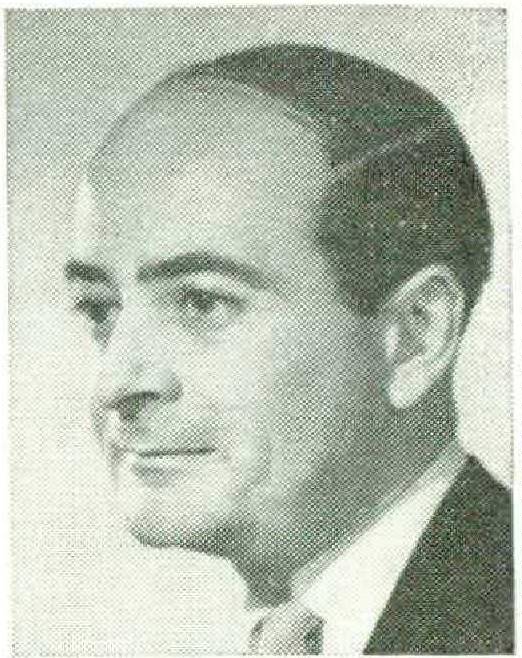
In his autobiography, ARTHUR KOESTLER candidly described himself as a sort of intellectual Don Juan forever seeking “the ideal Helena” in the form of causes and credos. He has had affairs of varying intensity with Communism, anticommunism, Zionism, psychoanalysis, natural science, and cosmology; and now he has conscientiously made passes at the so-called “wisdom of the East.”THE LOTUS AND THE ROBOT (Macmillan, $3.95) is the record of a recent pilgrimage to India and Japan, where he hoped to find “an answer . . . to our perplexities and dead-locked problems.” He chose these two countries “because they are at opposite ends of the spectrum: one the most tradition-bound, the other the most ‘modern’ of the great countries of Asia.”
Opening with descriptions of four very different contemporary Indian “saints,” Koestler gives us vivid impressions of persons, places, and rituals; crisp expositions and discussion of the various aspects of Yoga and Zen; and neat, dramatically stated analyses of the links and conflicts between tradition and contemporary trends. He has briefed himself in the relevant scriptures, and his book is a consistently interesting example of that higher journalism at which Koestler excels.
In India, Koestler was disconcerted by the indifference to misery of a society whose holy men accuse the West of having developed the head but not the heart; by the stifling subservience of son to father; the dearth of research into the medical and miraculous claims of Yoga; the incompatibility between an ancient tradition and the needs of the new state, whose leaders are trying to impose on it blueprints borrowed from the West. Modern Japan struck Koestler as a culture with a painfully split personality. “Lotusland” and “robotland (the latter, a reflection of the West in a distorting mirror) coexist and do not make an integrated whole. The Japanese, he says, hate robotland, and yet they recognize that lotusland, to which they are still strongly attached, has become an anachronism.
Koestler’s detailed examination of Zen interprets it as having served for centuries as a vivifying antidote to the fearsome rigidity and perfectionism of the Confucian code. But his verdict is that, as practiced today, Zen is spurious and degenerate. “Both India and Japan,”Koestler concludes, “seem to be spiritually sicker, more estranged from a living faith than the West.”He found the Eastern approach to life, with its turning away from external reality, its rejection of logic, its emphasis on annihilation of the ego, far more one-sided than that of the West, in whose history mysticism and science, intuition and logic have complemented each other. And he returned with a renewed respect for the West’s cultural achievement.
Koestler’s report seemed to me a useful corrective to the reverential twaddle some Westerners have written about the wonderful “spirituality” of Eastern life. At the same time, though he confirms many of my prejudices, I feel that his makeup doomed him to remain insensitive to whatever enlightenment the East may have had to offer. For Koestler, though he has paid his respects to the irrational inner life, is inescapably afflicted with “the hubris ot rationalism,”which he acknowledges to be a major source of the West’s spiritual distress. He has, in effect, turned to the irrationalism of the East with the impossible demand that it furnish answers acceptable to the rationalism of the West. He cannot help being peeved with the exponents of Oriental religion for iracturing the grammar of Western logic, and his critique of Zen misses the crucial point that it is, to quote Dr. Suzuki, “beyond the ken of conceptualization. It is literally beyond thought.” Koestler’s book, moreover, suffers from his customary allor-nothing approach to things. Having concluded that Eastern irrationalism has glaring deficiencies, he cannot keep his mind and eyes open to the possibility that it may nevertheless have something of value to teach the overrationalistic Westerner.
INSIDE HOLLYWOOD
THE FIFTY-YEAR DECLINE AND FALL OF HOLLYWOOD (Simon and Schuster, $5.95) by EZRA GOODMAN is probably the most devastating indictment of the American movie world ever to find its way into print. Mr. Goodman has been associated with the movies for twenty years, as publicist, columnist, reviewer, magazine writer, and former Cinema editor of Time. He has documented the familiar charges, and charges which seldom get a hearing, with no end of hard, precise, and often startling detail. He does not, I should add, go in for scandalmongering of the Peeping Tom variety. Although his book is written in a reportorial style, garnished with puns, witticisms, and much entertaining anecdotage, its intentions are as serious as murder.
Piece by piece, Goodman builds a factual picture of a business “reeking with incompetence and corruption"; of an empty, ruthless little world, ruled by greed and egomania. The unsung technicians are the one group that passes his scrutiny with credit. He has a withering disdain for the new breed of slick, college-educated producers — the Kramers, Wangers, and Scharys — who present themselves as high-minded liberals trying to “elevate" the movies. In Goodman’s estimate, their triumphs have been in the sphere not of art but of publicity, and he finds them just as hostile to critical discussion of their work as the primitive robber barons.
One of the highlights of Goodman’s book is its detailed account of how the press, by and large, has allowed itself to be corrupted, brainwashed, and blackmailed (through the advertising department) by the studios. Even the nation’s leading newspapers have regularly treated the fraudulent concoctions of press agents as news, and the more critical reviewers have always found their situation a harrowing and thankless one.
The decline of Hollywood, in Goodman’s view, began immediately after its pioneer era, which, for all the crudity of its products, was a period in which creativity and individual genius flourished; Griffith, Sennett, and Chaplin remain for him the giants of the American screen. Goodman blames the artistic bankruptcy of Hollywood on the control of movie making by businessmen and on the American mania for organization. A great movie is the outcome of a creative process fully controlled, from script to cutting, by a brilliant director. But in Hollywood, movie making became rigidly departmentalized, and by the 1950s few directors had a free hand. The producers, in cahoots with the big stars and their agents, were in command.
It will certainly be said that Goodman is hard on Hollywood, but I must confess I found it enormously exhilarating to see the nauseating cant, pretensions, and hokum of the movie world so ruthlessly demolished by a reporter who cites chapter and verse and unsparingly names names. Goodman’s major mistake is his failure to situate his diatribe in the proper perspective. The Hollywood story is merely a spectacularly awful exhibit of the failings and vices of mass culture. On television and many mass magazines, businessmen are giving the creative hands their orders. And there is no less shameful venality and puffing in the coverage of fashion, restaurants, and the wares of Detroit than in the coverage of the cinema.
TROUBLE IN THE EMBASSY
The narrator of NANCY MITFORD’S new novel, DON’T TELL ALFRED (Harper, $3.95), is the same Fanny who chronicled The Pursuit of Love and Love In a Cold Climate. Now she is middle-aged, and her husband, who has held the chair of Pastoral Theology at Oxford, has unexpectedly been appointed ambassador to Paris.
Miss Mitford’s plot, following a familiar recipe for comedy, piles crisis upon crisis. The former ambassadress, a terrifyingly chic charmer, stays on in a wing of the embassy and monopolizes the cream of Parisian society. Fanny’s beautiful social secretary bewitches a corps of French VIPs with disruptive consequences for the running of the embassy. Fanny’s grownup sons — one a Teddy Boy in the tourist business, the other a bearded student of Zen with a silent wife and an adopted Chinese baby — add their embarrassing presences to the diplomatic household. Her younger children run away from Eton and descend upon the embassy in the company of Yanky Fonzy, a frightful idol of the rock-’n’-roll set. Meanwhile, a crisis in Anglo-French relations over the ownership of uninhabited islets in the Channel is mounting to a head.
In the course of these proceedings, Miss Mitford pokes fun at the current cilts of English youth, French politics, Americans (her portrayal of them is painfully, inexcusably wrong), psychoanalysis, and British journalism. Miss Mitford is an elegant and beguiling writer, but her brand of sophistication and her satiric perspective are beginning to show signs of being dated. Although she is writing about the present, one almost feels that one is back in the pre-war world of Noel Coward and Evelyn Waugh. Readers who are not too disturbed by this should find her novel, as I did, very entertaining.
VARIETIES OF EXPERIENCE
TAKE A GIRL LIKE YOU (Harcourt, Brace & World, $3.95), by KINCSLEY AMIS, is his best book to date. His view of life has become more serious and more complex without diminishing his fine flair for farce. The setting is a town near London, and the two leading protagonists. Jenny and Patrick. are a very young and provocatively beautiful schooltearcher and a schoolmaster of thirty. Patrick is a bounder of great charm, with a chronic appetite for seduction and an intermittently active conscience. He and Jenny fall in love. But Jenny is firmly committed to the old-fashioned idea of keeping her virtue intact until marriage, and Patrick, though he promises to behave, continues with all the guile he can muster to try to get her into bed with him. It is a tribute to Amis’ skill that this relationship, which could so easily collapse into vulgarity and fatuity, is tender, touching, and funny.
A balance between sadness and humor is maintained throughout the large and varied cast of characters. Among them are a Scotsman who suffers from not being attractive to girls; a headmaster’s daughter who has made herself into a parody of an American teen-ager and lets her juvenile promiscuity get her into trouble; and a rich, friendly, fantastic partygiver - a splendid comic creation — whose speech is Wodehouse updated by the R.A.F. Below the comic surface, Amis is subtly confronting the problem of human relationships, especially the sexual relationship, in a world without fixed rules of conduct. He emerges as a likable contemporary moralist, whose modest theme is that people would hurt each other a great deal less if they did the obviously “decent” thing a bit more often.
REVOLUTIONARY ROAD (AtlanticLittle, Brown, $4.75), a remarkable first novel by RICHARD YATES, is a powerful treatment of a characteristically American theme, which might be labeled “trapped.” The trap begins to close seven years before the novel opens. Frank Wheeler was living in Greenwich Village, supporting himself by odd jobs in order to give himself the freedom to find his vocation — some intellectual pursuit that would take him to Europe. April, the girl he married, fervently endorsed this design for living, but when she became pregnant by mistake, necessity forced Frank into steady employment. Now, with two children to provide for, he is tied to a job in business and a life in exurbia which both he and April despise, and there is mounting tension between them. April concocts a scheme which would enable them to move to Paris, and when another unwanted pregnancy upsets it, the crisis in their lives advances to a catastrophic climax.
Frank is a weak man; he talks a fine line about the good life but lacks what it takes to realize it. April is a neurotic who taunts her husband for not making more of himself and unconsciously resents the role of the female. Their story is clearly meant to be representative of American marriage, to be a diagnosis of what Alfred Kazin’s tribute on the jacket calls “the new American tragedy.”A complementary theme is touched on in two scenes involving the inmate of an asylum: plenty of people complain about the emptiness of American life, but only those considered crazy by our society have the courage to see its hopelessness. While I don’t agree with the fashionable thesis that total negativity is the only admissible attitude for an American writer, I found Yates’s book a highly impressive performance. It is written with perception, force, and awareness of complexity and ambiguity, and it tells a moving and absorbing story.
Failure in marriage is one of the insistent secondary themes of THE GAY PLACE (Houghton Mifflin, $4.95), by WILLIAM BRAMMEK, winner of a Houghton Mifflin Literary Fellowship Award. The book, a long work of fiction portraying a Southern state which is obviously Texas, consists of three interlocking novels, each with a different protagonist — a member of the state legislature, the state’s junior senator, and the governor’s press secretary. The governor himself, a master politician, infinitely canny and seductive, remains the dominant figure throughout.
As the action swirls from political intrigue to bacchanalia in the houses of the rich and dramas of love, it creates a picture of a feverish, dreamlike world, a world whose people are perpetually giddy with alcohol and chasing after sex; a world where love cannot survive in private life and political life is a realm of “fantasy.” I have some doubts as to whether this mythologizing adequately expresses the essences of the new Southwest. What is certain is that Mr. Brammer has great creative energy and a vision of his own. With its driving pace and tremendous sweep, his book is an arresting performance for a young writer. It is sure to be a considerable success.
EQUALITY VERSUS PERFORMANCE
The launching of the first Sputnik produced in the United States an acute access of concern over the failure of our educational system to make the most of exceptional talent, the growing tolerance of slovenly standards in our society, and its dedication to easy living. This challenging issue is discussed by JOHN W. GARDNER, president of the Carnegie Foundation, in a discerning, temperate, and well-written essay entitled EXCELLENCE (Harper, $3.95).
American democracy subscribes to two contradictory principles — the equalitarian principle that all men should be equal, and the competitive principle, “Let the best man win.”Thus our society puts restraints on, and simultaneously encourages, individual performance. This tension, Mr. Gardner argues, never will be or should be resolved. No democracy can unreservedly commit itself to the competitive principle and remain a democracy, or to equalitarianism and retain its vitality. The problem to which he addresses himself is how we can hold these contesting philosophies dynamically in balance.
To raise higher education higher, the crowding of our colleges must be halted. One of Mr. Gardner’s major prescriptions is that we need to revise the false emphasis which has lately been placed on college education; educating everyone to the limit of his ability does not mean sending everyone to college. Those who are clearly not fitted for higher education should be made aware of other constructive possibilities open to them and should not feel that failure to go to college dooms them to lower status. One way of tackling the status problem is to cultivate respect for high standards of workmanship. To a society which cares deeply about standards, “the excellent plumber is infinitely preferable to an incompetent philosopher.”
Everything Mr. Gardner recommends seems eminently desirable to this reader, but his essay has a utopian flavor in places. I am sure that among educators it will have a tonic effect. But the decline of excellence is intimately bound up with the whole system of mass production, and it would take something approaching a social revolution to bring about certain of the changes Mr. Gardner is calling for. Who is going to persuade the all-powerful trade union bosses to encourage performance rather than featherbedding?
INVEST NOW, PAY LATER
A far more radical challenge to the labor unions is implicit in THE NEW (RANDOM House, $3.50), by Louis O. KELSO and MORTIMER J. ADLER. THIS short essay is a supplement to their previous book, The Capitalist Manifesto, which outlined a program that would transform our present mixed economy into a truly capitalist one. While its audacious proposals stand little chance of being adopted within the predictable future, The New Capitalists is a fresh, interesting, and often penetrating critique of the workings of our economic system. Messrs. Kelso and Adler have nothing in common with the brainless reactionaries who pine, fruitlessly, for a return to old-fashioned, laissez-faire capitalism. What they are advocating represents an advance: a government-sponsored plan for the creation of new capitalists; a plan which would bring about far-reaching changes in our economic and social system.
The authors start out from premises which were established in The Capitalist Manifesto. Technological progress has made capital the predominantly productive factor in our economy; it accounts (they assert) for 90 per cent of the gross national product; indeed, many types of labor have become economically worthless. But ownership of the great productive factor, capital, is concentrated in the hands of 5 per cent of the nation’s families, and the present system of financing corporate enterprise out of savings is intensifying this concentration - capital is producing more capital for those who already own it. Our method of coping with this dilemma has been artificially to maintain an approximation of full employment and to hand out to labor much of the wealth that has really been produced by capital. This is the inflationary policy of the welfare state, and the authors argue that it retards economic growth. The alternative which they propose is to diffuse the private ownership off capital through the “financed-capitalist plan.”which would rescue economic growth from the tyranny of savings.
The authors take as their model the experience of the Federal Housing Authority in insuring mortgages. They suggest the creation, by Act of Congress, of a Capital Diffusion Insurance Corporation (CDIC), which would insure bank loans to individuals without capital who wish to make certain approved types of investment, principally in new enterprises. The loan, plus interest charges, would be repaid out of dividends, which presumably would become larger than they are today, since it would no longer be necessary for corporations to withhold earnings to finance their expansion; all such financing would be provided by the public, assisted by the CDIC. If the dividends were insufficient to enable the investor to meet the payments due to the bank, he would be in exactly the same position as the holder of a mortgage. He would forfeit his stock. Thus, the element of risk, for which capital is rewarded, would remain for the investor but not for the bank, which would be protected by the CDIC.
A brief summary such as this can only describe in crude outline the authors’ plan, and cannot even touch on its radical implications, which include changes in the tax structure, in the role of the stock market, and in the idea that there should be jobs for all. The major weakness of the essay is that it is a summary itself. It leaves a number of important points undeveloped and nagging questions unanswered. Still, by stressing the current fallacies and pieties about the role of labor and of savings in our economy, it makes a provocative contribution to economic thought. The layman who has a modest grasp of economics should have no trouble following the argument.