They Shall Have Music
BY JOHN M. CONLY
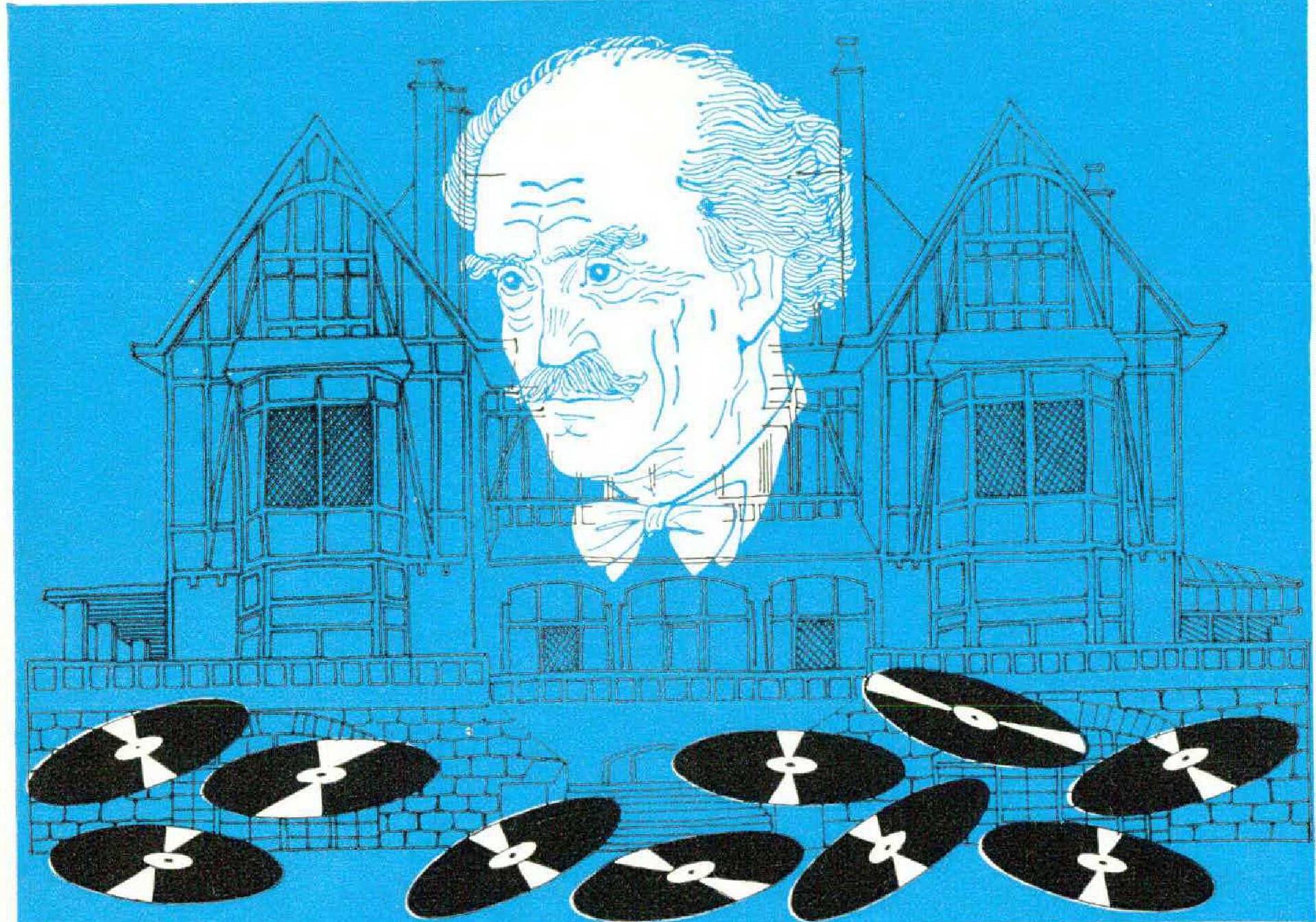
The Villa Pauline at the foot of West 254th Street towers over a peculiar enclave of New York’s Riverdale district. Here the crowding apartment houses yield abruptly to a fringe of spaced estates along the Hudson bank, above the New York Central tracks. A Morgan partner built the Villa Pauline, but it is most famous as the residence of Arturo Toscanini during the last quarter of his life. Now it is the home and the laboratory of his son Walter, and Walter intends that finally it shall be a museum. It looks like a museum, of a sort. It is of brown plaster with half-timbered decoration. At its corners are truncated turrets. Between them is a baronial hall, galleried all around the inside. A balustraded terrace affords a ten-mile view of the river and the Palisades.
For a time after the Maestro died in 1957, just before his ninetieth birthday, there was an almost palpable emptiness in the great house, but this could not last, and did not. Walter Toscanini is a man of immense vigor and vivacity (who should some day write his own fascinating life story). At sixty-two he still looks a very fit fifty and moves like an athlete, especially up and down Villa Pauline’s long staircases. He has subtly brightened the place. A widower now - with one son, an architect working on the Lincoln Center project - he lives alone but for a housekeeper, a marvelous cook, a splendid collection of wines, books, and audio equipment, and the daytime company of his assistant and friend, John Corbett.
The two men spend much of their time belowstairs, in a Byzantinearched room which the Morgan partner intended for billiards. Now it is a sound laboratory, lined with tape recorders, console amplifiers, turntables, loudspeakers, and racks and racks of tapes and acetate transcriptions. Corbett says they have at least 1150 hours of sound on tape. All of it is Toscanini: concert hours, rehearsals, commentary (“cursing and swearing,”adds Walter). From the Byzantine dungeon have come all the release approvals for Toscanini recordings in the last decade, and the flow has by no means stopped.
For an instance, the last items to undergo checking have been three RCA LPs of Toscanini in pseudo stereo, the Respighi Pines and Fountains of Rome, the Dvořák New World, and the Moussorgsky Pictures at anExhibition. These are products of a Victor idea for reviving the Toscanini market, after the company itself, in the early flurry of stereo, had depressed it by withdrawing Toscanini performances from the catalogue and substituting stereo playings by Reiner or Munch. They assigned a young engineer named Jack Somer to this pleasant fakery. After some joint experimenting with Walter and Corbett, he came up with a simple but effective conversion. By using filters, he moved all the high strings and winds to the left channel (by which I mean their fundamental tones) and the lowvoiced instruments to the right. This was not the way Toscanini disposed an orchestra, but some conductors do. Then both channels were reinforced by a subdued, and almost imperceptibly delayed, full orchestra signal, since in stereo each microphone hears most of what the other does, though with a slight lag. The deception, to my ear, is better than fair, and the whole processing has been done with loving care. The stereo may seem a little out of phase at times, but the overall sound has a beguiling richness.
Walter and Corbett have some treasures of their own contriving, too. From broadcast transcriptions, pieced out with inserts from rehearsals, they have put together nearly twenty tapes, fit for disc use, of Toscanini performances never issued on records. These go as far back, in some instances, as 1941 (the Walkiire broadcast with Traubel and Melchior) and come within six years of the present. They include the Sibelius Second Symphony, excerpts from Berlioz’s Damnation of Faust, a pair of Vivaldi concertos, some Rossini, Haydn’s Toy Symphony, and sundry short works. Whether or not RCA Victor will be interested in these for release, Walter doesn’t know. Meanwhile he has, for the fun of it, made several into private pressings for his friends. Emory Cook did the processing, and Walter had him cut the twelve-inch discs at 45 revolutions per minute instead of 331/3, since the faster speed keeps the treble a little cleaner. They sound as good as the variously aged broadcast acetate transcriptions could make possible. If no large companies want to issue the records commercially, Walter may try to do so himself.
Something I should think RCA Victor would surely be interested in issuing is the only stereo recording of a Toscanini performance. It is that of his final broadcast, all Wagner. Listeners may recall that he faltered briefly in the latter part of the program. Guido Cantelli, in the control room, thought the concert was going to pieces and had the engineers hurriedly insert a recording of a Brahms symphony. All the NBC transcriptions carry the irrelevant insert, but RCA Victor was recording separately, and in stereo. Walter says the flagging was very brief. He doesn’t know what caused it.
41 Maybe preoccupation,”he says, “or maybe perspiration got in his eyes.” Walter, his father’s manager then, had asked the Maestro not to conduct that day, since only the night before he had finally signed a letter declaring his retirement. But Toscanini insisted. “Until then,” Walter says, “I had helped make him conduct as long as he could. I could not see him in retirement, sitting around or going fishing, though he often said that he was through. A year after he did retire, however, he would sometimes say: ‘I am as good as I ever was, yet here I am doing nothing.’ In a way he was. His hearing never failed. Until his death he still could hear the triangles in the orchestra, which is rare in a man almost ninety.”
Project Riverdale really began in 1950, born out of this concern of Walter’s over his father’s last years. “We had enough music here, his own and others’, to give him plenty of chance to listen, and to get mad, and to be unhappy. He never could be satisfied if he wasn’t unhappy. He was the unhappicst man in the world, and this was part oh his greatness. He was like Faust, always looking for impossible perfection.”
Toward this end, Walter began in 1950 to wire and equip the villa for sound. RCA Victor’s commercial machines (“although beautiful,” Walter amends) could not give the Maestro the sonic immediacy he required. So Walter, first by himself, then with the aid of the violinist and audio experimenter David Sarser, RCA’s engineer Richard Gardner, and Corbett, chose and devised a sound system that met the need. It has never stopped growing, because Walter in the process became an aficionado. Indeed, he can be called a pro, since three years ago he received a decoration from an audio engineering group.
Corbett, a ruddy, light-haired man in his mid-forties, came to the Toscaninis from the engineering department at NBC, but he was not an engineer to begin with. In fact, he had started his earning career as an English instructor at the University of Minnesota. “Early morning classes, ” he recalls. “Football players and dental hygienists.”He found this unrewarding and began haunting recording sessions on the campus, where Columbia was making discs of Ormandy and, later, Milropoulos. A Columbia engineer told him, truly enough, that he might well be able to sell his lore in New York. Within a year he was at NBC, transcribing programs and running a mixing amplifier. He lives in Riverdale, to the mild dolor of his wife, who would prefer Central Park East, but he likes walking to work. He and Walter complement each other admirably, the latter furnishing impulse, the former patience.
Walter Toscanini must have some patience, too, to have got along as well as he did with his father. He says his father also had great patience, although this flies in the face of legend. “He never fired a musician, that I know of,” Walter told me, “and he never tried to terrify one, though all were terrified of making mistakes when he was around. Sometimes, over a mistake, he would hold his temper for a week, and then explode when everything finally was going well. We who knew him came to understand this.”
Walter is plainly a chip of the ancestral granite. As a schoolboy he was a celebrated soccer player. Still a schoolboy when World War I began, he became a sniper attached to a mountain artillery regiment. He got into enemy trenches twice, he says, once by mistake. Finally an Austrian with a good eye lobbed a small explosive device almost under his feet. This ended Walter’s aspirations for a soccer career and also returned him to civilian life. He studied law at Pavia and Urbino and came to a different kind of war — the kind he was going to fight all his life. He began by defending nineteen accused deserters in a court-martial. He got them off, but partly by speaking unkindly to several rear-area generals among the hostile witnesses, for which he was put under surveillance as a possible Communist. He wasn’t a Communist, possible or otherwise, as he showed soon thereafter in Milan, during the undeclared civil war between Communists and Socialists. In charge of a militia detachment reinforcing the police, Toscanini, still under twenty, planned an ambush and came back to headquarters triumphantly bearing six captured Red banners. He was immediately put in jail for initiating an attack without written orders.
He remained a stanch Socialist, though, even to the point of volunteering as bodyguard for a rising deputy named Benito Mussolini, who, he says, was a terrible coward, always fearful of being shot from a rooftop. Toscanini now hopes that he didn’t keep this from happening, though he may have. He began to abominate Mussolini then, and a little later, when he entered the publishing business with three friends, had a peculiar opportunity to show it. After the march on Rome, a disgruntled old Socialist sold him a sheaf of old newspaper editorials by Mussolini, all in manuscript and signed, which had fiercely condemned everything the Duce was now doing. Walter advertised them in his catalogue simply as Mussolini autographs and sold them all.
He escaped jail because the local Fascist censor had clearly given an OK to the catalogue. However, the Black Shirts bore down on the Toscanini bookshop. “The so-andsos,” says Walter (this is not his exact wording), “stopped my mail, including orders from America, and intimidated my customers. Except Crown Prince Umberto.” Prince Umberto couldn’t keep him in business all alone, however, so he closed shop and became advertising manager for Mondadori, Italy’s leadingpublisher. Even there he managed to keep consistently in trouble, though he performed brilliantly. One of his last Italian difficulties came of his success in publicizing Anthony Adverse. In Hervey Allen’s tortuous novel are some strictures on the Maltese, whom at the time Mussolini was trying to annex. Walter, mad as a hornet, went to the public library and proved that the Maltese were ethnically un-Italian. This was a wrong move, but it didn’t matter. By then the senior Toscanini had launched upon his public feud with the Duce, and Walter’s time in Italy was up.
He came to America in 1938, with a bright idea he tried at once to peddle to book publishers: popular fiction in low-priced paperback editions. “They thought it was preposterous,” he says now, gleefully. So he approached David Sarnoff, became a sales research executive for RCA Victor, started the cut-rate Black Seal classical series, and demolished the nationwide record price structure in a little under two years. He did not get fired (for being right), because meanwhile the management had discovered he could handle their most formidable performing artist, his father. His wars within the industry would make a good chapter by themselves. Probably they are not finished yet. I am almost certain another report from Riverdale will be necessary, sooner or later.
Record Reviews
Haydn: Symphonies No. 103, “Drum Roll,” and 104, “London”
Igor Markevitch conducting Orchestra des Concerts Lamoureux; Epic BC-1096 (stereo) and EC-3725
Markevitch gives performances quite as strong and graceful as any in the catalogue, and on the only single record that couples the two symphonies which are perhaps the choicest of the ten Haydn wrote for Mr. Salomon and the audiences of London. Epic’s sound is firm and dulcet.
Schubert: Die Schöne Müllerin
Peter Pears, tenor; Benjamin Britten, piano; London OS-25155 (stereo) and LL-5581
Far be it from me to say that Pears and Britten are another Schiøtz and Moore, but the Schiøtz version is something of an antique by now; and of latter-day issues, I think the two Englishmen’s is the best. It may seem a little swift at first hearing, but Schubert permits this option if lyricism is maintained, and it is Pears and Britten both fully understand the mixture of pathos and classical lightness that Schubert magically dispensed. The engineers have balanced the performers beautifully.
Verdi: Requiem (two versions)
Fritz Reiner conducting Leontyne Price, Rosalind Elias, Jussi Bjoerling, Giorgio Tozzi Vienna Philharmonic Orchestra; Chorus of the Vienna Friends of Music; RCA Victor LDS-6091 (stereo) and LD-6091: two records
Tullio Serafin conducting Shakeh Vartenissian, Fiorenza Cossotto, Eugenio Fernandi, Boris Christoff; Chorus and Orchestra of the Rome Opera; Angel SGBR-7227 (stereo) and GBR-7227: two records
Everyone should have this songful and thunderous piece of musical mourning in his home, and, it must be said, it is hard to own a bad one. Each of the earlier versions, by Toscanini, de Sabata, and Fricsay, had its peculiar splendors. But they did not have the sonic splendor of stereophony, which the new ones offer. It makes a difference in the Dies Irae, may say, and in the quartet singing. No great conductor plays the Requiem badly, and both Reiner and Serafin are great conductors. I nterpretively they differ in that Reiner strives harder for dynamics, Serafin for a singing continuity, but each has plenty of both. Serafin gets more out of his chorus. Reiner has by far the better soloists and the better orchestra. The engineering of the two is on a par; if Serafin’s orchestra sounds weaker, it is because it is. The Victor set is one of the Soria Celebrity Series, specially packaged and containing a brochure which offers the Resurrection frescoes of Luca Signorelli in full-page, four-color reproduction.
Parkinson’s Law
Professor Cyril Northcote Parkinson, reader; Libraphone AS-3301 (monophonic) Presumably everyone who is anyone knows now about Parkinson’s Law, that any administrative function will expand to overtake its facilities. Parkinson is, of course, a real political economist of great stature, and he wrote the Law first as a piece of waggery. It has been a great success in print and should be so also in microgroove, because his delivery, droll and deliberate, is perfectly suited to the material.