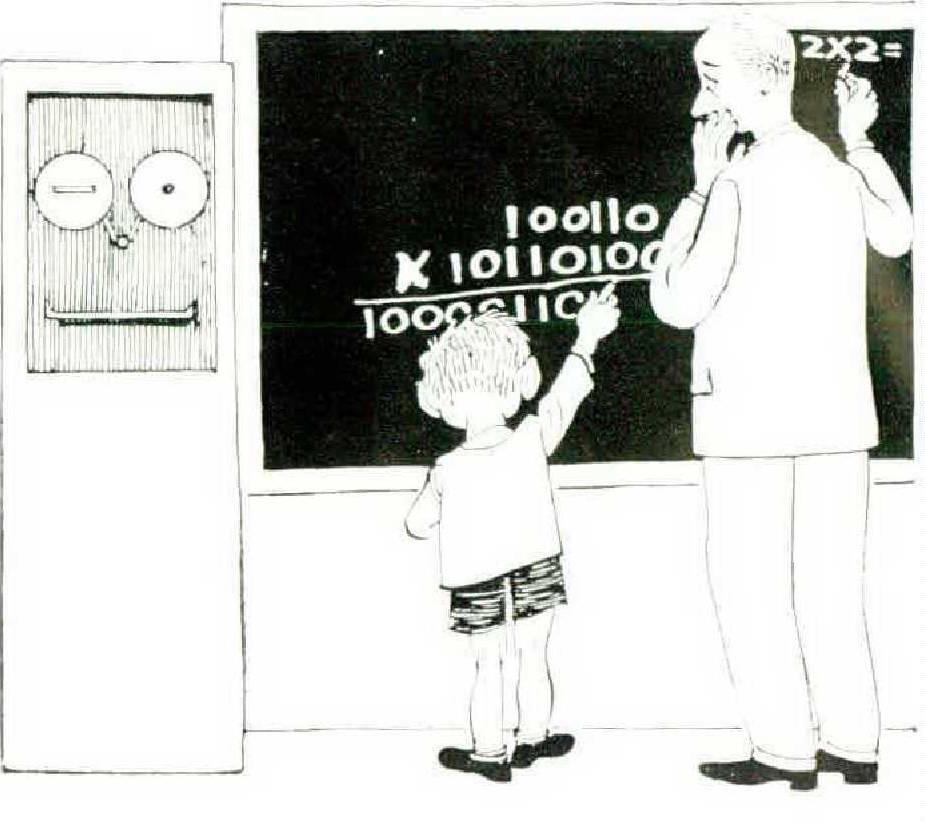
5 X 3 = 1111
A graduate of the University of Nebraska, VOLTA TORREY is the author of many magazine articles and is editor of the TKCHNOLOGY REVIEW, alumni publication of the Massachusetts Institute of Technology.
Generations of schoolboys have resisted learning the multiplication table, but teachers have gone on beating it into their tender minds. Machines have metallic memories, and they are tougher. Machines, too, have balked at memorizing the times table and in a single generation have won the privilege of skipping eight tenths of it.
This victory has made the current generation of mathematical computers mightier and haughtier than people. A Japanese schoolboy with an abacus can no longer shame them. T he machines are beginning to read and write English now. and pretty soon they may grab all the easy jobs. People then will have to take on difficult tasks or have nothing to do.
The prospect is grim, but belorc screaming about it, we should, as is customary, recall the problem’s origin. development, and environment. Thus, we may bring it into perspective. isolate its nucleus, determine its parameters, and possibly gain insight into what’s going on.
Harvard unveiled the first really colossal number mill in 1944. Professor Howard H. Aiken had resented having to spend a year on the computations needed to clinch his doctorate. Being a lazy fellow, he told the press, he had consequently conceived a way of avoiding more such work by building a machine. At his urging, the International Business Machines Corporation had assembled a 35-ton maze of wires, wheels, red lights, and reels of paper that could solve mathematical problems a hundred times as fast as a man.
That machine was considered a marvelous laborsaving device in those days, but its successors have made many young fellows work terribly hard and are threatening to lure others into tackling even bigger jobs in the future.
Compared with today’s computers, Aiken’s giant was a slowpoke. The 1962 models perform operations in millionths of a second that it took his machine whole seconds to do. But Aiken’s robot was an honest workman that operated the way people do. It dealt with 0’s, 1’s, 2’s, 3’s, and so forth, like a cash register. Big computers no longer do that.
For example, instead of multiplying 5 by 3 and getting 15, they multiply 101 by 11 and get 1111. which is 15 in the new lingo that the engineers have been persuaded to let machines use. They don’t need the 2s, 3s, 4s, 5s, 6s, 7s, 8s. and 9s with which schoolchildren arc still encumbered. If you give a member of the present generation of digital computers a problem containing these svmbols, it will instantly substitute numbers consisting wholly of 0’s and 1’s and. bingo, it will have the a nswer.
But is this cricket? Schoolboys being forced to memorize the times table have a right to doubt it. I here are no such fetters on machines, They are allowed to count by twos, as if they had only thumbs, and this makes matters relatively simple. In their world our 0 is still 0, but 1 is OF 2 is 10. 3 is 11. 4 becomes 100, 5 is 101. 6 is 110. 1 is 111. B becomes 1000. 9 is 1001. 10 is 1010. 11 is 101 F 12 is 1100. 13 is 1101. 14 is 1110. 15 is 1111. 16 becomes 10000, and so on and on.
These numbers become long faster than ours do, but remain easy to manipulate because they have only O’s and 1’s in them. All you have to know to multiply this kind of number is that 0 times 0 is 0, 1 times 0 is 0. and 1 times 1 is 1.
Suppose, for example, that your teacher asked you to multiply 5 by 3 and would let you do it the way IBM machines do. You could proceed like this, without ever having seen a table ol 3’s or 5’s:
101 11 101 101 1111
That 1111. as you have seen, is 1 5 in computcrland. This kind of arithmetic is called binary, and any child could master it in a jiffy if his mind weren’t cluttered with the old-fashioned kind. Why should we let machines. but not schoolchildren, get away with such easy figuring? Some smart kids are beginning to wonder. But this isn’t the only embarrassing question that teachers soon will have to face. The machines are being permitted to read and write without first learning to draw an A, B, or G.
In the cradles where the machines are coddled, 001 can stand for A, 010 for B, 01 1 for G, and so on; and such combinations of only two symbols can be distinguished from numbers by placing some other arrangements of 0’s and 1‘s in front of them to show that they stand for letters of the alphabet. This is actually being done.
The engineers who have let the robots take these shortcuts to the three R’s have not been as tough in dealing with machines as parents and teachers have been with youngsters. T he machines have been even more obstinately opposed to learning than the laziest children - and their supervisors have let them do hard things the easy way. If the computers weren’t so pampered, boys and girls might not have so much homework.
A close scrutiny of the mess children are in suggests, in fact, that happier days may lie ahead. The next generation of computers is likely to speak, as well as use electric typewriters. Being sassed by a child is bad enough, but being bawled out by a computer that doesn’t mind its tongue may exhaust the engineers’ patience and prompt them to crack down on these gadgets the way grown-ups always have on children. Then the machines really will have to think to stay ahead.
Educators, too, can be counted on to make life rougher lor computers than for children by staling problems badly. Possibly even the College Entrance Examination Board will come up with questions that make so little sense that they cannot possibly be answered by anyone or anything taking binary shortcuts.