Manners and Morals of the Auction Room
I ESLIE A. HYAM is president of Parke-Bernet Galleries, Inc., of New York, where alt sorts of financial records were recently broken at an auction of paintings.
In the course of the urban auction year (which isn’t a year, but a short-weight package of some eight months), we entertain a multitude of customers at Parke-Bernet; often, on a Saturday, as many as three thousand of the propertied classes and their advisers, heirs, and assigns. I say “entertain" because public auction partakes of the character of social conversazione, gambling rooms, and theater. And it would be unfair not to add that the customers, in turn, frequently entertain us.
This is not an anthropological treatise on the auctiongoer, whose long ancestry goes back, if not to the Peking man, at least to Roman times; but a few observations on his characteristics may not be amiss. He is the flower of his species, for he not only has money to spend but is willing to lay it out in the purchase of artifacts, some of which have no conceivable use, and little aesthetic quality either, like the horrendous art glass of 1890 to 1915, currently being collected at fantastic prices, lie is stimulated, and sometimes made acutely nervous, by competitive bidding; and he is fairly convinced that his private treasures are vastly superior to any that we can set before him — his Picasso is better than the one we have on exhibition this week, or our paperweights cannot hold a candle to his father’s. I heard one collector who came to an exhibition deliver deprecatory comments on no less than twelve out of twenty-odd paintings that we sold a few days later for over a million and a half dollars.
The customer is anxious to buy bargains. He hates to start the bidding, and sometimes cuts his bids, but it must be understood that this is because he is shrewd, not penurious. And he cannot stay away from the auction room too long, for going to auctions is habit-forming, and there is no known cure. A true story of the great blizzard of 1961 will serve to illustrate.
By midmorning of Saturday. February 4, some fourteen inches of snow had fallen on New York. Two of our auctioneers were marooned in Westchester; another had left Queens hours earlier and had not been heard from. A few hardy customers had trickled in, and at 1:45 the little sale known as McKinnon et al was due to begin. Cars had just been ordered off the streets, and the mayor had declared a state of emergency. Should the show go on?
Divided counsels crackled over the telephone wires. For years we had known that snow had not hampered auction sales, but, face to face with millions of cubic yards of the stuff, we were not sure that the customers would know their parts. However, the galleries reported a few visitors chatting normally, and one of our officials had even been invited to lunch by a duchess. This somehow seemed to show that the ship was on an even keel. People were phoning in to inquire if we were going on with the sale. Our Queens auctioneer staggered in, having spent the entire morning in the subway. The decision was made to go ahead with McKinnon et al.
The rest is, if not history, at least of minor sociological interest. By 2:30 the salesroom was jammed; by 3:00. the balcony full. Some ladies arrived on skis, which they parked with our astonished doorman at the front door. Everybody expressed dismay at seeing all the other bargain hunters present. Over a thousand people attended, and the session went six thousand dollars above the estimate.
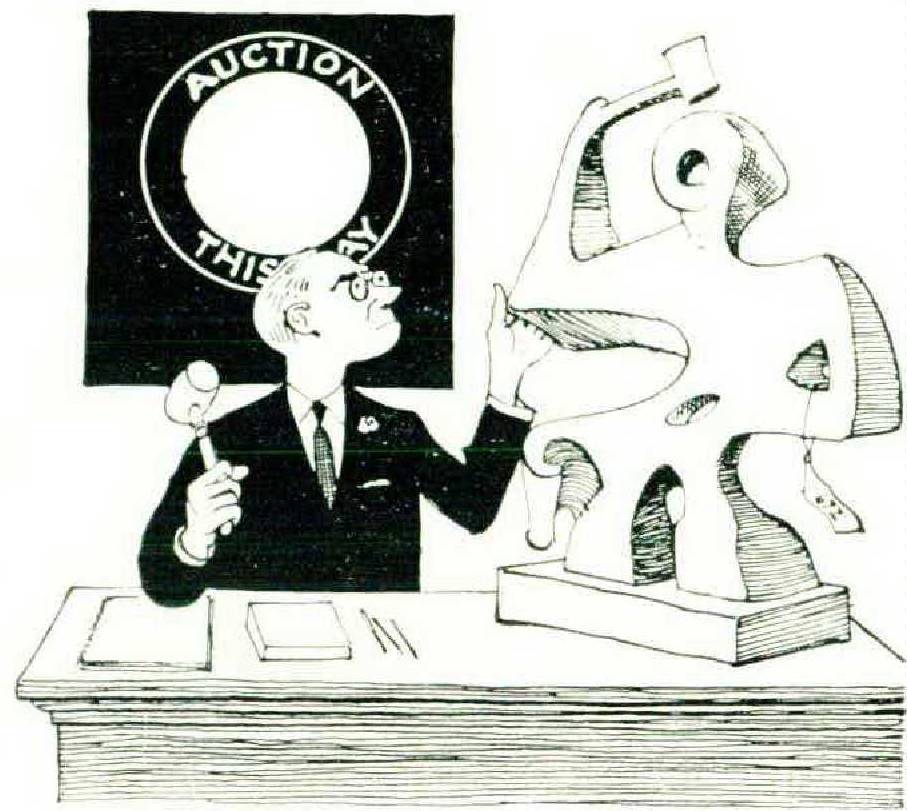
If we possessed the rhetorical skill of the creator of Br’cr Rabbit, we would undoubtedly try to draw a moral. Is English furniture worth more during a snowstorm? Is one part of the human race always trying to steal a march on its neighbors? Is auctiongoing a compulsion neurosis? Do cats eat bats? None of these profound questions has been resolved by McKinnon et al, now a leading case on the statute books. But let us at least think more kindly of the humble blizzard, that unsung catalyst of personal enterprise.
At Parke-Bernet, there are certain restrictions on the behavior of our guests. They cannot bring into the salesroom dogs, cats, parrots, or goldfish; neither can they consume luncheon, even surreptitiously, or smoke. They may not chatter loudly enough to attract the auctioneer’s attention (an invariable habit among the dealers at jewelry sales) but are expected to laugh politely at the standard rostrum jokes, which are five in number. Gentlemen must remove their hats, and children under bidding age must remain close to their mothers and not climb on things. Bidding may be conducted by nods, winks, scratching one’s nose, or any other signal arranged with our attendants, who will be surprised by nothing. For example, in a sale of eighteenth-century French furniture, a dealer, standing near the door, had arranged to bid by unbuttoning his overcoat, buttoning it again when he wished to stop. Anxious to acquire a Louis XVI sofa, he opened the garment, and then, in the middle of the bidding, saw someone outside to whom he urgently wished to speak. He departed. and our attendant continued to bid for him, so that when he returned, he had secured the piece at an uncomfortably high price. The ensuing argument as to whether an unbuttoned coat no longer in the room is, philosophically speaking, still unbuttoned in esse was worthy of Bishop Berkeley.
After a successful bid, the customer is asked to sign a card, and if he welshes on his offer, he is not invited back to the party. Either husband or wife may bid, but not both simultaneously; and if the little woman buys something and her husband doesn’t like it when she gets it home, she is not permitted to return it the next day on an invented pretext. There are, of course, exceptions. Many years ago, in a sale of Spanish furniture, a wrought-iron pulpit some seven feet high was put up for sale. The auctioneer descended in search of an opening bid until he had reached fifty dollars, at which figure a little woman put up her hand and bought the piece. The next day her husband appeared, in a towering rage, and refused to pay for it. It seems that his wife had thought that it would be pleasant for him to sit and meditate in the pulpit after dinner. Sympathetically, we took it off his bill, and we have not seen the lady again.
We are very insistent that people know we are not a department store and do not own the merchandise that we as agents sell for our consignors, so that our conception of service does not include the premise that the customer is always right. In fact, we are rather prone to assume that he is generally wrong and trying to pull something. By and large, however, people are honest, even when there is no written record of their transactions; and we, who have to print all our opinions in black and white, are even more honest, and a great deal more careful. We do business for cash, and conjugate the verb “to pay” only in the present and past tenses. In dealing with the rich, who in the main have an offhand attitude toward invoices, we have realized the need for a program of higher education, which we have pursued with tenacity. As a result, we have a large class of graduates who settle their bills cheerfully and promptly.
It is customary to sum up, but human behavior does not lend itself easily to neat conclusions. The customer, it must be admitted, has met our advances more than halfway. As for ourselves, we are pleased and rather proud that people generally understand what we are trying to do with our painstaking catalogue descriptions and exhibitions and our elaborately equipped sales theater. We abhor the spirit of caveat emptor, and, for good measure, belong to the Better Business Bureau and go to church regularly.