Undiplomatic Correspondence
RUTH KRONMANis a suburban wife, mother, teacher, and researcher. She lives in Tuckahoe, New York.
My fault lay in disobeying George Washington’s advice. And as a result, my two young Americans find themselves in entangling alliances from which there seems to be no retreat.
They are innocent victims of a myth accepted by well-meaning people whose solution to international problems is Understanding. Understanding what? Oh, having exchange students, person-to-person contacts, people getting to know one another as human beings. I accepted the myth, and, innocent myself, encouraged my children to international amity.
The big problem is Nigeria. Some years ago, when our daughter was in high school, she found a notice in a student periodical, calling hopefully for an American correspondent: young man, aged eighteen, exchange information, Lagos, Nigeria. All M. needed was some encouragement from me, and off went the first letter: I am an American girl, sixteen years old, in my third year at high school, and I am much interested in your country. The first of the little blue thin airmail letters arrived in haste: I am a Nigerian boy, eighteen years old.... In quaint English, a host of details followed — height, weight, complexion, color of eyes, members of family. Send me a picture? It might have been a request for a driver’s license. M. was disappointed, but I explained that international understanding takes time; one must become personally acquainted first. She had the faith of the young, so she included a picture in her letter and a lot of leading questions — conditions, educational opportunities, interests, and so forth. The answer was prompt: I do not have fine picture to send. But I will tell you of myself. And he told. He went on: I like very much the American T-shirt, white.
So off went M. with her babysitting dollars and bought three Tshirts, at a bargain. There are no bargains in the U.S. post office. Airmail would have cost about seven dollars, so the shirts left by slow boat to Africa for a little less than three dollars. But eventually they arrived, because a thank-you letter came in which M. Raba said he liked the shirts very much, he had a birthday in two months, and he also liked sport shirts, size medium.
M. never answered that one, and she considered the episode finished.
In the meantime, the local French teacher became interested in international amity, and our son, L., came home with the name and address of a French girl. L. has a total aversion to correspondence, but this was an assignment. Dutifully he wrote. She wrote. He did not write. She wrote. She sent a picture, of a pretty girl on the luscious side, and he was forced to acknowledge it. She answered, correcting his French. He did not write. She sent a book of pictures of Paris, and a birthday card for the name day she chose for him. After considerable nagging and considerable delay, he sent a brief note saying he was a poor correspondent and was going away for the summer. The response was a record in French and her summer address. In the fall she sent another record, and a fear of creating an international scandal made him send her two records, which prompted a return letter, at once. She included a new photograph, bigger. She had lost weight. Even this fact did not help overcome L.’s epistolary reluctance. I doubt that he would have written to Brigitte B. But I intervened: Have you written to Hélène? Don’t press me, he said.
Our relations with France worry me. Algeria, the new franc, the thing with Yves Montand and Marilyn Monroe — and now add L. Hèlène sent him a Christmas card; sent us, his parents, one also. Then she sent him a letter opener with a little Eiffel Tower on it. You must,
I said. Lay off, Ma. He is determined to maintain a policy of strict isolation. Her next letter asked, Are you angry?
What can I do! We remain with the shattered illusion that French girls are not so aggressive as American ones. And we remain with a very touchy situation. We plan a trip to France this summer, and what will I do if I meet Hèlène?
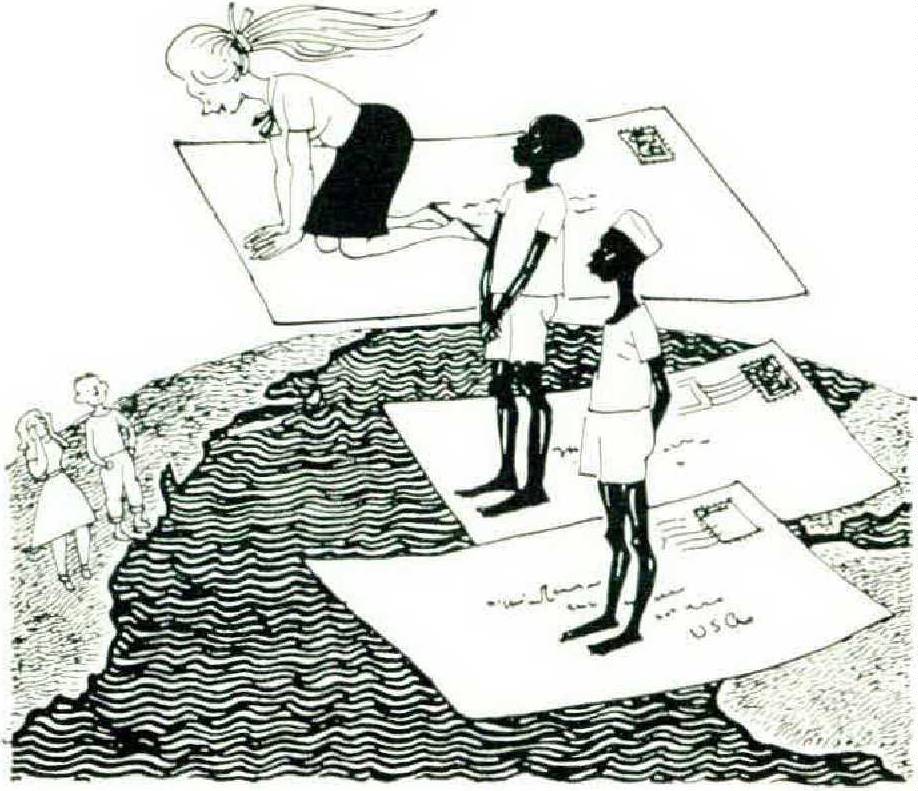
Things are not so good in the African affairs department either.
After months of blessed silence, M. again received one of those skinny blue folded airmail letters. I am young Nigerian boy. I have been given your name by my friend M. Raba. How are you and your dear family? (They all seem to be concerned for the family — French, Africans. . . .) I am eighteen years old, and I like very much the American T-shirts and would like to exchange for anything you ask.
M. decided against the export of any more T-shirts and dropped the letter into the wastebasket.
One day we hit the jackpot — two of the thin blue international airmail letters in one mail. Hélène wrote: Dear L., Are you still angry with me? Tell me what I have done, and remember me to your dear parents and sister, and all my love to you, dear L. And a new Nigerian. A young nation needs persistent and determined youths who know what they want. Nigeria has them. They want T-shirts. Our wastebasket was once more heavy with the destruction of Nigerian hopes.
Then, just recently, a little thin blue letter arrived, and there was the Nigerian stamp again. Not again, I cried, not more of the American T-shirt. I was wrong. Nothing as simple as a T-shirt M. showed me the letter, and here it is:
DEAR M..
How are you and your dear people at home? In fact I am yet unknown to you, but as time goes by you will find me very nice in deed.
You have been introduced to me by your former friend. M. Raba of Lagos.
He told me that Iyou are very nice and responsible.
I hope to come to New York very soon, I shall be glad if you can be replying all my letters. More over, I once had a friend in Nevada who wrote only three letters and stopped to write. I do not like that. I shall expect your photo and your full introduction.
So much for now until I see your picture and reply
Love,
O.
The question is, what does M. do now? Not to answer would endanger relations further; and to answer — well, diplomacy was never easy. Look at the UN. As for me, I am rereading Washington’s advice, and will take it seriously from here on. Unless it’s too late.