May 1962
In This Issue
Explore the May 1962 print edition below. Or to discover more writing from the pages of The Atlantic, browse the full archive.
Articles
Robert Frost: His Own Tradition
The eminent American poet, Robert Frost, who has four times been awarded the Pulitzer Prize for poetry, celebrated his eighty-eighth birthday in March with the publication of a collection of new poems, thus marking an event of great literary importance. For an evaluation of IN THE CLEARING, Mr. Frost’s first collection in fifteen years, we turn to PETER DAVISON, a member of the staff of the Atlantic Monthly Press since 1956.
The Summer of 1914
S. L. A. MARSHALL, who served for forty years in the United States Army, is one of this country’s foremost military specialists. He was the youngest second lieutenant during World War I, became a combat historian with the rank of colonel in World War II, and as a brigadier general was infantry operations analyst in Korea. From his experience he is well qualified to appraise Barbara W. Tuchman’s widely heralded book, THE GUNS OF AUGUST, published by Macmillan.
The Horst Commercial
Undiplomatic Correspondence
RUTH KRONMANis a suburban wife, mother, teacher, and researcher. She lives in Tuckahoe, New York.
A Poorer Mousetrap
Light Up and Live!
ANNE KELLEY lives in Evanston, Illinois, and is a frequent contributor to the pages of Accent on Living.
Gambia: The Colony Nobody Knows
They Shall Have Music
The Peripatetic Reviewer
Reader's Choice
Potpourri
The Atlantic Report on the World Today: Washington
East Africa
Latin America
Laos
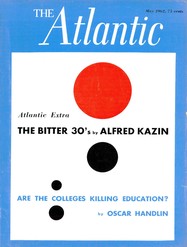
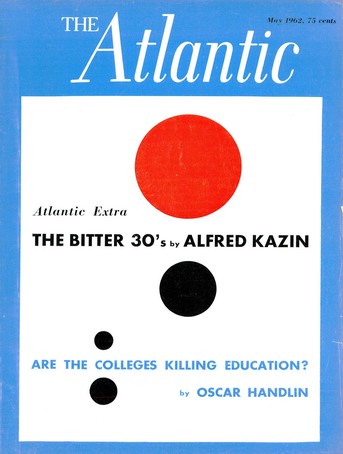
Are the Colleges Killing Education?
A professor of history at Harvard who has achieved national eminence for his study of the immigrant in America, OSCAR HANDLINwas awarded the Pulitzer Prize in history for his bookTHE UPROOTEDin 1952. As a teacher, Mr. Handlin is concerned about the stifling competitive atmosphere in the colleges, where emphasis on grades lends to destroy the broader educational values.
The Nuclear Age
In his famous book u.s. FOREIGN POLICY, which did so much to reshape the thinking of millions of Americans during World War II, WALTER LIPPMANN first pul forward the concept of the Atlantic community. In this paper he speaks of the only way in which he believes this community can effectively be strengthened.
The Empty Night
In 1955, Alfred A. Knopf published a book of short stories, THE BLACK PRINCE, which introduced a writer of original talent, SHIRLEY ANN GRAU. Since that time, Miss Grau has written two novels, THE: HARD BLUE: SKY and THE HOUSE ON COLISEUM STREET,and her stories have been reprinted in the O. Henry and Martha Foley collections.
The Tea Party
But What's a Dictionary For?
BERGEN EVANS, professor of English at Northwestern University, is known to a wide television and radio audience as one of our liveliest lexicographers and literary controversialists. He takes up, in the article that follows, the defense of WEBSTER’S THIRD NEW INTERNATIONAL DICTIONARY,which was assailed by Wilson Eollett in the January ATLANTIC.
Murder Trial in Moscow
Before taking his present post as assistant professor of political science at the University of Chicago, JEREMY R. YZRAEL was associated with Harvard’s Russian Research Center. In 1958, while he teas an exchange fellow at Moscow State University, he and his wife attended the trial here described.
Sugar-Loaf
Strange Interlude: Edward Viii's Brief Reign
KINGSLEY MARTINhas been studying the influence of the British monarchy ever since he became editor of the NEW STATESMAN AND NATION in 1934. He stood in a close relationship with Edward VIII at the time of the abdication, as is clear from the account which follows. In the June ATLANTIC Mr. Martin will describe the high cost of monarchy
The Pures
WILLIAM J. J. GORDON is a lecturer in the Engineering Department of Applied Physics at Harvard. He is also President of Synectics, Inc., a consulting firm primarily concerned with augmenting the creative output of industrial research organizations. The following story is clearly the outgrowth of his own immediate experience.
Bliss Sleeps
The Bitter 30's: From a Personal History
One of the ranking literary critics in America, ALFRED KAZIN Was educated at the College of the City of New York. He began his literary career as a book reviewer for the NEW REPUBLIC in the hot, desperate summer of 1934. Here he tells of his coming of age in the Depression and of the excitement, aspiration, and loneliness which beset him by turns during this revolutionary period. A collection of his critical essays, CONTEMPORARIES, appears this month under the Atlantic-Little, Brown imprint.