Always Worse Than I Had Thought
Nothing is so embarrassing to a journalist as the reminder, repeated again and again, that in some of his most fondly conceived ventures into the realm of controversy over the years, he proved to be no more than naïve. It is obviously better to be quiet than to go on documenting one‘s own greenness, but such is the allure of print that the journalist continues to write, perhaps in the subconscious hope of finding readers more naïve than himself. The greenness may not in itself be ruinous; it may be quite inconspicuous; but the gap between his conjecture and the reality in a given case might well suggest to the journalist that he ought to consider getting into some other line of work.
Near the head of the list of my own embarrassments is a short piece I wrote some years ago about college fraternities. I had long wondered why undergraduates in a local chapter were willing to pay substantial dues to a national organization having little or no connection with the college and offering benefits which seemed few or nonexistent.
It was plain that the permanent paid staff of the national organization enjoyed certain benefits from the arrangement — that is, they had their jobs — but the whole thing looked like an exercise in selfperpetuation: recruiting dues payers in order to pay the staff to recruit each year a new bloc of dues payers.
On the chance that other beneficiaries of the system might be found, I conjectured, facetiously, that these might be in the fraternity pin game — dealers in seed pearls and chip diamonds, I suggested, and manufacturing jewelers. It all seemed to me a harmless romp. Not long afterward, I read some very lively news accounts of what the Interfraternity Council proposed to do to college presidents who objected to racial and religious discrimination in the constitutions of certain national fraternities. It was none of the college president’s business, so the argument ran, and the alumni should be induced to rid the college of any such meddler. The strongest voice to this effect, I found, came from a highly placed member of the council who was also one of the foremost manufacturers of fraternity pins.
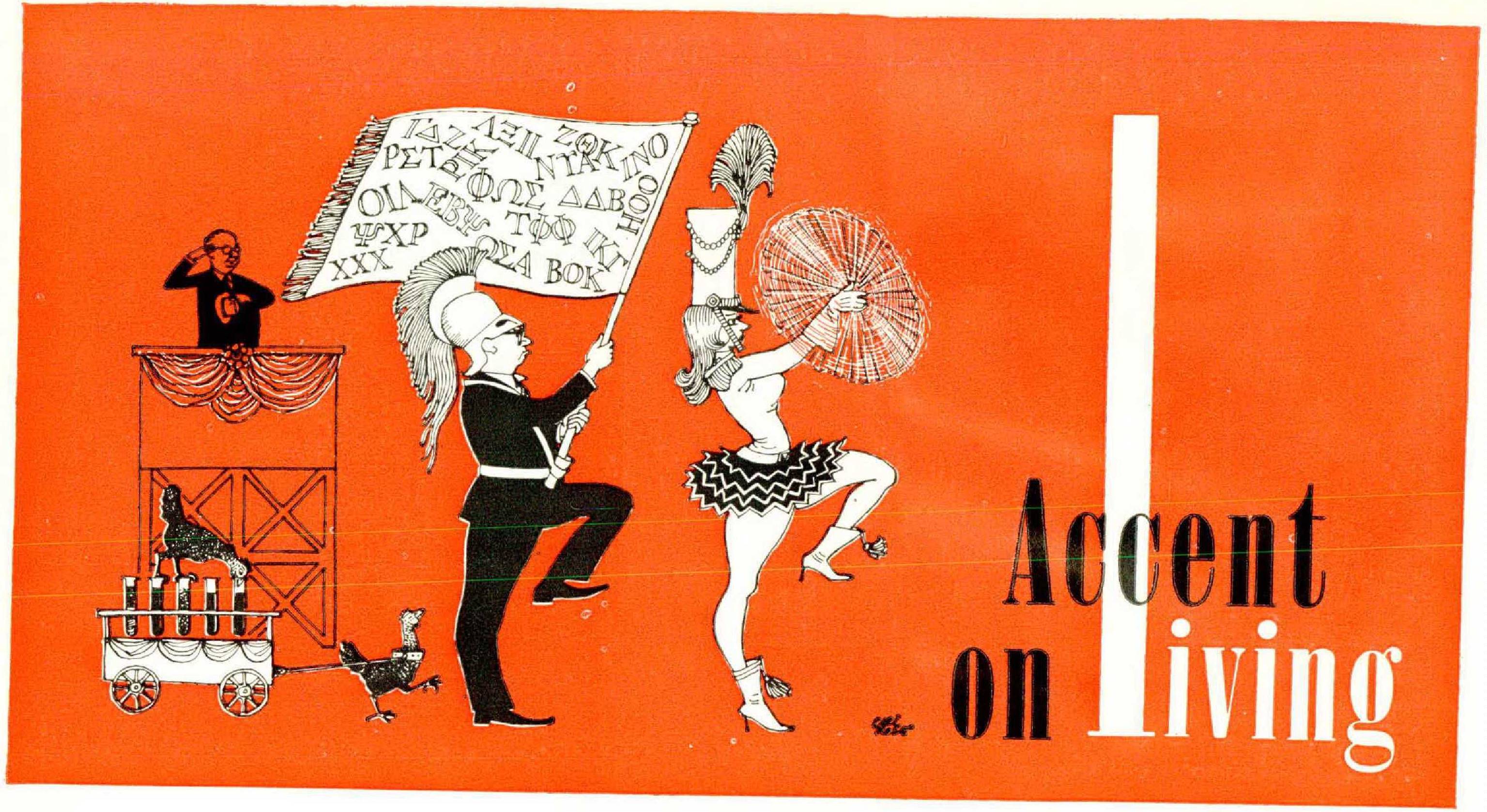
Far shorter of the mark were my attempts at various times to toss a few gibes at fake “scholarships” for college football players and athletes in general, and to twit the schools of education on some of their curricular peculiarities. I once wrote a piece about drum majorettes and baton twirling, and in a wild burst of fancy, went so far as to envision courses in baton twirling which would lead, inevitably, to additional courses in how to teach teachers of baton twirling.
Little did I realize the interrelationship of these disciplines, to borrow the term from the educationists, or their phenomenal rate of proliferation. No sooner would I make some cautious sally at the professionalism of the athletes than a player would apply, successfully, for workmen‘s compensation for injuries sustained in a football game; baton twirling expanded into flaming-torch twirling, and there are more majorettes than spectators; as to the schools of education, it has come to pass in many areas that “physical education” is just as good as any other kind of education. A student can take “phys. ed.” courses without having to endure the frills of algebra or history or English, and on his graduation he can become a coach or even a school principal.
Another broad miss occurred last year when I took on the subject of battery-reared, frozen poultry and our attempts to export it to Europe. My point was that the stuff is unattractive and that selling it overseas would impair our national image, provided we still have one, among Europeans. I learned subsequently that de-beaked battery broilers, frozen, were in production all over Europe and the British Isles; that the once renowned beef of Scotland is now somewhat de-flavored by a barley diet on the feedlot for premarket fattening; that pigs are raised in an air-conditioned prison on a liquid diet without ever seeing the natural light ot day; that the preparation of a calf for the veal market is even more mechanistic; and that vast studies are going on with a view to increasing the per-acre yield of lamb. It was only about a year ago that I was writing happily about lamb being the one animal that could scrounge its proper diet so cheaply that no one could make a profit by interfering with it. Full circle once again.