Footloose in Prague: A Marxist Bohemia
CURTIS CATE, who represents the ATLANTIC in Paris, served with the American Army in Czechoslovakia at the end of the Second World War. Last June he returned to Prague for the first time since 1945. Here is what he saw and heard.
I FOUND Prague stuffed full of tramcars and buses. The trams were for its million-odd inhabitants, few of whom possess a car; the buses were for the tourists flowing in in droves from Hungary, Poland, East Germany, Bulgaria, and other Iron Curtain countries. They absorbed the parking spaces in front of the hotels; they blocked traffic in the narrow streets, which they filled with squid-ink diesel fumes; they were drawn up in platoons in the square outside the Royal Palace on the hill overlooking the city.
This was early summer, and the tourist flood was at its height. For Prague has become a tourist mecca for the Iron Curtain countries. Unlike Berlin or Warsaw or Dresden or Budapest, it miraculously escaped destruction during the last war. I say miraculously because at the very last moment it looked as though it might go the way of Warsaw. In April of 1945 the people of Prague rose in revolt and seized the radio station. The SS units in the neighborhood would have liked to put the rebellious city to fire and sword but were unexpectedly prevented from doing so by Russian troops not of the Red Army, advancing painfully from the East, but from one of the divisions raised by General Vlassov to fight with the Germans against Stalin. Their commander must have hoped that by helping to save Prague he would gain a measure of clemency from the Allies; in this he was grievously mistaken, for most of these men were subsequently turned over to the Red Army and executed by firing squads as turncoats and traitors.
Finding a hotel room in this unravaged cynosure posed quite a problem. Fortunately I was assisted by a painter who had driven with me to Prague and who kindly offered to do the rounds. At one of our first ports of call, the Ambassador Hotel on Wenceslaus Square, he struck up a conversation with two Hungarians, a young boy and girl who were in evident distress. They spoke no Czech, and the painter, whose mother was of Hungarian origin, offered to interpret for them.
“No room, no room!” repeated the hotel clerk, a spidery little man in horn-rimmed glasses.
“But they say they have reservations,” insisted the painter.
“No reservations,” cried the spidery clerk in an obstinate tone. He made a show of reading down the page of the registry, covered with a chaotic maze of crossed-out names. “No reservations, do you understand?” He shook his head with emphasis and peered over the tops of his spectacles. “These people are unknown, strangers. Tell them to go elsewhere.”
The altercation went on for five minutes and was resolved only when the painter whispered something into the ear of the Hungarian. The boy pulled out a passport and slipped a twenty-crown note between the pages before handing it across the counter.
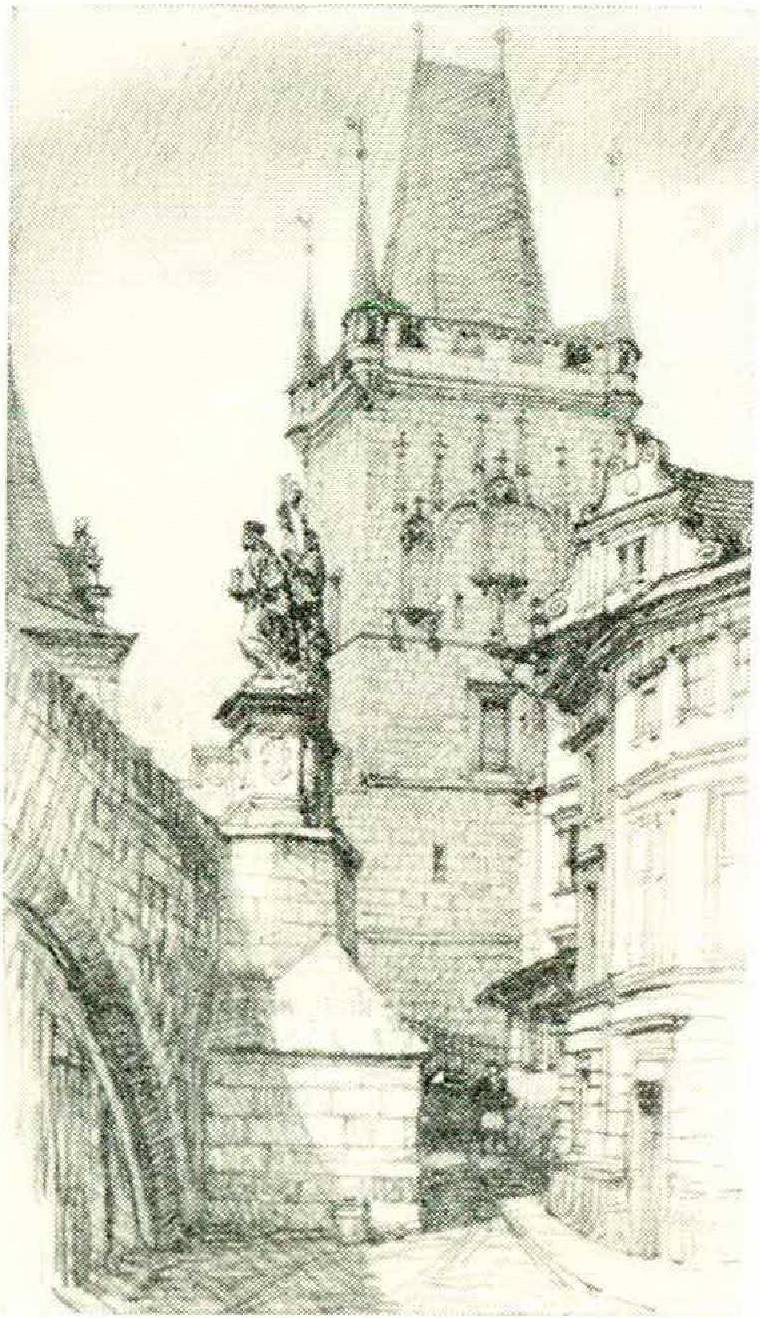
Sketch of theMalá Strana end of the Charles Bridge, Prague.
“Vadas?” cried the spidery clerk, opening the passport. A sudden light of recognition blazed in his rapacious eye. “Of course. Yes . . . we do have a reservation.” But he offered no apology to the bewildered couple.
“That’s socialism for you,” remarked the painter in a tone of disgust as we walked out of the hotel. “Selling reservations made through regular channels by the official tourist organization! The kind of thing they said could happen only under capitalism. And did you notice? It wasn’t some capitalist from the West he was milking; it was someone from a fellow socialist country.”
After trying a dozen hotels, I finally found a room in a dubious hostelry not far from the old Powder Gate, above whose Gothic archway gunpowder used to be stored in the late Middle Ages. The hotel had no proper entrance, only a sign running down the facade which spelled out the word HYBERNIA; directly below was a broad passageway, bordered by shops, which led through to a Moravian vinarna, or wine tavern, where buxom couples could be seen in the evenings drinking and occasionally rocking to the music of an accordion. The lobby, situated to the left, was simply a crooked extension of the passageway, and recognizable only because it boasted a couple of couches and a glass cage where the passports were taken and room keys hung. To get to the breakfast room one had to climb a back staircase past several parked bicycles, and cross an empty dance hall, where a band thumped and tootled far into every hot night.
It was obviously a second-rate establishment, catering for some reason to second-class Soviet citizens, but I was in no mood to quibble; and the manager, who seemed surprised to see an American in such a risky milieu, was kind enough to give me a room with two beds as well as a private bath, which I didn’t need to be told was a luxury. Each day, walking down the canvas-matted corridors, I would encounter new faces speaking in the flat nasal accent characteristic of Soviet speech, but the manager would take an officious delight in greeting me: “Well, Mr. Cate, and what are you going to see today?” And to humor him, I would mention some prominent landmark – for I had, after all, come in on a tourist visa and thought it best to make a show of respecting my calling. “But you are a journalist?” he would say every now and again, hoping to trip me as he hung up the room key, and I would invariably reply, “No, I’m an editor.” I’m certain he wasn’t taken in for a moment, but since it was his job to keep track of my doings, I felt it would be unfair to facilitate his task.
We kept up this game for more than a week, by the end of which I began to feel like a permanent fixture, like a wayward barnacle obstinately clinging to these shabby walls amid the ebb and flow of transient bodies. In the morning, when I pulled back the curtains from the double windows, the cooks working in white toques on an upper floor opposite would flock to the windows and point, as though I were something that had just been unveiled.
Why, I had no idea. There was something impalpable and absurdly Kafkaesque about the whole situation. An eight-day client was evidently an unheard-of anomaly, but whether this was because no Russian was ever allowed to stay for more than a couple of days or because no Westerner was expected to stick it out for more than a couple of nights I never did discover. But I had the definite impression when the manager finally informed me with “great regret” that he really had to have my room to be able to absorb next Monday’s tidal wave, that it was also because of an uneasy feeling that someone who showed so little desire to move from such seedy surroundings must be a genuine subversive.
FOR a stranger arriving from Warsaw or Sofia or Smolensk, Prague, I suppose, must seem a radiant city. No amount of drabness can smother the perennial beauty of the Hradcany, the mighty palacefortress which dominates the Moldau’s western bank, a structure so vast that it houses an entire cathedral within its walls. No dose of monotony can rob the Charles Bridge, with its three Gothic towers and its baroque saints, of its rambling magnificence; just as no amount of revolutionary upheaval has been able to undermine the picturesqueness of the Malá Strana – the “small side” or “little city” – wedged in between the river, the castle heights, and the Strahov and Petrin hills, that enchanting quarter whose steep, narrow streets are crammed with enough palaces to make old Prague the finest baroque city in Europe.
Yet I found Prague depressing. The first two days of my stay were windless, and the air was heavy with the smell of coal being burned in the power stations in the suburbs. The odor, mingled with diesel smoke and exhaust fumes from the fleet of antiquated cars put-putting through the streets, followed one everywhere, like an olfactory accompaniment to the soot-gray leitmotiv of the buildings. Gray, indeed, seemed to be the predominant color of the city. The streets, so badly swept that a couple of months earlier angry articles were being published in the papers to denounce the scandal, were gray, the shopwindows were gray, and even the faces seemed to have something gray and unsmiling about them.
It is possible that this may already have been the case in the twilight years immediately preceding the First World War when Kafka lived here. There is something gray and limbolike about most of his writings which may well derive from some intangible quality in the city as much as from his depressing contacts with Hapsburg officialdom and his own preoccupations with the ancestral neuroses of the ghetto Jewry. Certainly the Czechs, in contrast to the Hungarians and Rumanians, have never been noted for a native exuberance; and if there is one flagrant misnomer in the etymological book, it is the raggle-taggle slovenliness we customarily ascribe to the words “bohemia” and “bohemians.” The original inhabitants of this part of the world were the Boii, a Celtic tribe which began to be displaced around the first century of our era by the Slavic Czechs; the old name, in its Romanized form, has survived down to the present day, rubbing off in the course of many centuries on the Gypsies as they trekked through central Europe on the interminable exodus which took them from India and Egypt to Hungary and Spain.
Certainly no people could be accused of being less flighty and carefree than the pragmatic, industrious, down-to-earth Czechs. I was about to add “sober,” though this is perhaps going too far. For the joie de vivre in Bohemia was always a joie de boire — not wine, which quickens the spirit, but beer, which thickens the tongue. For if it is true, as an American has written, that one is what one eats, it is no less true that one is what one drinks. The same soddenness that marks the beer-drinking Bavarians inhabits the beer-drinking Czechs whose genius for brewing hops has given us two of our greatest brand names, Pilsen and Budweiser (the German form of Ceske Budejovice in southern Bohemia) – only with this important difference: the Czechs, for centuries a subject people subordinated to a Germanic ruling class, have none of the aggressive boisterousness or wild romanticism characteristic of the Bavarians. Prague has nothing comparable to Munich’s Hofbrauhaus, just as Bohemia has never produced an Adolf Hitler. U Kalicha (At the Chalice), the little tavern which Jaroslav Hasek’s Good Soldier Schweik proverbially frequented, has two tiny rooms and just eight tables, and though the red-faced topers sitting behind them are often in their cups — the best Czech beer runs to 12 percent, which is as much as most French wines — they mercifully refrain from bawling obscenities and smacking the expansive bottoms of their feminine companions. Absurd though it would be to attribute the grayness of Prague to the mind-numbing qualities of beer, it does little — unlike wine, or slivovitz, the plum brandy downed in such quantities by the Yugoslavs — to offset the drabness which characterizes all Communist cities.
THE HEIRS OF KARL MARX
It is difficult for someone who has never been behind the Iron Curtain to appreciate just what it means to try to organize a society without a bourgeoisie. When Marx wrote Das Kapital, the science of sociology was in its infancy and scholars like Werner Sombart and Max Weber had yet to darken the intellectual horizon with formidable Himalayan ranges of erudition. Hypnotized as he was by the economics of production, Marx paid all too little attention to the economics of consumption, which has proved to be every bit as important to the effective working of a modern society: above all, in the city which has, as Sombart and Weber showed, from the time of Dante’s Florence right down to the present, been as much a locus of consumption as of production. The style may have been aristocratic, but the content was bourgeois; and everything that gives the city color, vividness, and individuality — everything from pastry shops to haberdasheries, from bookshops to restaurants — is the fruit of an industrious middle class.
This was true of pre-war Prague, just as it was true of Berlin, Vienna, and Budapest, with which it enjoyed a comparable standard of living. It is no longer true of Prague today, where private ownership and the bourgeoisie have, in theory at any rate, been eliminated. Everything belongs to the State and must be run by a committee. The simplest decisions, such as choosing the color of the paper to be used in a shopwindow, have to be made by collective vote or rammed down the throats of the reluctant consensus by Party diktat.
For this is a socialist country and therefore utilitarian. Why offer fifteen kinds of soap for sale when one can get along with five? Why twelve brands of nail polish or ten brands of lipstick when one can make do with two or three? Why indeed? In a society trained to regard the law of supply and demand as a sinister capitalist invention, the sudden exhaustion of a particular product isn’t regarded as a reason for stimulating its production; it comes to be treated as a kind of accident of nature, like a drought or a flood. One’s quota is pre-established; once exhausted, one must simply wait out the interval until the time comes when the stock can be replenished. The customers in the interim must satisfy themselves with less popular products, or simply go empty-handed. An unofficial rationing system thus comes into being in countries where rationing is supposedly unknown, with the curious result that what one sees offered in shopwindows is very often precisely what cannot be sold.
A classic example is the bookshops. None of the books one sees exhibited in Prague bookshops are best sellers. When a popular book appears, it sells out in twenty-four hours. The readers know that it won’t be reissued, no matter how quickly it sells out, and since most printings run from three to live thousand, it’s a race to see who can get hold of a copy. To be in the running at all one must be tipped off in advance, so that a vast underground of confidential publishing information comes into being. The publishers, for their part, must decide what the printing figure will be and leave it at that. The figure for foreign books is likely in any case to be whittled down by some Communist committee on the grounds that Western literature is being unduly favored over domestic output. In the case of Lampedusa’s The Leopard, the committee relented to the extent of allowing 25,000 copies to be issued. The news spread like wildfire, and the day the book hit the window shelves there were queues two blocks long outside all the bookstores in Prague. Twenty-four hours later not a copy was to be had, unless one was willing to pay three times as much for a black-market copy.
Universal sloppiness thus marks merchandising as well as service. Why make the extra effort since the State is the owner and there is no personal profit to be had? Whence the general listlessness I felt everywhere I went in Czechoslovakia, with people going through the motions of work with the passive resignation of automatons. From it also derives a wastage which must, on a national scale, rise to monumental proportions. It is the blood brother to the G.I. mentality I remembered so well from the Second World War. Who cares, since no one is responsible? The government is the owner, so let the government foot the bill. The radiator in my hotel room was going full blast, though it was so hot outside that everyone was walking around in shirt sleeves. When I mentioned this to a Czech, he shook his head and said, “Go over to the railroad station. The radiators there are so hot you can’t get within a meter of them.”
These absurdities have been aggravated by what can only be called the “planned” decline of the artisan class. Marx’s heirs have, here again, gone the prophet one better. For it was one of his convictions that capitalism, through the relentless accumulation of productive resources in the hands of an oligarchy of greedy monopolists, would fatally bring on the liquidation of all small industry and enterprise, the intervention of the State being needed to save the weak from the strong. The great day dawned, the long-awaited apocalypse was ushered in with a flurry of red banners, and the Messiah-State calmly stepped into the capitalist Caesar’s shoes. Small industry was placed on the index. Why? The reason, interestingly enough, has little to do with Das Kapital, but a great deal to do with class resentment. The artisans, more so than any other members of the middle class, traditionally worked for the aristocracy. In a society which was rendered classless by a stroke of the proletarian pen it could thus be argued that there was no further need for artisans. Now a society can get along without cabinetmakers or tapissiers; it can scrape along without gardeners or even carpenters, to the extent that factory-made furniture can replace what comes out of a workshop. But a modern society cannot get along without mechanics, electricians, or plumbers. Yet such has been the mythology built up around factory production – respectably proletarian — that these other professions have been all but blacklisted.
The result is that in a highly industrialized Communist country one may have to wait weeks to have a car repaired. Tractors are delivered to collective farms without spare parts: presumably machines produced in socialist factories are so perfect they never need to be repaired. But the breakdowns occur, the machines have to be abandoned, the harvest is not all got in on time, and the first thing one knows there are bread queues in the streets and a meatless Thursday has to be introduced to camouflage the public humiliation of rationing.
One Prague apartment house I visited had an elevator struck four feet from the ground, so that no one could use it. I had to climb the stairs to the fourth floor, and when I remarked on this anomaly, the man I was visiting uttered a short laugh: “The elevator? It’s been that way for two years. We can’t find an electrician to fix it.”
THE BEATNIKS OF PRAGUE
I got the definite impression, however, that the regime’s prolonged efforts to denigrate everything capitalistic account in no small part for the extraordinary enthusiasm for all things American. Nothing is more coveted than forbidden fruit, above all in a country whose greatest industrial triumph has been the mass production of monotony. Youth is a prolonged exercise in imitation, and the quest for a pattern of behavior has here, as in so many other countries on both sides of the Iron Curtain, found its model in the James Dean. Elvis Presley, Johnny Hallyday type of hero. Blue jeans in Prague are rampant, and the word is singularly appropriate, for their Czech adopters have developed the same cowboy slouch and moccasin-dragging gait which seem to be the universal hallmark of this garb.
More surprising in a way is the passion Czech women have developed for trousers. There were times in Prague when I would have to look hard at a sidewalk throng to spy a skirt. Is it because the skirt is considered old-fashioned, part of that bourgeois way of life which has been inexorably condemned by the proletarian march of history? Or is it that the skirt is instinctively associated with household chores and the perennial domestic bondage to which, since the time of Adam, Eve has traditionally been subjected? I don‘t know, but I had the feeling that this feminine passion for pants, in the hottest months when a skirt is so much more airy, expressed the same flouting of authority, the same desire lor emancipation as the masculine cult of the blue jean, the Robin Hood hat — of which I saw an incredible long-beaked version at Karlstejn and the guitar. The absolute equality of the sexes is. of course, one of the cardinal pillars of Communist ethics, so that the right of women to wear pants is unimpeachable. But the spirit in which so many were sported seemed to me to conceal a deeper impulse, as though their wearers were saying to the authors of the 1948 revolution: “All right. You made your bed; now you must lie in it.”
One day I was driving along the western bank of the Moldau under the hill where Stalin’s statue used to stand. It had been a colossal granite affair which took six months to remove. A single dynamite charge would have sent the eighty tons roaring down the hillside onto the bridge next to which Franz Kafka‘s house stood before it was hit by an American bomb in 1944; so the work of demolition had to be done gingerly, fragment by fragment.
The Czech sitting next to me had hardly finished explaining this when he suddenly pointed ahead. Two girls were calmly walking along the embankment in mauve slacks and white T-shirts. A large black beetle adorned the back of each shirt, with the words “The Beatles” written in bold black letters beneath, They were Czech girls, and far from seeming abashed, they looked mockingly exultant in this public exhibition of smuggled goods.
The guitar, by way of contrast, does not have to be imported; it is manufactured at home, and anyone can buy one for from 1200 to 1500 crowns ($170 to $210 at the official rate of exchange). For the youth of Prague it has become a kind of status symbol, somewhat similar to what the rapier and the knob-headed cane were in bygone centuries. It represents the ultimate in avantgarde sophistication, and the mere fact that it is relatively expensive – 1500 crowns is a month’s salary for a well-paid job – only enhances its prestige. Usually three or four friends have to chip in to pay for one, cementing a bond which takes the form of an informal jazz or hillbilly group. On Sundays one can see them on all the roads leading out of Prague hitching their way in blue jeans to nearby landmarks. For hitchhiking too has become a national Czech pastime; indeed, almost an established institution in a country where only one citizen in fifty is fortunate enough to own a car. Some hitchhikers even come equipped with insurance coupons, officially issued by the State to protect drivers from possible claims in case of accident.
At Nelahozeves, Antonin Dvořák‘s birthplace, some twenty kilometers north of Prague, I saw one such group of traveling troubadours tramping around with knapsacks and mountain boots. It had been raining, and there were puddles along the roadside, but I got the impression that the boots were sported less for functional than stylistic reasons. The regime, which has relented to the extent of tolerating the fabrication of blue jeans, has yet to authorize the manufacture of cowboy boots. Mountain boots were as close as these five melodic trampers could get to the Wild West pioneer style they were so anxious to re-create.
ANOTHER hiker I picked up later in the day told me that there were forty “Big Beat” clubs in Prague. One of them had worked up such rhythmic steam about a month before that it ended up wrecking a dance hall in the purest Presley or Hallyday style. The most famous of these clubs is the BigBeat Mephisto group, which usually performs at four thirty in the afternoon in the cultured sanctuary of the Laterna Magica theater, which nightly brews its weird Czech cocktail of movie and opera. I was anxious to see how a Czech Big Beat differs from others, but unfortunately this particular group had just decamped to the provinces with its diabolical thump. Far from being taboo, as they were six years ago, such groups are now accorded an almost professional respect under the aegis of the Communist-run Union of Czechoslovakia youth, which hires the halls where they perform.
The two dance halls I did visit had bands which played almost nothing but jitterbug. In one of them, an upstairs dance hall overlooking Wenceslaus Square, a throng of young people were eating ice cream. I ordered a limonade and was brought a strange sugary drink with three greengage plums in the bottom of a tall glass. It was pink, like the ceiling. There were soldiers on leave — open collars, no ties — and young girls in cheap cotton dresses at the nearby tables. The only older people in the hall were two men who looked like workmen: a small wizened little fellow with gray hair and sunken eyes, and a hulky round-faced man in a red shirt and gray jacket. Both were smoking pencil-thin cigars and made up for their nonparticipation in the dancing by rhythmically thumping their approval of each new jitterbug.
It was an odd spectacle. Their fathers had danced the polka with much the same boisterousness. But who dances the polka today? Perhaps the Poles, but not, evidently, the Czechs, any more than do the Auvergnats. One old-timer, when asked recently by a tourist passing through his village what local dances were danced, pulled the pipe out from under his mustache and rumbled: “Dances? Oh, Monsieur, the only local dances we know around here are the twist and the madison.”
I sat there watching the young bodies being wrenched back and forth and wondering to myself how long it would be before one of those arms disconnected with a click and came clean away from its socket. The jitterbug is, with little doubt, the dance which has been most completely emptied of all erotic content; it is pure gymnastics, the partner no longer being considered as a human being but as something more like a yo-yo or marionette, thrown out and pulled back by a pulsing series of centripetal jerks. Perhaps this is one reason for its success in an increasingly mindless age. It is certainly one of our more dubious exports, even though it seems to have acquired an irresistible appeal for a world — the world behind the Iron Curtain — which is trying to reduce the human individual to the condition of a robot. It has become a new cult, one unforeseen by Marx: the opiate of the youth, if not of the masses.
Finally, after repeated prodding, the band broke into a twist. I soon understood the cause of its reluctance. The rhythm was immediately recognized as something ultranovel, daring, superAmerican, and everyone wanted to get into the act. The crush on the floor grew denser. But instead of giving way to hip-swivel oscillations, the mechanical jerks increased in dithyrambic frenzy. Only one or two couples had even a vague idea of how the twist should be danced; for the rest it was simply a supercharged Big Beat jitterbug.
When the music stopped, there was a lot of stomping and cries for more. The two workmen broke into frantic clapping, the cigars in their grinning mouths cocked at a jaunty angle. After a good deal of forehead-wiping the perspiring players at last reluctantly gave in. The shirtsleeved pianist sat down at his piano, the trumpeter picked up his trumpet, It was the same twist over again, the only one they knew.
I FOUND this enthusiasm for things American expressed on a more sophisticated level by the several writers and translators I spoke to. At the Union of Czechoslovak Writers, which boasts a club on one of Prague’s main streets — a rather dowdy establishment full of heavy maroon-felt armchairs and second-rate pastels — a bright young author told me that Salinger’s Catcher in the Rye had been a tremendous success, partly because of the excellence of the translation. Faulkner and Thomas Wolfe were well known, and John Updike’s The Centaur was to be published later in the year. Extracts from Jack Kerouac’s On the Road had been printed in Svetova Literatura (World Literature), a bimonthly literary journal devoted exclusively to the publication of foreign authors in translation. Alan Ginsburg’s Howl had been published in a monthly called Plamen (The Flame), as had Ferlinghetti’s Coney Island of the Mind and poems by William Carlos Williams and W. H. Auden. Samuel Beckett’s Endgame had been published in toto in Svtova Literatura, accompanied by a long critical study of his work. T. S. Eliot’s Four Quartets was due to appear in translation in 1965, and four volumes of Robinson Jeffers’ poetry had already been published, Jeffers having been lucky enough to find a devoted translator.
He admitted some regrettable lapses in this impressive attempt to keep abreast of Western literature. Most translations are published by the State Publishing Company, where there is just one editor for each foreign language. A book under consideration is farmed out to two or three readers (who theoretically don’t know each other), but the responsible editor is under no obligation to heed their recommendations. His own, if they are favorable, must be approved at a joint meeting of all the editors; they can always overrule him, though in practice, to avoid antagonizing colleagues, who can always veto his own favorites, each editor tends to respect the wishes of his colleague in his particular field. The final decision thus really belongs to one man. When I remarked that this could be a good or a bad thing, depending on the individual, he answered with a sad smile, “Yes, in this as in everything else,”
He cited one example to point up the weakness of the system. Peyton Place had been translated into Czech, but Lawrence Durrell’s Alexandria Quartet had failed to make the grade. It was consequently unknown in Prague. Its advocates — and I gathered that he was one of them — had tried to circumvent the veto by getting fragments published in Svetova Literatura, but Durrell had opposed any fragmentary publication of the four novels.
Enthusiasm for American works is perhaps even more pronounced in the theater. At the S. K. Neumann Theater, a suburban playhouse located in a working-class suburb which has to cater to an unsophisticated clientele, they had already given fifty-two performances of Edward Albee’s Who’s Afraid of Virginia Woolf? — rebaptized Kdopak by se Kafky bal? (“Who’s Afraid of Kafka?”). The management, under the impression that I was a personal friend of Albee’s, marshaled a small welcoming committee to greet me and seemed somewhat put out to discover that I was an illustrious nobody. They did, however, tell me that they expected to get through one hundred performances before the year was over. Though the directors still shrank from hazarding a Beckett play and though Ionesco’s Rhinoceros had been a Hop, Max Frisch and Dürrenmatt were in great demand. Most of Tennessee Williams’ plays had been successfully staged, and a second Albee play was to be put on in the winter.
The demand for Western playwrights contrasts conspicuously with the Prague public’s weariness with Soviet plays of all sorts. Even the last Brecht play staged at the Karlín theater — which, with twelve hundred seats, is the second largest in Prague — played night after night to an empty house. The theater, subsidized by the State, was losing 900.000 crowns a month until the management reluctantly switched to Friml’s light operetta Rose-Marie, which was filling the house.
“But what do you expect?” one of Prague’s best translators said to me. “We had such a surfeit of Soviet plays forced down our throats for a dozen years that this was bound to be the reaction. Besides, there just haven’t been any real good Russian plays in recent years. The last halfway decent one was by Podolin; it was put on here a couple of years ago. Since then we haven’t staged a single Russian play. The public isn’t interested, and the Russians can’t measure up to the competition from people like Tennessee Williams, Arthur Miller, and Edward Albee. After plays of this caliber, the Russian plays look stupid.”
Official criticism, curiously enough, almost invariably induces a kind of boomerang reaction. “It’s a funny thing.” he went on to explain, “but if the critics praise a play, it’s enough to scare everyone away. But just let them damn a play, and people will come in droves.” He didn’t say so explicitly, but I gathered that this was one more symptom of the general scorn in which the regime and its literary hacks are held.
The competition for foreign plays among Prague’s twenty-five theaters has, at any rate, been getting steadily fiercer. Each theater employs readers and translators whose job is to keep tabs on theatrical developments abroad. The first to get his request for a new play in to the National Committee (to which all theaters are subordinated) is traditionally accorded the first option on the play. He himself, to keep abreast of what was going on in the West, had to read the London Times, the New York 7ones, Figaro, and the Frankfurter Allgemeine. I asked him how he got hold of copies of these papers, since the only foreign newspapers available at Prague newsstands are Communist organs like Pravda, l’Humanité, or Neues Deutschland. Did he subscribe? No, he answered, with a slightly sheepish grin, he didn’t subscribe. He didn’t get them from the Union of Czechoslovak Writers either. He got them — well, he really shouldn’t tell me this, it was a kind of trade secret — but he got them by going every day to the Prague Radio Station. ... I asked about his competitors. How did they manage? He smiled cryptically: “Oh, they have other ways of getting the papers they need.”
I also gathered from this conversation that the National Committee on Theaters had finally accepted the extraordinary notion that theaters, though subsidized, should so far as possible be paying propositions. When a play or an operetta makes money, the profits go into a common pool, out of which another theater’s losses are paid. But a theater which steadily loses money ends up beingregarded as something of a black sheep: it needs either a new director or new shows capable of bringing the audiences back. Thus the law of supply and demand, which Czechoslovakia’s Marxist planners tried to throw out the front door years ago. is here, too, quietly creeping back in again through the kitchen window.
THE same grudging admission of popular tastes and consumer preferences has dictated the regime’s reluctant toleration of what are known as “state studios,” small experimental theaters specializing in avant-garde drama, pantomine, and musical skits. The most famous of them is the Semafor, founded a few years ago by two clever songsters who compose and accompany their own songs with the help of a five-man band.
The two bards were out of town when I was in Prague, involved, so far as I could gather, in some kind of film. So I did the next best thing, paying a call one evening to the Viola, a kind of poetryreading club which I found hidden away at the end of a small courtyard. Its official title is vinarna, a name it shares with another such establishment, which offers only alcoholic entertainment, in the same courtyard. I had to buy a ticket at the entrance from a young boy who sat behind a rough table in shiny black leather trousers of the kind worn by motorcyclists.
To the left there was a bar whose heavily shaded lamp threw an oblique, mysterious light on four high stools and a curious assortment of Eastern liquors — Polish brandy, Bulgarian whiskey — watched over by a fat woman whose main sustenance was obviously beer. A headless tailor‘s dummy, with an upturned bottle sticking out at an angle on the jutting peg of the neck, stood spectral guard by the curtains, while the tiny stage was presided over by an easel with a blurred, blown-up photograph of an X-rayed human form and the words Le Sang d’un Poète crudely scrawled on the screen behind.
The spirit of the evening, however, was closer to Whitman than to Cocteau. A large dark-haired girl came out in a misty-patterned gray and black dress and crooned some American songs, accompanying herself on the guitar; she had learned them well, though “Arkansas” came through quaintly as it is spelled, with the accent on the second syllable. There followed a poetry-reading session by two young boys and a girl who sat hunched on wooden chairs under a spotlight, reading their parts from typewritten sheets of paper. I understood only little of the seemingly interminable ballad describing the westward trek to San Francisco of our pioneering forebears, but the monotonous Czech sounds, inflated with artificial drama by the studied rising and lowering of the pitch of the voices, gave their recitation an oddly hypnotic force.
There was an earnestness about the whole performance which imbued it with something of the climate of a religious cult. The applause, in keeping with this spirit, was respectfully polite, only rising to a faintly more frantic register with the subsequent appearance of a bona fide American, a slim young man with a small spade beard set off against his gleaming white shirt. My neighbors fastened their eyes on him as though they were looking at Gary Cooper, beard and all. He sang a number of Westerns in a droopy voice which never quite got off the prairie, but his audience, stunned by the real thing, listened with rapt attention and wouldn’t let him go until he had led a rendition of “John Brown’s Body” which they accompanied with a solemn chorus of “Glory, Glory, Hallelujah!”
I emerged from the smoke-filled sanctum feeling as if I had just attended a revivalist session. The young man in the heavy motorcycle trousers smiled at me timidly. He spoke a few words of German, enough to ask me what nationality I was. “American,” I told him. He eyed me with wonderment, as though reluctant to believe me: I wasn’t wearing cowboy boots, and I didn’t have a beard.
THE CROSS AND THE HAMMER
It was Sunday, and the clouds sulked over the wet-roofed city. Prague, like any capital, is a city of many faces. There is the Prague of the springtime, in its dazzling trousseau of white-blossomed boughs, with flutelike birds piping merrily in the wooded hills. There is the Prague of the sunsets, with the windows blazing like golden lockets under the molten rooftops and the Moldau the color of liquid bronze. And there is the Prague of the rainy days, with the slate-gray steeples glistening damply in the mist.
I stood looking down at the wet towers from the top of the long flight of steps which descend from the castle heights through the vegetable gardens and old tiled roofs of the Malá Strana. The stairway is guarded by a stone statue of Bohemia’s pation saint, the same Good King Wenceslaus whose memory we celebrate every Christmas, gazing out from his turreted window at the snow lying deep and crisp and even. In front of the castle gates two grim-jawed sentries mounted guard in visored caps and boots, holding automatic carbines diagonally across their khaki chests. There was something absurdly stilf about their wooden stance, contrasting markedly with the Herculean contortions of the sculpted heroes above the gatepost, ferociously clubbing their grounded foes.
In the inner court I passed a flock of tourists being lectured to in German. They followed me in through the great west door, their umbrellas still dripping. Inside the Cathedral of St. Vitus — named after that twitching saint whose legendary dance is perennially re-enacted by the aged and infirm they were celebrating Mass. The organ pealed, and little clouds of incense rose from a single oscillating burner. The lofty nave echoed with the hollow shuffle of sightseers in plastic raincoats, convoys of children paddled over the old polished stones, and several crew-cut Americans sauntered past the soaring pillars in blue baseball jerseys, advertising “Bakersfield” and “Fresno, California” in large gold letters on their backs. Momentarily arresting their munching, they gaped at the eight officiating priests in their emerald green and scarlet robes; they gazed up at the organ loft, where a white-haired choir leader in a worn brown coat directed his tiny bespectacled brood — four old ladies and four old men in shabby everyday clothes; they stared with vacant curiosity at the score or two of worshipers, kneeling in the sculpted seats of the choir and at the dozen pews of the vast, empty nave; then they turned, still nonchalantly swinging their cameras, and ambled out.
I EMERGED from the cathedral in my turn with the feeling of having just visited a zoo where a strange superannuated species is kept on display for the benefit of the curious. Nothing, of course, is more fallacious than to draw hasty conclusions from a casual Sunday visit — as do many foreigners, who, finding Moscow’s Saint Basil’s crowded on Sundays, hastily conclude that religion in the Soviet Union has once again become respectable. A Czech told me that if I wanted to see a crowd, I would do better to drop in to the Carmelite Church, farther down the hill of the Malá Strana, which houses the famous “Little Jesus,” a doll-like figure in a sunburst of golden rays and silver angels, which draws pilgrims all the way from South America. The Hradcany and its surrounding palaces, most of them now museums, have become an administrative area staffed with functionaries, who are not the sort of people who go to church on Sunday; and rather than climb the three hundred steps which lead to the castle heights and the cathedral, most Prague churchgoers prefer the humbler sanctuary at the foot of the hill.
The emptiness of Saint Vitus’, however, aptly symbolizes the fate of the Catholic Church in Czechoslovakia today. The priests — those who are not in jail — continue to officiate; the churches are open, but for the most part they are empty. Old-timers, particularly women, continue to go to Mass, but the young are conspicuously absent.
The persecution of the Church, which was recently resumed in Russia, has never ceased in Czechoslovakia since the Communists seized power in 1948. Archbishop Beran, after being confined to a monastery for years, was finally permitted by the authorities to reside under house arrest not far from Prague. His home attracted so many pilgrims that last May he was moved to a new place of confinement near Tabor, in southern Bohemia. He is still under house arrest, though free to receive visitors who journey to see him.
The second of Czechoslovakia‘s two archbishoprics, that of Olomouc in Moravia, is empty, the Vatican having been unable to name a new titular since the previous bishop’s death. Dr. Skoupy, the Bishop of Brno, is under house arrest in the monastery of Porta Ceoli in the village of Tisnov, some thirty kilometers to the north. Like all other monasteries in the country, this one is run by the State; in many cases they are no longer inhabited by monks but have been turned into old-age homes.
Only in Slovakia does the Church continue to prosper in the face of adversity. Its three bishops, who traditionally fall under the jurisdiction of Ostrogon, the seat of the Cardinal Primate of Hungary (the same Cardinal Mindszenty who is still harbored in the American Embassy in Budapest), have suffered fewer vexations than their Bohemian and Moravian brethren. They have been sustained in their continuing struggle with the regime by the fidelity of their Slovak flock, traditionally far more staunchly Catholic than the Czechs.
History here again supplies the clue to what might otherwise appear a simple accident of geography or a peculiarity of temperament. The Slovaks, like the Hungarians, were those most exposed to the Turks, who as late as 1683 were still besieging Vienna. The fight against Islam, which was led by the Church, was also a struggle for national, or at any rate ethnical, survival, as was the case in Spain in the battle against the Moors. The cause of Catholicism thus became fused with the spirit of national independence. The same thing happened in Poland, first in the century-long battle with the Orthodox Russians, and later in the struggle against Swedish Protestants and Prussian Lutherans. It happened in Ireland, where the religion of Saint Patrick became the spearhead in the struggle against the dominance of Protestant Ulster and the Tudor aristocracy imported under Elizabeth and Cromwell. One could even formulate this phenomenon as a general historical rule: that Catholicism is never stronger than where it is most threatened.
Bohemia and, to a slightly lesser extent, Moravia present the other side of the coin, the obverse of this historical truth. From about the tenth century on, their Slavic inhabitants began to be colonized by the Germans as part of that general Drang nach Osten, or “push to the East,” which took the Teutonic Knights as far as Königsberg and Jerusalem. The German overlords and the burghers who were imported by a number of Bohemian kings to people the towns with traders were Catholics, giving the Slavic underdogs every reason to find some nonor even anti-Catholic faith to buttress their struggle against an invasive aristocracy. A number of Czech nobles even went so far as to Germanize their names, and the regulations drawn up in the late fourteenth century for the administration of the university in Prague actually specified that the top ecclesiastical posts should be occupied by Germans.
Walking about the Klement Gottwald Museum, now housed in a grim, gray-stone bank building, I was startled to note how much importance the Communists attribute to the Jan Huss revolt of the early fifteenth century, which was in no small part a protest against this Germanic supremacy. The museum’s elaborate display of prints, photographs, and texts — covering the entire history of Communism from the days of medieval serfdom right down to the liberation of Prague by the Red Army in 1945 and the imposition of the Gottwald regime in 1948 includes no fewer than three rooms devoted to Jan Huss. His life and preachings, his trial at the Council of Constance, and his subsequent martyrdom at the stake are given exhaustive prominence, as though this premature Protestant had been a forerunner of Marx and Gottwald.
Huss, of course, being born of peasant parents, has a natural proletarian appeal. It is also true that under the pressure of battle, his followers adopted collective forms of work, land tenure, and wealthsharing which might appear to be precursors of Communism. In fact, however, the most extreme of his followers — the Adamites, who preached an equality going back to Adam — were ruthlessly suppressed by the leading Hussite general Ži žka) and it is equally clear that these innovations owed as much to the monastic practices of the times as to any advanced social philosophy. But it struck me as singularly significant that the Communist regime should be at such pains to graft its own revolutionary efforts onto the historic trunk of an antiCatholic and anti-Germanic tradition.
THAT same Sunday evening I dropped in on a Catholic priest in a small village some distance from Prague. A woman was sweeping the empty church, whose pews were basking in the dusty rays of the western sun. Leaning her broom against the wall, she led me out past the cemetery to a two-story house, where we pressed repeatedly on a rusty doorbell and pounded the wooden door. It was finally opened by another wrinkled woman, her peasant face wrapped in a shawl. Yes, she nodded smilingly, the Farář was in.
The small stone vestibule smelled of potatoes and onions. While I waited there a large barechested man came in through the narrow door opposite, which gave out onto a garden full of fruit trees. He was evidently the housekeeper’s husband, and from what I was able to gather later, they now occupied most of the house, in which the priest was no more than a lodger. Two rooms on the ground floor to the left of the vestibule still belonged to him. They were crammed with religious pictures, books, several crosses, and, tacked up next to a window, a photo portrait of Pope Paul VI.
A secretive young man who had been closeted with the Farář when I arrived bowed to me timorously as he passed on his way out, and I was left face to face with the priest. I am not a believer in predestination, though human beings obviously come into the world with certain innate faculties and weaknesses which they can exploit or stunt, master or succumb to as they choose. But the man who stood before me seemed to have been born to his calling. He had a large forehead and deep sunken eyes, rather like Dostoevsky, except that he was clean-shaven. The pale eyes, like those of an icon saint, seemed to be veiled, as though focused on some inner light. They flitted to and fro, but in a strangely abstract way, like his fingers, which kept ceaselessly knotting and unknotting themselves. He could not keep still, getting to his feet and sitting down again repeatedly, and when he spoke, the words came out like water under pressure, in stammering spurts interspersed by long pauses of silence, as though each new utterance required a new and painful effort at speech.
The encounter was as embarrassing to me as my unheralded visit must have been to him. Several times I mentioned the names of friends living abroad, only to elicit a kind of glaucous gaze, neither of comprehension nor of incomprehension, something simply nebulous and unfathomable, as though I were talking of someone living on the moon or Mars. Relatives they may once have been, but it was as though they no longer existed. God knows what trials this poor man had been subjected to, what police harassments he had had to endure, what agent provocateur traps he had had to elude, but he had developed a kind of furtive wariness, as instinctive as second nature, which expressed itself in a vagueness of look and answer that made me think at times that he hadn‘t properly heard me. Only after a couple of hours did I get the impression that the inner tension was beginning, ever so slightly, to relax. I told him how surprised I had been to see Leo XIII’s famous encyclical, Rerum Novarum — considered in its day an almost revolutionary social document — dismissed in the Klement Gottwald Museum as no more than a reactionary counterattack on the part of embattled capitalism in the face of the “mighty upsurge of the Socialist movement.” I coupled this with some unflattering remark about his predecessor‘s, Pio Nono’s, ultramontane leanings, and for the first time a faint light, like an answering echo, seemed to flicker briefly in the depths of the veiled eyes. “Oh, he wasn’t that bad,” he protested, rising to the old Pope’s defense.
He invited me to share a frugal supper of thick country bread and soup, which the smiling housekeeper set down before us on a bare wooden table. Outside, the light began to fade, and we sat in the darkening room without a candle or electric bulb, enveloped in a deepening gloom which fell around our intermittent dialogue like a sheltering blanket. I asked him about his parish: did a lot of people still come to Mass? He made a vague answer, but when I asked him if most of them were women, he reluctantly nodded. Not many young people, I took it? No, not many young people, he vaguely agreed. And how big was his parish? I assumed that the church next door wasn’t the only one he had to tend to? Oh, no, he said, he now had eight churches to take care of . . . well, several of them were no more than chapels, but still — Some of them were twenty kilometers distant. And how did he get around from one to the other not on foot, I hoped? Oh, no, he had a car, a tiny Fiat 500, in which he made the rounds. There was nothing of comparable economy made in Czechoslovakia, gasoline being unrationed but expensive. I asked him about the Communist initiation rites which all youths in East Germany are forced to undergo around the age of thirteen or fourteen: did anything similar exist here? No, he said, that was purely German, or rather it was a deliberately atheistic and pagan ceremonial imposed on an old Lutheran practice, the emphasis the Lutherans gave to confirmation. There had never been anything similar in Bohemia. And how about religious instruction, I asked. Did he give religious instruction to the young? No, he finally answered, not anymore. There was a long pause. He hadn’t given any religious instruction at all for the past three years, he added. His eyes lit on me briefly and then shifted hastily away.
He insisted, when I left, on accompanying me all the way to my car. I had left it a hundred yards down the main road because I didn’t want to compromise him too openly by parking a foreign car outside the church or smack in front of his house. It was a transparent precaution, for it was still light as we walked down the road, and a number of villagers were out sitting on stools and benches by their doorsteps. They eyed us with idle curiosity as we walked by.
“So this is your car?” said the priest as I pulled out the keys.
“Yes, I said. “From France. A Dauphine.”
He nodded silently and then gave me a warm, sad smile as we shook hands. He didn‘t ask me to come back, but I detected a tremor of relief in his parting stammer. I don‘t know what he had expected to find, but my car wasn‘t one of those beady-eyed Tatras, exclusively reserved for high functionaries and members of the Secret Police.
THE THEATER OF THE ABSURD
The tiny theater, when I turned up shortly before eight, was full to overflowing. A dozen crestfallen students were arguing ineffectually with a pleasant middle-aged woman who was guarding the box office. No, she kept repeating as she shook her blond curls, there wasn’t a free seat to be had. No wonder. The small whitewashed hall, formerly the refectory of some monastic establishment, could not have held more than 150 seats, with perhaps another 60 in the balcony above. A few curious onlookers peered down through three open windows high up in the wall to the right; they had climbed the narrow staircase in the court, once used by the monks to reach their cells, in the hope of being able to steal a free view of the play from the outside balcony, which has given the theater its name: Na Zabradli (“the theater with the balcony”). They must have been disappointed, for the heavy wooden shutters were closed over the windows just before the curtain rose.
I was ushered to a seat in the third row next to a dark-haired man who turned out to be a German. He was working for a West German television company which was doing a cultural roundup on Czechoslovakia. “We want to give these fellows a big hand,” he explained to me. “ They’ve only been at it for a couple of years, but it’s one of the most interesting examples of really free initiative and enterprise in this country.” Officially, the Na Zabradli does not rank as a theater; it is a “state studio” which Fialka, the Marcel Marceau of Prague, founded four years ago with the help of some friends in order to exhibit his genius for pantomime. From this modest beginning it has since grown into a full-fledged experimental theater, which now supports a repertory of five or six plays a year.
There was some technical hitch with the lighting, and for twenty minutes we sat there, intermittently talking and staring at the fire curtain, a gray-white affair covered with scrawled names. I reread the two-page leaflet I had been given by the woman usher. It seemed to have been printed on rice paper of such transparency that the text was shadowed on each side by the reverse print showing through; it contained no dramatis personae, no listing of actors and actresses, no synopsis, nothing more than a lengthy quotation from an article which some Czech critic had written back in 1927, when Kral Uhu “King Ubu” was first put on in Prague, with Jan Werich playing the role of the usurper-king. As a program it was curiously uninformative, but I assumed that this quest for dramatic anonymity stemmed from some arcane avant-garde impulse or from some socialist determination to dissolve the “stars” into a limbo of collective namelessness.
When Alfred Jarry wrote Ubu-Roi in the early 1890s, Poland, which had been carved up between Russia, Prussia, and Austria, had virtually ceased to exist; which caused Jarry to remark, in the onstage speech he made prior to the memorable Paris premiere of 1896, “The action is in Poland, which is to say, nowhere.” The geographical unreality of Poland accorded itself perfectly with the absurd unreality of Father Ubu’s grotesque ambition to supplant the king and the established aristocracy with himself, his wife, and their country bumpkin followers. Ubu himself is given no specific profession; he is, as the name suggests, a kind of Humpty-Dumpty Everyman, the sort of indeterminate, universal individual who figures so prominently in the plays of Ionesco and Beckett, whose forerunner Jarry was in creating the theater of the absurd.
This kind of theater, generally dismissed as “negative̶ and “decadent,” has long been frowned on behind the Iron Curtain, and this was one reason I wanted to see what the Na Zabradli would do with Jarry’s epoch-making opus. I was not disappointed, either by the production or the spectators’ response. The zany atmosphere of the play was admirably conjured up even before the curtain rose by the sudden whirring of a strange machine, up front by the footlights, composed of wheels and gears and tiny electric bulbs which flashed on and off as they oscillated to and fro, throwing weird ripples of light across the curtain and the darkened stage. The only stage props used consisted of a bed made of cast-iron railings, which were repeatedly dismantled and reassembled to form whatever the next scene required — a fence, a platform, a ladder — and two tall garbage cans, whose metal tops kept flapping open incongruously. In the liquidation scene, where Father Ubu, having dethroned King Wenceslaus and usurped the Polish throne, undertakes to liquidate the aristocracy and the financiers, one of the garbage cans was laid down horizontally to form a kind of culvert — for it was bottomless, like the famous sardine barrels in Duck Soup and through it, as though they were being flushed through a drainpipe, the victims of the purge were unceremoniously pushed and pulled. For the final battle scene Ubu was decked out in sackcloth, with an upturned caldron on his head for a four-pronged helmet, two stovepipes for armplates, and for weapons a pitchfork and a rake.
It was an extraordinarily effective performance, with an uncanny relevance to the conditions of the present day. The liberties taken with Jarry’s French text in the Czech adaptation — as, for example, in the addition of historians and writers to the list of the purged — were hardly noticeable, so incredibly prescient is the original text. The Czar, who routs Ubu in the final scene, was portrayed as a kind of drunken lord in a black shapka and boots, while the Bear, who silently carts off a series of victims — for the Bear, too, is in the original Jarry text — needed no special costuming to make his symbolism clear. The audience, at first silently awed by the unaccustomed zaniness of the dialogue, quickly warmed up, the laughter growing in a steady crescendo with each new sally.
The performance, played straight through without a break, lasted a little over an hour. I emerged from the hot, crowded theater with the same strange feeling I had had when I first read the text — that there is something fragmentary and unfinished about this story of Everyman’s short-lived insurrection against established law and order. Many of the other spectators must have shared the same feeling, for they seemed loath to leave the immediate vicinity of the playhouse, clustering in the tiny square outside for argumentative postmortems. One or two couples ambled slowly down a narrow side street toward the river. I followed them, feeling no immediate desire to go to bed.
I passed under the Gothic archway and walked out over the Charles Bridge. The tiny lamps beckoned to me like banquet torches, and the gesturing statues of crowned kings and gently leaning saints carried on their silent discourse with eternity. The night was green, illuminated by a full pale moon rising over the rooftops to the south. A second moon, a soft melon yellow, hung like a lantern in the sky — the translucent clockface in the dark mill tower to my left. Beneath me the black waters of the Moldau rippled quietly past, the quivering moonlight breaking into iridescent gurgles against the triangular wooden breakwaters protecting the six-hundred-year-old arches of the bridge. Ahead, the somber Gothic towers and baroque domes of the Malá Strana rose in a dark formless mass, punctuated here and there by luminous dots and commas, to the ink-dark battlements of the Hradïany, whose four cathedral spires, like the sword of the archangel, stood watch over the slumbering city. All was dark, mysterious, tranquil, imbued with that civilizing softness which is the secret of old cities. This was Prague, the Prague Mozart knew when he came here in 1787 for the first performance of Don Giovanni — that incredible premiere where the copyists were still spraying sand over the hastily inked scores as the musicians sat down for the overture. The old playhouse, rebaptized Tyl Theater in honor of a Czech dramatist, still stands in the old quarter of the city, its baroque interior as charmingly intimate as the Landestheater in Salzburg or the Fenice in Venice.
I was rudely brought back to reality by the sudden appearance of a car which raced through the Gothic archway ahead of me and on to the bridge, its headlights blazing. It roared past, shattering the tender mystery of the night, at fifty miles an hour — in open defiance of the signs fixing a maximum speed of thirty kilometers an hour on the bridge. It was a black Tatra, driven by one of the privileged denizens of Milovan Djilas’ “new class,” one of Father Ubu’s proletarian cousins who, unlike their less fortunate prototype, still enjoy the fruits of power.
THE next day, as I was walking down a narrow street, I ran into the German who had sat next to me at the theater.
“What happened to you?” he asked. “Did you find it too hot in there?”
I asked him what he meant.
“Why, walking out in the entr’acte like that.”
“The entr’acte?” I said, with a sinking feeling.
“Why, yes. But don’t tell me you didnt realize . . . I thought maybe you’d seen it before. Too bad, the second part had some wonderful scenes.”
I felt like a fool. I had read Ubu years before, but had stupidly neglected going to see Jean Vilar’s production of the play at the Théâtre National Populaire in Paris. For the purposes of that production he had combined Ubu-Roi with a second play, or more exactly, a playlet, which Jarry later wrote under the title Ubu Enchainé. This is a continuation of Ubu’s epic, telling the story of his trial and condemnation to the galleys after his overthrow and defeat by the Russians. The Czech adaptation had followed Vilar’s precedent, combining both plays under the title of the first — all the more legitimate in the eyes of the authorities, past whose noses the play had to be smuggled, in that Vilar is a Communist. What Vilar had done in Paris could logically be repeated in Prague, and I didn’t need to be told what pertinent satirical material the dramatization of Ubu’s grotesque trial afforded an anti-Stalinist audience which had lived through a nightmarish decade when trumped-up charges, wholesale condemnations, and the claptrap of an organized miscarriage of justice were common currency.
“If only I‘d realized,” I said lamely. “If only they’d given us a proper program instead of that ridiculous two-page leaflet.”
“Too bad,” said the German sympathetically, “though you weren’t the only person who left, thinking the play was over. But you know why we weren’t given proper programs?” He moved closer and perceptibly lowered his voice. “They had a perfectly good program printed up, a ten-page job including a detailed description, in the best ‘pataphysical‘ jargon, of that crazy machine you saw giving off sparks as the curtain went up. The idea being to get the spectator into the proper ‘pataphysical‘ spirit Jarry believed in — you know, anarchist, antiscientific, irreverent. But you know what happened? Just last week one of the actresses took off for Paris and decided not to return. Luckily it was only a bit part, and they found someone to replace her. But the Party boys were so mad they came storming down to the theater and scooped up all the programs. They wanted to tear down the curtain because her name appeared on that too. Without it Na Zabradli would have had to close shop for the season. They finally let the poor manager keep the curtain, but refused to give back the programs, even though he told them his group couldn’t afford to print up a new set of programs with a different actors’ listing. You know, they get practically no subsidies and have to operate on a shoestring. But the Party said no, anything with her name on it had to disappear. They kept the programs, which I suppose they’ve now burned, and the manager had to rush over to the printers and have them stamp out that tissue paper they gave us last night. I’m keeping mine as a souvenir.”
I have kept mine too; and if I haven’t yet framed it, it’s only because the thinness of its tissue would reveal the cardboard behind.
EVENING ON THE KAMPA
Everywhere I went in Prague I was given the same answer: You want to meet a Czech writer? Well,, there’s X, but he’s pretty conventional, Partyliner type. There’s Y — speaks fluent English; you won’t have any trouble there — but he’s as slippery as an eel and could talk for hours without getting off anything but clichés. But why not try to see Werich, Jan Werich? Admittedly he isn’t a writer, though he’s written a number of plays and scenarios, but he’s the Grand Old Man of Czech theater and someone who doesn’t hesitate to speak his mind — the only man in Czechoslovakia who kept on saying exactly what he thought right through the worst Stalinist years. Used to be a Socialist, was pretty far to the left, but the revolution this crowd brought in wasn’t exactly his cup of tea. He’s never made any bones about it, but they don’t dare touch him. He’s got too much international prestige; he’s become a kind of monument. . . .
One evening I paid a call on the monument. I found him on the Kampa, a tiny island separated from the Malá Strana bank of the Moldau by a gushing stream which races under an arch of the Charles Bridge pushing an old mill wheel. It is a charmingly secluded oasis studded with trees, old lamps, and cobbles, whose tranquil harmony is marred only by the somber intrusion of a hideous soot-gray edifice in the finest Gestapo style which appropriately houses the National Planning Commission, where the disorganization of the Czech economy is now systematically planned. Next door, in a diminutive eighteenth-century doll’s house, lives the “artist” Trinka, the Walt Disney of Czechoslovakia. Werich’s own house around the corner is somewhat larger, looking out under a canopy of leaves over a park filled with playing children, and the riding school (still in use) where once were lodged the horses and carriages of the Nostitz Palace.
I didn’t have to knock at Werich’s door, for it was already open, as was the low grillwork gate at the foot of the stairs inside. The stairs ran straight up to an interior door, which opened, when I rang the bell, to reveal a thickset man who held a flowerpot with a thin delphinium-blue flower in one hand and a table napkin in the other. I had arrived late and was evidently interrupting his supper, but the grip of the hand was firm and warm.
“Come in, come in,” he said, leading me into a drawing room full of large comfortable furniture and pleasantly modernistic watercolors. He set the flowerpot down on a table and mixed a couple of whiskies before sitting down in a large leather armchair. “Well,” he said, eyeing me quizzically, “I don’t know what you wanted to see me about — I don’t suppose it’s to talk about Novotny. But say, where did you get those dandy shoes?”
I had gotten them at some shop on Regent Street in London, a cheap aniline-leather pair which it had never occurred to me might attract attention in a land boasting the world-famous name of Bata, manufactured at the great shoe factory of Zlin — now renamed, in spite of the ban on the “cult of personality,” Gottwaldov, in eastern Moravia. I looked at his own, a pair of thick-soled, light tan shoes which added to the general Bohemian aspect of his attire — a checked wool jacket, gray slacks, and a mandarin-red tie spangled with a single offcenter star cluster. There was something friendly and bearlike about his whole appearance which I found singularly sympathetic. His mustache was slightly darker than the graying beard and the graying hair on his head, but these premonitions of age were more than belied by the mountains of shrewdness in the screwed-up eyes, which twinkled at me through the horn-rimmed glasses. His resemblance to Hemingway was so striking that when he was visiting Italy six years earlier, people kept coming up and saying, “Buon giorno. Mister Hemingway,” to which he would answer, “Sorry, you’ve got the wrong beard. I‘m Mister Werich.”
I remarked on the lovely location of his house, situated on an island. “Yes, Pm damn lucky,” he nodded huskily. “One of the reasons I love this place — I mean Prague. Seclusion. My God, what I wouldn’t give for seclusion! Seclusion, that’s the thing, seclusion in the Big City! But try finding it. Like a needle in a haystack. I’d have to be a millionaire to live in a house like this in New York, say, or London. I went back there last year — New York, I mean. My, what a place! I couldn’t recognize Manhattan anymore, the entire skyline had changed. You know, I went down to that square — what’s it called? —that square in Greenwich Village. . . . Yes, that’s it, Washington Square. Talk of variety; you can meet every kind of character under the sun there any hour of day or night. The sky’s the limit! Exciting, it’s bursting with excitement. Great for a short spell, but I wouldn’t want to live there. Give me peace, seclusion, a place where I can settle down and think as well as see the world go round.”
He exchanged a few words in Czech with my friend, then turned back to me. “It was the same thing in Italy five — or when was it? — six years ago. We drove down to Florence through Milano. Holy mackerel, I couldn’t recognize the landscape anymore. Gas stations every hundred meters. That road — it could have been anywhere, Illinois, South Dakota . . . And Florence — the noise, the crowds! You can have them.”
“Where do you live?” he suddenly shot at me.
“Paris,” I said,
“Paris?” he threw me an appraising nod. “Well, you haven’t done so badly for yourself, have you?”
I asked him if he had recently visited it. He shook his large gray head: “No. I don’t know what the French have got against us. Any Frenchman can now visit Czechoslovakia, but just try getting a Czech into France. Or maybe it’s a personal gripe they’ve got against me — found out I’d been cracking too many jokes about De Gaulle — I don’t know. But I had one hell of a time getting a visa out of them. Had to make out an application form in triplicate which they spent three weeks going over with a fine-tooth comb in the Ministry of the Inferior — and I mean just that, because those people really are inferior. Wanted to know what I intended doing in France, as though I was going to rob a bank or something. I told them I wasn’t going to rob anything except maybe the bank at the Monte Carlo Casino, that all I wanted was a transit visa, and that they wouldn’t have to face that beard of mine on the Champs-Élysées. Maybe that was the trouble. If I’d just asked for a straight tourist visa to visit Paris they wouldn’t have spent three weeks mulling over my request. They must have reckoned that someone going directly from Prague to Monte Carlo nonstop must be up to some kind of mischief. That was at the height of the cold war — what I call the Postage Stamp War — between De Gaulle and Rainier.”
I asked him about Rainier. He took a swig of whiskey and made a wry face. “Rainier? Well . . . h’mm . . . I’d better not say— We didn’t seem to have much to talk about. He asked me how I did and I said I did, and I asked him how he did and he said he did, and that was about the size of it.”
“Your English is incredible.”
“You’re being too generous,” he replied, taking another swig. “It should be getting rusty, God knows, having been away from the States so long. But to keep in shape, you know what I do? I limber up on Shakespeare. Nobody like him.”
“I take it you already knew English when you first went over,” I said.
“Not a word,” he answered, “not a blessed word. Woskovec spoke French because his wife was French, but I was just too darn lazy to learn it. Well, there were other reasons, but never mind. Anyway, Woskovec and I hadn’t been in New York twenty-four hours when there was a knock on our door. I remember well, it was four o’clock in the afternoon. There was a fellow there, another Czech like ourselves, with a book in his hand. ‘I’ve come to teach you English,’ he said. So-and-so had sent him. We thanked him, and he showed us the book he had with him. It was a copy of Hamlet. ‘I thought we’d begin with this,’ he said. ‘There’s nothing like Shakespeare.’ There certainly isn‘t, but it’s one hell of a way to start learning English. We had quite an argument before we could get him to agree that maybe Shakespeare was a bit rough on a couple of beginners. The next day he brought around a book by Hemingway. That was better — you know, short sentences, the clear, straight prose — Hemingway was OK. But it was hard work, even so. We worked at it eight hours a day. In the evening I‘d feel completely exhausted. My jaw muscles would literally ache from trying to pronounce strange consonants: for example, the th sound, which we don‘t have in Czech. But one day there it was. I found myself walking along and asking: ‘Where’s Fifty-fourth Street?’ And asking it in English. My God. I was thinking in English! That was it. I was over the hump.”
HE REMINISCED about a production of The ‘I‘ Tempest he had starred in, and I remarked on the tremendous fuss the Czechs were making over Shakespeare’s quadricentennial, with special stagings of Midsummer Night‘s Dream and The Merry Wives of Windsor and a huge commemorative exhibition in one of Prague’s biggest halls.
“Yes, we‘re great exhibitionists,” he said, nodding and chuckling. He lapsed into a silence for a moment and then got to his feet. “But my God, it makes me feel small every time I think what those fellows, what those Elizabethans, could do.”
He walked across the room to a bookcase lined with bound leather volumes.
“Here,” he said, running his finger along a shelfful, “just look at this, the works of Beaumont and Fletcher. Thirty-six plays. How do you like that? And some plays too, some of them. It comes as a surprise to reread them and see how good those boys could be. And I mean boys, because it wasn t as though they lived to be old graybeards like me. And Shakespeare”; he patted another line of volumes with the palm of his hand. “Just look at that. And remember — because this is something we keep forgetting — there was no electricity in those days, there were no typewriters, no taperecorders, no stenographers taking shorthand. You had to drag out the old inkwell and the scratching quill pen and go to work by the light of day unless you wanted to write by the light of flickering candles with the wax dripping down onto the table. Where on earth did he find time to write all those plays, rehearse them, act in them, and still have the time and energy to go out and get drunk in the taverns?”
He was now launched on one of his pet themes, and for the next twenty minutes he talked about the “one big thing” he wanted to do before he died: a film about Falstaff which he wanted to produce with Trinka. “Have you ever thought about Falstaff?” he asked.
He squinted at me through his shrewd, twinkling eyes and then went on with gusto: “Yes, Falstaff and Prince Hal, there’s a Falstaff and a Prince Hal in all of us. They’re great friends, but the day comes when he’s got to clap his old friend behind the bars. And mind you, I’m not saying he’s wrong to do it. There’s the rub. Because Prince Hal can‘t go on being Prince Hal forever. One day he’s no longer Prince, he’s King Henry. He’s ruler and he’s got to rule. So he must clap his old companion in jail. It’s a cruel conflict. It’s a cruel dilemma. It’s as old as time, as old as the history of the human race.”
Every actor feels a natural affinity for certain dramatic parts which happen to accord themselves particularly well with his temperament. FI is own enthusiasm had crystallized around the monumental figure of Falstaff, to whom physically he bore a striking resemblance. Here was a character, not in search of an author, but who had found him, as though, by some freak of literary predestination, his own role, his own dramatis persona, had been cut out for him four centuries before. But there was also Prince Hal, whom he obviously didn’t resemble in the least. The day comes when the comedy is over, when youth is at an end. when one must face the harsh realities of power. In retrospect, his seven years in America must have appeared to Werich a golden. Falstaffian age, an Indian summer of youth and laughter which had been snuffed out when he elected to return to Czechoslovakia in 1946. Stoically, he had lived there ever since, a hall-caged Falstaff whose rumbling laughter and impertinent scorn continued to echo among his chums and prison mates, like a ray of light beneath a closed door.
“Well,” concluded Werich, getting to his feet. “God knows what good I’ve been to you. Been shooting my mouth off as usual.” The shrewd eyes squinted at me merrily as he accompanied me out to the landing, where we stood for a moment admiring a painted hobbyhorse.
I thanked him for squeezing me in during the supper hour and turned toward the stairs. On the wall to the right was a descending series of colored prints: basket-funneled railway engines, Mississippi paddle boats.
“Currier and Ives,” nodded their owner with a bushy smile. He gave me a brief patriarchal wave and then turned back to his interrupted meal.
Outside, the quaint old lamps were already glowing faintly, though there was still light in the sky. I could hear the distant cries of children playing in the park behind, but it was so quiet in the street that my footsteps echoed on the still, warm cobbles. The sound of Werich’s voice rang in my ear. warm, husky, contagiously human. For the first time in Prague I had heard a completely free, uncringing, uninhibited voice. I took a deep breath of evening air, and it smelled strangely different — lighter, freer, more bracing than before.