A Honkin' Good Time
Dogs, whether for the hunting field or Sealyhams, of which she has a famous kennel, have long had a strong hold on ELIZABETH R. CHOATE’S affections, but she has her own attractive way of communicating with most domestic animals, geese and ganders included.
by ELIZABETH R. CHOATE
THERE is a New England saying, “As the days grow longer the cold grows stronger,” so when April comes, with the peepers singing in the swamps and soft colors rising all about us, it is small wonder that we become a little daft at being released from the grip of winter.
Every year my husband, Bob, used to get an attack of spring fever, and once he bought two Toulouse goslings, which he carried home in a shoe box. They were so young that their owner had been reluctant to let them be taken from the nest; in fact, they never would have survived at all if we had not kept them in the barn until the season warmed up and their plumage became waterresistant. We were never really sure whether they were boys, girls, or one of each, but we fell quite easily into the habit of calling them Ethel and Albert.
I had always supposed that geese were hardy creatures, but Ethel and Albert turned out to be definitely delicate. Infrared lights were hurriedly installed over their pen to prevent them from getting leg weakness, and trays of sprouting oats for their consumption crowded my greenhouse and cluttered up our whole cellar.
At long last, when the willows put forth their yellow catkins and the fence was fox-proof alter many hours of labor, we launched them on the farm pond, where they quickly made themselves at home.
We enjoyed feeding Ethel and Albert every evening. When we called them, they floated gracefully toward us, their beige and white feathers framed by the dark waters, while above them the willow branches sprayed all about in a golden fountain. Alas, it was 1954, the year of the great hurricane Carol. When the vicious storm was over, Ethel and Albert were missing, lost and gone forever on the wings of the wind.
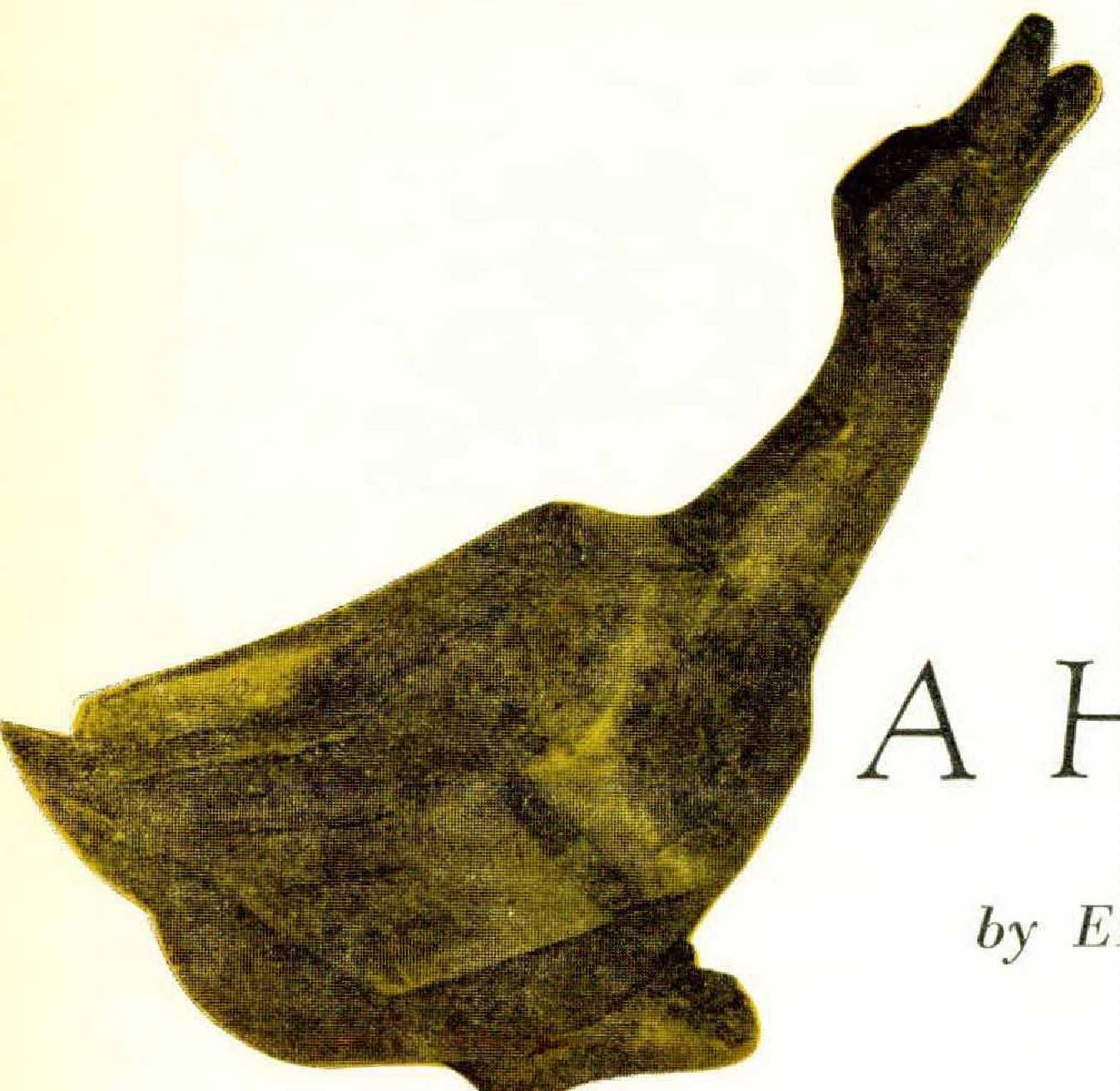
Some time later, when I arrived home from a visit to Arizona, Bob smilingly greeted me with the news that a goose had appeared from nowhere and was living at Lake Frogmore, a small catch basin on the edge of our swamp. At first I was suspicious of this announcement, thinking that spring fever had got him again and this was his way of telling me that he had bought a goose in my absence. With some curiosity I accompanied him to look at this newcomer, and was pleasantly surprised to be warmly greeted by a handsome purebred Toulouse who was very tame and friendly. It was fully feathered out, which meant that it was at least six months old, and while it was not fat, it was in good condition. Toulouse geese boast an attractive color scheme; their beaks, feet, and legs are soft orange, their eyes are hazel, which gives them an expression more intelligent than the cold chinablue gaze of white geese, and their plumage is colored like the dove’s, with lacy white feathers outlining their wings. An adult bird is about the same size as a wild Canada goose but more heavybodied.
How such a creature had arrived there was a mystery to us, for Lake Frogmore lies in an isolated part of the farm, surrounded by pastures and fences. I felt sorry for the wanderer, and the next evening when we went to feed it, I said, “Come back to the house with us; come on,” and to our surprise this lonely goose followed like a dog through the fences and fields to our terrace.
I had always regretted the loss of our first geese, and now I tested this new one by alternately calling “Eth-e-l-l–I,” and then “A-I-l-b-e-r-t.” It answered much louder to Ethel, so Ethel it became. However, there was quite a lot of controversy about Ethel’s sex. Two people who consider themselves experts pronounced her to be Albert. I don’t know how they were so sure, because geese are lacking that convenient curled feather on their tails which makes it so easy to tell a domestic drake from a duck. The only thing that worried me was the fact that Ethel showed no sign of wanting to lay an egg, which she ought to have been doing in the spring of the year. She paraded about among the tulips and other flowers on the terrace, looking absurdly decorative, and I could not see that her Hat flat were doing any harm; at least not much. She may have tasted the primroses and forget-me-nots, but she really preferred grass and tender shoots.
In many states geese are professional weeders and are employed by farmers and nurserymen to keep their crops clean; they are extremely selective eaters and would not dream of consuming one leaf of a strawberry or mint plant. White Chinese geese have been used for forty years in the Willamette Valley of Oregon, where they are put out in the peppermint fields from February to June. Mint growers say that the expense of hand hoeing might run as high as fifty to seventy-five dollars an acre, but by using geese, the costs can be kept down to as low as five dollars. The field is fenced with three-foot wire, and two or three active young geese suffice to keep it weeded. Farmers put water at one end of the enclosure and supplemental feed in a box at the other end to encourage them to keep on the move.
ETHEL took up residence on our terrace, and true to her heritage from the fourth century B.C., she was a vociferous watchdog. No sacred goose of the Temple of Juno ever proclaimed an intruder more loudly than did Ethel when a caller came to our front door. One would have thought that the Gauls were seeking to invade our house instead of sneaking up to capture the Capitoline Hill. She also honked noisily whenever the telephone rang.
I didn’t mind, except that the people on the other end of the wire would say, “I can’t hear you; we must have a bad connection; it sounds as though there is a goose on the line.” When I told them that it really was a goose, even my best friends said, “Oh, come now!”
In the dawn I had only to whisper her name to have Ethel answer with a blast like a bullhorn from the hot frames around the corner and hurry to join me on the terrace. As I fed and patted her, she conversed with me in that soft wispy language geese use when they are happy. She jumped into a stone pool to bathe and was very much pleased when I sprayed her with a hose. After breakfast she would settle down contentedly to preen her feathers in the sunshine, tuck her head under her left wing, and go to sleep.
This morning routine developed into a daily habit for Ethel and me, and I became more aware of goose behavior than I had been before. One thing I found out was that when she elongated her neck and raised the smooth short feathers on it into corduroy wales, she wished to be let alone. I learned this lesson quickly, because twice she gave me a fast nip on the forearm. It is supposed to be a warning signal when geese hiss, but there are several types of hissing. The low, mild one really doesn’t mean very much; more of a question mark than anything else. However, when Ethel’s hiss developed into a harsh croupy sound, it meant “Look out, I’m getting angry.” Otherwise, harmony reigned.
Ethel kept nibbling at the screen door trying to open it and come into the house, but even I did not think that this was a good idea. Mind you, I hate the rug in our front hall, but l was not keen to turn the hose on it either. Eventually I did let her in, one day when we had visitors who had stayed too long. She advanced cautiously through the door, wisp-wisping as she came, placing her pancake feet quite daintily. Unlike me, she admired the floral motif which adorns the rug, and tried to eat it. But her advent had a satisfactory effect on our guests, who left immediately, saying, “How can you let that dirty goose into your house?” Later it was reported that they also said, “Those Choates are crazy. They have a goose right in their front hall.” To Ethel’s eternal credit, she behaved as though she had been house-trained all her life. So, while Emily Post might frown upon my method, a goose will break up a party as fast as anything I have ever tried.
The local grapevine brought us the news that Ethel had originated from our neighbor Dan Connors’ farm half a mile away. It was also intimated to us that if we wanted to keep Ethel, it would not bother him. Apparently, quite a few people have an active dislike of geese, I suppose because their habits are rather careless. When I went to the grain store to buy Ethel some food, l asked the salesman what he would recommend for her. His instant answer was “Ground cyanide,” but we eventually settled on a mixture of whole corn and hen pellets instead. My gardener also took a dim view of Ethel, saying, “If you lika da dirt, datsa ho-kay.” So when I showered her in the morning, I gave the terrace a good bath too, thus avoiding any complaints. However, the weeks that she spent with us produced some astonishing results later in the year. The portulaca that I had planted between the paving stones turned into ferocious doormats of bloom; the dwarf alyssum, which is supposed to reach a height of only three inches, grew to eleven, and the whole terrace was such a riot of luxuriant growth that it quite alarmed me.
The cook who was working for me at the time was one of those people who enjoy purveying bad news. Her eyes shone when she could announce that the dishwasher was broken or the danger light on the freezer was showing red. Therefore, it was with evident relish that she greeted me one evening by saying, “I guess you have lost your goose. I saw a big bird flying over the swamp.” Ethel had never shown any symptoms of even wanting to fly, so I really did not believe this bulletin, but it was true that she was not there anymore. At first I thought a raccoon or a fox might have got her, but there were no feathers to be found: only a dismal silence hung over the terrace and Lake Frogmore.
After several days we found out what had become of the departed Ethel. Bob rounded a curve outside our gate and beheld a breathless Ruthie Connors chasing her lickety-larrup down the main road with a stick. He stopped to inquire why the violent pursuit. She told him that Ethel had somehow returned to Dan’s place, where she had become fascinated by the white traffic line in the center of the road and persisted in walking along it. This habit was thought by Miss Connors to be a suicidal hypnosis on Ethel’s part which must be stopped at all cost. My own opinion was that the whole performance smacked of suicide, and that they both were lucky not to have been knocked into Kingdom Come by one of the Jehus who roar the roads today.
I called on Dan to ask him about Ethel’s history. He told me that she had been brought to his farm by a young man named Ford. Dan said that she dirtied up his garage and that he was not one bit in love with her. In fact, that very day she had fallen into the oil pit there and was rescued after some time so heavily coated with grease that he had been compelled to put her out in the abandoned peat bog behind his vegetable stand.
Naturally I hurried right over to see Ethel, who greeted me with a royal honking and wing-flapping. It had been in my mind to take her home with me and give her a shampoo, but when I saw the nasty state she was in, I gave up any such idea. She was smeared from her beak to her toes, every feather impregnated with oil. If I had not enjoyed her acquaintance before, I would have thought her to be some new breed of black goose. In short, Ethel was a mess. It was clear that her only salvation lay in staying right where she was and letting nature take care of her plight.
During the summer I visited her regularly, carrying bread and grain to her. Since the water was low in the bog, I thought it safer to feel my way across the spongy quagmire and leave the bowls of food on a bar where raccoons and foxes could not catch her unaware, although every raccoon for miles around was otherwise employed eating up Dan’s corn crop.
Ethel was not the only inhabitant of the peat bog. It was a quiet place, where I enjoyed watching the wildlife that came and went. The brown water mirrored the colors of approaching autumn. The birches and maples were turning to gold and red, the fall asters were massed in banks of bloom, and beside my favorite resting-place grew the delicate mauve snapdragon Antirrhinum orontium, which is not common in our county. Many killdeer walked the bar, sinking their beaks into the mire in search of larvae; two blue-winged teal skimmed swiftly over the water, while a wood duck dwelt on the farther shore. Occasionally a small fish rose, creating concentric rings on the smooth surface, and I promised myself to cast a line in there the following year.
One day I met Mr. Ford’s mother at the bog. I found her to be a pleasant lady, so we fell to discussing Ethel’s future. Two long months had restored her plumage to normal, and by now she had become a favorite with all the children in the neighborhood. However, no parent would allow her to be brought home; even the kindly Dan threatened to wring her neck, and our farmer held her in low esteem. But the fact remained that she could not stay out in the bog all winter. Furthermore, the hunting season was sure to be the end of her, for if even a cow can get shot, what price poor Ethel? Mrs. Ford said she thought of taking her to Maine, where she could join a flock of her own sort on a farm, and I agreed that this seemed to be a very good solution to the whole problem.
Dan told me later that Mrs. Ford tried keeping Ethel at her home as a pet, but she had such “a honkin’ good time” in the heart of town that the neighbors complained bitterly, and finally Mrs. Ford was forced to take her to Maine. Dan added, “They’re ahf-ful welcome to her.”