Georgia O'Keeffe
Georgia O’Keeffe, whose work is now in many of the major museums in this country, came to her painting only after a sudden burst of independence had projected her out of her schoolteaching and into a world she made her own. This portrait of her was written by the city editor of the Albuquerque TRIBUNE.
by Ralph Looney
GEORGIA O’KEEFFE lives in an old adobe house on the top of a hill in the isolated Spanish-American village of Abiquiu, forty miles northwest of Santa Fe, New Mexico. The country is raw and colorful and lonely, a timeless land of big sky and vast distance. It is her kind of country, and here, at the age of seventy-seven, she is still painting pictures as bold and as different as those which put her in the forefront of America’s artists nearly half a century ago.
Her face is that of a woman marching stolidly across the plains behind a covered wagon. Her skin is tanned the rich brown of old leather. Her lips are thin and at first give the impression of sternness. But that lasts only until she smiles. It is the warm smile of a highly sensitive woman with a gift for humor, a woman who loves life, a woman who has been much alone. Her curiosity is as unrestrained as her energy. She walks confidently, quickly, with a spring in her step.
She was born in farm country at Sun Prairie, Wisconsin. The daughter of an Irish father and a Hungarian mother, she made up her mind before she was twelve that she was going to paint.
“I really don’t know where I got the idea. I painted very little as a child, and it was always my younger sister who was considered the talented one.”
In 1904, when she was seventeen, she entered the Chicago Art Institute, where she learned the fundamentals. In John Vanderpol’s class in figure drawing, young Georgia O’Keeffe was the top student. “Vanderpol taught a careful, meticulous kind of drawing,” she remembers. “I always felt I owed this man a lot.”
From the institute she went to New York and the Art Students League, where she was taught the then current vogue in painting — what she calls the “dash and go” method. This was the technique of John Singer Sargent and of William Chase, known to art historians as the virtuoso of the heavily loaded brush. Miss O’Keeffe recalls a Sargent painting at the Metropolitan Museum that was pointed out in those days as a marvelous example of “how to paint.” The reason: Sargent had painted a man’s watch chain in a single swipe of the brush. Chase, whom she remembers as a “good painter,” came to class wearing a brown serge suit, high silk hat, chamois gloves, spats, and often a carnation in his buttonhole.
Her work pleased Chase. She was made class monitor, an honor reserved for the best pupil; and a still life she did of a copper pot containing a dead rabbit won the top prize for students. “It may still be hanging somewhere around the League. But nobody knows what they want at that age. And if you study with anyone, you try to do what they’re trying to teach you.” She had not yet found her own direction.
She went back to Chicago and put what she had learned to practical use. She took a job doing commercial art for an advertising agency. “That’s where I learned to hurry. The idea was to do it faster or you didn’t get the job. I pretty soon found out I wasn’t cut out for that. It was appalling.”
She then went on to Texas to become supervisor of art in the Amarillo public schools. During her first year she persuaded the school superintendent to stop forcing students to buy what she considered a useless and costly drawing book. But the following year he changed his mind and insisted that the book be bought.
“Sorry,” declared Miss O’Keeffe. “We won’t.” The argument continued throughout the year. The superintendent threatened. Miss O’Keeffe stood firm. When school ended in the spring, the books still hadn’t been bought.
She left Texas and returned to New York to take classes at Columbia University. At Amarillo she had not painted at all. At Columbia she began again, and for a while became interested in impressionism. In summer she taught at the University of Virginia, where her instructor at Columbia, Allen Bement, also taught. She considers Bement her best teacher, although not because of his painting instruction. He told her the things she should read, the things she should learn, the music she should listen to. But his advice about painting was “bad.”
“He was too timid. I had gotten a lot of new ideas and was crazy to get off in a corner and try them out.” He thought she should follow traditional forms and never approved of the methods of painting which later were to make her famous.
They had frequent disagreements.
Up till now, she had followed the teaching of her instructors. She had, of course, seen exhibitions of modern art. She was aware of the unrest, the new ideas that were threatening the status quo in art; but she missed the famous Armory Show of 1913, where the radically new methods caused so much controversy. She did attend several exhibitions at a gallery run by Alfred Stieglitz called “291.” Here, in 1908, she saw the first showing of drawings by the sculptor Rodin. “They made no sense.
They were very beautiful but really just a lot of little scribbles to me. This was because of what I was being taught.” Sometime later she saw a show by John Marin, and his abstractions seemed “weird” to her. She remembers wondering if “anyone could make a living doing that.” A similar exhibition by Picasso made little impression.
In the fall of 1915 she took a job teaching at a girls school in Columbia, South Carolina. Here, at last, she had a room large enough to work in and a chance to experiment privately, as she pleased. “I decided to have a little show, just for myself.” She spread all her pictures about the room and looked at them carefully. “All at once I realized there wasn’t a single one of them that was me. Every picture was painted the way someone else thought it should be painted.
“I decided I’d paint some of the things I’d had in my head for so long — and I’d do them in black and white. I’d wait to use colors until I had something that had to have color in it.”
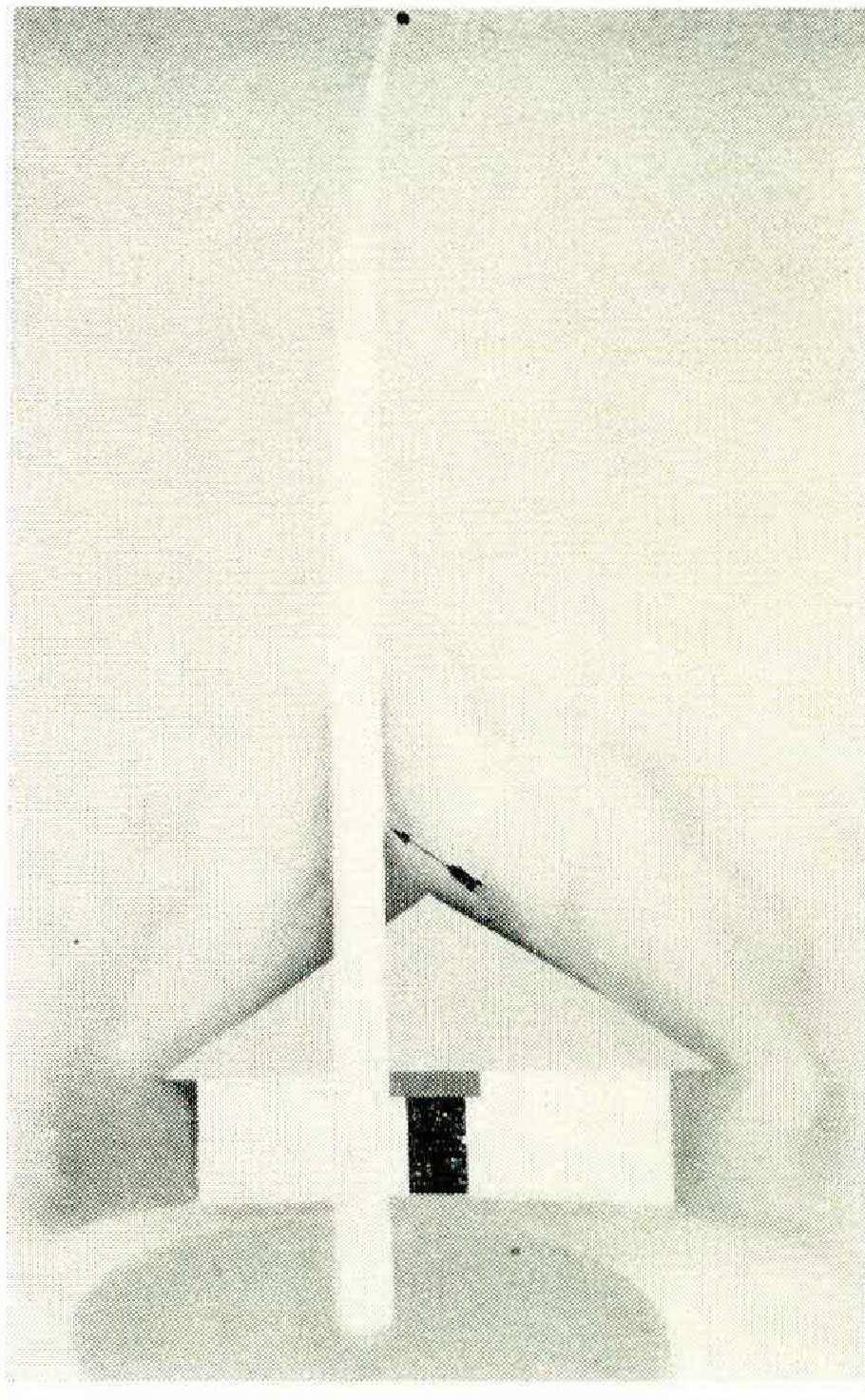
In the privacy of her room, the young art teacher began creating abstract drawings, something totally different from anything she had ever done before. She painted things she had seen, but in a new and strange way. “I have the kind of mind that transfers experience into shapes and colors.”
She drew portraits of her friends, abstractions, sometimes ten and fifteen times. She drew things like the evening star, cattle lowing in the night, shadows on the wall cast by the streetlight, or the sun behind a red cliff. When she had a number of these drawings, she sent them to a friend at Columbia University to show her what she was doing. Her friend took them to Stieglitz, and at first sight he was excited. “At last,” he shouted, “a woman, on paper!” He put the drawings on exhibition.
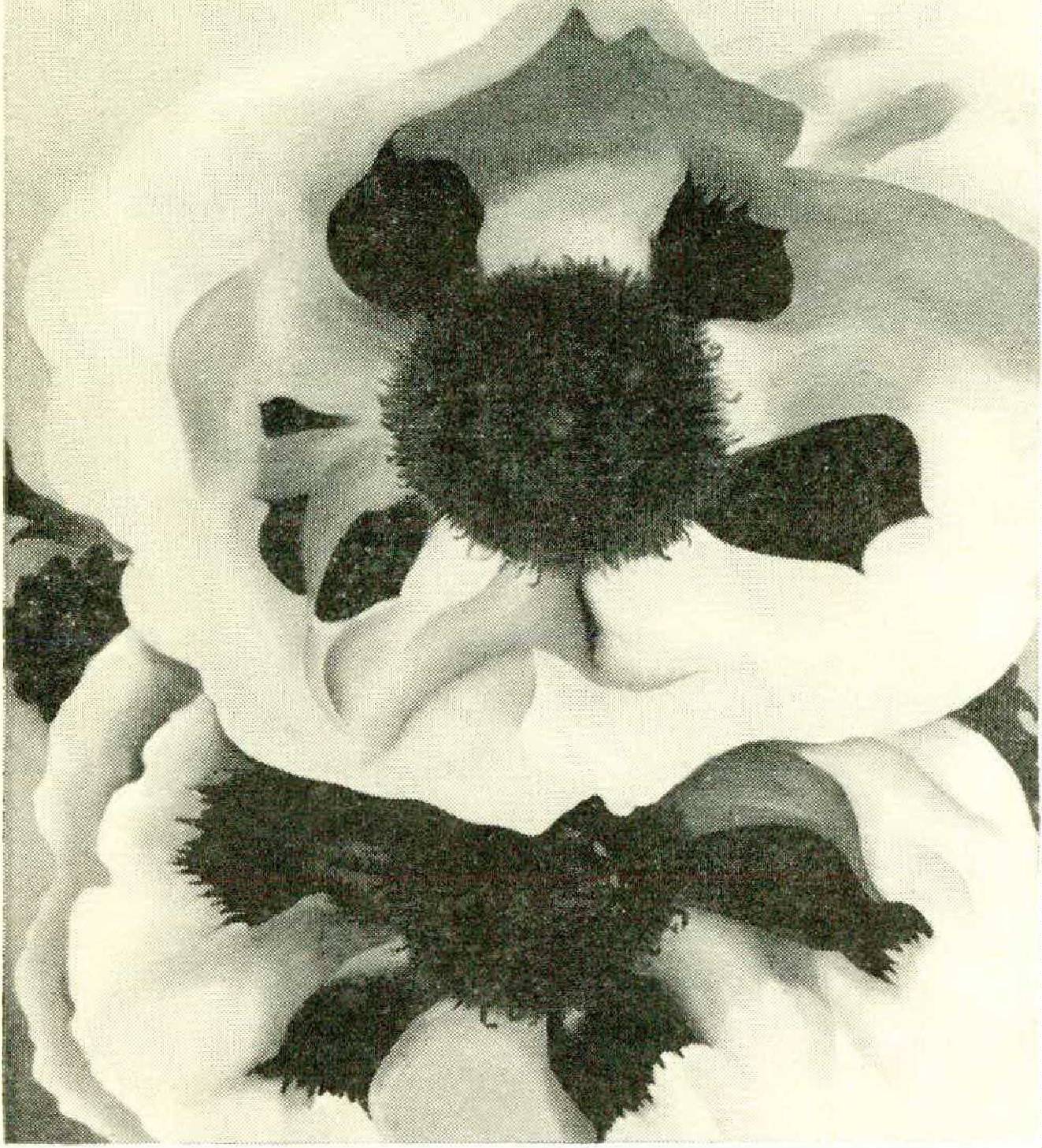
“I was very flattered to have my pictures shown at 291. I don’t think I would have taken my own work there.” The drawings were an overnight sensation. Naturally enough, the only criticisms they drew were from the conservatives, who objected to the artistic upheaval under way.
Encouraged by Stieglitz, she gave tip her job and in 1918 returned to New York to paint. The pictures she had painted previous to her private little show in her room were disposed of without regret. In New York she tossed all but one into the trash. So perished the early Georgia O’Keeffe, the shreds of her pictures carried away on the evening wind. She now became a member of the group of modern artists associated with Stieglitz.
“It’s very nice to have someone interested in what you do. At the time Stieglitz exhibited my drawings, no one else in New York showed that kind of thing. Many people objected to me in the beginning,” she remembers, “because I didn’t fit into tradition. In those days you had to be a follower.”
Her sex was another handicap. “Men in that day didn’t want women painting. The painters and the art patrons figured it was strictly a man’s world.” Often, she reminisces, patrons would ask Stieglitz to arrange an art show, adding: “and I don’t want any goddamn women!” Stieglitz always insisted, however, on showing her work.
Typical of the reactions because of her sex was the one she faced when she started painting pictures of New York City buildings. “The men decided they didn’t want me to paint New York.” At one exhibition in the 1920s she found a “perfect” spot in which to hang one of her new pictures of New York. “They wouldn’t let me. They told me to ‘leave New York to the men.’ I was furious!”
The following year the determined Miss O’Keeffe tried once again. She succeeded in getting the picture hung. “It sold on the very first day of the show: the very first picture sold. From then on they let me paint New York.”
GEORGIA O’KEEFFE was soon a peculiarly American phenomenon in a day when American culture was struggling to break its European ties. A reaction had begun to set in to the old days when the only good art was supposed to originate in Europe; when an artist or writer hadn’t really arrived in America until he had spent some time in Paris. It was a time when pure American art was first being sought and when there was much talk of the still unwritten Great American Novel. Georgia O’Keeffe was one hundred percent pure American: she had never been to Europe.
Her painting was completely fresh, completely new, completely original. There were the abstractions, beautifully blending color and design; there were flowers, painted as no one else had ever painted them before. She examined flowers closely, then enlarged them enormously and explored their innermost secrets. Their colors were magnified, like the flowers themselves, until they almost seemed to glow. These were bold paintings, put on canvas and paper with flawless technique. Others followed. There were the New York buildings; plants, leaves, houses, barns; and then the stark countryside of New Mexico, the bones and skulls bleaching white beneath the sun.
Throughout the early years Stieglitz made sure that her work was kept in the limelight. “He thought my painting was something in an odd way. I remember when I started doing my big flowers. He stood and laughed. ‘I don’t know how you’re going to get away with anything like that.’ ”
Stieglitz himself was a remarkable figure. A born leader, a sensitive photographic artist, an intense personality, he had become a moving force in the art world. And never once did he waver as the great champion of Georgia O’Keeffe: he kept her work talked about; he showed her drawings privately between exhibitions. That they were married in 1924 was the logical development of their long and close association.
Today, Miss O’Keeffe stands at the pinnacle of artistic accomplishment. Her paintings bring in large sums and are shown in the largest museums and galleries in the United States. Yet her way of life is simple, completely without frills; what many would consider Spartan. And success seems very unimportant to her, except that it allows her to live as she chooses.
THE house in Abiquiu is an old house, once a typical Spanish-territorial-style adobe. Now it is pure O’Keeffe. She remodeled it herself. “I did many things over. I didn’t want it to be Spanish. I didn’t want it to be Indian. I didn’t want it to be modern. I just wanted it to be my house.”
A ram’s skull with horns intact is mounted over the gateway at the front of the house. Across a courtyard a hallway leads to a small dining room. There, an extremely low window meets the eye. Outside is a tiny patio containing a twisted, weathered tree stump set off by two little patches of green plant life against the sunbaked earth.
To the left is a long living room, severely yet comfortably furnished. The floor is natural brown adobe, unpainted. The walls are white. The high ceiling, containing skylights, is of wood supported by peeled-log beams, the kind the Spanish Americans call vigas.
The adobe couch, built up from the floor, is cushioned in white. So are the four chairs. The hassock is also white, topped by a black and white checked bandanna. Bookcases built into the walls are covered by white drapes. Black tables jut out from the walls. On one is hi-fi equipment. A simple table made of a single piece of thick plate glass sits in front of the couch. Dominating the wall across from the sofa is an immense unframed oil painting. The lower two thirds of the canvas is almost pure white, the top part green and blue. The picture is unsigned.
Miss O’Keeffe walks about the room briskly, her graying hair done up in a bun. Her dress is a long, simple wraparound. It is black, set off by a white collar and a black belt adorned with hand-tooled Indian silver. Two big blue chow dogs follow her at first, then sprawl on the floor.
I asked her what the big picture was called. “I don’t put names on them,” she answered. “I never do. Other people always put the names on my pictures — quite funny names I think. I don’t think it’s necessary.” She feels the same way about signatures and never signs her pictures. “If there is any personal quality in them, then that will be signature enough. The picture on the wall is not an abstract. It’s really almost photographic. It’s something I saw from the air. There was a line around the whole horizon. It was an extraordinary effect. Here was this great white field of clouds against the blue! I toyed with the idea of doing it on the wall, running it all the way around the room, but decided against it. It would take too much time.”
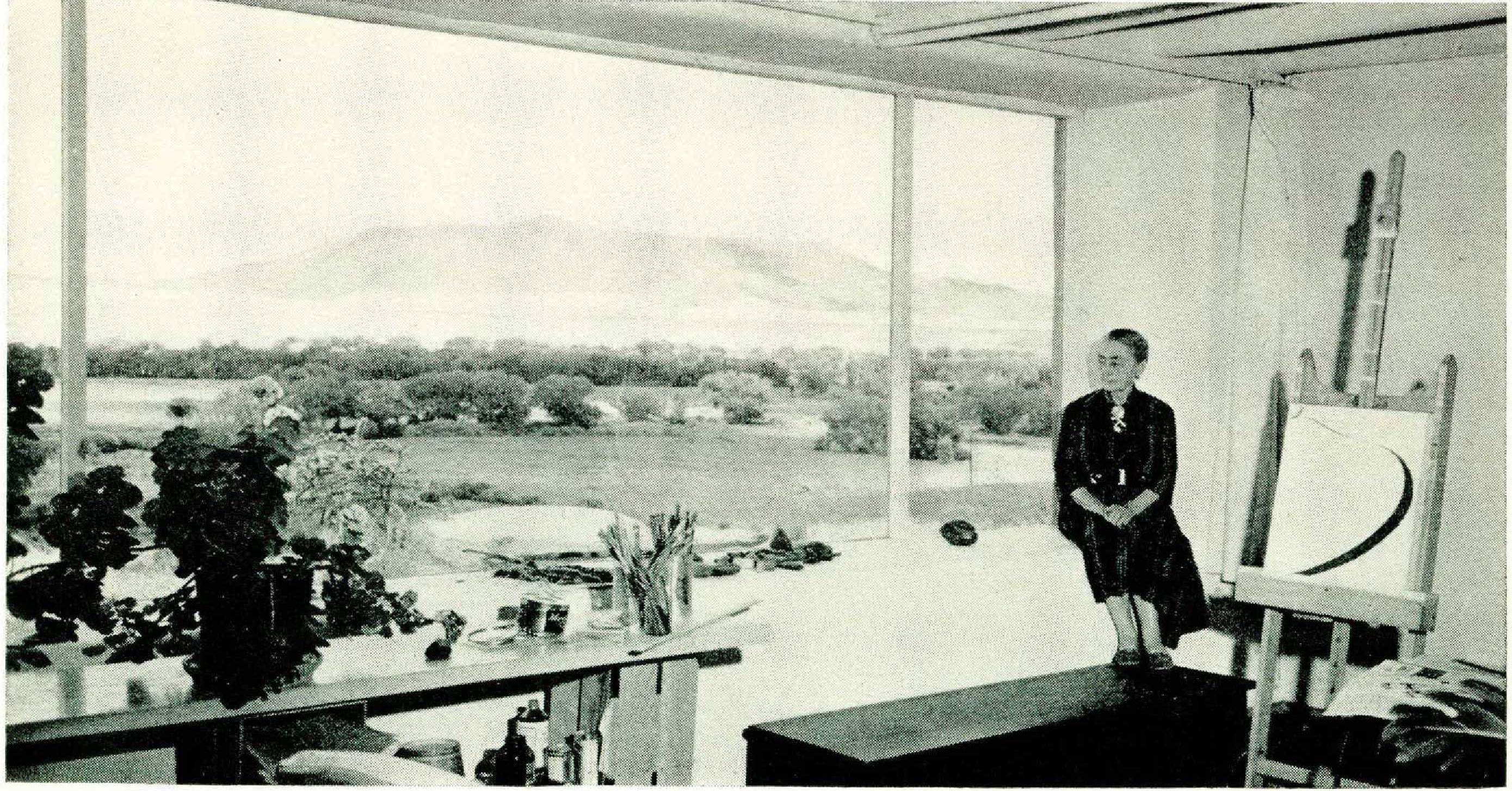
She remodeled the house fifteen years ago with the help of a friend. It was a ruin, abandoned to the village pigs, which slept inside its crumbling walls. Her first home, where she spent every summer but two until after her husband’s death, was in the Ghost Ranch country about fifteen miles north of Abiquiu. One summer she spotted the ruined house on the hill in that Spanish-American village. It was owned by the Roman Catholic Church, but she decided she must have it. “It took me ten years, but I kept after them.”
The house is surrounded by three well-kept irrigated acres. Flowers are everywhere, but they are of secondary consideration in her garden. She tries to raise all the vegetables the household needs throughout the year. She is an organic gardener. Luncheon is likely to consist of delicious soup and salads, roast beef, cheese and yogurt, washed down by herb tea or beer. She gathers the greens for the salads herself all winter.
Her studio is an enormous room dominated by a huge picture window overlooking the green Rio Chama Valley. Once a carriage house and stable, the studio is in sharp contrast to the rest of the house. It shows the disorder of a workroom. Papers, brushes, and odds and ends are scattered about. There are many pictures and canvases ready for paint.
In one corner a large canvas of some yellow daffodils is propped against the wall, half hidden by an easel. She has been working on it off and on for months. She works all day every day until a picture is finished. “If I don’t keep after it, it is apt to be no good. When you let them go and work on them for months and months, they’re never any good.”
Another painting shows a pattern of gray, black, and blue. The inspiration was again something she had seen from the air, the merger of two desert rivers somewhere in the Middle East. It looks like an abstract, a complete contrast to the picture of the flowers. “I’m always swinging from one thing to the other. I have always been very free in my approach. I see no reason why abstract and realistic art can’t live side by side. The principles are the same. I like to be interested. And I paint what interests me. If I could be ten people, I’d keep them all running all day. I like to do things. I like to go places. Yes, I live here in a rather isolated fashion, but now and then I take a trip. There are so many things to do and see! I think if I have a next life I would like to sing in it. I love music.”
In 1962 she took a six weeks’ trip to Greece, Egypt, and the Middle East. In 1961 she went with several friends in a rubber raft on a 185-mile, week’s trip down the turbulent Colorado River. In 1960 she visited the Far East, Australia, and the South Pacific. The year before, she flew around the world.
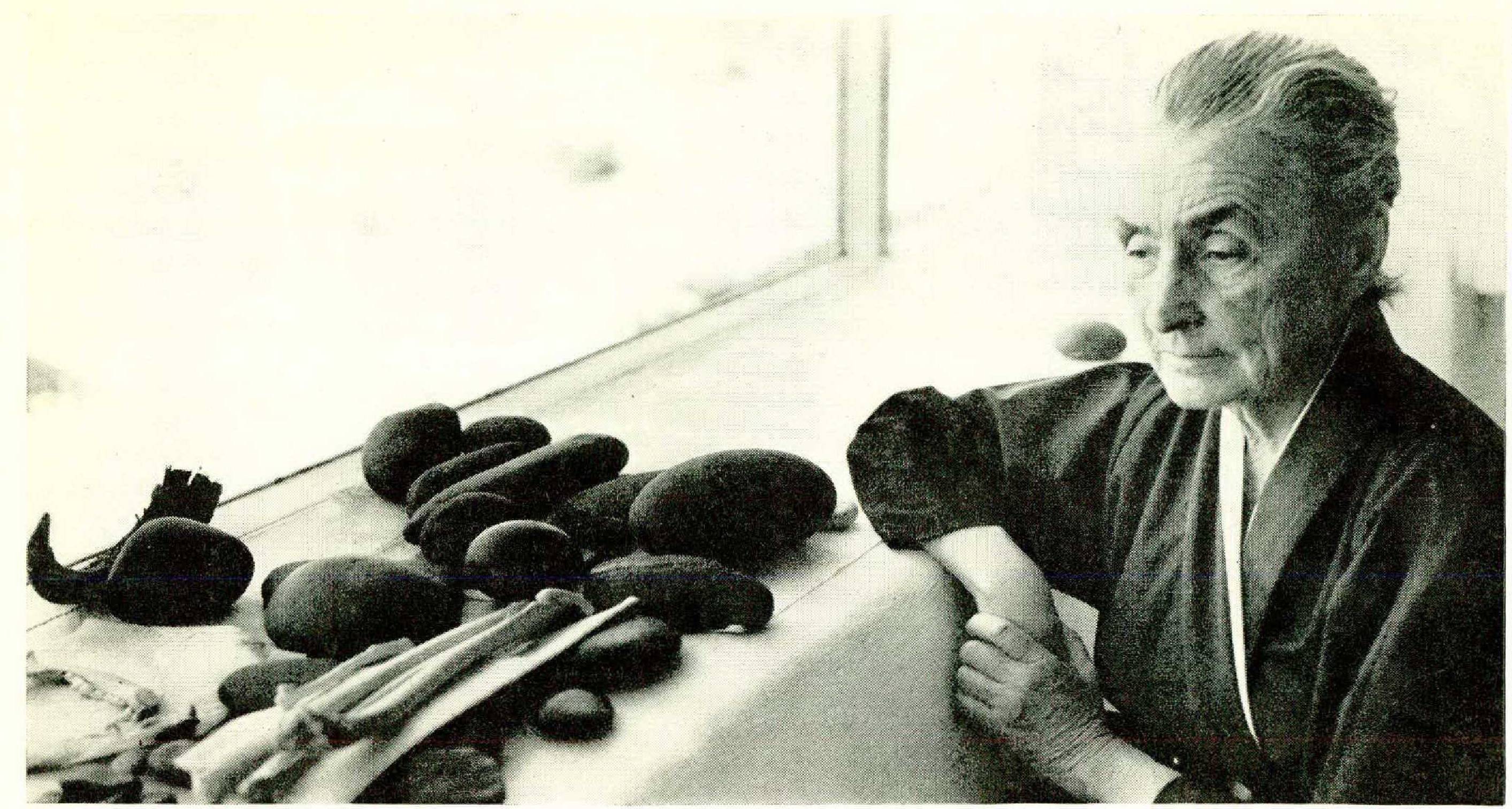
Mementos of her travels are sprinkled everywhere: a piece of iridescent silk from India, a primitive wood carving from Africa, a hand of Buddha from Siam. But most noticeable of all are the rocks that lie about nearly everywhere. Most of them have been smoothed and polished by some form of erosion. They are found in every room in the house. Sometimes there are only a few in a glass dish; sometimes, a single rock on a table.
In front of the picture window in her studio is a stone table literally covered with them. Some of the most beautiful are lined up on a shelf in her simply furnished bedroom just off the studio. “You’re wondering about the rocks, aren’t you? Those are my treasures. I had to have a house to keep my treasures. There wasn’t room in an apartment.”
She extends her hand to the windowsill, taking up a smooth black rock. She rubs her hand across it. “It started when I first fell in love with this country out here. I wanted some means to keep it, to express the country. You couldn’t press flowers. So at first I started picking up bones; then, later on, rocks. I remember one year I sent back a whole barrel of bones to New York. The express charges came to sixteen dollars! Later, I graduated to rocks. I pick them because of their shape, their smoothness, their beauty.”
Her favorite is a small black stone polished by the Colorado River. It was picked up by her close friend Eliot Porter, noted Santa Fe photographer. Its only distinguishing characteristic is its round smoothness. To her it is finer than a rare jewel.
There are also many animal skulls around the house. Among them is a bison skull obtained on a hunt in the West by Theodore Roosevelt and Gifford Pinchot. It was given to her many years ago. There is also the skull of a horse that came from the ranch of D. H. Lawrence near Taos.
These things that she cherishes are the simple symbols of the country’s hardness: bones and skulls, whitened by the hot yellow sun, smoothed by wind-blasted sand; rocks, prepared the same way. The beauty of nature is her passion. She appropriates it as her own whenever she can. Far away looms a towering, flat-topped mountain called Pedernal. “It’s my mountain,” she says. And surely no one would deny it.
Her financial success has meant very little. “Possessions are such a headache. I’ve often thought how wonderful it would be to simply stand out in space and have nothing!” When she is asked if her success required self-discipline, she answers simply: “You decide on the kind of person you want to be, and then you get at it. It’s like a habit of neatness. But I don’t really know,” she adds; “I don’t think much about myself.”