Early Bird
SARA WEEKS has worked editorially on books and magazines and is the author of a children’s book, TALES OF A COMMON PIGEON.
Some people are always early and some are always late. Most of my life I’ve belonged to the latter group, although I don’t enjoy being late or causing other people inconvenience. It’s true that I don’t like to stand in stations waiting for trains to leave and am embarrassed to arrive at a party first. Of course, there are people who are punctual. That is the real art. And I think the secret is to allow a little more time than you think you will need — providing everything goes according to your plan. Since I hate to waste time, I never plan for enough to take care of the unexpected delay which is more often the rule than the exception.
I’ve had several friends who have earnestly tried to take me in hand. They shake their heads over my flying down the platform, calling to the conductor that I’m coming; and they eat a sandwich before they come to my house for dinner. The sad thing is that most of their best efforts have ended in disaster.
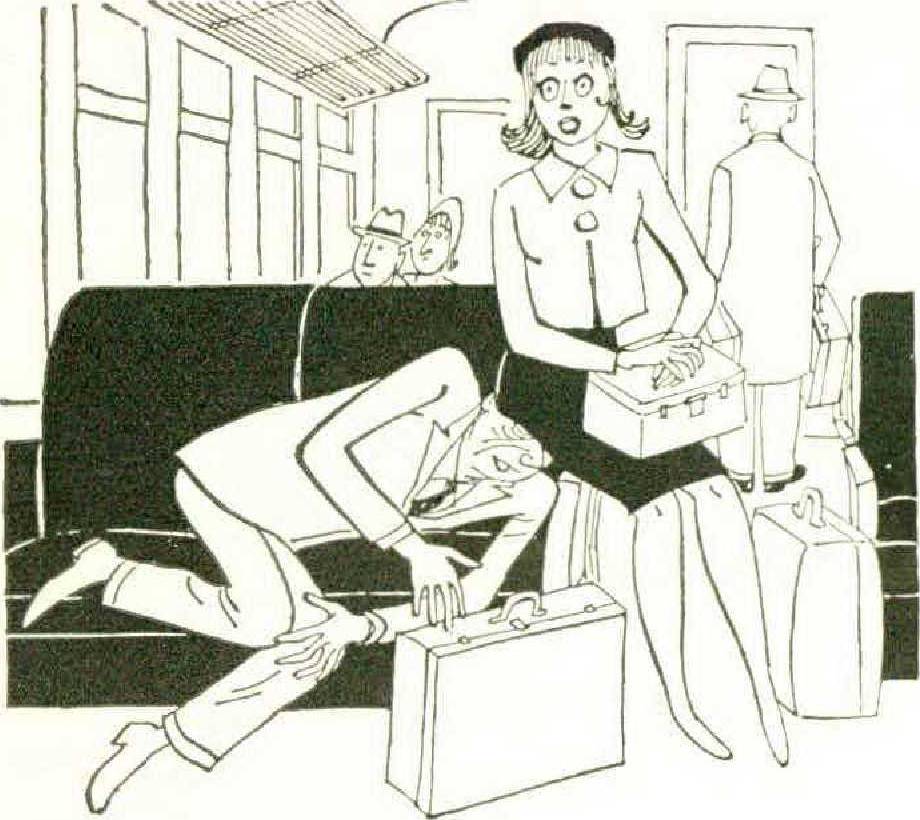
For instance, left to myself I never would have sat on that man’s head on the train to Chicago. It was a terrible shock to both of us. I was going to Chicago with my roommate, her parents, and her brother. Her father was the earliest of early birds — first one up in the morning and the first one up in any train. He habitually arrived at stations half an hour ahead, and on this occasion he had us all buttoned into our coats and on our feet in the aisle twenty minutes before we saw the streetlights of Chicago’s suburbs.
I was wearing a new pair of spike heels and carrying two awkward pieces of hand luggage. Finally I couldn’t stand any longer; I dropped heavily onto the arm of the chair behind me. There was a muffled cry and some wild flailing of hands and feet. I suffered a moment of panic when I realized that the hard egg-shaped object I was sitting on must be a head, probably the head of a gentleman we’d observed making a good many trips to the club car. Horrified, I lurched back to my feet. The poor bewildered man sat there, upright, rubbing his temples with both hands. He kept on rubbing his head all the rest of the way to Chicago. I couldn’t think of anything adequate to say to him — he just looked at me in mute astonishment. How could I have done it? Indeed, how could I?
Several years later I went back to visit this family when my roommate was married. They lived in a stalwart little town in Ohio called Defiance (it was where Mad Anthony Wayne took his last stand before the Indians). After the wedding I had decided to stop briefly in Detroit, and could only afford to go there if I went by bus. My friend’s father took it upon himself to see that I got to the depot in time and aboard the bus. I have always adored him, and he saw me off with great affection and aplomb — even though we were there three quarters of an hour early. We bought my ticket, and then while he made some inquiries I looked around the station. (I remember that I found a list of nearby towns that intrigued me. It began with Defiance and continued: Alliance, Independence, Napoleon, Jewel, Brunesberg.) With his help, I was the first person on the bus; I kissed him good-bye and read my book quite happily before anyone else appeared. Some fifteen minutes out of Defiance the driver began to shuffle through his tickets. “Is there somebody on this bus going to Detroit?” he asked. “Yes,” I answered. “Well, lady,” he said, “all the rest of us are going to Fort Wayne, Indiana.”
“This is an express bus,” he added. “We don’t make any stops but ‘rest stops.’ ” I went all the way to Fort Wayne and then all the way back to Defiance with him. He didn’t charge me for the trip, but it took me six hours before I was ready to start out again for Detroit.
I always wait till the last possible moment to get my reservations, and this sometimes leads to difficulties, as it did on that night train from Boston to Detroit. It was a Sunday during the war, and the ticket agent had no berths available until just before the train left, so I was surprised to be only one of three people in my car when we pulled out of South Station. The delay at the next stop, Back Bay, explained everything. We’d been there a long time when there was a lot of shouting and cheering, and the triumphant Chicago Bears football team was escorted down the platform to our car. They more than filled it up. I have really never seen so many enormous men, bursting with health and vitality; they’d been undefeated that year. The Bear in the seat opposite me was small, relatively. And quiet, at first. He asked me if I was sure this was my berth, and when I nodded, he said wasn’t that just fine, it was the same number as his. The others all went off to the club car singing. But he kept asking me questions like, what time is it? I said I didn’t know and went on reading. He wondered if I’d like a drink, and I said no. Dinner? No. I said. He was silent until a Western Union man came along and he asked for a blank. Several minutes later it was thrust over my book; on the back of the blank he had drawn a picture of me. At least he said it was me (it was a great deal more buxom than I was at the time). Now he had to know my name to put on the picture. I was only fifteen; I’d been told not to give my name to strangers, so I gave him a name that wasn’t mine but had my initials (since they showed on my suitcase). I thought I was pretty smart to think of Sylvia Watkins. He made a couple of other attempts to interest me in dinner, but I kept saying no, so he left. Although I was hungry, I decided that if I was quick and got to bed before he came back I’d manage to escape him. I had the lower. Of course, it was earlier than I was used to going to sleep, so I didn’t for quite a while. I guess I must have just dropped off with my book on my chest and the light still on when someone sat down across my knees. I rose up, bristling with bobby pins. It was my Bear. I told him to get right out of my berth. Instead, he pulled the curtains closed behind him. He had obviously had quite a bit to drink; luckily it made him more genial and less determined. He did finally agree to leave if I’d write him a letter. But as soon as he got off my stomach and out into the aisle the rest of the team booed and jeered. I really couldn’t be sure he wouldn’t change his mind until they all got off at Syracuse at two thirty in the morning.
What I didn’t discover until the next day, and then I learned it from an angry lady in the washroom, was that he had gone into each of the lower berths on either side, struck a match, and said, “Oh, I’m sorry, you’re not Miss Watkins, are you!” and then continued until he found me. I suppose you could say in this case that the early bird did catch the worm, but just didn’t want it.