The Hired Help
WEARE HOLBKOOK is an infrequent but welcome contributor to these pages. He lives in Hartsdale, New York, and is the author of many tight articles.
Far be it from me to sabotage a fellow writer, especially a writer so much older and better than I. But if you were a youthful admirer of P. G. Wodehouse and are thinking of rereading some of your old favorites, my advice is, don’t.
My enthusiasm for Pelham Grenville dates from the days when a nickel would buy you a big fat Saturday Evening Post. (As a matter of fact, I got it for three and a half cents because I peddled it every Thursday afternoon and sold almost enough copies to get one leg of a Shetland pony.)
It was easy to spot the Wodehouse serials because they were always illustrated with rather pale watercolor sketches by May Wilson Preston. Even without the illustrations it would have been easy to spot them; the snappy dialogue, frequently augmented by a character who was hard of hearing or hard of thinking, left plenty of white space to attract the eye, quite unlike the solid-gray prose of Ben Ames Williams or Corra Harris. The serials ran in about six installments, and I used to save them unread until I had a complete novel. Though it was a prolonged privation, like not taking a drink of water until all the lawn had been mowed, the end result was worth the wait.
But my latest reading of Wodehouse follows a wait of some forty years, and the end result is not what I expected. It isn’t that the humor is dated. The airy banter is as airy as ever. I still enjoy hearing an egg greet a bean with “Yo-ho, yo-ho! Yo-most-frightfully-ho!” and sharing the Marquis of Blandings’ preoccupation with pigs.
As with many revivals, however, its overall effect is depressing. In my wildest flights of fancy I never dreamed of having a valet, or gentleman’s gentleman. But there was always the hope that somewhere in my life there might be a sort of blurred copy of someone like Jeeves.
The closest I ever came to being waited on, hand, foot, and brain, in the Bertie Wooster manner was during initiation week at the Sigma Nu house when, as an upper classman, I had a freshman pledge at my beck and call. It was a corn belt version of the Oxford “fag” system, and a week of it was about all the democratic spirit a state university could stand; any more, and the temporary slaves might have decided that those Greek letters just weren’t worth the drudgery.
Then there were a couple of Atlantic crossings during which the stewards gave me an all too fleeting illusion of Woosterity; and the waiters and bellboys in London left me feeling faintly feudal. But along with the deference and solicitude, I detected the appraising side-glance reserved for tourists who have not yet bestowed the ultimate tip. These were faithful old family retainers — but only as long as the American Express checks held out. None of them had the picturesque aplomb of the ever-resourceful servitors who furthered the plots of the old Bolton and Kern musicals, or their successors on stage and screen; none of them looked like Sydney Greenstreet or Eric Blore or Arthur Treacher.
It must be admitted that even the least impressive gentleman’s gentleman would have appeared out of place in my ancestral home in Iowa (where my one and only attempt to sport a walking stick evoked the sympathetic query, “How did you hurt your foot?”). He would have been equally incongruous in my threeand-a-half-room monoplex New York apartment or my suburban split-level ranch house. There were no servants’ quarters — or even eighths — in the former. And in the latter, my neighbors would have considered me guilty of living above my station, which is only a local stop.
In all my life I have never been awakened by the suave intonation, “Your bath is drawn, sir.” Nor has breakfast ever been brought to me in bed except when I’ve been feeling too miserable to appreciate it. For one thing, it is impossible to draw a shower bath; for another, the threat of toast crumbs in the pajamas always impels me to get up and look my fried eggs in the eye like a man.
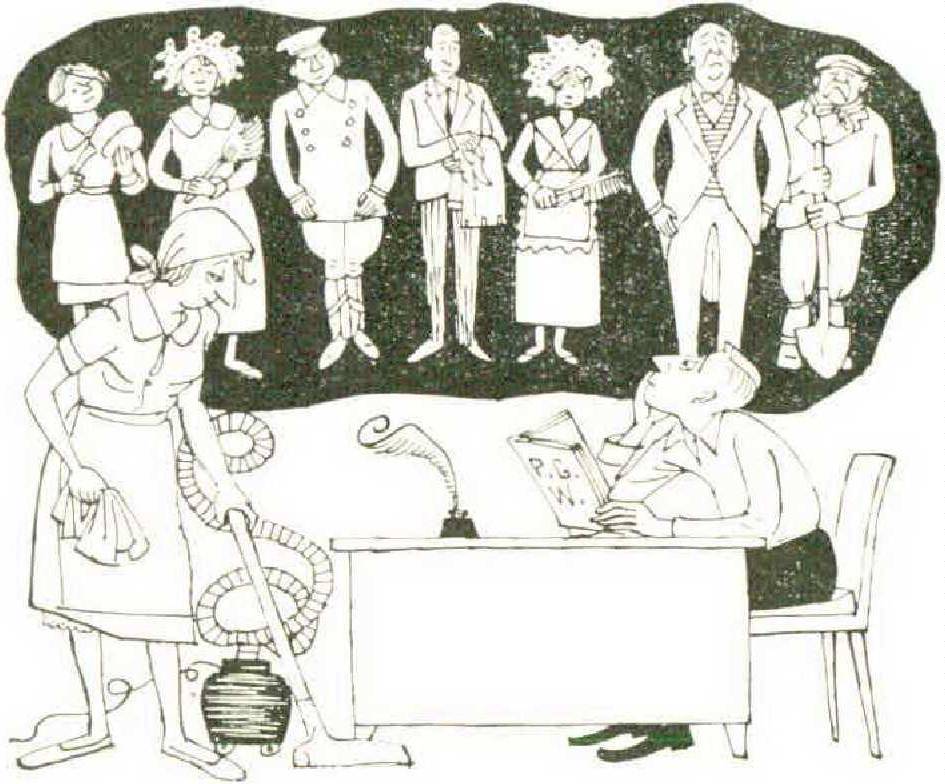
In the Wodehouse world, the only servant problem was a superfluity. There was the usual populous staff, including gardener, stableman, butler, social secretary, cook, laundress, boots, housekeeper, and assorted maids. But the complications of the plot also required a few extra servants — bogus servants temporarily engaged for the big house party and purporting to come from a reputable agency, but actually American criminals scheming to steal the jewels of the guests.
All this makes tantalizing reading for the average householder today, whose ancestral acres are fractional and whose social position depends on keeping up with the Dow Joneses. This is not to say that my wife and I haven’t had any domestic help in our ménage. We’ve had plenty; quite enough to constitute a staff, except that it didn’t come as a serried rank but rather in single file — a succession of females named Carrie, Eulah, Olive, Kitty, Anna, Rose, Wilma, Elizabeth, Helen, Ingrid, Othilde, and Legion.
Over the years we have watched the wage scale tilt from fifty cents an hour to six bits, to a buck, and then up to a dollar and a quarter. We have also shared in the evolution of the social security system by filling out countless forms and punch cards for withholding taxes for insurance and unemployment.
According to the Internal Revenue Department, the taxes apply to cash wages paid, regardless of when earned, to a household employee in a calendar quarter for household services if the employer pays the employee $50 or more cash wages in the quarter; the $50-a-quarter test applies separately to each employee.
This involved considerable bookkeeping at first. But there were occasional benign blanks, especially during the summer, when because of the rapid turnover of personnel, no one employee was paid $50 or more a quarter. Bookkeeping has been further simplified from time to time by complete inactivity on the labor front, with nobody being paid anything.
These periods of do-it-yourself housekeeping often last long enough to effect a perceptible lowering of standards. Breakfast in the kitchen, which has always been recognized as convenient and cozy, leads reluctantly to the conclusion that lunch and dinner in the kitchen can be equally convenient and cozy. Paper napkins, once restricted to picnics and cafeterias, suddenly acquire the status of linen. The corner delicatessen, with its cold cuts and potato salad, takes on the baronial charm of Fortnum & Mason’s. Among the discoveries I have made as the lord of a maidless manor are these:
A couple of slugs of straight liquor before retiring — just enough to induce inertia — will make bed-making much easier next morning.
Blowing on the tops of books is the best way to clean a library.
Waving a newspaper under the bed is the best way to clean a bedroom.
The best way to keep eggs from sticking to plates and kitchen utensils is to give up eating eggs.
If you just put off washing the windows, pretty soon you won’t need curtains.
Of course, with the impending return of hired help, we hastily raise our standards again. For many years, in fact, Thursday used to be a day of frantic tidying up to meet the critical eye of the cleaning woman, who came on Friday. But I doubt that we ever fooled her. As in the Wodehouse establishments, the employee was usually several shades smarter than the employer.
And fussier. Almost before the old class distinctions were abolished, new class distinctions appeared. It was only morbid curiosity that moved me to ask,
“Why are you leaving us, kitchen maid,
So abruptly, without any warning?”
“Because of the Missus, sir,” she said.
“I give her my notice this morning.”
“But how has she treated you, kitchen maid?
Please be quite frank in your answer.”
“Like one of the family, sir,” she said,
“And I’ve stood it as long as I can, sir.”
I’m sure Jeeves wouldn’t have put up with it either. He knew his place.