In the Apuan Alps
pleasures and places
BY NORMAN THOMAS DI GIOVANNI
Gomes a time in Italy, after you have absorbed so much beauty and so much decay as you can hold, when you long to break loose from the overordered, overcivilized Old World and taste again if only for the briefest spell clean and unencumbered desolation. For several months, sometimes thoughtfully, sometimes blankly, we had gaped at Italy’s ancient stones from the Lombard-Gothic castles of Piemonte to the Byzantinish cathedrals of Puglia. Wanting at last to be done with all that, we made our way to the corner of Tuscany lying behind Carrara and Massa for some tong walks and purposeless rambles in the empty chestnut woods and marble mountains of the Apuan Alps.
At a place called San Carlo Terme, on an overlook several hundred feet above Massa, we found a base in a reasonable pension. The locale — San Carlo could not be called a town — was advertised as a “Centro di Cura,” or health resort. “Miraculous oligometalic waters” gushed from the rock not far from our hotel and were bottled in a plant so tiny that it was only the clinking of glass containers knocking together along a conveyor belt as you strolled past that gave the industry away. Italians came there for two weeks at a time to drink the stuff; Germans came for the day to enjoy the view. You could look up the narrow valley of the Frigido River into the heart of the mountains, or sitting on the hotel terrace see down to the Mediterranean shore along an arc of coast some twenty miles distant to the light on Tino Island at the entrance to the bay off Portovenere.
At the beginning of our stay, the hotel’s only other guests were two Italians, young businessmen who had come for the cure. When during lunch on our first afternoon I asked them why they went to all the trouble and expense of the fortnight at San Carlo when they might have drunk the bottled water at home, they answered with melancholy resignation, “Ah, but the water’s more efficacious near the source,”
They left the next day for an overdue reunion with their families, and we did not see them again. That afternoon we took to the winding road for a hike up to the Madielle quarries.. All the desolate mountains lay before us.
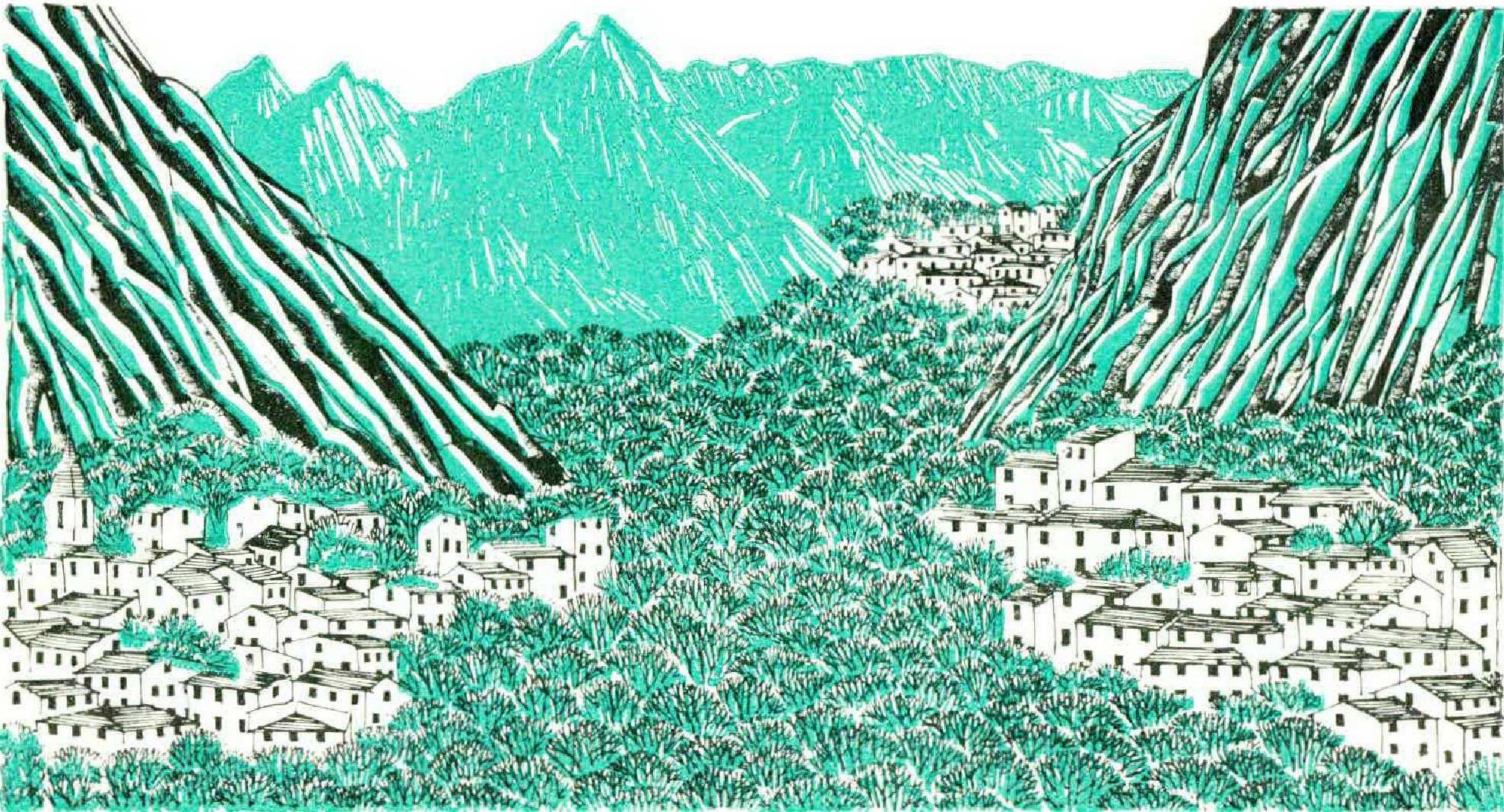
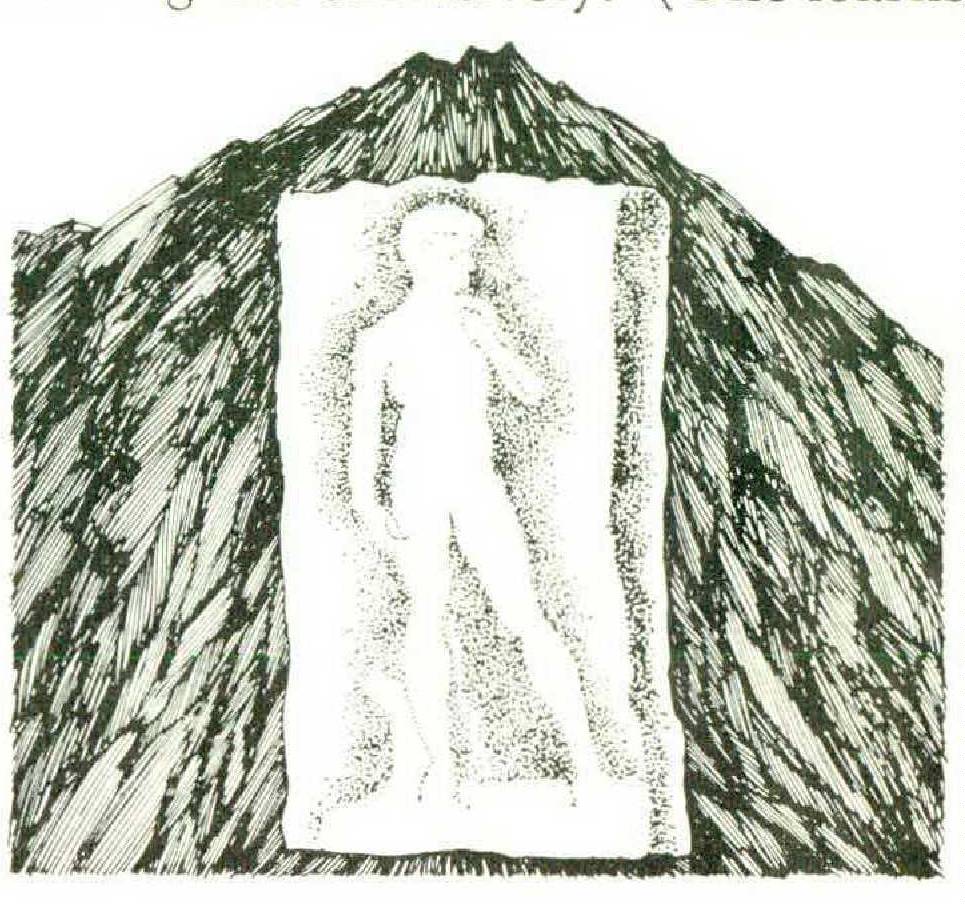
The Apuan Alps are a pocket range of extreme ruggedness whose principal peaks, just ten miles back from the sea, exceed five and six thousand feet in height. The impressive thing about these mountains in a country with many taller summits is that they rise right from sea level to more than a mile into the sky, with nothing but a narrow strip of coast separating them from the Mediterranean. So it is an absolutely clean and sudden six thousand feet. Also impressive is the concentration of these alps. Compressed into a very small area, this pile of jagged peaks and sharp ridges appears to be one massive impenetrable barrier of bare, awful rock; and for the most part is. Yet in the midst of this stony wilderness one finds a tremendous industry of mountaintop quarrying. And up in the cul-de-sac valleys, in tiny gloomy towns that are remote, though fifteen minutes from the center of modern Massa, lives a population of marble cutters, a people of remarkable, even heroic, endurance.
Early on the morning following our visit to the quarries, we set out again on shanks’ mare — or as it is called in Italian, St. Francis’ horse — for a really good excursion. How far we would go and exactly where, we could not tell. From our eyrie at San Carlo we saw three villages set on the mountain slopes one behind the other in a straight line. Pariana and Altagnana were on the wooded slopes of one mountain; Antona, higher up, was on the slopes of another. It was above Antona that we hoped to go, beyond where the road doubled back on itself in long tight turns like spilled ribbon, to a pass over the first treeless mountains that rose as a wall back of the village.
The morning road was cool, shaded by the thick scrub growth of chestnut trees. Being but a narrow shelf carved in the steep slopes, it kept to the contour of the mountain, tracing in and out the sides of deep wooded ravines. Each turn presented new sights, and from across the great open spaces the various sounds of quarrying carried to us and set our eyes searching for each source. A snarling engine miles and miles away turned out to be an old U.S. Army truck loaded with an enormous block of marble; looking like an ant under a huge crumb, it felt its way down a mountain track in first gear, more slowly even than a man could walk. The ringing of sledgehammers on steel: up on a spur peak, a lonely marble promontory of Mount Belvedere where the Madielle quarries were, three men astride a partially excavated block drove wedges into the rock. From somewhere else came a dynamite blast, no greater in sound than a gunshot, and then a pattering as of rain on leaves. Rocks and boulders showered down the mountainside, tumbling into the ravines as far as the battered tree line.
We reached Antona by noon. The town was touched by the highway, but no road entered it. None could. Its streets, cool narrow stairways and passages, were open only to foot traffic, for Antona was a jumble of stone houses piled together one above the other on a steep slope. Walking, or climbing, along its ways with just a crack of shining sky straight overhead was like walking down miniature canyons. Only with a certain instinct did we make all the right turns and come to the center of the maze, Antona’s tiny square, a cement-paved opening among the doorways that was hardly bigger than a dance floor. At once, strangers being rare in such towns, we attracted attention; children backed away in fear, and adults gaped. We went into a couple of cavelike places and bought bread and cheese, cold meats, and beer to cat somewhere above the town under the last trees.
At a grocery in an Italian village you do not get service, you submit to it. Several people — loiterers or customers? — are ahead of you. Waiting, you follow the progress of one of them shopping, which runs like this: over each item she purchases, one at a time, the customer deliberates in silence, then semiaudibly makes up her mind, then discusses it publicly and thoroughly, and finally is served. Her next item: deliberation, decision, thorough discussion, service; third item: idem. Oh, it’s a medieval torture when there are three or four of these women before you without a queue to indicate just how many. Medieval, too, because village women buy nothing their mothers and grandmothers had not bought day in and day out before them. Surely one-tenth kilo or one-and-one-halftenths kilo of salame need not be the greatest decision of their lives. At least there are always chairs around for the rest of the customers to sit in. But I stood, and when my turn came I asked for two bottles of beer to be drunk now and another couple to take with me. The unusualness of the request caused a stir, but a mere ten minutes’ worth of bustle ironed it out. I was brought two bottles almost right off, then made my other purchases; only at the end were the other two beers brought out. It was not that the beer might have warmed; it had never been chilled. Making two trips for four bottles of beer kept in a distant back room was just Italian style. By the time the last of the beer arrived, my collection of packages was popping and the contents sliding out, for the paper the stuff got wrapped in had been cut too short. What’s done must be redone. The lady grocer announced:
“Better cut some bigger pieces of paper.”
“No, don’t bother.”
“It’s no trouble.”
“All right, then.”
“You don’t want it?”
“No, it won’t be necessary.”
“But I’ve cut the paper now, and it’s half done anyway.”
While the other half was being done, and before I could escape (because I knew the packages were about to pop again), I studied some postcard views of the town that lay dusty and half-buried under the litter of the counter. An old-fashioned sepia photo of a highway bridge spanning a gully, and another of the town’s church, whose only distinction was that it was unusually ugly for Italy. Twice I leafed through the pile of old postcards for other views, but there were only the two scenes, the highway bridge and the church. Amid the wide natural splendor of the mountains, the absolute dreariness and narrowness of the town suddenly struck me like a blow. We departed in haste.
Out into the little square, bearing terrible appetites, we had to face our major problem: how were we to get out of the place and onto the path above the town, which cut off a couple of kilometers of looping highway? I asked a group of women who sat chatting on the parapet of a wall, and my worst fears came alive: it seemed that the possibilities of egress were infinite and many of them subtle. A path existed all right, but there was enormous discussion and vast disagreement among them about reaching it. They pointed, but their pointing was valueless because their hands indicated only the blank walls of the stone houses which I could see neither over nor through; besides, they pointed in different places. But among the five, one of the women spoke up positively, using such explicit terms as “third left” and “second right.” The others, who sabotaged her efforts, said things like, “They should go to Francesca’s house,” or, “They might cut through Carlo’s olives.” Plainly, their directions would never do; instead, I pursued my good woman’s instructions, from there on questioning and hearing her exclusively. (One learns to develop this faculty of eliciting a single right answer after several months in Italy, for country Italians, though well intentioned, give directions poorly.)
In five minutes we had come out of the maze and were spreading our food at the edge of an olive grove under huge chestnut trees. A little woman came down the rocky slope striding with seven-league boots; balanced on her head was a burlap rag the size of a bed sheet and stuffed with grass, and behind her, trotting to keep up, was a great female goat. The woman was more surefooted than her beast. We looked out onto the roofs of the town, which were like one great roof gone crazy and fallen to many pieces. And I began reflecting to myself on the Italians. Take them seriously and they will break your heart; but see them comically, plunging into their midst only on the edge of caring, and you will survive and even enjoy them and their country. But — as history shows — pity the man of strict principles in that incongruous nation.
Now we began climbing. The old road, which once ended at Antona with only a track continuing over the mountain to the Fioba Plain, was being converted into an excellent modern highway, asphalted, and with great thick stone walls bearing the tight hairpin turns. We scrambled straight up between these long switchbacks to save ourselves miles of road. At the top there were no more trees, just rock and a burning sun. For a half mile we kept to the highway until reaching a small new hotel that was wedged in the rock and looked like a Swiss chalet. Its proud owner, a schoolteacher from Antona, was at work with masons laying paving stones in the drive. We had drinks with him on a small porch, looking far down from where we had come to a triangle of sea that showed between the mountains. He spoke enthusiastically about parties of Germans and Englishmen who drove up from the coast nights to watch the stars over the mountains and enjoy the vast silence and eat great meals of hare and polenta. We told him we were Americans. He said he was a sculptor and that his town, Antona, had commissioned him to do a bust of the late President Kennedy.
“How did that come about?” 1 asked.
“Antona is a very Catholic town,” he said,
“Aren’t all these towns very Catholic?”
“Not the same as Antona,” he said. “We loved your President. I have written Mrs. Kennedy.”
He led us to a corner of the hotel yard where the footpath wound up to the pass.
“ Tante graziei.”
“just follow the orange blazes.”
The path was a taste of real Alpine country. At first it turned between tall stone fences that bounded tiny pastures and bits of garden and vineyard, but soon it was in the open. From there on, the ground was all broken stone and tufts and pockets of dwarf flowers — yellows and whites and blues. Back and forth and tip zigzagged our way. Against the sky stood a hut that looked like a goatherd’s shelter, and nearby, a thin cross of iron was planted in an outcrop of the rock. We were some time climbing before the cross and the stone hut appeared any closer. On entering, we found it to be a sanctuary marking the spot where a supposed religious miracle had taken place two centuries before. There were stubs of burnt-out candles on the floor and an old fresco, scratched and fading, on one wall. It was not a good piece of work, yet there was something touching in the devotion of men who would climb such heights, and with wet plaster and paints commemorate an occasion that was dear to them. A marble plaque erected on the bicentennial of the legend attempted an explanation, but the text was so poorly composed I could not tell what it meant to relate. I am by nature out of sympathy with religious beliefs, but it was impossible not to admire the rough simplicity of the little enclosure nestled there in the absolute silence of the mountains high above all human habitation.
A lew rods beyond the shrine lav the pass. There we sank down on tufts of soft thick grass, and in awe and wonderment beheld all the Apuan Alps before us. Over the rim and across a vast bowl were the lofty stone peaks of Tainbura and Cavallo and the Sell as. And far, far below, in gullies too narrow to be called valleys and where no trace of road could be seen, were a few isolated, sparsely settled villages. No more of them showed than their rooftops, a half dozen or so strung in a single row along hidden roads. The atmosphere was windless; we drank in the great emptiness. Here at last was what we had come for: desolation enough to soothe the sorest American soul.
The next afternoon, wanting to see what it was like down under the mountains, I went alone on the bus along the Frigido to the last stop, a forsaken little town called Forno. I should have imagined the place beforehand— the gang saws slicing the marbles into thin slabs in big sheds by the river, clouding the water with stone dust; the acres of pulverized rock around the stonecrushing pits — and not found it so depressing. But where desolate nature may be inspiring, desolate humanity is not. Forno was pressed in at the bottom of a gorge that was wide enough to accommodate only the narrow river and the narrower road running alongside it. But somehow the men there had managed to squeeze tall houses in, both by the road and, spanning the stream with footbridges, by the river as well. No side streets, no sidewalks, just fiveand six-floor row houses with rock walls pressing in behind. To turn around, the bus had to drive above the town and back into a slot blown out of the blue-black ledge. I walked through the town toward the quarries, stopping only to take in a nightmarish tenement that overlooked the river. It was a longwarren of live floors, with corridor balconies running its full length; eight doors opened on to each balcony, and by the forty-eight or more chimney pots on the roof, I estimated some forty families lived there. Half of them swarmed the balconies, gazing down on the heap of garbage and refuse turning pulpy on the rocks of the shallow river. Where the women washed clothes, discarded rags thrown from the heights had been caught in the leafless shrubs and bloomed there. I went on, walking past signs that warned of the blasting, and into the stone pits. Here was an end-of-the-world sort of place where suddenly the rock rose up in vertical stratifications, as if the bowels of the earth had gushed out in a flamelike column and then been frozen forever.
On my return I paused to talk with a man, and together in the late afternoon gloom we looked down from a bridge into the dizzyinggorge. Wagtails bobbed among the rocks in the stream bed. 1 had been reading the history of the Resistance movement and asked him what it had been like in Forno then. The partisans, who to my mind showed themselves the most principled Italians of recent times, had been ten thousand strong in the valleys of Massa-Garrara during the last months of World War II.
He himself had been a prisoner of war in Africa, he said, but the town had been quite active in combating the Germans the summer of 1944 and the following winter. He then told me about the Germans’ act of reprisal, the Forno massacre, when one day the enemy came into the town with a force of tanks, rounded seventy-five young men out of their homes (they ranged in age from eighteen to twenty-five), and machine-gunned them to death by the river below the town. After I heard that, the terror of the place seemed complete. Only a few minutes later, barreling along in the bus, I saw the spot marked by a memorial in a niche of the canyon wall.
Perhaps, after all, the human lives under the mountain were not so desolate as my eyes had superficially judged. Certainly, considering the record of the partisans, I had encountered splendors down in the valleys of these Apuan Alps as well as on the passes. So it seemed to me on the way back to the hotel at San Carlo.