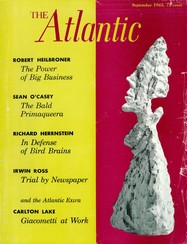
September 1965
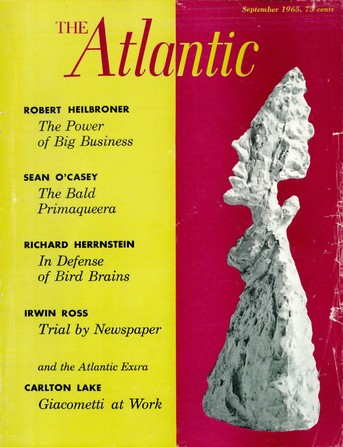
In This Issue
Explore the September 1965 print edition below. Or to discover more writing from the pages of The Atlantic, browse the full archive.
Articles
The Quiet Victory of the Cigarette Lobby: How It Found the Best Filter Yet—Congress
A Cincinnati-born, Wellesley-educated magazine writer and author of children's plays, Mrs. Drew lives in Washington with her lawyer husband and writes as a freelancer. A former staff member of the Congressional Quarterly, she has had ample opportunity to study that Americanized Byzantine process by which the United States Congress deals with issues before it.
In Defense of Bird Brains
A Harvard professor has I rained pigeons to scan reconnaissance photos, spot industrial faults, and perform other feats now under security wraps. Richard J. Herrnstein, director of Harvard’s Psychological Laboratories, here describes his experiments.
Wo Plumbing & for Negroes
When a Tennessee land-reform project brought better living conditions for Negro farm workers, the local White Citizens Council intervened. Solon Barraclough, who led the fight for these reforms, is a Harvard-trained economist, now project manager of an agrarian reform project in Santiago, Chile, and professor of agricultural economics at Cornell University. His collaborator, Frances Barraclough, has a graduate degree in economics from Radcliffe.
The Strength of the Light Rod
The founding editor of ESQUIRE and publisher of that magazine since 1952, Mr. Gingrich is known among his angling friends as a devoted fly fisherman who has scored a success with his skillful handling of light rods and light tackle. We are happy to publish the following excerpt from his new book, THE WELL-TEMPERED ANGLER, soon to f>e published by Knopf.
The Wisdom of Giacometti
Swiss-born Alberto Giacometti in one of the world’s most controversial sculptors. A major exhibition of his work, now at New York’s Museum of Modern Art, wilt go to Chicago in November and to California next year. Last fall, while he was preparing for this exhibition, Carlton Lake, American art critic and collector, talked with him in the Paris studio where he has worked for forty years.
Upstaging the British
The Power and the Glory
ALAN COREN is assistant editor of PUNCH. This is his first appearance in the ATLANTIC.
Subways Are for Dancing
PHILIP HAYES is a native of Lynn, Massachusetts, and works near Boston for the U.S. government.
The Dinosaurs at the Fair
In the Apuan Alps
Algeria
Record Reviews
The Peripatetic Reviewer
Reader's Choice
Potpourri
Rhodesia
West Germany
Washington
Trial by Newspaper
A longtime contributor to magazines and a former reporter on the New York POST, Harvard-educated Irwin Ross is the author of STRATEGY FOR LIBERALS(1949) and THE IMAGE MERCHANTS (1959). He lives in Manhattan and travels widely in the United States and abroad in search of material for articles and books.
The Bald Primaqueera
It is fitting and typical of Sean O’Casey that his last work, this essay on the theater of decay and despair, should be more than a polemic . It is a vigorous affirmation that life is worth living from a great playwright whose own early work set off a riot in a Dublin theater and was called “sewage .”Mr. O’Casey wrote the article a few weeks before his death last September at the age of eighty-four.
Poems
On the Edge of Arcadia
In July, 1961, the ATLANTICintroduced to its readers a new young writer, Tom Cole, whose story “Familiar Usage in Leningrad" subsequently won the Atlantic “First” prize and an O. Henry award. The following story will appear in his book AN END TO CHIVALRY, to be published next month by AtlanticLittle, Brown.
The Lost Ticket
The Power of Big Business
Benders of such books ;is THE WORLDLY PHILOSOPHERS or THE FUTURE As HISTORY knolo Mr. Heilbroner’s talent for illuminating complex economics and complex personalities with bright and accurate prose, He studied at Harvard and is visiting professor of economics on the graduate faculty of Manhattan’s New School for Social Research: Currently he is working on a large-scale history of the industrialization of America.
Foghorn on East End Avenue
There is every evidence of an increasing interest in ATLANTIC poetry, As an incentive for writers yet unestablished, twice a year we set aside a number of pages in the ATLANTIC to be devoted to the work of young poets.
The Lovers
Return
Rafters
How Not to Write, What Not to Say
This literate survey of the pleasures and pitfalls of the English language is Ihe first of a series of reviews and essays that Mr. Kronenberger will write for Ihe ATLANTIC. His works include several novels and anthologies and many years’ worth of drama criticism. He is now professor of theater arts at Brandeis University