Subways Are for Dancing
PHILIP HAYES is a native of Lynn, Massachusetts, and works near Boston for the U.S. government.
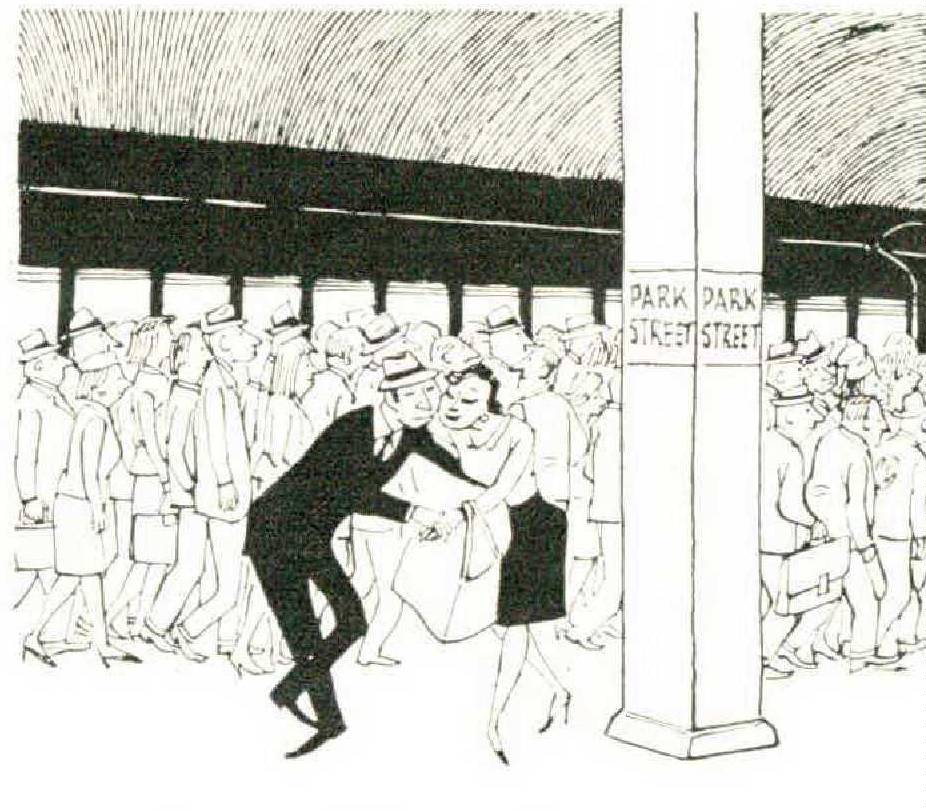
The experiment in piping music to subway platforms produced for me an adventure I shall long remember. It began the first time I heard the strains of Noel Coward’s “I’ll Follow My Secret Heart” bathing the white tiled walls of the Copley Square subway platform with its bittersweet enchantment.
Waiting patrons eyed their neighbors suspiciously, some gazing upward with amazement, while others pressed trembling fingers to their temples and studied the stomachdistress billboards with new interest.
A woman standing to my right smiled. “I love that, don’t you?”
“Yes,” I replied, “but what is it?”
“Something new.” she answered. “Piped-in music.”
“Very nice,” I said.
The throbbing show tunes were a sound track to our dialogue, making me feel, all at once, terribly British, terribly witty — a character in a him. Movie houses in the vicinity of Copley Square had responded to the call for a new Boston by no longer showing motion pictures. They all featured “films” — many English, all foreign.
“Quite,” the woman replied, entering into the spirit of things.
I couldn’t remember what I had said that was “quite,” but I felt that the moment demanded something, some sort of wild, bravura, impulsive gesture on my part.
“Dance?” I asked, extending my arms.
“Love it,”she responded, moving toward me.
We glided lithely between the poles and wastepaper receptacles, executing a graceful pivot that was marred somewhat when my partner struck her elbow on the Dentyne gum machine.
“Sorry about that.” I smiled ruefully.
“Quite all right,” she said. “It was nothing. Don’t think of it.”
“ fell me,” I inquired, “do you come from hereabouts?” I executed a slight dip while the string bag of groceries, suspended from her arm, swung in an arc and struck me soundly between the shoulder blades.
“Sorry about that.”
“Don’t think of it.” I said. “It was nothing. You still haven’t answered my question,”
She smiled, biting her lip. “I haven’t been quite fair with you . . . you see . , . I’m married. Oh, please don’t look at me like that. It hasn’t been working out. God knows I’ve tried, but who knows what makes the magic go out of a relationship? What do you call this step we’re doing now? It’s awfully effective.”
“I call it my double twinkle crossover,” I said.
“Awfully effective,” she murmured as the final notes of “My Funny Valentine” faded into the roar of an oncoming subway train.
“The music seems to have stopped.” I laughed. “Would you care for something?” I indicated the soft-drink vending machine.
“Only if I can pay for my own,” she replied. “I wouldn’t want you to think — ”
“I wouldn’t hear of it,” I interrupted. “I should never for a moment think — ”
“Well,” she pouted charmingly, “all right ... I will.
“Natural or carbonated?” I asked. “Grape soda, I think, uncarbonated .”
We stood there quietly, sipping. “Can I sec you again?”
She sighed. “We can’t go on meeting like this. It’s madness.” She pushed a can of enriched deviled ham deeper into her string bag.
“Please,” I begged, “say you’ll be here next Wednesday.”
“Perhaps.” She smiled, then turned and fled through the opened door of a waiting train.
How can I describe the incredible depression that followed me through haunted days and nights until the Wednesday when I would see Her again? I began to see her everywhere. Once, as the piped-in music filled the aisles of my local supermarket. I thought I spied her standing between the cold-cut freezer and a mound of grapefruit, tapping one foot and rocking rhythmically as she consulted the list in her hand. I tiptoed up behind her and whispered softly. “Dance?” A stranger glowered back, balancing a grapefruit thoughtfully on one palm.
“Knock it off.”she growled.
Again I thought I saw her in the drugstore examining a hot-water bottle, while die P.A. system blared “You and the Night and the Music.” As I danced toward her with arms outstretched, she turned into an ugly crone, who flung the hot-water bottle at me and inquired, “How much with tax?”
Finally — it was Wednesday. There was none of the strain of our previous meeting. She talked quite freely. I found out that she was a woman of some culture and refinement who had attended B.U., where she studied Ethnic Folk Singing I, II. and III and changed her name from Gladys to Natasha.
During intermission we were standing by the newsstand dividing an Oh Henry bar when a furtive-looking gentleman, the Lype usually encountered in stations several stops farther downtown, sidled up to us.
“I been noticing you,” he said. “You dance real good together.”
Natasha’s eyes danced into mine.
“Sir,” he went on, “I wondered if you’d be interested in a little something for the lady?” He removed a grimy hand from his overcoat pocket and extended it. On the third linger glistened a bluewhite diamond of incredible brilliance. “Fell off the back of a truck,” he explained.
The shrill blast of a police whistle echoed through the station.
“My God! The Cops!” the man cried, running toward die exit.
“I can’t become involved in anything like this,” shrieked Natasha, running for the waiting train.
I crumpled the paper cup, and with a slight shrug, flung it into the litter basket; then I turned and walked slowly toward the stairs leading to the street, while the music on the sound track swelled “It Was Just One of Those Things,” the characters dissolved, and the words “The End” filled the giant screen.