The Cornflake Syndrome
SUSAN FULLER is a writer and foreign correspondent, and is now spending some time in West Africa.
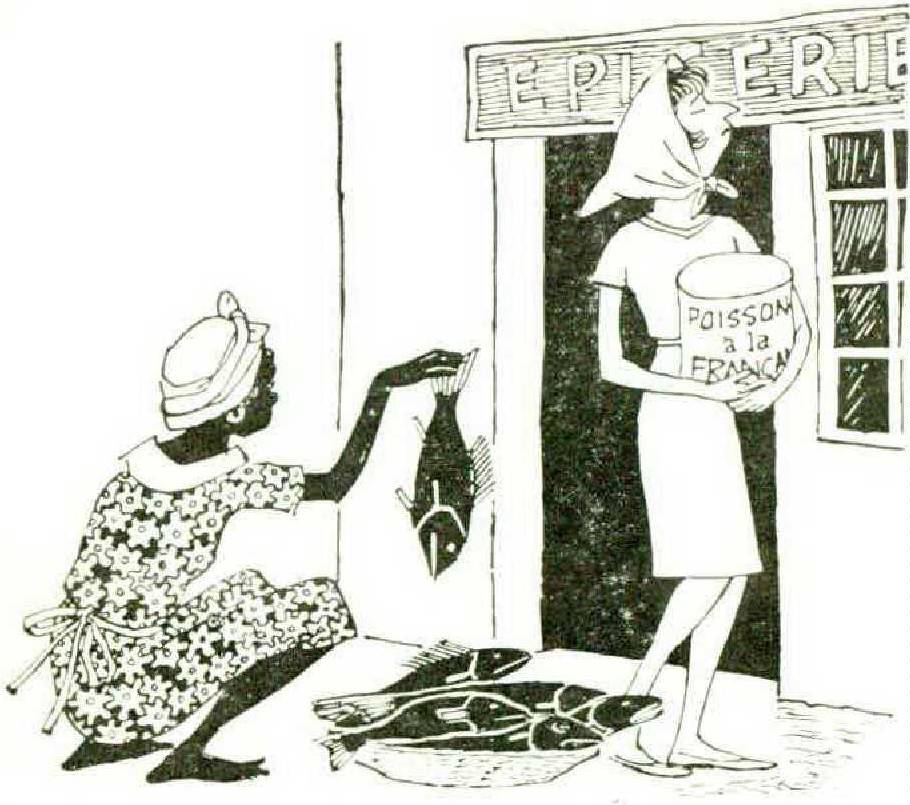
In the capital of the formerly French-administered west African country of Togo, the blackboards propped up every now and then outside the two small offshoots of famous French chain stores are considered to be a source of far more important news than the daily TogoPresse. They announce the date on which the next French boat with French food shivering in its refrigerated hold will drop anchor a few hundred yards from the shore. Every Frenchman in Lomé is on the lookout for it once its arrival has been announced, and there are happy, greedy smiles transfiguring every face once the lighters are seen to be on their way over choppy waters between the ship and the quay, unloading the delicacies for which every French femme de ménage is craving. Next morning the crowds in Monoprix and Scoa press toward the delicious Camemberts and Bries, the demi-sel and the fromage de chèvres, sigh ecstatically over genuine escalope de veau and minced horse. They might be restoring themselves and their larders after a siege.
Sometimes the joy is even more profound and the crowds even larger than when a boat has arrived. On these occasions it is a plane which has touched down in Lomé, and now the baskets are loaded with lettuce and carrots, grapes, artichokes, and peaches. There are even oysters and snails to be had and occasionally tiny, rather squashed shrimps. Prices, naturally, are astronomical. A lettuce flown 5000 miles cannot be retailed, even if limply faded, for a few cents; in fact the price is around three dollars. Other indispensable luxuries are similarly high priced, and although stomachs may be comfortably fuller after the next meal, purses are certainly uncomfortably lighter.
All this could be understood if Lomé were ungenerous to its European guests, providing little for their gastronomic delectation and leaving them with that gnawing hunger for the produce of their own country, which is one of the most painful forms of homesickness. But it isn’t. Every morning fishermen delicately negotiate their frail pirogues over Atlantic breakers, crashing up the romantic palm-fringed sands. They haul their deep-blue nets out of a sea brimming with fish to disgorge sparkling and gasping catches of sole, tunny, mullet, mackerel, sardine, squid, and capitaine into the wicker baskets of the waiting market mamas. Who wants escalope de veau or minced horse when such delicious alternatives are available? Nor is this all. Crab, lobster, crayfish, still waving feebly as proof of their freshness, are a common sight in the town. They are hawked from enamel basins on the heads of tiny children, who frequently plead their wares in vain with foolish women feeling smugly superior because they have just bought a dozen frozen oysters or a handful of long-dead shrimps.
The story is the same with fresh vegetables and fruit. It is true that artichokes, peaches, and grapes do not grow in the climate of Togo, but bananas and avocados are almost given away in the market; mammoth pineapples are available for around fifty cents; and grapefruit, lemons, and oranges glow in brilliant shades of green and yellow to tempt housewives who seem to prefer serving colored squash out of a bottle to the fresh juice, which, let it be said, they don’t even have the bother of squeezing themselves. It is the same story with lettuce, carrots, cabbage, and leeks: all there in profusion to be bargained for, and all bought too often, stale and unprofitable, from the shops. “But the lettuce in the market doesn’t taste as good as our own,” protest women who have never tried. And perhaps the reason why the withered airlifted carrots are preferred to those that shine like a hundred suns from their morning scrub is that they are still encrusted with the hallowed soil of la patrie.
For some strange, snobbish reason, everything grown locally is thought to be inferior to anything sent from abroad, or if not exactly inferior, then so ordinary as to be beneath the attention of a good housewife and certainly unworthy of offering to a guest. New arrivals in Lomé or visitors passing through are wined and dined very generously, but seldom on local food. If meat is served, it has invariably been imported from France, although the market lamb, hacked at irresponsibly and alarmingly by vicious-looking men with long machetes, is not at all bad; and only Americans serve chicken because they have their own commissariat, where hygienically wrapped frozen fowl is available. No European thinks it amusing to pick out a bird, alive and squawking, from a pile on the dusty pavement, brought into town by an old harridan, who always hopefully demands twice as much as she expects to be paid.
In general, the French buy French food from the French shops, the Americans buy American food from their commissariat, and the British buy British food from Saccone and Speed. The result is that dinner parties have a sameness reminiscent of international hotels, with tinned smoked salmon only too often the pièce de résistance and tinned peas the only vegetable. “Do you know,” one distinguished visitor to Togo complained in horror, “the pineapple I was given here came out of a tin!”
The explanation for this odd approach to living in a foreign country is complex. An American doctor with the Peace Corps calls it the “cornflake syndrome” and says it stems from insecurity. “Most people,” he said, “hate experimenting with food — look how babies spit out something new. People only seem to feel safe with what they have got used to gradually over the years; and of course as far as Americans are concerned, they are just terrified of anything not wrapped in cellophane.” Among the French and the British, moreover, there is also a slight residual dread, a hangover from colonial days, of being thought to have “gone native.” Standards must still be kept up, even if no longer quite to the point of dressing for dinner in the jungle; and by standards is meant the transplanting of as much as possible of one’s own way of life onto the alien soil where one happens to be. The French don’t feel at home without Camembert, the Americans are uneasy without cereals for breakfast, and the British remain nostalgically partial to bangers and mash even when the sweat is running down their faces.
All this is sad enough, but perhaps the real tragedy is that the European attitude has begun to give the Togolese a sense of inferiority. The highly educated wife of a Togolese official in Lomé is a nurse and is out at work all day, but, she told dinner guests recently, she manages to find time to do all her own cooking because she enjoys it. “Did you cook this meal?” she was asked, as a series of rather boring European dishes came and went. “Oh, no,” replied the minister’s wife, “I got someone in to do the cooking tonight because I know Europeans refuse to eat anything but their own kind of food.”