Three Cheers for When
A regular contributor to PUNCH of light articles and literary criticism, R. G. G. PRICE lives in Sussex and writes for the ATLANTIC on a variety of subjects.
R. G. G. PRICE
Haydn was born the same year as Washington and died the year of Lincoln’s birth. Do you find this kind of information fascinating? Probably not. Where men were born seems to impress people far more than when. Shakespeare gets continually belauded for having been born at Stratford on Avon, but only once in a hundred years is he praised for having been born in 1564. Yet it was a splendid year, in which Marlowe and Galileo were born and Calvin and Michelangelo died, while Stratford, for all its charming setting, is the great example of a one-celebrity town. To go back to Lincoln, do you associate him with Kentucky or 1809? Yet 1809 was a vintage year, with the birth of Poe, Oliver Wendell Holmes, Tennyson, and Darwin. It was also the year that Napoleon divorced Josephine.
Places stick in the mind better than dates, words better than numbers. Children find it easier to remember that the capital of France is Paris than that the French Revolution broke out in 1789. My friends are often puzzled that I am prouder of being born in 1910 than of being born in South London, which, for all its plain-spun virtues, is a fraction dull. But if the place is unexciting, the year is magnificent. The obituaries included Tolstoy, William James, Julia Ward Howe, and O. Henry. It was also enlivened by Crippen, who chopped up his wife, laid her under the cellar floor, and sailed for America, on the way to which he found detectives waiting for him and became one of the earliest casualties of radio. South Africa embarked on its career as a Union, and Korea was annexed by Japan. Speaking as a man born during the presidency of Taft, the premiership of Asquith, and the reign of Nicholas I of Montenegro (just), I can afford not to boast that in 1910 the legislative council of Ceylon was remodeled or that by this year, according to the rather cautious work of reference I am leaning on, the manufacture of celluloid had begun in Italy.
The Asians are popularly supposed to give names to years so that the mathematically backward can cope with time more easily. Instead of trying to remember four digits, they remember some poetic label like the Year of the Grasshopper. This has never been adopted in the West. The nearest we have ever come to it is the way racing men fix years by the winners of classic races. I once tried to popularize 1910 in my circle as the Year the Gods Blessed Man, but it did not catch on.
The Atlantic Monthly began life in 1857, but I expect more people think of it in connection with Boston than with the year when Conrad was born, Trollope’s Barchester Towers was published, and the Dred Scott case was decided by the Supreme Court. There was also Sir William Thomson’s quadrant electrometer; but I doubt whether thoughts in the office often turn to it. After all, the New Yorker’s the same age as Richard Burton, and how much does it boast about that?
Astrologers take birth dates seriously, though probably belief in their views doesn’t lead to any sort of chronological patriotism. I shouldn’t like to claim that the qualities of either Crippen or Tolstoy were discoverable in my own character. It is just that I feel a gentle nostalgia, an affection, a pride when 1910 crops up, and I think more people ought to take a pensive interest in the year that they share with so many others.
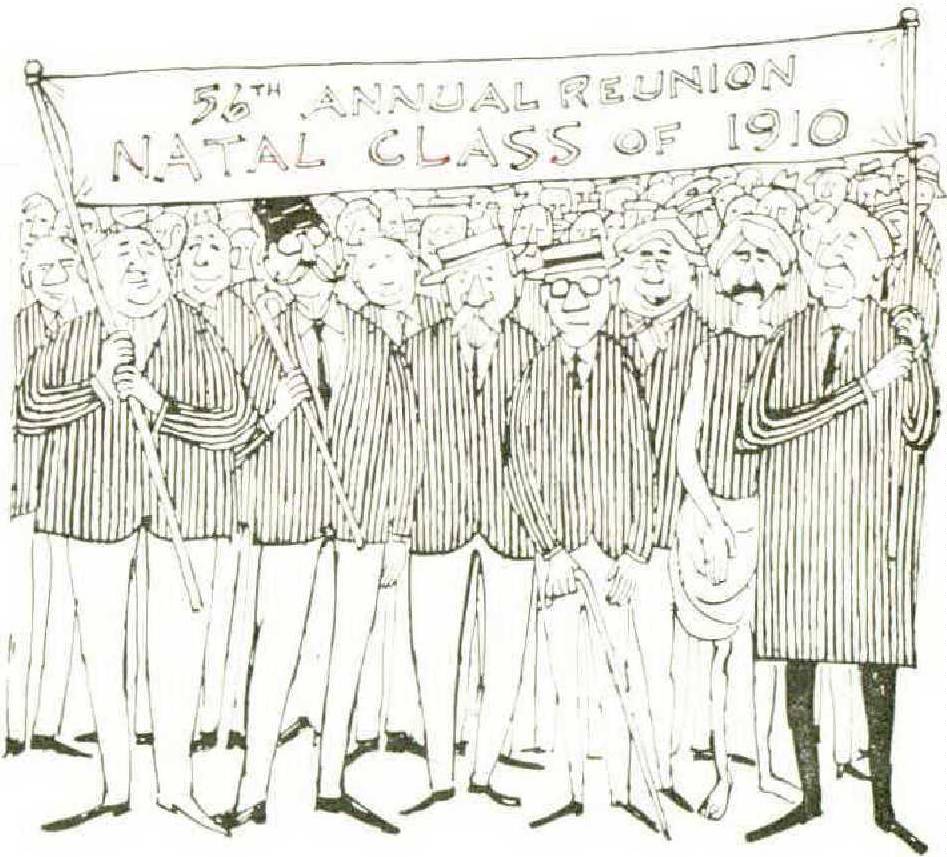
I can’t see, I am glad to say, the 1910 class ever ganging up in an organized association to run reunions and boost the good old year when we all first arrived on earth. No section of the community that has Tolstoy on its mental banners is going in for drum majorettes. I can’t see us bawling out, “One-nine-one-o, What do we know?” I can’t even see us meeting to eat vast meals, with an empty place for Crippen. But there is a middle course between the brash and the neglectful. I should like to think that scattered about the earth’s surface are sentimentalists who feel, like me, a twinge of loyalty and, like me, do nothing much about it. Heaven forbid that I should actually be in touch with my fellow nineteen-tenners; but it is cheering to know that they exist. One of our characteristics, I guess, is that we do not like externalizing our loyalties. We are a shy, retiring, publicity-dodging lot. If any expert on the lore of numbers likes to prove that we are gentle, sensitive, and an odd combination of brilliance and modesty, let him, or more likely her, go ahead.