The Wizard of Plockropool
“Follow the Yellow Brick Road. . . .”The words of the song kept running through my head, except that this wasn’t Oz but the Isle of Harris in the Outer Hebrides, and the narrow, bumpy road was far from being brick, yellow or otherwise. The wizard I was off to see was Miss Marion Campbell, who lives on a croft at Plockropool and literally weaves her magic by turning straight-from-the-sheep wool into Harris tweed. She spins the thread, Weaves the yarn, designs her own patterns, and nearly all the dyes she uses are homemade. There are very few women like her left these days in the islands.
Since replacing fishing as the main industry, most Harris tweed is now produced by the five mills in Stornoway, capital town of the Western Isles on the Isle of Lewis. Lewis and Harris are actually joined together by a narrow strip of land but in every other respect are quite separate from each other. Lewis comes under the county of Ross and Cromarty, Harris is under Inverness. Lewis is flat moorland, Harris is mountainous. There is even a slight difference between the Gaelic spoken in the two islands, and the Harrisman has more of a lilting accent. But the common bond between the islanders is the livelihood they make from tweed. There are approximately 1500 weavers, or “spiders,” who live in Lewis and Harris. Usually they work a croft as well as weave, and between them produce an annual total of over six million yards of tweed, 75 percent of which is exported to countries all over the world. The United States provides the biggest market by buying half of the total amount of tweed exported.
The Harris Tweed Association sets a high standard. All finished tweed must be passed by a strict inspection before being stamped at three-yard intervals on the reverse side of the cloth with the association’s insignia —an orb surmounted by a Maltese cross. In the case of finished garments, there should be an Orb mark label sewn inside. It was in 1964 that Lord Hunter gave judgment in the Court of Session, Edinburgh, that a tweed to be legitimately described and marketed as Harris must be made from 100 percent pure virgin wool produced in Scotland, spun, dyed, and finished in the Outer Hebrides, and handwoven by the islanders at their own homes “in the islands of Lewis, Harris, Uist, Barra and their several purtenances, and all known as the Outer Hebrides.” Therefore, only tweed legally recognized as genuine Harris tweed by the British courts can now bear the Orb stamp. Before this it seems even the Japanese got into the act by passing off an imitation cloth under the label “Scotty Harris Tweed.” The litigation was fought in Scotland and England for nearly five years, and the hearing continued for forty-nine days in the Court of Session. The whole thing was very complicated, and I’m told two million words were recorded by the court’s shorthand writers.
When the Harris Tweed Association was first formed in 1909, the yarn had to be spun by hand, the way Marion Campbell still does hers. This was a time-consuming task, so in the interest of steppingup production, the association amended the regulation in 1934 to the way it stands today. The mills scour, dye, card, and spin the raw wool in readiness for the weaver.
I saw two of the Stornoway mills in action, Stephen Burns Ltd. and Kenneth MacKenzie Ltd. The comparatively small Burns mill is owned and run by three brothers, one of whom, Calum Burns, showed me around. Although it was all carefully explained to me, I still came away with confused impressions — the clank and clatter of complicated machinery, the greenhouse atmosphere smelling of damp wool, skeins of black that looked like lengths of Polynesian hair, hanging from some sort of roller. I did learn, though, that the mixture for dyeing wool a particular shade is called a recipe, not a formula; and that there are eight feet to a weaver’s yard, not three.
The MacKenzie mill, founded in 1906, is the oldest in Stornoway, and they also have the only mill in Harris, at Tarbert. I had the same experience here but on a larger scale, as the MacKenzie mill is vast. When I looked through a glass porthole at the mixing room, the scene reminded me of something out of a James Bond picture. The chamber was filled from ceiling to floor with a wild storm of differentcolored wool being blown this way and that. I could just imagine some poor victim trying to claw his way to freedom before suffocating.
To my surprise I discovered virtually all weavers are men, not women as I had presumed. “It’s a man’s job,” I was told. Working from home, they own their own handlooms, which cost around $300 to buy new. The mills deliver the spun wool to them in gunnysacks with an instruction sheet giving details of the design required. The yarn is sufficient for thirty-three weaver’s yards, which make eighty lineal yards of woven cloth.
I visited Pringle Macaulay, weaver who lives on a croft at a tiny village called Shadder, about eight miles from Stornoway. Like most of the weavers on the islands, he had his loom set up in a shed near the house. In this case the shed was originally a “black house,” as the old crofters’ cottages were called. There were two rooms with thick stone walls covered with remnants of plaster and paper. In one corner was an open hearth, with hooks still dangling from a crude chimney where the cooking pots used to hangover the fire. I watched Mr. Macaulay half sit, half lean on a high stool that tilted forward. As he moved his feet on the treadle, the boat-shaped wooden shuttles whizzed back and forth and the loom clattered. Harris tweed was in the making. “It’s the foot rhythm,” he said. “Once you’ve got that you’re away.” I asked him how long it took to complete a length, and he said he worked an average of three tweeds per week, taking about thirteen hours per length. Ordinary tweed pays about £7 a length, and a more complicated pattern such as a tartan tweed pays £8.10. “It keeps me happy, and I always knock off work at lunchtime every Friday for the weekend.” Foolishly I agreed to Mr. Macaulay’s suggestion to “have a go” at the loom. Apart from discovering it was very hard work, I also found I had no sense of weavers’ rhythm. One of the shuttles failed to return, and the thread broke.
Another weaver I met, Murdo Nicolson (he doesn’t like his name to be spelled the English way, with an “h”), had recently been south to demonstrate work on a handloom at a big department store. He told me about a woman shopper who watched him weave for a while and finally said: “You know, I always thought Harris tweed was an aftershave lotion!”
Plockropool, where Marion Campbell lives, is a tiny place unmarked on most maps of Harris. Her croft is set back from the roughsurfaced road that meanders past hills, lochs, glens, and wild moorland. The wizard herself welcomed me at the brightly painted orange front door, a plumpish woman with brown eyes and gray hair braided neatly around her head. It was her hands that drew my attention when I first met her — they looked so red and shiny.
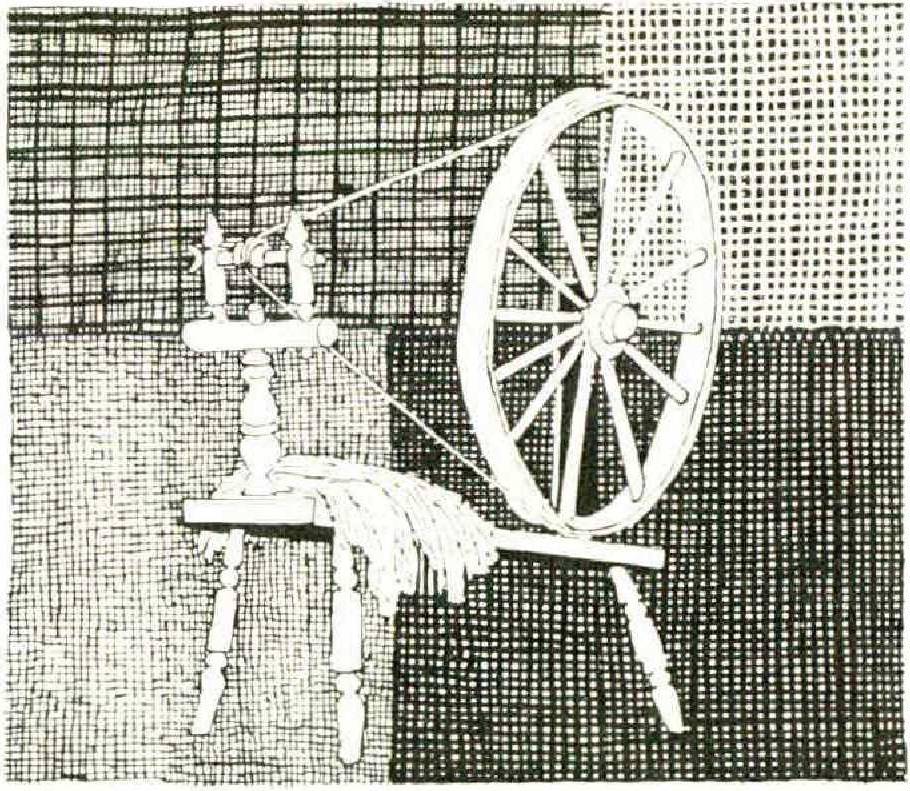
Miss Campbell took me inside to the parlor, a plain but cheerful room where linoleum roses bloomed on the floor and an old-fashioned black range heated by peat dispelled the chill. There was a framed tinted photograph of a young man wearing a kilt, and beneath the picture stood Miss Campbell’s spinning wheel. I sat on a leather sofa by the window that overlooked the hillside at the back of the house leading down to a loch. Directly outside was a little open porch, with reddishbrown fleece hanging on the railing. She noticed me looking at the wool and said, “That’s what we call a crottle brown. I make the dye out of crottle I get from the rocks. It’s like a lichen. Just take an old spoon and scrape it off.”
Miss Campbell put the kettle on and made tea for us, serving it with home-baked scones and country butter. I commented on the spinning wheel, and she told me her mother had given it to her when she was fourteen. “I remember I had just left school, and that was forty years ago, so now you know how old I am!” She refilled our cups, checked the fire, and continued. “When I was young, there was nothing else for girls to do then but spin and weave. There were eleven of us, and it was something I could do at home. Five of my brothers live here.” She ticked them off on her fingers. “Peter, John, Angus, Malcolm, and Alex. They take care of the croft and the sheep. I look after the house and the cooking. We’ve got a hundred head of black face; they yield the toughest kind of wool — it never wears out.”
Then I asked the wizard exactly how she makes her tweed, and this is what she told me. After the sheep are fleeced in the summer, she rinses the wool in the river “to get rid of the bits.” The wool is scoured in a tub with hot water and ordinary soap powder, and while it’s still wet she dyes it. She gets her dyes from many different things. “There’s green from heather, a darkish blue from iris; then I make yellow from bracken roots or sometimes peat soot, depending on the shade I want. And I blend them too. For instance, I can get orange from ragwood mixed with crottle. I use everything, even dandelions.” When she’s gathered all the ingredients, she fills a big pot with water, adds the flowers, and boils them over a good peat fire. “Keep it boiling all the time. With lichen moss, the better the fire, the redder the dye; and the longer I let it boil, the deeper the color.” Next the wool is put into the dye mixture and boiled. “Afterward I boil the wool again in alum or salt to fix the color before letting it cool.”
She sat down at the spinning wheel and showed me how she spins the yarn. “It’s really to put a twist in it,” she said. “There’s the warp and the weft. The warp is your strong thread, and it needs more twist than the weft, which is easier to spin.”
I followed her outside onto the porch, and she patted one of the reddish-brown fleeces drying there. “Crottle,”she said. We walked down the path to a shed with a corrugated iron roof. A man was repairing a boat in front of it, and Miss Campbell paused briefly to introduce me to her brother Alex. “He’ll be seventy-three in December,” she said. “He used to build boats, but now he just mends them.”
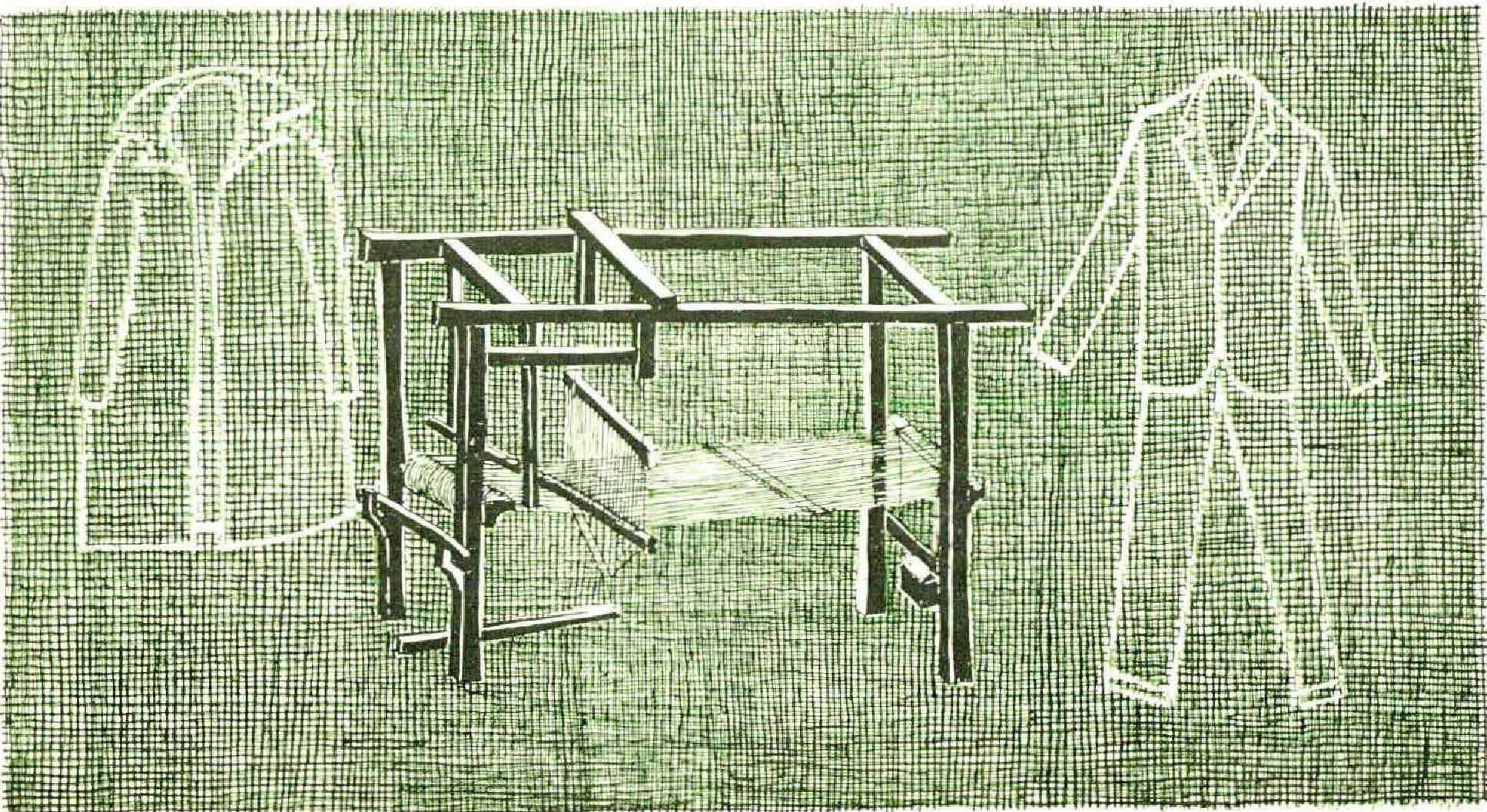
Inside the shed there was another boat that Alex was fitting with a new keel. Wood shavings littered the floor, and there was a hayloft under the roof. In one corner stood Miss Campbell’s handloom. “It’s fifty years old,” she said, looking at it fondly. “I wouldn’t thank you for one of those mechanized looms.” I asked her what the difference was, and she said that with her loom you pushed the shuttles from side to side by hand as well as working the foot pedal. She showed me how the threads were set up on the loom to make a particular pattern. “I’m not sending anything to the mills to be finished,” she said. “Others do that because of the work, but I’m used to it. And the fluff or pile is thicker on yarn done with my handloom.”
Miss Campbell told me that now she only made tweed ordered by individual people and no longer did lengths for shops such as W. Bill in Bond Street or the Highland Home Industries. “I used to do a lot of the brown and green mixtures, forty and fifty yards at one time.” She showed me a swatch of tweed that she had designed and won first prize with at the Agricultural Show in Tarbert last August. It was a four-color check weave of black, crottle brown, and green on an offwhite background. “Those are all my own dyes except for the green — that’s commercial,” she said. “I put different-colored threads on a piece of paper and move them around until I see which way they go best.” I looked at the design and fell in love with it. “Of course I can make it for you,” she said. “I never forget a pattern once it’s in my head.”
We left the shed and walked over to an outhouse where a cat and two kittens were sleeping. Miss Campbell filled a tub with hot water and soap powder, washed a length of tweed, then rinsed it. “Now this part really is hard work,” she said; “it’s called waulking the tweed.” I watched her sit at a table with a ridged wooden board on top of it and pound the wet tweed against the board with a drumming rhythm. “This shrinks it,” she explained. “At present the cloth is thirty to thirty-one inches wide, and the waulking shrinks it to twenty-eight inches wide, the width specified by the Harris Tweed Association. After I’ve waulked it, I give the cloth a final wash, and the tweed is ready.”
I looked at her red, shiny hands and thought of all the yards and yards of tweed they have handled. It was as if the wizard of Plockropool had guessed my thoughts, for she smiled and said, “I know it seems like a lot of work, but when it’s all done with, and you see the finished tweed, there’s no grander feeling.”