What's New in Fried Chicken?
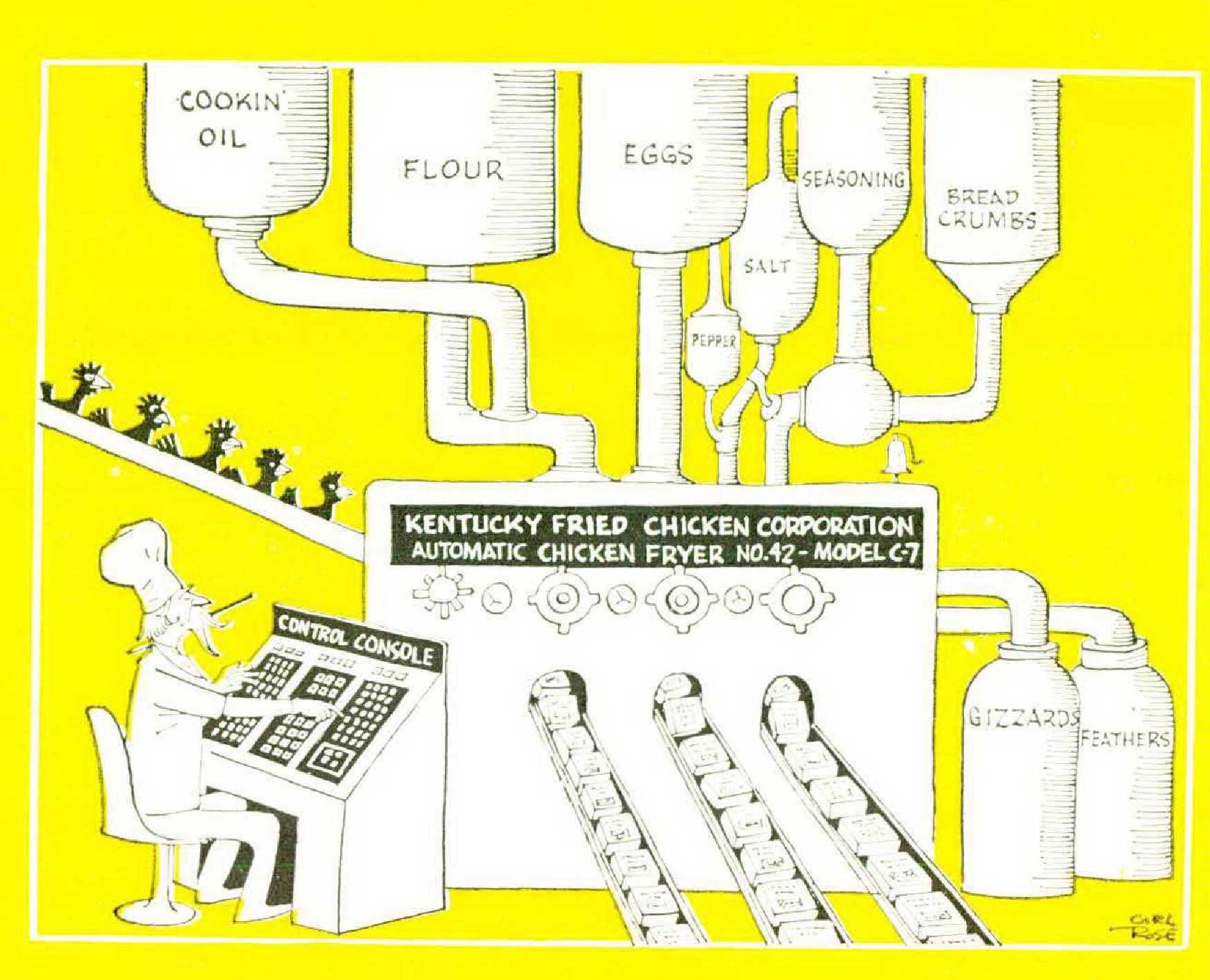
“This announcement constitutes neither an offer to sell nor a solicitation of an offer to buy these securities. . . .” The italicized note at the top of the advertisement went on to refer to the Prospectus and the underwriters from whom a copy could be obtained. Immediately flanking the note were the words “Not a New Issue.”
This cautionary language accompanies most financial advertising, and I mention it only to keep my terminology in order, for it was more the subject of the “announcement” than its precise legal status that caught my attention: the existence of 425,000 shares of common stock — “Price $15 per share” — in Kentucky Fried Chicken Corporation.
The regional touch in this otherwise austere piece of copy is a drawing of a white-haired man, with mustache, goatee, and string tie. The rest of the advertisement lists the twentyone underwriters from whom the Prospectus can be had.
The highly specialized corporation is certainly nothing new in American life. I think offhand of a company whose proprietors devised and patented a machine that does nothing but prepare and apply the batter and mix used in “breading” such foodstuffs as scallops and veal cutlets in vast quantities. The cost of their machine runs into the tens of thousands, yet it more than earns its keep in a restaurant — perhaps a government cafeteria in Washington — undertaking to serve 5000 portions at a single meal. The success of this company I think I can understand: it developed a machine to perform a service that no previous machine could accomplish. I myself am nursing along a small investment in a company which expects to “revolutionize” all television receivers. (I bought a few shares at 12, watched it decline instantly to 7, and am now uneasily letting it laze its days away between 12 and 15.) So far, its annual reports speak jubilantly of nonrecurring losses; the hydra heads continue to spout red ink as fast as the vigilant management lops them off; but at least I have the feeling that I may learn some bright morning that the revolution in TV receivers has come to pass.
While the revolution in television is still in the making, I cannot help wondering what expectation is causing hundreds or thousands of investors to dream great dreams about Kentucky fried chicken, dreams sufficient to gain support upwards of $6 million for an enterprise based on that commodity. What sort of developments would set Wall Street buzzing about fried chicken? The investment counselor, the financial editor, the broker’s letter—what would they be remarking in the friedchicken world, near term or long pull, that might lead to an upward movement of 10 or 15 points? True, there might be an intracompany struggle for control that would run the price up. There was the rich mineral deposit that the Curtis Publishing Company happened to find on its timberland in Canada, and something like this could very well befall the fried-chicken people — an oil strike under the incubator area or perhaps gold itself just outside the fry house. There is always the possibility, too, that a huge company in search of diversification might ask itself, “How come we have never gone into fried chicken?” and a takeover could follow at a fancy figure.
But any business could experience this kind of contingency, and there ought to be some bold stroke, some inspired decision by its management that would give the fried-chicken concern a sharp upswing overnight. I confess to a certain degree of regionalism, even of prejudice, in making this conjecture, but some of the very worst meals I have ever eaten were in the middle South, and the more Southern the dish was vaunted to be, the more discouraging it was in reality. I wonder, therefore, whether the Kentucky Fried Chicken Corporation might not score a great coup by firing the goateed man and his string tie, and moving its operation base and changing its name, becoming the Fried Chicken Corporation of Vermont.