Today marks the first anniversary of the release of images from NASA’s James Webb Space Telescope (JWST). JWST was launched in December of 2021, and now orbits around a point in space about 1 million miles from Earth. In the year since its debut, the new telescope has delivered a tremendous amount of data, fueling many new discoveries, and revealing some spectacular new views of the universe around us. Collected below, a handful of images from JWST’s first year in space.
A Year of Amazing Images From the James Webb Space Telescope
Hints:
View this page full screen.
Skip to the next and previous photo by typing j/k or ←/→.
-
![An image of deep space, showing numerous galaxies of varying sizes and shapes, featuring a pair of larger spiral galaxies at lower right]() Read more
Read moreA crowded field of galaxies fills this image from the James Webb Space Telescope, alongside a few bright stars crowned with Webb’s signature six-pointed diffraction spikes. The large spiral galaxy at the base of this image is accompanied by a menagerie of smaller, more distant galaxies, which range from fully fledged spirals to mere bright smudges. Named LEDA 2046648, it is situated a little more than a billion light-years from Earth, in the constellation Hercules. #
ESA / Webb; NASA / CSA; A. Martel -
-
![Massive clouds of swirling gas in space are illuminated by close stars.]() Read more
Read moreThis first-anniversary image from NASA’s James Webb Space Telescope displays star birth like it’s never been seen before, full of detailed, impressionistic texture. The subject is the Rho Ophiuchi cloud complex, the closest star-forming region to Earth. It is a relatively small, quiet stellar nursery, but you’d never know it from Webb’s chaotic close-up. Jets bursting from young stars crisscross the image, affecting the surrounding interstellar gas and lighting up molecular hydrogen, shown in red. Some of the stars display the telltale shadow of a circumstellar disk, the makings of future planetary systems. #
NASA; ESA; CSA; STScI; Klaus Pontoppidan; Alyssa Pagan -
![An infrared image of the planet Saturn, looking like a brownish-colored ball in space, surrounded by several bright rings.]() Read more
Read moreOn June 25, 2023, the James Webb Space Telescope focused on Saturn for its first near-infrared observations of the planet. The initial imagery from Webb’s NIRCam (Near-Infrared Camera) is already fascinating researchers. Saturn itself appears extremely dark at this wavelength, as methane gas absorbs almost all of the sunlight falling on the atmosphere. However, the icy rings remain relatively bright, leading to the unusual appearance. This new image of Saturn clearly shows details within the planet’s ring system, along with several of the planet’s moons—Dione, Enceladus, and Tethys. #
NASA; ESA; CSA; STSc; M. Tiscareno; M. Hedman -
![Huge clouds of interstellar gas swirl and form into pillarlike formations in space.]() Read more
Read moreIn Webb’s mid-infrared view of the Pillars of Creation, thousands of stars that exist in this region appear to have vanished (not easily detectable at that wavelength)—and the seemingly endless layers of gas and dust become the centerpiece. The detection of dust by Webb’s Mid-Infrared Instrument (MIRI) is extremely important—dust is a major ingredient for star formation. Many stars are actively forming in these dense blue-grey pillars. When knots of gas and dust with sufficient mass form in these regions, they begin to collapse under their own gravitational attraction, slowly heat up, and eventually form new stars. The Pillars of Creation is a small region within the vast Eagle Nebula, which lies 6,500 light-years away. #
NASA; ESA; CSA; STScI; J. DePasquale; A. Pagan -
-
![A view of a galaxy shaped like a small spiral within a much lager spiral.]() Read more
Read moreThis image shows one of a total of 19 galaxies targeted for study by the Physics at High Angular Resolution in Nearby Galaxies (PHANGS) collaboration. The nearby barred spiral galaxy NGC 1433 takes on a completely new look when observed by Webb’s Mid-Infrared Instrument (MIRI). NGC 1433’s spiral arms are littered with evidence of extremely young stars releasing energy and, in some cases, blowing out the gas and dust of the interstellar medium they plow into. The brightness and lack of dust in this image could hint at a recent merger or even a collision with another galaxy. #
NASA; ESA; CSA / J. Lee; A. Pagan -
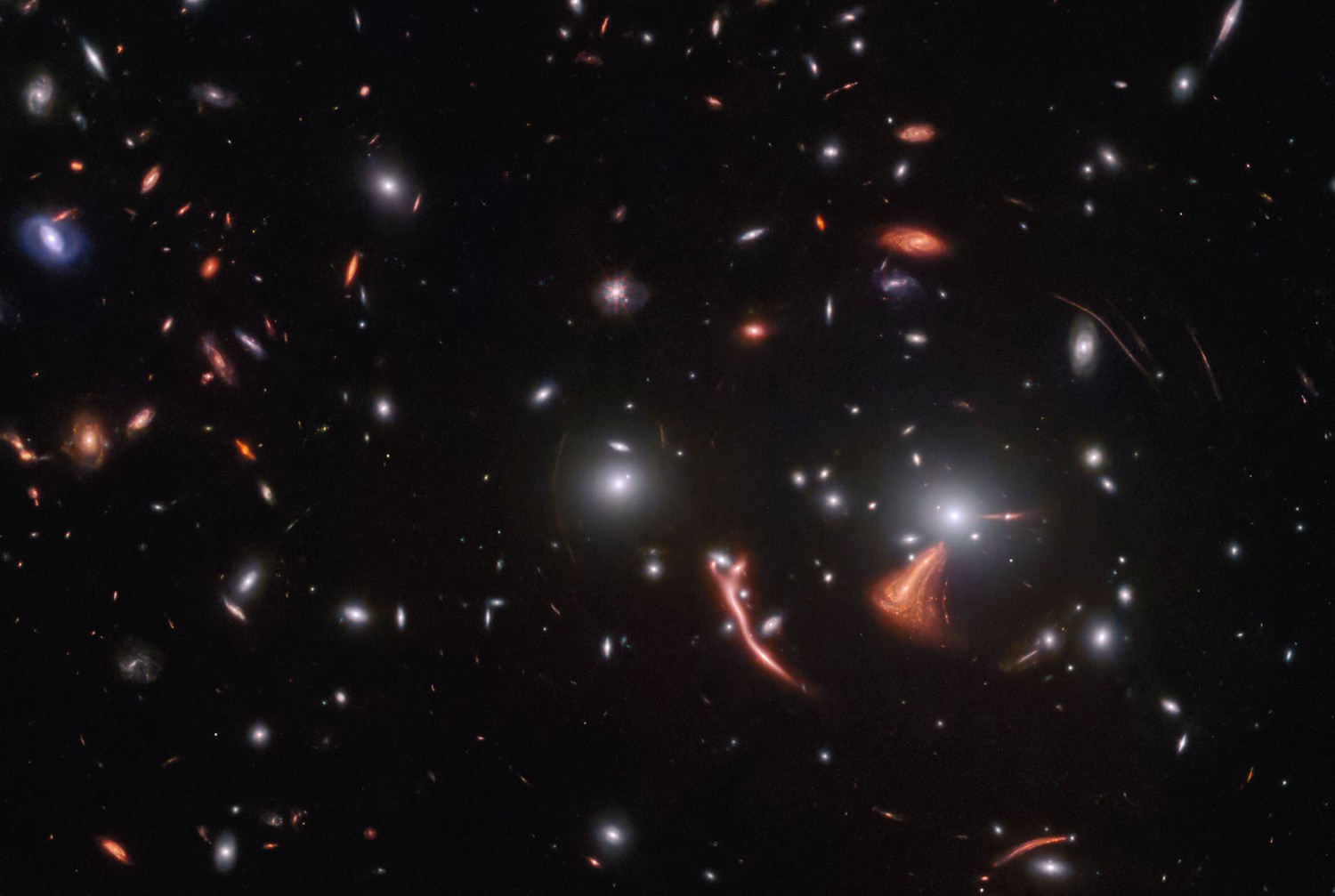
![A view of deep space, featuring dozens of small, distant galaxies, and one area that appears slightly warped, with several galaxies that look stretched and twisted.]() Read more
Read moreStreaks of light and bright arcs betray the presence of a vast gravitational lens in this image from the James Webb Space Telescope. A galaxy cluster in the foreground has magnified distant galaxies, warping their shapes and creating the bright smears of light spread throughout this image. This effect, referred to by astronomers as gravitational lensing, occurs when a massive celestial object such as a galaxy cluster causes a sufficient curvature of spacetime for light to be visibly bent around it, as if by a gargantuan lens. The long, bright, and distorted arc spreading out near the core is a distant galaxy known as the Cosmic Seahorse, its brightness is greatly magnified by the gravitational lens, which has enabled astronomers to study star formation there. Galaxy cluster SDSS J1226+2149 lies at a distance of about 6.3 billion light-years from Earth, in the constellation Coma Berenices. #
ESA / Webb; NASA / CSA; J. Rigby -
![A bright spot in space blasts material and energy outward in two broad cones, forming a colorful bowtie shape in space.]() Read more
Read moreThe protostar within the dark cloud L1527, shown in this image from Webb's NIRCam, is embedded within a cloud of material feeding its growth. The region’s most prevalent features, the clouds colored blue and orange in this representative-color infrared image, outline cavities created as material shoots away from the protostar and collides with surrounding matter. The colors themselves are due to layers of dust between Webb and the clouds. The blue areas are where the dust is thinnest. The thicker the layer of dust, the less blue light is able to escape, creating pockets of orange. #
NASA; ESA; CSA; STScI -
-
![A panoramic image of billowing clouds of gas among a field of stars]() Read more
Read moreA view of the edge of a nearby young, star-forming region called NGC 3324, in the Carina Nebula. Captured in infrared light by the Near-Infrared Camera (NIRCam) on NASA’s James Webb Space Telescope, this image reveals previously obscured areas of star birth. Called the Cosmic Cliffs, the region is actually the edge of a gigantic, gaseous cavity within NGC 3324, roughly 7,600 light-years away. The cavernous area has been carved from the nebula by the intense ultraviolet radiation and stellar winds from extremely massive, hot, young stars located in the center of the bubble, above the area shown in this image. #
NASA; ESA; CSA / STScI; J. DePasquale -
![The planet Uranus shines, seen on a black background, surrounded by several bright moons and a handful of faint galaxies.]() Read more
Read moreThis wider view of the Uranian system with Webb’s NIRCam instrument features the planet Uranus as well as six of its 27 known moons (most of which are too small and faint to be seen in this short exposure). A handful of background objects, including many galaxies, are also seen. #
NASA; ESA; CSA; STScI; J. DePasquale -
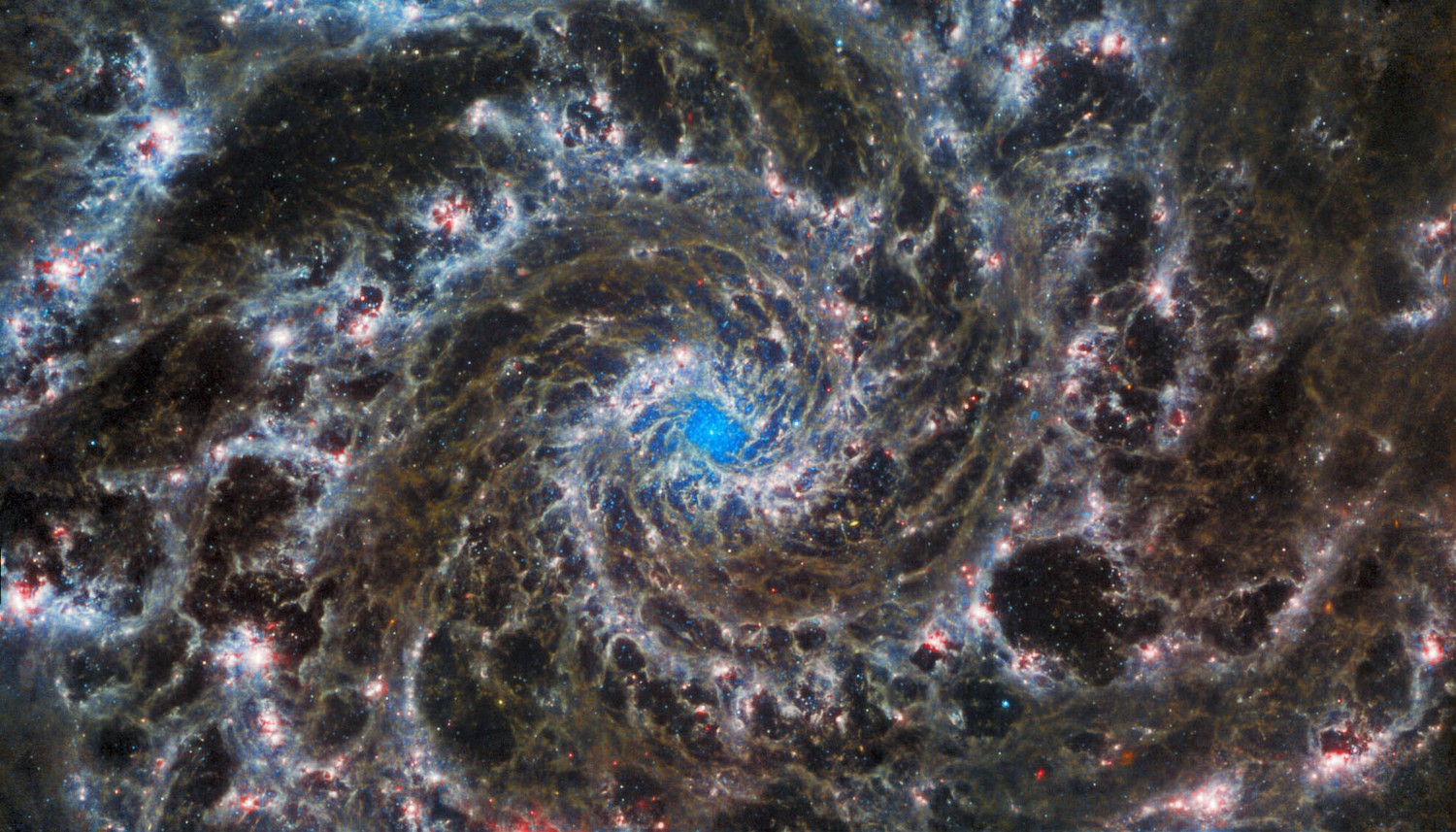
![A view of the swirl at the center of a distant galaxy, looking like a whirlpool of clouds and stars.]() Read more
Read moreThis image from the James Webb Space Telescope shows the heart of M74, otherwise known as the Phantom Galaxy, with delicate filaments of gas and dust in the spiral arms that wind out from the center of this image. A lack of gas in the nuclear region also provides an unobscured view of the nuclear star cluster at the galaxy's center. The Phantom Galaxy is about 32 million light-years away, and lies almost face-on to Earth. #
ESA / Webb; NASA / CSA; J. Lee and the PHANGS-JWST Team -
-
![A jumble of galaxies and galaxy clusters fills an image of deep space.]() Read more
Read moreAstronomers estimate there are some 50,000 sources of near-infrared light in this image. Their light has traveled over various distances to reach Webb’s detectors, representing the vastness of space in a single image. A foreground star in our own galaxy, to the right of the image center, displays Webb’s distinctive diffraction spikes. Bright white light sources surrounded by a hazy glow are the galaxies of Pandora’s Cluster, a conglomeration of already massive clusters of galaxies coming together to form a mega-cluster. The concentration of mass is so great that the fabric of spacetime is warped by their gravity. Gravitationally lensed distant light sources appear red in the image, often as elongated arcs. #
NASA; ESA; CSA; I. Labbe; R. Bezanson; A. Pagan -
![A bright point is space is surrounded by lines that fade away with distance, like ripples of light.]() Read more
Read moreLocated a little more than 5,000 light-years from Earth, this pair of stars is collectively known as Wolf-Rayet 140. Concentric shells of cosmic dust have been created by the interaction of the binary stars, appearing like tree rings. The regularity of the shells’ spacing indicates that they form like clockwork during the stars’ eight-year orbit cycle, when the two members of the binary make their closest approach to one another. #
NASA; ESA; CSA; STScI; JPL-Caltech -
![A detailed view of an enormous cloudlike structure of gas and dust, lit by young stars]() Read more
Read moreThis new view of the Tarantula Nebula displays the nebula's star-forming region, including tens of thousands of never-before-seen young stars that were previously shrouded in cosmic dust, in a view that spans 340 light-years across. The most active region seems to sparkle with massive young stars, appearing pale blue. Scattered among them are still-embedded stars, appearing red, yet to emerge from the dusty cocoon of the nebula. #
NASA; ESA; CSA; STScI -
-
![Two spiral galaxies merge in space, appearing twisted out of shape, throwing out tendrils of gas and dust.]() Read more
Read moreThis pair of merging galaxies, known to astronomers as II ZW 96, is roughly 500 million light-years from Earth and lies in the constellation Delphinus. As well as the wild swirl of the merging galaxies, many background galaxies are dotted throughout the image. The two foreground galaxies are in the process of merging and as a result have a chaotic, disturbed shape. #
ESA / Webb; NASA / CSA; L. Armus; A. Evans -
![Wispy clouds of gas and dust fill the image, with a handful of bright stars in the foreground.]() Read more
Read moreThis image by Webb's NIRCam features the central region of the Chameleon I dark molecular cloud, which resides 630 light-years away. The cold, wispy cloud material (blue, center) is illuminated in the infrared by the glow of the young, outflowing protostar Ced 110 IRS 4 (orange, left). The light from numerous background stars, seen as orange dots behind the cloud, can be used to detect ices in the cloud, which absorb the starlight passing through them. #
NASA; ESA; CSA; M. Zamani -
![A bright star sits at the center of a giant cloud of glowing gas and dust, amid many other fainter stars.]() Read more
Read moreThe luminous star Wolf-Rayet 124 (WR 124) is prominent at the center of this James Webb Space Telescope composite image that combines near-infrared and mid-infrared wavelengths of light. NIRCam effectively balances the brightness of the star with the fainter gas and dust surrounding it, while Webb’s Mid-Infrared Instrument (MIRI) reveals the nebula’s structure. Background stars and galaxies populate the field of view and peek through the nebula of gas and dust that has been ejected from the aging massive star to span 10 light-years across space. A history of the star’s past episodes of mass loss can be read in the nebula’s structure. Rather than smooth shells, the nebula is formed from random, asymmetric ejections. #
NASA; ESA; CSA; STScI; Webb ERO Production Team -






We want to hear what you think about this article. Submit a letter to the editor or write to [email protected].