



 Certain food writers try to see the world in a dish, believing that the greatest enjoyment derives from understanding the culture that produced something to eat -- the historic struggles and everyday pleasures that make something taste the way it does.
Few foods are as freighted as the bialy, a very plain small bread that many people confuse with a bagel, because it's flat and round and eaten by Jews. But a bialy made right still has soul -- tough, uncompromising, something to sink your teeth into, ultimately slightly sweet from the shredded onions in a small central indentation, and wholly satisfying. The bagel, of course, sold its soul years ago, turning unrecognizably sweet and puffy.
Previously in Corby's Table:
The Chowder King -- July 26, 2000
Corby Kummer on Jasper White's 50 Chowders, the latest from Boston's master seafood chef.
Simply Summer -- June 22, 2000
Corby Kummer satisfies his fresh-herb lust with a new book by Lisa Cowden, Ladle, Leaf, & Loaf.
Tuscany, Reluctantly -- April 26, 2000
Corby Kummer is tired of Tuscany, but he likes Pino Luongo's new cookbook, Simply Tuscan.
Matzoh Makeover -- March 22, 2000
Corby Kummer on Jayne Cohen's The Gefilte Variations, a new cookbook offering multiple versions of Jewish holiday classics.
Ham and Beans to the Rescue -- February 16, 2000
Weary of the Boston winter, Corby Kummer serves up "one of history's great couplings."
How to Cook (and How It Should Look) -- January 20, 2000
Corby Kummer on James Peterson's Essentials of Cooking, a kitchen primer that should fascinate beginners and old pros alike.
Encyclopedia Gastronomica -- December 22, 1999
Corby Kummer makes his way through The Oxford Companion to Food -- and still finds Room for Dessert.
Italian Soul Food -- October 14, 1999
Corby Kummer serves up selections from Lynne Rossetto Kasper's The Italian Country Table.
Countercultural Cooking -- September 15, 1999
Corby Kummer on Chez Panisse -- the influential Berkeley, California, restaurant that started as a countercultural collective -- and the new Chez Panisse Café Cookbook.
Charmed by Chile -- August 18, 1999
A new collection of home-style recipes reflects the Chilean way of life.
Hail to the Chef -- July 15, 1999
A tribute to Patrick Clark, a chef who was a model for many young African-Americans and an inspiration to other chefs.
More by Corby Kummer in Atlantic Unbound
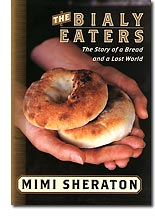
It was an arresting image from a writer I always read with pleasure, expecting nothing less than scathing opinions. And Sheraton dismisses not only today's bagels but most bialys, too, in The Bialy Eaters, a monograph she has just published about her seven-year, still-incomplete search for the origin of the "squashy, crusty onion-topped bread roll" she has always loved.
This is an unusual book on food -- not a cookbook, not a formal history, not a picture book. It starts with an epigraph of a man's recollection of "lying on the hard shelf that was my bed" at Auschwitz, as he tried to visualize the breads of his youth, and ends with a single, very detailed recipe intended for those foolhardy enough to try to bake a bialy, something Sheraton emphatically believes shouldn't be attempted at home. (Her advice is to order the real thing by Web or mail from the one place, Kossar's Bialys in New York City, that makes them well.) The book often reads like a very long magazine article (it's just over a hundred small-format pages), and rambles through story after story from survivors of Bialystok, the once-thriving Polish town that made the rolls, which were simply called "kuchen" (for something baked).
It's an oral history with many connecting threads -- mostly detailing Sheraton's efforts to track down living bakers who might still have bialy knowledge in their hands. She telephoned, corresponded with, and traveled to see anyone who could help answer such questions as why no other town made this exact bread, whether anyone in the old country ever split it to make a sandwich, as Sheraton does (only one person did), and when it was eaten (all the time).
In other words, the book is a lot of old Jews talking. Some of the speakers are tedious and are allowed to ramble too far afield into their post-Bialystok life stories, some are delightfully tart and no-nonsense. What held me were the generous flashes of Sheraton's turn of phrase ("huge, wide salamis" at a Russian flea market in present-day Bialystok "that looked as though they had been run over by a truck"), her humor and stern opinions, and her excellent travel writing as she goes to Jerusalem, Argentina, Israel, Chicago, and other places to find sources.
What distinguishes the book are the witnesses to a way of life that many of today's Jews want, and need, to know more about. Sheraton kept following leads -- more and more doggedly as time went on and questions remained cloudy. As it happens, Sheraton has no familial connections to Bialystok, although after enough years of immersion in its life she understandably wondered whether maybe she did -- or whether in some former life she had somehow walked the streets of the town in the days when there was a bialy baker on every block of the Jewish neighborhood. Saul Bellow and Elie Wiesel come in for cameos, but the featured players are the non-famous yet extremely engaged, tangily spoken residents of a community that was destroyed. The cumulative effect of the book is a longing to taste a real bialy; affection for the people who will argue over the best way to slice, slather, and eat a bialy to their last day; and enormous anger that gathering these stories required trekking around the world to follow a post-Biblical diaspora. That's a lot for a small book about a "simple and runty onion roll."
-- Corby Kummer
Excerpts from The Bialy Eaters: The Lost World of Bialystock's Jews and the Bread That Sustained Them by Mimi Sheraton
Internet shopping for bialys may be the only option open to those far from from New York, but it hardly compares with the human experience of going into Kossar's on Saturday at midnight or later, as bearded Orthodox Jews line up for bialys along with the purple- and green-haired young swingers who drop by after a night at the new, hip clubs now opening around nearby Ludlow Street.
If the future seems relatively safe for bialy purists in Manhattan at Kossar's, I did not find it to be so elsewhere in the New York area. Traveling to Brooklyn to try the specimens turned out by Bell Bagels and Bialys in Canarsie and the Coney Island Bagel Bakery on Coney Island Avenue, I found those, like others from Slim's in Queens and Nassau County, to be pale, strangely damp and rubbery, and topped with at least some of the dismal flesh-pink onions.
And even in Manhattan, Millie Graves, "the Bialy Lady" who is a renegade from the world of high fashion, has been creating designer bialys that she has sold wholesale for the past seven or eight years. Her bialys are much larger than the standards, and are topped with various vegetables and herbs, or nothing at all, not even onions and some are made of wholewheat flour, for a heavy, grainy effect. She also turns out other shapes from her bialy dough, including a sort of Pita pocket. Having tasted them intermittently through the years, I find them mildly pleasant as bread, but not worthy of the bialy accolade.
Beyond New York, things are even worse, a statement I make confidently after having sampled bialys from Miami Beach and elsewhere in Florida, and from Chicago, Scottsdale and Beverly Hills. All seemed underbaked and undersalted and, in addition to onions or garlic, might be made with blueberries or even raisins and cinnamon sugar. Weirdest of all, is one I picked up at the Broadway Deli in Santa Monica, a huge albinotic, floppy disk of almost raw dough smeared with glassy white squares of onions that looked bleached.
Nor do California bialys hold any charms for Meyer Galler, a food technologist who was born in Bialystok and loved kuchen as a child, and who spent ten years in a Soviet gulag where he wrote three volumes on Russian prison slang. Now living close to Berkeley, the 84-year-old Galler reports, "The kuchen was the symbol of Bialystok and there they were hard and crisp. But in California they are soft and white."
I must admit some responsibility for maverick bialys being created in Austin, Texas. There my good friend, Patricia Slate, the gifted cook and baker who owns the delectable Sweetish Hill Bakery, heard me rant about bialys and thought they might be novelties for her loyal breakfast clientele. And so she came to New York where Danny Scheinin and his bakers walked her through their methods, even giving her their recipe which she faithfully mastered.
Unfortunately, what appeals to New Yorkers can fall flat with Texans. Trying to be more authentic than Kossar's, Patricia Slate topped her bialys with poppy seeds, only to find that Texans wouldn't touch them and they also complained that the onions got stuck in their toasters. Some locals rejected the flavor of onions at breakfast but, surprisingly, loved garlic and bits of jalapeño peppers that were stirred into some of the dough for an interesting fusion flavor. In addition, like the young Wonder Bread set in New York, Lone Star bialy eaters prefer those that are very lightly baked and pale, and spread them with strawberry cream cheese as well as with the more suitable salmon and herb spreads. Patricia Slate reported that they also had trouble pronouncing bialy in the early days and tended to call them "bee-lees" and "bay-lees" and many just called them bagels.
"No one born in Bialystok can forget kuchen. It was the most important and popular food, like a hamburger in your country," [Arieh Shamir, a 74-year-old man living in Jerusalem] said, adding that he had visited the States several times, stopping in New York en route to California where his daughter lives. "Rich Jews ate kuchen with meals, and for poor Jews kuchen were the meal. Sometimes we had kuchen with tea and maybe a piece of smoked herring or other fish, or with a soup of cabbage and potatoes. We bought hot kuchen in stores and from street sellers who carried them in straw baskets, all in the Jewish section, close to the town clock. We ate them in the morning and in the night and in between....
"I eat kuchen in the United States when I visit my daughter in California, but, to tell you the truth, without poppy seeds, they're ridiculous.... Anyway maybe it's me," Arieh Shamir said a bit downcast. "Now I am old. When you're young, everything is tasty."
Corby Kummer is a senior editor at The Atlantic Monthly and the author of The Joy of Coffee.
More by Corby Kummer in Atlantic Unbound.
Copyright © 2000 by Corby Kummer.
Excerpts and illustrations from The Bialy Eaters: The Lost World of Bialystock's Jews and the Bread That Sustained Them by Mimi Sheraton. Broadway Books: New York, New York, 2000. Hardcover, 192 pages. ISBN: 0767905024 $19.95. Copyright © by Mimi Sheraton.
 |
 |
 |  |
 |  |