Edwin Muir, "The Combat" (February 26, 2003)
Read aloud by Peter Davison, Maxine Kumin, and Brad Leithauser. Introduction by Peter Davison
John Keats, "To Autumn" (July 17, 2002)
Read aloud by Sven Birkerts, Emily Hiestand, Stanley Plumly, and C. K. Williams. Introduction by Sven Birkerts.
"Sir Walter Ralegh to His Son" (January 30, 2002)
Read aloud by Henri Cole, David Ferry, and Linda Gregerson. Introduction by Linda Gregerson.
Robert Lowell, "For the Union Dead" (April 11, 2001)
Read aloud by Frank Bidart, Peter Davison, and Robert Pinsky. Introduction by Peter Davison.
Andrew Marvell, "To His Coy Mistress" (February 26, 2001)
Read aloud by Linda Gregerson, J. D. McClatchy, and Heather McHugh. Introduction by Linda Gregerson.
More on poetry in Atlantic Unbound and The Atlantic Monthly.
Atlantic Unbound | July 23, 2003
Soundings
Introduction by Brad Leithauser
.....
fter a brief illness, a charming and much-loved young woman lies dead—about this, there can be no doubt. But how is she to be memorialized? Now that's a question that serves only to generate further, ever-subtler, ever-more-troubling questions.
I don't know whether John Crowe Ransom (1888-1974) had anyone specifically in mind when he composed his poignant and elegant elegy "Here Lies a Lady." In the end, it scarcely matters whether his subject was mortal or immaterial, for we grieve over Ransom's enchanting woman, a "lady of beauty and high degree," irrespective of whether she actually existed. We respond in much the same spirit to perhaps his most famous poem, "Bells for John Whiteside's Daughter," which pays tribute to a dead girl in such exact, vital detail that it's hard to believe that in fact John Whiteside had no daughter. Or, for that matter, that Ransom didn't know anybody by the name of John Whiteside.
When Ransom put together the final edition of his Selected Poems, which appeared in 1969, he did a peculiar thing at the close of the book: he included "sixteen poems in eight pairings." In other words, he printed two versions—an A version and a B version—of eight different poems. "Here Lies a Lady" was one of those that made a dual appearance.
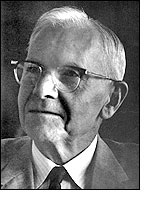
John Crowe Ransom
Ransom—who essentially abandoned the writing of poetry while in his forties, choosing henceforth to devote his energies to revision, to teaching, to scholarship, and to editing the Kenyon Review—explained his motivation for the "eight pairings" in his rather endearingly fussy prose; "My purpose is didactic, and even euphuistic: to see how a deficient poem may be whipped into something more satisfactory." And: "Let A stand for Average, for the sort of poem which is good enough to look for publication. And let B stand for Better; I must not say for Best."
Clearly, these were eight poems that Ransom had struggled to bring to a state of poised resolution. The inclusion of earlier drafts was a tacit admission of artistic roads not taken, of poetic appetites left unappeased. There is something a little defensive both in Ransom's dry contention that his "purpose is didactic" and in the firmness of his assertions of the superiority of the B poems to the A poems. One might speculate that Ransom, who was over eighty when the final edition of the Selected appeared, was understandably keen to put various vexing issues to rest. In any event, it seems safe to assume that he included the A poems because he discerned within them too much enduring richness to allow them to vanish utterly. He loved those A versions—and Ransom's admirers have discovered much to love in them as well.
Here are both versions of the poem—or, one might say, here is a pair of great ladies lying side by side:
Here Lies a Lady
A
Here lies a lady of beauty and high degree.
Of chills and fever she died, of fever and chills,
The delight of her husband, her aunt, an infant of three,
And of medicos marveling sweetly on her ills.
For either she burned, and her confident eyes would blaze,
And her fingers fly in a manner to puzzle their heads—
What was she making? Why, nothing; she sat in a maze
Of old scraps of laces, snipped into curious shreds—
Or this would pass, and the light of her fire decline
Till she lay discouraged and cold, like a thin stalk white and blown,
And would not open her eyes, to kisses, to wine;
The sixth of these states was her last; the cold settled down.
Sweet ladies, long may ye bloom, and toughly I hope ye may thole,
But was she not lucky? In flowers and lace and mourning,
In love and great honor we bade God rest her soul
After six little spaces of chill, and six of burning.
Here Lies a Lady
B
Here lies a lady of beauty and high degree,
Of chills and fever she died, of fever and chills,
The delight of her husband, an aunt, an infant of three
And medicos marveling sweetly on her ills.
First she was hot, and her brightest eyes would blaze
And the speed of her flying fingers shook their heads.
What was she making? God knows; she sat in those days
With her newest gowns all torn, or snipt into shreds.
But that would pass, and the fire of her cheeks decline
Till she lay dishonored and wan like a rose overblown,
And would not open her eyes, to kisses, to wine;
The sixth of which states was final. The cold came down.
Fair ladies, long may you bloom, and sweetly may thole!
She was part lucky. With flowers and lace and mourning,
With love and bravado, we bade God rest her soul
After six quick turns of quaking, six of burning.
ell, I get only as far as line one before I'd pick a quarrel with Ransom, based on punctuation. For me, the A version, with its period to close the line rather than the open-ended comma of the B version, does a far surer job of striking that note of awed solemnity, that sense of grave stillness and mysterious interruption, which the death of a young mother naturally evokes. Other readers may disagree, which seems all to the good—since disagreement is, I think, the most fruitful result of setting variant versions side by side.
For only out of disagreement will be born that noble production that waits here with a patient implicitness: the C version, the Consummate version, that as-yet-unwritten, never-wholly-glimpsed poem that would combine the best of A and B, achieving an incorruptible stasis at last. Notwithstanding Ransom's categorical plumping in favor of his revisions ("in the later stanzas B is far superior"), experience tells me that most readers will encounter, scattered throughout all eight pairs of poems, details they prefer in A and details they prefer in B. I know of no other body of accomplished poems that so beguilingly invites readers in and asks them to participate in the process of revision. I often find, in my role as a college professor, that students naturally hesitate when encouraged to propose alterations to canonical poems. They're likely to balk when asked to consider ways in which—restricting ourselves to Ransom's contemporaries—T. S. Eliot or Marianne Moore or e. e. cummings might be modified. And yet the search for a C version in Ransom—this is a quest taken up easily and ardently.
The variant versions encourage us to compile our own list of preferences, some of them extremely minute. Just as I considered the B version's comma in line one a mistake, the period at the end of the second stanza feels regrettable, given that our heroine is in the midst of a deadly fever, with one thing blurring into another. Surely the A version's em-dash does a better job of conveying the poor woman's slippery dissolution? And so the tallying goes ("rose" in stanza three is superior to "stalk," and "you" in the final stanza preferable to "ye"), as a new poem steadily, but always respectfully, erects itself.
Ransom's "eight pairings" provide a lively challenge to Paul Valéry's famous dictum that poems are never finished, only abandoned. Ransom looks to be contesting the notion at both ends—by treating the B versions as essentially finished, and by not quite abandoning the stages that brought the poem to completion. Yet the triumphant instability that Valéry insists upon reasserts itself each time a new reader goes off, pencil in hand, to pursue that elusive, fully satisfying C version—while aware that any such construction is apt to leave a host of readers unsatisfied, and perhaps a few of them inspired to wander off in search of that Dead-on and Definitive version D.
A charming and much-loved young woman lies dead—and if this is something we know from the poem's opening line, it's also something we might momentarily forget during discussions of As versus Bs, and periods versus commas, and yous versus yes. Ransom's own comments on the two versions turn initially to prosodic matters—as in his decision to substitute a pentameter ("Fair ladies, long may you bloom, and sweetly may thole!") for a hexameter ("Sweet ladies, long may ye bloom, and toughly I hope ye may thole"). Nonetheless, this particular self-described "didactic" man eventually turns out to be an old softie, as revealed in his later comments on the B version: "The third stanza, where chill replaces fever, is almost unutterably painful; but I was most intent upon it, and managed to the best of my ability. Lines two and three are the saddest in the poem; perhaps in all my poems."
And we are returned to the notion of how little it matters if Ransom had in mind a particular unfortunate woman when he wrote the poem. Whether or not our "lady of beauty and high degree," who while lying on her deathbed stitched and unstitched her clothes, was truly mourned by a husband and a child and an aunt, her loss was felt profoundly by a poet/professor/editor who stitched and unstitched his lines for her, seeking over many years at last to dress her suitably.
Click on the names below to hear these readers recite "Here Lies a Lady" (in RealAudio):
Mark Jarman is the author of several volumes of poetry, including Unholy Sonnets (2000) and Questions for Ecclesiastes, which received the 1998 Lenore Marshall Poetry Prize. His collection of essays, The Secret of Poetry, appeared in 2001. He teaches at Vanderbilt University.