| |

 Return to this issue's Table of Contents. |
D E C E M B E R 1 9 9 9
by Ian Frazier
| ||
|
Discuss this article in Post &
Riposte.
More on politics & society in The Atlantic Monthly and Atlantic Unbound. Related links:
United States Bureau of Indian Affairs
Allies of the Lakota
Voices from the Little Bighorn |
I kind of resent the term "wannabe" (what's wrong with wanting to be something, anyway?), but in my case there's some truth to it. I don't want to participate in traditional Indian religious ceremonies -- dance in a sun dance or pray in a sweat lodge or go on a vision quest with the help of a medicine man. The power of these ceremonies has an appeal, but I'm content with what little religion I already have. I think Indians dress better than anyone, but I don't want to imitate more than a detail or two; I prefer my clothes humdrum and inconspicuous, and a cowboy hat just doesn't work for me. I don't want to collect Indian art, though pots and beadwork and blankets made by Indians remain the most beautiful art objects in the American West, in my opinion. I don't want to be adopted into a tribe, be wrapped in a star quilt and given a new name, honor though that would be. I don't want to stand in the dimness under the shelter at the powwow grounds in the group around the circle of men beating the drums and singing ancient songs, and lose myself in that moment when all the breaths and all the heartbeats become one. What I want is just as "Indian," just as traditional, but harder to pin down.
In 1608 the newly arrived Englishmen at Jamestown colony, in Virginia, proposed to give the most powerful Indian in the vicinity, Chief Powhatan, a crown. Their idea was to coronate him a subemperor of the Indians, and vassal to the English King. Powhatan found the offer insulting. "I also am a king," he said, "and this is my land." Joseph Brant, a Mohawk of the Iroquois Confederacy, between eastern New York and the Great Lakes, was received as a celebrity when he went to England with a delegation from his tribe, in 1785. Taken to St. James's Palace for a royal audience, he refused to kneel and kiss the hand of George III; he told the King that he would, however, gladly kiss the hand of the Queen. Almost a century later the U.S. government gave Red Cloud, a victorious war leader of the Oglala, the fanciest reception it knew how, with a dinner party at the White House featuring lighted chandeliers and wine and a dessert of strawberries and ice cream. The next day Red Cloud parleyed with government officials just as he was accustomed to do on the prairie -- sitting on the floor. To a member of a Senate select committee who had delivered a tirade against him, Sitting Bull, the Hunkpapa Sioux leader, carelessly replied, "I have grown to be a very independent man, and consider myself a very great man." That self-possessed sense of freedom is closer to what I want; I want to be an uncaught Indian like them. When Columbus landed, there were about eleven people in Europe who could do whatever they felt like doing. Part of the exhilaration of the age came from the freedom that Columbus and other explorers were rumored to have found. Suddenly imagination was given a whole continent full of people who had never heard of Charlemagne or Pope Leo X or quitrents or the laws of entail, and who were doing fine. Amerigo Vespucci, the explorer who would provide the name for the continent, brought back news that in this land "every one is his own master." If this land new to Europeans was the setting, the lives of these untrammeled people suggested the plot: we could drop anchor in the bay, paddle up the river, wade up the creek, meet a band of Indians, and with them disappear forever into the country's deepest green. No tyranny could hold us; if Indians could live as they liked, so could we. The popular refrain about Indians nowadays is that they and their culture were cruelly destroyed. But beyond the sphere of rhetoric the Indians as a people did not die out, awful though their suffering was. Killing people is one thing; killing them off is another. The destruction story gives the flattering and wrong impression that European culture showed up in the Americas and simply mowed down whatever was in its way. In fact the European arrivals were often hungry and stunned in their new settlements, and what they did to Indian culture was for years more than matched by what encounters with Indians did to theirs. By way of the settlers, Indian crops previously unknown outside the Americas crossed the Atlantic and changed Europe. Indian farmers were the first to domesticate corn, peanuts, tomatoes, pumpkins, and many kinds of beans. Russia and Ireland grew no potatoes before travelers found the plant in Indian gardens in South America; throughout Europe the introduction of the potato caused a rise in the standard of living and a population boom. Before Indians no one in the world had ever smoked tobacco. No one in the Bible (or in any other pre-Columbian text, for that matter) ever has a cigarette, dips snuff, or smokes a pipe. The novelty of breathing in tobacco smoke or chewing the dried leaves caught on so fast in Europe that early colonists made fortunes growing tobacco; it was America's first cash crop. Surrounded as we are today by pavement, we assume that Indians have had to adapt to us. But for a long time much of the adapting went the other way. In the land of the free, Indians were the original "free"; early America was European culture reset in an Indian frame. Europeans who survived here became a mixture of identities in which the Indian part made them American and different from what they had been before. Influence is harder to document than corn and beans but as real. We know that Iroquois Indians attended meetings of the colonists in the years before the American Revolution and advised them to unite in a scheme for self-government based on the confederacy that ruled the six Iroquois nations. Benjamin Franklin said, at a gathering of delegates from the Colonies in Albany in 1754, "It would be a strange thing if Six Nations of ignorant savages should be capable of forming a scheme for such an union and be able to execute it in such a manner that it has subsisted ages and appears indissoluble, and yet that a like union should be impracticable for ten or a dozen English colonies." His use of the term "ignorant savages" is thought to have been ironic; he admired the Iroquois plan, and it formed one of the models for the U.S. Constitution. When I go to Indian reservations in the West, and especially to the Pine Ridge Reservation, I sometimes feel unsure where to put my foot when I open the car door. The very ground is different from where I usually stand. There are fewer curbs, fewer sidewalks, and almost no street signs, mailboxes, or leashed dogs. The earth here is just the earth, unadorned, and the places people walk are made not by machinery but by feet. Those smooth acres of asphalt marked with lines to tell you where to park and drive that cover so much of America are harder to find on the reservations. If the Iroquois hadn't resisted the French in the 1600s, the Northeast would be speaking French today; if the Comanche hadn't opposed the Spanish, the American Southwest would now be Mexico. The Oglala Sioux reservation, actively or otherwise, continues to resist the modern American paving machine. Walking on Pine Ridge, I feel as if I am in actual America, the original version, which was here before we came and will still be here after we're gone. There are windblown figures crossing the road in the distance who might be drunk, and a scattering of window-glass fragments in the weeds that might be from a car accident, and a baby naked except for a disposable diaper playing in a bare-dirt yard, and an acrid smell of burning trash -- all the elements that usually evoke the description "bleak." But there is greatness here too, and an ancient glory endures in the dust and the weeds. Bil Gilbert, the biographer of Tecumseh, the great Shawnee war chief and statesman, says that the Indians of North America resembled the ancient Greeks in their ability to produce heroes, and that both societies considered heroism more important than wealth or power. In American history the names of Sequoya and Osceola and Black Hawk and Roman Nose and Chief Joseph and Looking Glass and Satank and Quanah Parker and Cochise and Geronimo ring like names of heroes out of Homer. The Western Sioux, also called the Lakota, included seven tribes. Together they never numbered more than 70,000 souls in all, but they have given America and the rest of the world heroes in quantity far out of proportion to the size of their population. Sitting Bull, a warrior and medicine man, became one of the most famous Americans of all time. Spotted Tail, of the Sicangu, or Brule Sioux, was perhaps the greatest Indian diplomat and negotiator. Other Sioux, such as Rain in the Face and Gall and Pawnee Killer, were known mainly for deeds in battle. Among the Oglala the number of heroes is unusually high. First among them is Crazy Horse, the victor of the Little Bighorn, whose determined resistance and martyr's death won him a nearly mystical reputation. Red Cloud, the tribe's leader during the early reservation years, spoke to power in Washington and New York as no Indian had done before. The Oglala chiefs Little Wound and Red Dog and American Horse and He Dog and Young Man Afraid of His Horses attained eminence within the tribe and beyond. Black Elk, the holy man known worldwide through his teachings in the book Black Elk Speaks, was an Oglala and lived on Pine Ridge. A surprising amount of Oglala culture is the same today as it was in pre-reservation times. The Oglala still produce heroes, even though the wider market for them seems to have waned. If you want to see a lot of combat veterans in one place, go to a Veterans' Powwow in Pine Ridge village on an August afternoon. There's probably more foreign shrapnel walking around the small towns of the reservation than there is in similar towns anywhere else in America; some Oglala families can give you a genealogy of warriors that begins at Operation Desert Storm and goes back to the Little Bighorn and before. The Oglala have always honored warriors, and they honor children as well. The Lakota word for child, wakanyeja, translates literally as "the child is also holy." An Oglala hero of recent history was a girl athlete who died just before she turned eighteen. She starred for the Lady Thorpes, the girls' basketball team at Pine Ridge High School, from 1987 through 1991. I have only heard about her and read local news stories about her, but words fail me when I try to say how much I admire her. Her name was SuAnne Big Crow.
Le and I have fallings-out from time to time. He often is not a very nice guy. If he has done only a few of the things he says he has done, it's amazing he isn't in jail. (Evidently, he did go to prison for car theft and writing bad checks, back in the early 1960s.) When he's drinking, which is frequently, he tells me all kinds of stories. I don't completely disbelieve any of them. For years I thought his story about jumping off the Space Needle, in Seattle, attached by just a Band-Aid to the end of a bungee cord in a promotional stunt for the Johnson & Johnson company might have a grain of truth in it somewhere. When I reminded him of it recently, he laughed and said that if he told me that, he had just been having fun with me. Other stories that are only slightly less wild have turned out to be true. He calls me every few weeks, it seems, to ask for money. It's good that he does, I suppose; it keeps me from getting sentimental when I think of him. Even now I can feel that my words want to pull him in a wrong direction, toward a portrait that is rose-tinted and larger than life, while he is pulling the other way, toward reality. Sometimes when he calls, his voice is small and clear, like neat printed handwriting; other times, depending on his mood and how much he's had to drink, his voice is sprawling and enlarged, like a tall cursive signature with flourishes on the tail letters and inkblots and splatters alongside. I have wired him money many times, for more purposes than I can remember -- to help a friend who was stranded at a Micmac Indian reserve, in Canada, to resole a pair of boots, to fix a heater, to buy any number of car parts and tanks of gas, to provide a wreath on a coffin, to provide a suit of clothes for a relative who had just died, to buy a used mobile home, to buy steamer trunks to hold the presents at a giveaway ceremony, to pay a DWI fine. After a while the wire-transfer company sent me a good-customer card that lets me take a dollar or so off the service charge. I get a satisfaction from these transactions that would be complicated to explain. Of course, I also often get annoyed. Once, when I said I had no money to send, Le became angry and told me that he would not be seeing me again, that he expected soon to die. Then he told me to "suck on a banana and make it real," and hung up. I didn't hear from him for a year or more after that, and I began to worry that maybe he actually had died. At Christmas I sent a card to his girlfriend's address and inquired about him. Four or five days after I mailed the card, I found a message on my answering machine -- Le's voice, the extra-large version, in a rising volume: "Hey, Little Brother, I hear you forgot my name!" I played it over several times. I was delighted to hear from him again. For a while I was seeing Le every few weeks. When he happened to be downtown, he stopped by my apartment, and on weekend afternoons I sometimes made the trip up to Washington Heights, where he was then living with his girlfriend. Most visits we sat around and drank beer and talked and watched TV. Though I didn't meet Le's girlfriend, I met a number of his Lakota friends and relatives who were staying in his apartment. There was a skinny guy with glasses named Will, whom Le introduced as his brother; they looked so unlike that I asked Will if he really was Le's brother, and Will said, "Well, that's what he introduces me as." Another guy, Thomas Yellow Hair, I recognized right away. He was the marcher featured prominently in a big photograph of an American Indian Movement protest march hanging on Le's wall. A guy in a Western shirt and blue jeans who was so thin that his beaded belt seemed to go around him twice Le also introduced as his brother. In this case he really was a brother -- Floyd John, born five years and five days after Le. Floyd John said little the first time I saw him. Le told me that Floyd John was a veteran who had served two tours in Vietnam, and that after he had signed up for the second tour, their uncle had given him his own name -- Loves War. To make conversation, I asked Floyd John which branch of the service he had been in. Floyd John said, "Army." He said nothing else to me the rest of the afternoon. I usually showed up with beer. Once I brought a six-pack of a beer called Moosehead, which I happened to have in my refrigerator because a guest had left it. It was not a brand I would have bought myself. When I pulled it out of the shopping bag, the shouts of derision from Le and Floyd John (who had begun talking to me by then) were something to hear. I might as well have pulled an actual moosehead out of the sack. How could I have been so peculiar as to bring this extremely non-Budweiser, off-brand beer? Le and Floyd John never got over it. They still remind me of that Moosehead incident to this day. If this were 150 years ago and I were an eccentric white traveler passing through the Oglala camps, I have no doubt what my Indian name would be. When other people were around, Le did not tell yarns the way he often did when we were alone. Mostly we all sat in Le's living room and watched old Western movies on cable TV. Generally Le and the others preferred Westerns to anything else that was on. I did too. My own TV didn't get cable, and the other channels in New York didn't seem to care about Westerns at all. When I first moved to the city, I complained about this, and pointlessly told people that the only movie I could ever find on television in New York was Daddy Long Legs, starring Fred Astaire. Most of my favorite movies are Westerns. That sound of Indians screaming and yipping and firing guns as they circle a wagon train was the basic TV background noise of my childhood. Perhaps it should have occurred to me that those TV and movie war cries were made by actual people with names. It didn't, though, until I watched Westerns in Le's living room. Often an Indian would cross the screen to tomahawk a soldier, or would catch a bullet and fall, and (depending on the movie) Le or Floyd John would say, "That's Burgess Red Cloud." "No," the other would reply, "that's what's-his-name, Kills Enemy. Lived over there with Mildred? Was it Bob? Bob Kills Enemy?" "No, not Bob." "Burgess Red Cloud was the guy in the buffalo-horn hat in How the West Was Won." "No, man -- Burgess wasn't in that movie." "That guy -- there -- that's Marvin Thin Elk." "Yeah, that's Marvin." "That's Vince LaDuke. He played the Indian guy on Bonanza." "That guy that just got shot off the roof -- I forget his name -- wasn't he the guy the Mennonites gave a trailer house to over by Manderson? Died of alcoholism?" "I don't know. Now, that guy right there, that's Matthew Two Bulls as a younger man. You can't hardly recognize him. He's the greatest Lakota drummer and singer of all time. Of course, they had to get Victor Mature to play Crazy Horse." "Victor Mature as Crazy Horse! It's insane!" One time a face appeared and Le said, "There's Lot Cheyenne! Hang on, Lot!" and both he and Floyd John began to laugh. Le said to me, "Lot Cheyenne lives near where we used to, over by Oglala on the reservation, and he told us about this movie, or maybe it was another one -- anyway, him and these other Indians was supposed to attack a wagon train, and they all had it in their contracts that they was gonna get twenty-five dollars a day, and if any of them fell off his horse he'd get a bonus of fifty dollars. So Lot and them went riding and hollering up to the wagon train, and a cowboy sticks his head out and fires one shot with a pistol, and immediately all thirty Indians go sprawling off their horses onto the ground!" A footnote: Thousands of Indians have been in movies. They appeared in some of the first movie footage ever made -- starting in 1894 an assistant to Thomas Edison filmed documentary scenes of Indian life and Indian performers in Buffalo Bill Cody's Wild West Show. The first American hit movie was a ten-minute-long Western called The Great Train Robbery, made in 1903. It had no Indians, but many films that imitated it did, as the Western became the basic American movie genre. Like the Wild West Shows, some movie directors preferred to use "real" Indians. By that they generally meant Plains Indians like Sioux or Cheyenne. Around 1910 a moviemaker named Thomas Ince brought a group of Sioux to his studio, near Los Angeles, and set them up in a village there so as to have a ready supply. To the many categories of Sioux a new one was added: the Inceville Sioux, as these movie-actor Indians were sometimes called. Westerns tended to use actors who didn't look even remotely Indian in Indian roles, but Indian actors like William Eagleshirt and Chief Thundercloud and Chief Big Tree and Lois Red Elk and Jay Silverheels played those parts too. Generally their names were pretty far down in the credits, their characters called simply "Indian" or "Indian Brave." John Ford, perhaps the greatest director of westerns, often used the dramatic landscape of Arizona's Monument Valley for the setting of his films. Monument Valley is on the Navajo Reservation, and the Indian actors in John Ford westerns are usually Navajo. In one movie they play Comanche, in another Arapahoe, in another Cheyenne; but whenever background dialogue was required, they spoke Navajo. If you look closely at the Navajo in a John Ford western -- for example, when they are Apache waiting along a ridgetop for the approach of the unsuspecting cavalry in Fort Apache -- sometimes they seem to be trying hard not to smile.
(The online version of this article appears in four parts. Click here to go to parts two, three, and four.) Ian Frazier received the inaugural Thurber Prize for American Humor, in 1997. His article in this issue of The Atlantic is drawn from his latest book, On the Rez, to be published by Farrar, Straus & Giroux next month. Photographs by Guy Kloppenburg. Copyright © 1999 by The Atlantic Monthly Company. All rights reserved. |
||
|
|
|||

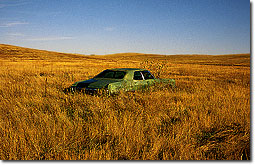
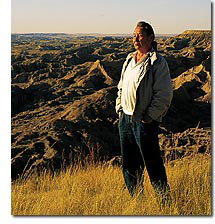
 HIS ARTICLE IS ABOUT THE OGLALA SIOUX Indians who live on the Pine Ridge Reservation, in southwestern South Dakota, in the plains and badlands in the middle of the United States. When I describe this subject to non-Indians, they often reply that it sounds bleak. "Bleak" is the word attached in many people's minds to the idea of certain Indian reservations, of which the Oglala's reservation is perhaps the best example. Oddly, it is a word I have never heard used by Indians themselves. Many thousands of people -- not just Americans but German and French and English people, and more -- visit the reservations every year, and the prevailing opinion among the Indians is not that they come for the bleakness. The Indians understand that the visitors are there out of curiosity and out of an admiration which sometimes reaches such a point that the visitors even wish they could be Indians too. I am a middle-aged non-Indian who wears his hair in a thinning ponytail copied originally from the traditional-style long hair of the leaders of the American Indian Movement of the 1970s, because I thought it looked cool. When I'm driving across a field near the town of Oglala, on the Pine Ridge Reservation, and I see my friend Floyd John walking across it the other way, I stop, and he comes over to the car and leans in the window and smiles a big-tooth grin and says, "How ya' doin', wannabe?"
 O Le War Lance and I became friends. I mentioned him in a book; I said that I had noticed an Indian waiting to cross the street in front of my apartment in New York City, that I had asked on impulse if he was Sioux, and that he had replied, "I'm an Oglala Sioux Indian from Oglala, South Dakota." I described a conversation that Le War Lance and I had had on the subject of Crazy Horse and how he had told me, "Crazy Horse was my gran'father!" Le War Lance liked what I wrote about him; he said that I told the truth. I included a photograph of him in the book, and for a while he was carrying a paperback copy around in his back pocket so that he could show the photo to people from time to time. I kept running into him in various parts of the city: by the statue of Garibaldi in Washington Square Park at two in the morning, as I was returning from some party, or on a park bench in Columbus Circle in the middle of the afternoon. He wrote down his phone number for me and added mine to the long list of phone numbers he keeps in his head. He called me often, and he still does. I've known Le War Lance now for going on twenty years. All my other friends I met in school, at work, or through connections from work. Le War Lance is the only friend I have whom I met originally on the street.