


Return to this issue's Table of Contents.
D E C E M B E R 1 9 9 9
 UANNE Marie Big Crow was born on March 15, 1974, at Pine Ridge Hospital -- the brick building, now no longer a hospital, just uphill from the four-way intersection in town. Her mother, Leatrice Big Crow, known as Chick, was twenty-five years old. Chick had two other daughters: Cecelia, called Cee Cee, who was three, and Frances, called Pigeon, who was five. Chick had been born a Big Crow, and grew up in her Grandmother Big Crow's house in Wolf Creek, a little community about five miles east of Pine Ridge. Chick had a round, pretty face, dark eyes, a determined chin, and wiry reddish-brown hair. Her figure was big-shouldered and trim; she had been a good athlete as a girl. Now she worked as an administrative assistant for the tribal planning office, and she was raising her daughters with the help of her sisters and other kin. People knew that Everett "Gabby" Brewer was the father of the two older girls, but Chick would never say who SuAnne's father was. If asked, Chick always said she didn't want to talk about it. When SuAnne got old enough to wonder, people sometimes told her that her father was Elvis. And sometimes, when SuAnne wore her hair a certain way with a curl in front, you would have to admit that a resemblance was there.
SuAnne's birth came at a dark time on the reservation. The ongoing battle between supporters and opponents of the tribal president Dick Wilson's government showed no signs of letup, with violence so pervasive and unpredictable that many people were afraid to leave their homes. Wilson's people, sometimes called goons, were on one side, and supporters of the American Indian Movement on the other. Just the month before, a nine-year-old boy named Harold Weasel Bear had been shot and seriously wounded as he sat in his father's pickup in Whiteclay; his father was a Wilson man. The AIM leader, Russell Means, had campaigned against Wilson for the presidency that winter, and had gotten more votes than Wilson in the primary. In the runoff election, however, Wilson won, by about 200 votes out of the more than 3,000 cast. Means had promised to "destroy" the existing system of tribal government if he won, and many people were glad he wouldn't get a chance. He accused Wilson of stealing the election, and the federal Civil Rights Commission later agreed, saying that almost a third of the votes cast seemed to be improper and that the election was "permeated with fraud."
The beatings and stompings and shootings and bombings on the reservation would continue until two FBI agents investigating a reservation murder were killed the following year, after which a general exhaustion plus the presence of hundreds of FBI investigators brought the level of violence down. In those days if you were on the Pine Ridge Reservation, you picked a side, and Chick Big Crow was for Dick Wilson all the way. She still calls Dick Wilson one of the greatest leaders the tribe ever had. Distinctions between those with anti- and pro-Dick Wilson loyalties, between AIM and goon, mean less today than they did then. Before SuAnne's sixteenth birthday she would have a lot to do with helping those divisions to heal.
As a Big Crow, SuAnne belonged to a tiospaye -- the Lakota word for an extended family group -- that's one of the largest on Pine Ridge. Chick says that her branch of the family descends from Big Crows of the Sans Arc Lakota, a tribe much smaller than the Oglala, who lived on the plains to the north and west. A medicine man has told her that among the Sans Arc long ago there was a chief named Big Crow who was greater than any chief we know of. This chief was also so wise that he never put himself forward and never identified himself to the whites so that they could single him out as chief; he knew the jealousy and division this would cause. For years the chief led the Sans Arc in war and peace, carefully avoiding all notoriety as the tribe prospered and grew strong. After he died, the tribe began to quarrel internally and dwindled away. The memory of this chief vanished except among a few, according to the medicine man. After SuAnne died, the medicine man told Chick that she had been the spirit of this great leader come back to reunite the people.
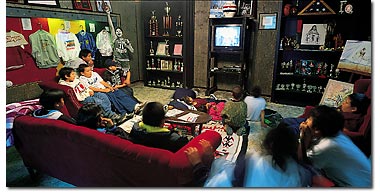 |
| The Boys and Girls Club, a favorite hangout, was named after SuAnne Big Crow: "Imagine that against odds upon odds she won: that she gave you someone to be" |
SuAnne grew up with her sisters in her mother's three-bedroom house in Pine Ridge. Even today people talk about what a strict mother Chick Big Crow was. Her daughters always had to be in the house or the yard by the time the streetlights came on. The only after-school activities she let them take part in were the structured and chaperoned kind; unsupervised wanderings and (later) cruising around in cars were out. In an interview when she was a teenager, SuAnne said that she and her sisters had to come up with their own fun, because their mother wouldn't let them socialize outside of school.
Chick Big Crow was (and is) strongly anti-drug and -alcohol. On the reservation Chick has belonged for many years to the small but adamant minority that takes that stance. When SuAnne was nine years old, she was staying with her godmother on New Year's Eve when the woman's teenage son came home drunk and shot himself in the chest. The woman was too distraught to do anything, so SuAnne called the ambulance and the police and cared for her until the grown-ups arrived. Perhaps because of this incident, SuAnne became as opposed to drugs and alcohol as her mother was. She gave talks on the subject to school and youth groups, made a video urging her message in a stern and wooden tone, and as a high-schooler traveled to distant cities for conventions of like-minded teens. I once asked Rol Bradford, a former Pine Ridge teacher and coach who is also a friend of her family, whether SuAnne's public advocacy on this issue wasn't risky, given the prominence of alcohol in the life of the reservation. "You have to understand," Rol Bradford said, "SuAnne didn't respond to peer pressure, SuAnne was peer pressure. She was the backbone of any group she was in, and she was way wiser than her years. By coming out against drinking, I know she flat-out saved a lot of kids' lives. In fact, she even had an effect on me. It dawned on me that if a sixteen-year-old girl could have the guts to say these things, then maybe us adults should pay attention too. I haven't had a drink since the day she died."
As strongly as Chick forbade certain activities, she encouraged the girls in sports. At one time or another they did them all -- cross-country running and track, volleyball, cheerleading, softball, basketball. Some of the teams were at school and others were sponsored by organizations in town. In the West girls' basketball is a bigger deal than it is elsewhere. High school girls' basketball games in states like South Dakota and Montana draw full-house crowds, and newspapers and college recruiters give nearly the same attention to star players who are girls as to those who are boys. There were many good players on the girls' teams at Pine Ridge High School and at the parochial Red Cloud School when SuAnne was little. SuAnne idolized a star for the Pine Ridge Lady Thorpes named Lolly Steele, who set many records at the school. On a national level SuAnne's hero was Earvin "Magic" Johnson, of the Los Angeles Lakers pro team. Women's professional basketball did not exist in those years, but men's pro games were reaching a level of popularity to challenge baseball and football. SuAnne had big posters of Magic Johnson on her bedroom walls.
She spent endless hours practicing basketball. When she was in the fifth grade, she heard somewhere that to improve your dribbling you should bounce a basketball a thousand times a day with each hand. She performed this daily exercise faithfully on the cement floor of the patio; her mother and sisters got tired of the sound. For variety she would shoot layups against the gutter and the drainpipe, until they came loose from the house and had to be repaired. As far as anyone knew, no girl in an official game had ever dunked a basketball -- that is, had leaped as high as the rim and stuffed the ball through the hoop from above -- and SuAnne wanted to be the first in history to do it. To get the feel, she persuaded a younger boy cousin to kneel on all fours under the basket. With a running start, and a leap using the boy's back as a springboard, she could dunk the ball.
Charles Zimiga, who would coach SuAnne in basketball during her high school years, remembers the first time he saw her. He was on the cross-country track on the old golf course, coaching the high school boys' cross-country team (a team that later won the state championship), when SuAnne came running by. She was in seventh grade at the time. She practiced cross-country every fall, and ran in amateur meets, and sometimes placed high enough to be invited to tournaments in Boston and California. "The fluidness of her running amazed me, and the strength she had," Zimiga said. "I stood watching her, and she stopped right in front of me -- I'm a high school coach, remember, and she's just a young little girl -- and she said, 'What're you lookin' at?' I said, 'A runner.' She would've been a top cross-country runner, but in high school it never did work out, because the season conflicted with basketball. I had heard about her before, but that day on the golf course was the first time I really noticed her."
By the time SuAnne was in eighth grade, she had grown to five feet five inches ("But she played six foot," Zimiga says); she was long-limbed, well-muscled, and quick. She had high cheekbones, a prominent, arched upper lip that lined up with the basket when she aimed the ball, and short hair that she wore in no particular style. She could have played every game for the varsity when she was in eighth grade, but Coach Zimiga, who took over girls' varsity basketball that year, wanted to keep peace among older players who had waited for their chance to be on the team. He kept SuAnne on the junior varsity during the regular season. The varsity team had a good year, and when it advanced to the district playoffs, Zimiga brought SuAnne up from the JV for the playoff games. She tended to get into foul trouble; the referees rule strictly in tournament games, and SuAnne was used to a more headlong style of play. She and her cousin Doni De Cory, a five-foot-ten-inch junior, combined for many long-break baskets, with Doni throwing downcourt passes to SuAnne on the scoring end. In the district playoff against the team from Red Cloud, SuAnne scored thirty-one points. In the regional playoff game Pine Ridge beat a good Todd County team, but in the state tournament they lost all three games and finished eighth.
OME people who live in the cities and towns near reservations treat their Indian neighbors decently; some don't. In Denver and Minneapolis and Rapid City police have been known to harass Indian teenagers and rough up Indian drunks and needlessly stop and search Indian cars. Local banks whose deposits include millions in tribal funds sometimes charge Indians higher interest rates than they charge whites. Gift shops near reservations sell junky caricature Indian pictures and dolls, and until not long ago beer coolers had signs on them that said INDIAN POWER. In a big discount store in a reservation-border town a white clerk observes a lot of Indians waiting at the checkout and remarks, "Oh, they're Indians -- they're used to standing in line." Some people in South Dakota hate Indians, unapologetically, and will tell you why; in their voices you can hear a particular American meanness that is centuries old.
When teams from Pine Ridge play non-Indian teams, the question of race is always there. When Pine Ridge is the visiting team, usually the hosts are courteous and the players and fans have a good time. But Pine Ridge coaches know that occasionally at away games their kids will be insulted, their fans will feel unwelcome, the host gym will be dense with hostility, and the referees will call fouls on Indian players every chance they get. Sometimes in a game between Indian and non-Indian teams the difference in race becomes an important and distracting part of the event.
One place where Pine Ridge teams used to get harassed regularly was the high school gymnasium in Lead, South Dakota. Lead is a town of about 3,200 northwest of the reservation, in the Black Hills. It is laid out among the mines that are its main industry, and low, wooded mountains hedge it around. The brick high school building is set into a hillside. The school's only gym in those days was small, with tiers of gray-painted concrete on which the spectator benches descended from just below the steel-beamed roof to the very edge of the basketball court -- an arrangement that greatly magnified the interior noise.
In the fall of 1988 the Pine Ridge Lady Thorpes went to Lead to play a basketball game. SuAnne was a full member of the team by then. She was a freshman, fourteen years old. Getting ready in the locker room, the Pine Ridge girls could hear the din from the Lead fans. They were yelling fake Indian war cries, a "woo-woo-woo" sound. The usual plan for the pre-game warm-up was for the visiting team to run onto the court in a line, take a lap or two around the floor, shoot some baskets, and then go to their bench at courtside. After that the home team would come out and do the same, and then the game would begin. Usually the Thorpes lined up for their entry more or less according to height, which meant that senior Doni De Cory, one of the tallest, went first. As the team waited in the hallway leading from the locker room, the heckling got louder. Some fans were waving food stamps, a reference to the reservation's receiving federal aid. Others yelled, "Where's the cheese?" -- the joke being that if Indians were lining up, it must be to get commodity cheese. The Lead high school band had joined in, with fake Indian drumming and a fake Indian tune. Doni De Cory looked out the door and told her teammates, "I can't handle this." SuAnne quickly offered to go first in her place. She was so eager that Doni became suspicious. "Don't embarrass us," Doni told her. SuAnne said, "I won't. I won't embarrass you." Doni gave her the ball, and SuAnne stood first in line.
She came running onto the court dribbling the basketball, with her teammates running behind. On the court the noise was deafening. SuAnne went right down the middle and suddenly stopped when she got to center court. Her teammates were taken by surprise, and some bumped into each other. Coach Zimiga, at the rear of the line, did not know why they had stopped. SuAnne turned to Doni De Cory and tossed her the ball. Then she stepped into the jump-ball circle at center court, facing the Lead fans. She unbuttoned her warm-up jacket, took it off, draped it over her shoulders, and began to do the Lakota shawl dance. SuAnne knew all the traditional dances (she had competed in many powwows as a little girl), and the dance she chose is a young woman's dance, graceful and modest and show-offy all at the same time. "I couldn't believe it -- she was powwowin', like, 'Get down!'" Doni De Cory recalls. "And then she started to sing." SuAnne began to sing in Lakota, swaying back and forth in the jump-ball circle, doing the shawl dance, using her warm-up jacket for a shawl. The crowd went completely silent. "All that stuff the Lead fans were yelling -- it was like she reversed it somehow," a teammate says. In the sudden quiet all they could hear was her Lakota song. SuAnne dropped her jacket, took the ball from Doni De Cory, and ran a lap around the court dribbling expertly and fast. The audience began to cheer and applaud. She sprinted to the basket, went up in the air, and laid the ball through the hoop, with the fans cheering loudly now. Of course, Pine Ridge went on to win the game.
 ECAUSE this was one of the coolest and bravest deeds I ever heard of, I want to stop and consider it from a larger perspective that includes the town of Lead, all the Black Hills, and 125 years of history.
Lead, the town, does not get its name from the metal. The lead the name refers to is a mining term for a gold-bearing deposit, or vein, running through surrounding rock. The word, pronounced with a long e, is related to the word "lode." During the Black Hills gold rush of the 1870s prospectors found a rich lead in what would become the town of Lead. In April of 1876 Fred and Moses Manuel staked a claim to a mine they called the Homestake. Their lead led eventually to gold and more gold -- a small mountain of gold -- whose wealth may be guessed by the size of the hole its extraction has left in the middle of present-day Lead.
In 1877 a mining entrepreneur from San Francisco named George Hearst came to the Hills, investigated the Manuels' mine, and advised his big-city partners to buy it. The price was $70,000. At the time of Hearst's negotiations the illegal act of Congress that would take this land from the Sioux had only recently passed. The partners followed Hearst's advice, and the Homestake Mine paid off its purchase price four times over in dividends alone within three years. When George Hearst's only son, William Randolph, was kicked out of Harvard for giving his instructors chamber pots with their names inscribed on the inside, George Hearst suggested that he come West and take over his share in the Homestake Mine. William Randolph Hearst chose to run the San Francisco Examiner instead. His father gave him a blank check to keep it going for two years; gold from Lead helped to start the Hearst newspaper empire. Since the Homestake Mine was discovered, it has produced at least $10 billion in gold. It is one of the richest gold mines in the world.
Almost from the moment that George Armstrong Custer's expedition entered the Black Hills, in 1874, to investigate rumors of gold, there was no way the Sioux were going to be allowed to keep this land. At Custer's announcement that the expedition had found "gold in the roots of the grass," the rush began. By 1875 the Dakota Territorial Legislature had already divided the Black Hills land into counties; Custer County, in the southern Hills, was named in that general's honor while he was still alive, and while the land still clearly belonged to the Sioux. Many people in government and elsewhere knew at the time that taking this land was wrong. At first the Army even made halfhearted attempts to keep the prospectors out. A high-ranking treaty negotiator told President Ulysses S. Grant that the Custer expedition was "a violation of the national honor." When the Sioux killed Custer at the Little Bighorn, in 1876, their victory only enraged the country and destroyed any chance of fairness that remained. One of the commissioners who worked on the 1877 "agreement" that gave paper legitimacy to the theft said that Custer should not have gone into the Hills in the first place, and with the other commissioners reminded the government that it was making the Sioux homeless and that it owed them protection and care. The taking of the Black Hills proceeded inexorably all the same.
Sioux leaders of Crazy Horse's generation began working to receive fair compensation for the Hills in the early 1900s. The Black Hills claim that the Sioux filed with the U.S. Court of Claims in the 1920s got nowhere. In 1946 the government established the Indian Claims Commission specifically to provide payment for wrongly taken Indian lands, and in 1950 the Sioux filed a claim for the Black Hills with the ICC. After almost twenty-five years the ICC finally ruled that the Sioux were entitled to a payment of $17.5 million plus interest for the taking of the Hills, a decision that the Court of Claims upheld. In 1980 the Supreme Court affirmed the ruling and awarded the Sioux a total of $106 million. Quoting from the Court of Claims, Justice Harry Blackmun wrote for the majority, "A more ripe and rank case of dishonorable dealings will never, in all probability, be found in our history" -- which was to say officially, and finally, that the Black Hills had been stolen.
By the time of the Supreme Court ruling, however, the Sioux had come to see their identity as linked to the Hills themselves, and the eight tribes involved decided unanimously not to accept the money. They said, "The Black Hills are not for sale." The Sioux now wanted the land back -- some or all of it -- and trespass damages as well. They especially wanted the Black Hills lands still owned by the federal government. These amount to about 1.3 million acres, a small proportion of what was stolen. At the moment the chances that the Sioux will get these or any other lands in the Black Hills appear remote. The untouched compensation money remains in a federal escrow account, where it, plus other compensation money, plus accumulated interest, is now more than half a billion dollars.
Inescapably, this history is present when an Oglala team goes to Lead to play a basketball game. It may even explain why the fans in Lead were so mean: fear that you might perhaps be in the wrong can make you ornerier sometimes. In all the accounts of this land grab and its aftermath, and among the many greedy and driven men who had a part, I cannot find evidence of a single act as elegant, as generous, or as transcendent as SuAnne's dance at center court in the gym at Lead.
For the Oglala, what SuAnne did that day almost immediately took on the status of myth. People from Pine Ridge who witnessed it still describe it in terms of awe and disbelief. Amazement swept through the younger kids when they heard. "I was, like, 'What did she just do?'" recalls her cousin Angie Big Crow, an eighth grader at the time. All over the reservation people told and retold the story of SuAnne at Lead. Anytime the subject of SuAnne came up when I was talking to people on Pine Ridge, I would always ask if they had heard about what she did at Lead, and always the answer was a smile and a nod -- "Yeah, I was there," or "Yeah, I heard about that." To the unnumbered big and small slights of local racism that the Oglala have known all their lives SuAnne's exploit made an emphatic reply.
Back in the days when Lakota war parties still fought battles against other tribes and the Army, no deed of war was more honored than the act of counting coup. To "count coup" means to touch an armed enemy in full possession of his powers with a special stick called a coup stick, or with the hand. The touch is not a blow, and serves only to indicate how close to the enemy you came. As an act of bravery, counting coup was regarded as greater than killing an enemy in single combat, greater than taking a scalp or horses or any prize. Counting coup was an act of almost abstract courage, of pure playfulness taken to the most daring extreme. Very likely, to do it and survive brought an exhilaration to which nothing else could compare. In an ancient sense that her Oglala kin could recognize, SuAnne counted coup on the fans of Lead.
And yet this coup was an act not of war but of peace. SuAnne's coup strike was an offering, an invitation. It gave the hecklers the best interpretation, as if their silly, mocking chants were meant only in good will. It showed that their fake Indian songs were just that -- fake -- and that the real thing was better, as real things usually are. We Lakota have been dancing like this for centuries, the dance said; we've been doing the shawl dance since long before you came, before you got on the boat in Glasgow or Bremerhaven, before you stole this land, and we're still doing it today. And isn't it pretty, when you see how it's supposed to be done? Because finally what SuAnne proposed was to invite us -- us onlookers in the stands, namely the non-Lakota rest of this country -- to dance too. She was in the Lead gym to play, and she invited us all to play. The symbol she used to include us was the warm-up jacket. Everyone in America has a warm-up jacket. I've got one, probably so do you, so did (no doubt) many of the fans at Lead. By using the warm-up jacket as a shawl in her impromptu shawl dance, she made Lakota relatives of us all.
"It was funny," Doni De Cory says, "but after that game the relationship between Lead and us was tremendous. When we played Lead again, the games were really good, and we got to know some of the girls on the team. Later, when we went to a tournament and Lead was there, we were hanging out with the Lead girls and eating pizza with them. We got to know some of their parents, too. What SuAnne did made a lasting impression and changed the whole situation with us and Lead. We found out there are some really good people in Lead."
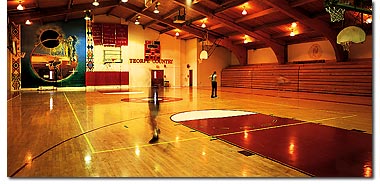 |
| Pine Ridge High School, where SuAnne Big Crow and her teammates played their home games |
 MERICA is a leap of the imagination. From its beginning people have had only a persistent idea of what a good country should be. The idea involves freedom, equality, justice, and the pursuit of happiness; nowadays most of us probably could not describe it much more clearly than that. The truth is, it always has been a bit of a guess. No one has ever known for sure whether a country based on such an idea is really possible, but again and again we have leaped toward the idea and hoped. What SuAnne Big Crow demonstrated in the Lead high school gym is that making the leap is the whole point. The idea does not truly live unless it is expressed by an act; the country does not live unless we make the leap from our tribe or focus group or gated community or demographic and land on the shaky platform of that idea of a good country which all kinds of different people share.
This leap is made in public, and it's made free. It's not a product or a service that anyone will pay you for. You do it for reasons unexplainable by economics -- for ambition, out of conviction, for the heck of it, in playfulness, for love. It's done in public spaces, face-to-face, where anyone may go. It's not done on television, on the Internet, or over the telephone; our electronic systems can only tell us if a leap made elsewhere has succeeded or failed. The places you'll see it are high school gyms, city sidewalks, the subway, bus stations, public parks, parking lots, and wherever people gather during natural disasters. In those places and others like them the leaps that continue to invent and knit the country continue to be made. When the leap fails, it looks like the L.A. riots, or Sherman's march through Georgia. When it succeeds, it looks like the New York City Bicentennial Celebration in July of 1976, or the civil-rights march on Washington in 1963. On that scale, whether it succeeds or fails, it's always something to see. The leap requires physical presence and physical risk. But the payoff -- in terms of dreams realized, of understanding, of people getting along -- can be so glorious as to make the risk seem minuscule.
I find all this hopefulness, and more, in SuAnne's dance at center court in the gym in Lead. My high school football coach used to show us films of our previous game every Monday after practice, and whenever he liked a particular play, he would run it over and over again. If I had a film of SuAnne at Lead (as far as I know, no such film or video exists), I would study it in slow motion frame by frame. There's a magic in what she did, along with the promise that public acts of courage are still alive out there somewhere. Mostly I would run the film of SuAnne again and again for my own braveheart song. I refer to her, as I do to the deeds of Crazy Horse, for proof that it's a public service to be brave.
Ian Frazier received the inaugural Thurber Prize for American Humor, in 1997. His article in this issue of The Atlantic is drawn from his latest book, On the Rez, to be published by Farrar, Straus & Giroux next month.
Photographs by Guy Kloppenburg
Copyright © 1999 by The Atlantic Monthly Company. All rights reserved.
The Atlantic Monthly; December 1999; On the Rez - 99.12 (Part Four);
Volume 284, No. 6; page 53-84.