


Return to this issue's Table of Contents.
D E C E M B E R 1 9 9 9
 E moved from the city to upstate New York, suffered various misadventures including a conviction for DWI, and eventually decided to go back to the reservation. Meanwhile -- this was about four years ago -- my wife and two kids and Imoved to Missoula, Montana. Not long after we arrived, Ibought a 1988 Chevy Blazer and drove the 780 miles to Oglala, South Dakota, for the first of many visits to Le and to the Pine Ridge Reservation. When I reached the boundary of tribal land, it was so early in the morning that no one else was about. I had the radio tuned to KILI, the Pine Ridge station, which broadcasts from the reservation near the village of Porcupine. It was playing Lakota singing and drumming. Under an overcast sky the prairie looked drained of color. Here and there I saw burned patches, the black extending in tongues where the wind had pushed the fire. In the middle of one burned patch was a car seat, also burned. A wheel rim with shreds of tire still on it hung from a fence post. Two rows of tires lay flat on the roof of a turquoise-colored trailer, anchoring the roof against the wind.
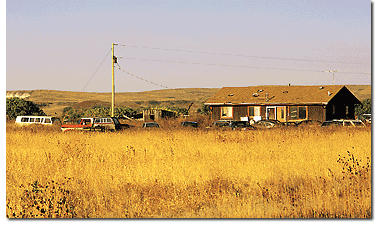 |
| A house north of the town of Oglala. "To the north and south are uplands leading to low, chalk-colored buttes that rise from the prairie like molars from a gumline" |
How many boundaries this reservation has had over the years! About a century and a half ago the lands set aside for the Sioux by treaty stretched from the Powder River in the west to the Heart River in the north to the Missouri River in the east to the North Platte River in the south -- an immense expanse in the middle of the continent, covering parts of the present states of Montana, Wyoming, North Dakota, South Dakota, and Nebraska. Since then Sioux lands have shrunk and shrunk again, leaving behind vestigial boundaries like a drying sea. The present reservation, the second largest in the country but only a small part of the Sioux's original holdings, has gone through many bureaucratic changes and transfers of land ownership to people outside the tribe; today some Oglala own parcels that have been divided so often they are measured not in acres but in square yards, feet, and inches.
Past the village of Red Shirt, inside the border of the reservation, the road I was on entered a piece of grassy tableland that declines steeply at its edges into badlands. Locals call this the Red Shirt Table Road. At certain places beside the road the badlands are like an erosion carnival opening at your feet. Travelers on the Red Shirt Table Road, frustrated by its lack of public restrooms, sometimes pull over, step out, stroll a short distance away from the car, and accidentally plunge into the chasms below. Some of the pillars of rock still have on top a flat piece of prairie the size of a living-room rug, from which the eroded rock face complicatedly descends hundreds of feet to the canyon floor. Some of the monoliths are jagged on top, like newspaper torn against the grain. Others are rounded and smooth, and as shiny as old pants. In places the ranks recede, one eroded gray-and-pink wall of rock behind another, all the way to the horizon. The Red Shirt Table Road is the worst-paved road I have ever driven. Even here on the flat the badlands seem to want to make their point. Sinks afflict the road's asphalt, creating places where you drive down in and then up the other side. Plates of roadway lurch up toward you, bumper-high. Potholes slurp and open wide. Not every road on Pine Ridge or in its vicinity is as bad as this (and this road has since been somewhat improved), but anyone who visits the reservation more than twice learns that Pine Ridge is a difficult place to get to. No major thoroughfare or rail line runs to it, or even very close by.
Within fifteen miles or so the Red Shirt Table Road left the bumpiness of the tableland and became a good gravel surface running straight through an expanse of little bare-top clay hills like gray haystacks and then through rolling prairie with low buttes to the east and west. The road then turned to asphalt again, this section smooth and newly paved. I continued to the junction with Highway 18, turned left, and drove on a mile or so to the village of Oglala. A woman sorting mail in the gray-cement post office told me how to find the house of a woman named Sarah Brave, who told me through her closed screen door how to find Le.
His house stood by a bend in the road with no other houses around, as singular as a letter in an alphabet book. It was a standard government-built house of the kind often seen on military bases or Indian reservations. It was one story, with faded brown siding and a yard run mostly to weeds. Six or eight cars and a pickup truck, in various stages of dilapidation, made a loose semicircle around one corner. I pulled into the rutted mud driveway, opened the door, and stepped out onto a flattened Budweiser can. Le was standing in the yard. We had not seen each other in a year and a half. He greeted me without surprise. We hugged each other and shook hands, and Le felt the pulse in my wrist with his thumb. He said, "Hoka hey, Little Brother. I am honored to be in your presence." His breath was Budweiser and a chemical I couldn't place. He was wearing cowboy boots, faded pegged blue jeans, a red cowboy shirt with buttons of blue imitation mother-of-pearl, and a neck brace in a color sometimes called "flesh" extending from his collarbone up to his ears. On the front of the neck brace, just above his collarbone, large raised letters said FRONT. He had his hair in a piled-high style I'd seen before. Combined with the brace, it gave him the look of a starched-collar lady from out of the past.
"I was in a car wreck three weeks ago," he explained. "Me and this guy named Archambault that I went to Indian boarding school with was drinking in Whiteclay, Nebraska, and in the afternoon we started hitchhiking back to Pine Ridge. We got picked up by Joe Red Star and Mark Goings, and me and Archambault got in the back seat, and I hadn't hardly got in when them guys floored it and we was flyin' up Highway Four-oh-seven, and then suddenly we was off the road on the right and I looked up and saw the light pole comin' at us. I was yellin' 'Hey, hey, hey!' and we took out the light pole and rolled four times. I went flyin' over the front seat and hit the windshield with the back of my head and shoulders, and I had the top of the car pressed right against my face. Man, there was a whole lot of moanin' and groanin' in that car. It took the emergency-medical-technician guys three and a half hours to cut us out."
Le invited me in, and we climbed the single cinder block he used for a doorstep. His door latch was a green-and-white plastic fish stringer, which he tied to a nail inside. He asked if I'd had breakfast and offered me a beer. I replied that I had quit drinking. He said, "That reminds me -- I've got to take my pills again." He produced half a dozen pill bottles of various sizes and shook pills from them into his palm. Hospitably, he first offered a large orange capsule to me: "Want one?" I declined, with thanks. Then he washed them all down with a few swigs of beer. He sat on a stove log and I on the only chair. The amount of stuff in his house overthrew my attempt to take it in. There was a nonworking clock on the wall, and a brown hole near it where the oven pipe used to be, and a cast-iron woodstove, and a plastic milk crate full of silver-tinsel Christmas wreaths, and a yellow hardhat, and a photograph of a statuesque Indian woman in a T-shirt smiling and holding a .357 Magnum revolver ("That's my nephew's wife, Deborah. She's a rowdy from the Fort Apache Reservation"), and a rolled-up section of snow fence, and a poster from the movie Incident at Oglala, and a copy of the collected short stories of Ernest Hemingway, and several sports trophies, and the paperwork from Le's recent hospital bills. A door just behind me opened into a room filled several feet deep with suitcases, plastic picnic coolers, backpacks, baby carriers, trunks, and heavyweight canvas tote bags.
I asked if all this stuff was his. He said, "Most of it belongs to my sister Florence. She lived here for a while with her kids and grandkids, until the tribe gave her a new house in a development in Oglala on the other side of Highway Eighteen. Before that my dad lived here. It was his house originally, and they all moved in here with him. It had a fire in '83, and when they fixed it up afterward, they didn't put in no insulation, so when the temperature drops, it can get pretty chilly in here. When winter comes, I'll just get me a fat woman and let her sleep on the windy side."
Back in the yard he led me on a brief tour of the accumulated cars. All of them, according to him, were much closer to being drivable than they appeared. He kept saying, "Oh, it'll run. Put a new battery and a windshield and a new set of tires and some gas in it, and it'll run." Then he said, "Let's go -- I'll take you to see my mom and dad." We got in my car. He did not put on his seat belt, but I insisted that he put on his seat belt. We headed north, on the road I had driven from Red Shirt Table. I asked him if anyone on the reservation called him Le. I knew that his birth name was Leonard Thomas Walks Out; Sarah Brave had referred to him as Leonard. "There's people here who call me Le or Laid-Back, but most call me Leonard," he said. "Or Lenny. And there's still a few real old-timers who remember when I was the baby of my family, before Floyd John was born. One old lady, Leonora Fast Horse, saw me at the post office the other day and said, 'Look! It's Baby Leo!' I mean, here I'm goin' on fifty-five years old!"
After about three miles Le directed me onto a grassy track leading off to the right. In the high weeds next to it were pieces of a broken guitar. The track led onto a low rise with a barbed-wire fence around a small plot of gravestones and crosses set back from and above the road; it would be hard to spot if you didn't know it was there. I took off my baseball cap and walked quietly as we entered the cemetery grounds. The more Le talked, the quieter I became. On this little patch of earth a vastness of suffering and disaster had converged. Among the murders, suicides, and car accidents the headstones could not describe, these three seemed central to Le's life:
Albert C. Walks Out. February 23, 1933 - August 3, 1957. An older brother. Heroic soldier in the Korean War. On leave, stopped to help some Indians whose car had a flat tire. Beaten to death with a tire iron.
Elizebith Walks Out. May 22, 1906 - April 7, 1958. Le's mom. Died as a result of an accident on Highway 87 between Rushville and Whiteclay, Nebraska. "She had gone over there shopping with Amos Red Paint and they ran out of gas and they were pushing the car by the side of the road when a bootlegger from Whiteclay with no headlights ran into them from behind. She got both her legs cut off and died seven days later. My dad, Asa Walks Out, lived to be ninety-one. He died just last summer. We buried him on top of her, but we don't have a marker for him yet."
Asa Elda Walks Out Jr. March 7, 1935 - February 14, 1959. "My mom died eight months after Albert, and Elda -- we called him Eldee -- died ten months after my mom. Eldee was just out of the Army and he could kick anyone's ass. He didn't even care if he got his own ass kicked once in a while. He'd get back in the car with his nose all bloodied and say, 'Well, at least I got the anger out of me!' He was running my dad's spread near here, and me and him had gone up to Rapid to buy sixteen hundred pounds of cattle feed, and we were coming back in the pickup drinking whiskey and beer, and he started telling me that he'd made a terrible mistake. He said he had married too young and in a Catholic ceremony and now he couldn't get out of it, and he was in love with a fifteen-year-old girl. So we got back to his place and I was outside unloading the truck when one of his kids come running out of the house saying, 'Mommy and Daddy is fightin'.' So I picked the kid up and comforted him and went inside and asked what they were fightin' about, and Eldee said, 'We're not fightin', we're just talkin'.' Then he takes me out in the yard and says, 'She won't give me a divorce. I'm goin'.' I said, 'Where to? I'll go with you.' He says, 'Where I'm goin' you can't follow. Take care of my kids.' He gets a rifle out of the truck and I think, Whoa, I better get the kids back in the house. I go in and right away I hear BLAM -- he shoots himself right in the head. I run out and he's flat on his back and blood is gushing from his forehead eighteen inches in the air.
"After that I went crazy for a while, writing bad checks. I got caught, went to prison, got out, stole a government truck, ended up back in prison again. When Eldee shot himself, I was sixteen years old."
Le closed the cemetery gate, pulling on it hard, and he latched it with its barbed-wire latch. Then we drove back the way we had come. As we approached his house, Le said, "Floyd John ought to be awake by now. Let's go eat up his food." We drove on, and he directed me to turn onto a puddled road just past the Loneman School. The ruts were deep and the car jounced, and Le's neck caused him to wince with each jounce. The going got muddier and muddier. I stopped and shifted into four-wheel drive. The ruts then split up into an every-man-for-himself profusion across a mudflat, and I must have guessed wrong, because soon I was roaring across it at maximum rpms, slewing back and forth, going nearly sideways sometimes, and hurling up flying mud around me like a magnetic field. Floyd John heard us coming -- anyone would have -- and he was standing outside his green tar-paper shack as we squished to a stop in his yard. The car had mud on the hood and the windshield and the side windows. I turned off the steaming engine. Floyd John walked to the car, looked me over, and asked, "Well, bro, are you likin' the rez as much as you liked New York?"
"Tell me, Floyd John -- when are they going to finish building the subway out to your house?"
"Any day, any day. The king snakes and the bull snakes are workin' on it right now."
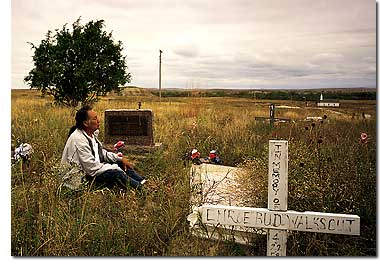 |
| Le War Lance at the cemetery near St. John's Episcopal Church, north of Oglala, where many members of his family are buried |
 LOYD John had put on some weight since I'd last seen him, and now he walked with a limp and used a cane. He began to tell me how he had been working on a modular home over at the air base by Rapid City, and a wall had fallen on him and crushed his hip. Then he described which new benefits this entitled him to. The paperwork of it, between agencies of the state and the federal government and the tribe, was so complicated that I couldn't have kept up if he'd explained it to me five times. Le asked him if he had any red beans with hot sauce we could eat, and Floyd John said he had no food in the house. He wasn't due to pick up his commodities for a couple of days. He said that his girlfriend, Wanda, who worked for the tribal police, was due to get paid that afternoon. He climbed with difficulty into the back seat, and we roared and crawfished our way back to the paved road.
First we stopped at the Oglala post office, so that Le and Floyd John could check their mail. The postmaster usually has all the mail sorted and in the boxes by 10:30, a time known thereabouts as "mail": "I'll see you tomorrow morning after mail." Not many on the reservation get their mail brought to where they live; most people have to go in and pick it up, either from a post-office box or by asking at the window for general delivery. In the later years of Red Cloud's life his two-mile trip to the post office and back was the big event of his day. At 10:45 in the morning the rutted lot by the Oglala post office was full of idling cars, some of them making plenty of noise and smoke. Le and Floyd John got out and exchanged a few words with the woman in the station wagon next to us. Then they went into the building and came out again in a second, disappointed and blue. "Nothing," Le said. "A lot of days there's nothing. I usually check it anyway. You never know. A few weeks ago I got a letter from the attorney general of New York, saying that he wasn't gonna come after me and make me go to jail as long as I never set foot in New York State again. It was a pretty friendly letter, all in all."
Like many of the other cars, we then pulled out of the post-office lot and headed for the village of Pine Ridge, fifteen miles away. Pine Ridge is the largest town on the reservation. The center of tribal government is there, and the reservation headquarters of the U.S. Bureau of Indian Affairs, and the Indian Health Services hospital. Many days on the reservation include a trip to Pine Ridge. The road from Oglala follows the valley of White Clay Creek much of the way. For some distance the creek bottom and a reservoir are on one side, and then the creek crosses to the other. To the north and south are uplands leading to low, chalk-colored buttes that rise from the prairie like molars from a gumline. Groups of the yellow pines that give Pine Ridge its name fit themselves into the upland creases and folds. On unsettled days cumulus clouds pile up for miles above. We passed a tepee made of white canvas, a tepee made of weathered white plyboard, a Quonset hut, a Seventh-day Adventist church. Trailer homes and one-story houses appeared here and there, mostly set far apart. Wherever their driveways met the road, deltas of muddy tire tracks spread across the pavement.
A rise brought us in view of the Pine Ridge water towers (most towns on the reservation have a water tower fixing them in place, but Pine Ridge has four), and the rise after that showed a slow line of cars below us moving toward the traffic light at the intersection of Highways 18 and 407, in downtown Pine Ridge. The intersection has had a traffic light for only five years or so. Before, it was a four-way stop. People on the reservation called it "the four-way," and many still call it that today. The four-way is the main crossroads of the Oglala nation. On one corner is a wooden bench whose back is a square concrete planter containing weeds and a small pine tree. A large concrete pot full of earth nearby was perhaps once intended to grow flowers. People sit on the bench and cross their knees and talk for hours, just as old men used to do years ago, long before the bench and the flowerpot, telling about the time Queen Victoria kissed them when they were young children in England with Buffalo Bill. "Bullshit Corner" is this corner's unofficial name. On another corner is the Pine Ridge post office, which shares a large brick building with an auditorium called Billy Mills Hall, where most of the important indoor community gatherings are held. On another corner is a two-story brick building containing tribal offices and the offices of the Oglala Department of Public Safety -- the tribal police. Floyd John got out and went to look for Wanda there. On another corner is a combination convenience store and gas station that then was called Big Bat's Conoco and now is called Big Bat's Texaco. Le and I parked and went in.
In Pine Ridge, Big Bat's is the place you go. If you're just passing through or visiting, you go to Big Bat's because it's one of the few places on the reservation that look like what you're used to in paved America. Big Bat's has a big, highway-visible red-and-white sign, and rows of pumps dispensing gasoline and diesel fuel, and full-color cardboard advertisements affixed above the pumps, and country music playing from speakers in the canopies overhead; inside, it has the usual brightly lit shelves of products whose empty packages will end up on the floor of your car, and freezers and beverage coolers set into the wall, and a deli counter highlighted in blue neon and staffed by aproned young people who use disposable clear-plastic gloves to put cold cuts on your six-inch or twelve-inch submarine sandwich, and video games, and TV monitors just below ceiling level showing CNN or country-music videos, and plastic tables and window booths where you can sit and eat or just sit, and a row of pay telephones. If you live on the reservation, if you're not just passing through, you go to Big Bat's because that's where everybody goes.
Big Bat's is always busy. No other small-town place I know of has such a plentiful and varied clientele. There are Indians, of course, of all blood degrees, full-blood as well as almost blond. Employees of the tribe and of the Bureau of Indian Affairs and tribal politicos come in for breakfast and for coffee afterward, prolonging conversations that are elliptical and hard to eavesdrop on. Drunks who have been up all night nurse cups of coffee they have bought with change, and use the john. There are truck drivers running overweight and avoiding the weigh stations on the main roads, Oglala teen-agers in groups of four or five wearing the colors of Denver street gangs, Methodist ministers on their way to local volunteer jobs, college professors leading tours of historical sites, TV crews shooting documentary footage, Mormon missionary ladies in polyester raincoats with scarves tied around their heads. In the summer tourists multiply -- mid-Americans wearing clothes so casual they might as well be pajamas and toting large video cameras, and fiftyish English couples having those bitter, silent arguments that travelers have, and long-haired New Age people smelling of patchouli oil, and Australian guys with leather Aussie hats and lissome girlfriends, and college kids from Massachusetts singing in a fake-corny way songs they just heard on the radio in their van, and black families in bright sportswear, and strangely dressed people speaking Hungarian, and ash-blonde German women backpackers in their early twenties effortlessly deflecting the attentions of various guys trying to talk to them, and Japanese people by the occasional busload, and once in a while a celebrity with an entourage. Observers who noted about a hundred years ago the disappearance of the American frontier have turned out to be wrong: America will always have its frontier places, and they will always look like Big Bat's.
Le and I each got a twelve-inch club combo sandwich with everything, including jalape�os, and a medium soda. Total cost: $10.62. The sandwiches lasted all day, because half was enough to fill us up, and we saved the rest for later. We sat at a table and ate, and Floyd John and Wanda joined us. Wanda was a short, unsmiling woman with long hair parted in the middle. She wore a heavy shirt unbuttoned like a jacket over a dark pullover and blue jeans. Her wary eyes took me in at a glance when Floyd John introduced us. He said she was the only person on the reservation who knew how to run the computer system for the police department. Wanda accepted this without comment; as we talked, she mostly listened, adding only a remark or two in a small, clear voice quieter than a whisper.
Le turned to three guys seated at a table next to ours and began talking to them in Sioux. He stopped for a moment to introduce me to one of them, who he said was his cousin, but I didn't catch the name. Floyd John joined the discussion, which went back and forth and seemed to be verging on an argument. After the three guys had left, I asked Le what it had been about. "White guys dancing," he said. "My cousin was saying that there was too many white guys dancing at the sun dances on the reservation last summer. Him and his friends think letting white guys or any non-Indians in ruins the ceremonies. They don't think outsiders should be allowed even as helpers or water carriers. They say that you let white guys buy the food and the firewood, the way some sun dances do, and then you've gotta let 'em dance, and then pretty soon people who don't know anything are running the whole ceremony. And he's right that there was hundreds of white guys goin' to the sun dances last summer. But I say if a person's heart is good, let him participate in a respectful way. There's non-Indian people that love the sun dance and are really sincere. You just have to be sure that you have elders and medicine men who run the ceremony as it's supposed to be."
A hundred years ago Oglala who continued to practice their traditional ceremonies despite the government's ban did so in secret, for fear that white people would find out and shut them down; today the fear is that white people will find out and want to join.
(The online version of this article appears in four parts. Click here to go to parts one, three, and four.)
Ian Frazier received the inaugural Thurber Prize for American Humor, in 1997. His article in this issue of The Atlantic is drawn from his latest book, On the Rez, to be published by Farrar, Straus & Giroux next month.
Photographs by Guy Kloppenburg.
Copyright © 1999 by The Atlantic Monthly Company. All rights reserved.
The Atlantic Monthly; December 1999; On the Rez - 99.12 (Part Two);
Volume 284, No. 6; page 53-84.