


Return to this issue's Table of Contents.
D E C E M B E R 1 9 9 9
 HE first afternoon I spent on the reservation can stand for many: we went to Big Bat's, gassed up, got supplies, and drove around. That day Le and Floyd John wanted to show me around the reservation, which meant a lot of driving, but being on the reservation almost always does. Two thirty-two-mile round trips between Oglala and Pine Ridge in a day are not uncommon. Then there are the longer drives, up to Rapid City to see doctors or relatives; to Chadron, Nebraska, to take a television to a repair shop; to Hot Springs, South Dakota, to drop Floyd John off at the veterans hospital; to see a medicine man who lives miles off the paved road. It seemed as if every time I looked at the gas gauge, it was falling back to empty, and every time I checked the odometer, I had added another 300 miles. The Oglala may have lost the prairie vastnesses they used to hunt, but they are still obliged to roam. The supplies we picked up beforehand were usually beer. Afternoons almost always began with a trip to Whiteclay, a mile and three quarters from the town of Pine Ridge. Selling alcohol is illegal on the reservation but legal in Nebraska.
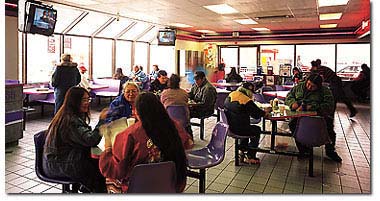 |
| Morning customer traffic at Big Bat's Texaco, in Pine Ridge, "one of the few places on the reservation that look like what you're used to in paved America" |
The reservation landscape is dense with stories. As we drove around, Le told me some of them, and Floyd John occasionally joined in. In the valley of the White River northwest of Oglala, on paved roads and gravel roads near where they grew up, Le said, "I was riding over this bridge one night with the He Crow boys when we saw a ghost. We heard the hoofs of a horse climbing out of the creek bottom, and then the sound came onto the road right in front of us, and there wasn't nothin' there. Then just for a second we saw the face and body of this Indian rider. The ghost said, 'Hey' -- and man, did we go gallopin' hell for leather out of there! We didn't stop till we reached the ridgetop. I never laughed so hard.
"That flat ground above the creek over there is where Francis Slow Bear died. He was playin' cards one night at his brother's cabin, back in the hills, and he decided to walk home, and everybody told him to stay till morning, but he went anyway. It was late November, and a blizzard hit. A cowboy found him the next morning, froze to death just above his cabin. He had got lost in the blizzard, probably snow-blind. His tracks showed he had walked in circles before he died.
"The people who lived in that house raised a deer. It grew up big and used to run with their dogs and chase cars. One day it heard the call of the wild and disappeared.... My aunt Rose White Magpie lives back there. There's a black pickup truck in her yard that was in the movie Thunderheart.� ... Just the other side of the hill is where somebody shot down the FBI helicopter that was lookin' for fugitives after the FBI guys was killed near Oglala back in 1975.... The guy in that house sent away to the National Enquirer for a white woman, and he got one, too." (Floyd John: "He didn't send away. He just mentioned in a story they did about Pine Ridge that he was lookin' for one, and a woman over in Europe somewhere read it and came here and met him and married him.").... "That's where Uncle John Bank lived. He always drank Four Roses whiskey.... That was Spencer Crow's place. Spencer was our fat guy. Every town on the rez has its fat guy, and he was Oglala's. He weighed four hundred and seventy pounds.
"That's where Lyman Red Cloud lives, old Chief Red Cloud's great-grandson. That's where the Young Man Afraid of His Horses family lives.... Vera Good Lance's ... My sister Aurelia's ... The sun-dance grounds ... Somebody dumped three fifty-five-gallon barrels of toxic waste in that schoolyard a few weeks ago.... That's Tobacco Road, where the Tobaccos lived.... "
After a stretch of silence Le added, "But August, 1977, was the really sad time on the reservation. They ran out of black crepe in all the stores around here, and all the women on the reservation were cryin'."
"What happened in August, 1977?" I asked.
"What happened? Elvis died!"
 NE morning when I had nothing else planned, I walked around the town of Whiteclay. Whiteclay, site of so many fistfights, and of shootings and beatings and stabbings. Next-to-last stop of so many cars whose final stop was a crash. Junkyard, dusty setting for sprawled bodies, vortex consuming the Oglala Sioux. Sad name to be coupled with the pretty name of Nebraska.
A man who worked for years as a bartender at the Jumping Eagle Bar, in Whiteclay, once spread his ten fingers before me and showed me the many scars on his hands from fistfights he'd been in there. He said he often broke up fights with a pump handle, and kept a loaded shotgun hanging behind the bar. So many mournful Oglala stories have Whiteclay at their end. When I was a kid, I liked movies about Wild West towns, those saloon-filled places where a cowboy riding in on Main Street always heard raucous laughter, and a gunshot or two, and glass breaking, and the tinkling of a barroom piano. Whiteclay is a Wild West town survived into the present which shows how uncongenial such a place would really be. In Whiteclay decades of barroom violence have smashed all the saloon windows and mirrors and broken all the stools over people's heads, and now no bars remain. Elsewhere Indian bars bolt stools and other furniture to the floor and serve drinks only in flimsy plastic cups that can't be used as weapons. Whiteclay has gone even further: there are abandoned houses and grain silos where you can drink protected somewhat from the weather, but the town's liquor sales are now all carry-out. Today no commercial establishment in Whiteclay allows its customers to drink indoors.
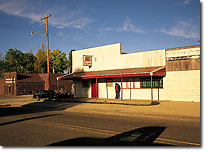 |
| The H & M Mini Store, in Whiteclay, Nebraska: "Many mournful Oglala stories have Whiteclay at their end" |
Even at 9:30 in the morning Whiteclay effervesces and bubbles as if acid were eating it away. On this particular Saturday there were loud cars cruising slowly, laughter, shouts. A group of tall men drinking twenty-four-ounce beers stood by the side door of the Jumping Eagle Inn, which is not an inn but a package store. Two gray-faced women in heavy plaid flannel shirts conferred by the side of the road and then smiled together and set out at a walk. Because Whiteclay is within walking distance of the reservation, the town usually has a lot of pedestrians. When the crowds get too big or unruly, the Nebraska Highway Patrol comes and makes everybody who's on foot walk back across the Pine Ridge border. Groups of evictees stagger along the highway out of town; when they see the Nebraska patrolman leave, they come back. Nebraska police officers made fifty-six alcohol-related arrests in Whiteclay in 1997. Whiteclay businesses paid almost $88,000 in Nebraska state liquor taxes in 1997, and another $152,000 in state sales taxes, and most of their customers came from the reservation. But Pine Ridge residents jailed in Nebraska can't really get treatment at state-subsidized alcohol-treatment centers. Those facilities are intended only for Nebraska residents.
Seen from the air Whiteclay would look like a small appendage to a multi-acre expanse of junk cars. The junkyard, on the prairie behind the Arrowhead Inn, is enclosed by a rambling fence made of corrugated iron alternating with chain-link mesh. The fence is permeable, and the cars provide some of the customers of the Arrowhead Inn with places to sit as they drink. Women too preoccupied with drinking to be called prostitutes accompany men into the junkyard in exchange for a car radio or a bottle of wine. Large auto junkyards like this one are a common feature of Western towns that sell alcohol on the borders of Indian reservations.
 VERY summer in early August, Pine Ridge opens out like a road map unfolding, as people begin to arrive for the big tribal powwow. First you see one motor home with an unfamiliar license plate, then you see three, then ten. They have lawn chairs strapped to the back or the roof, and they're emblazoned with brand names -- Tioga or Itasca or HitchHiker or Wanderer. Suddenly the village seems enlarged -- a spread-out encampment rather than a small town. Here and there cars are pulled off the pavement alongside the road, and people in shorts, carrying cameras or binoculars, are stepping through the sagebrush in the fields. A pale bunch of teenagers sit on the curb outside Big Bat's licking ice-cream cones, making a row of white knees. At the cement picnic tables west of town a family of seven -- two white-haired oldsters, blond dad, blonde mom, and three blond children -- carefully lay out seven places for a picnic lunch. Then they sit, hold hands, and bow their heads in prayer; their extra-long motor home has Utah plates.
Some early arrivals pitch tents and set up campsites among the trees just west of the powwow grounds. There are two-man and four-man high-tech nylon tents in luminous shades, and old-fashioned canvas tents, and several white-canvas tepees with pennants of colored cloth hanging from the ends of the tepee poles. People indicate their campsite boundaries with low fences made of wooden stakes connected by twine or by strips of yellow-plastic tape bearing the words POLICE LINE DO NOT CROSS. Next to many tents are stacks of freshly split firewood. The tent neighborhood grows, and soon acquires at least two sketchy streets with many vehicles parked along them here and there. One morning the big tractor-trailer trucks begin to arrive -- first the stock trucks, with the steers and bucking horses and bulls for the powwow rodeo, and then the long caravan of carnival attractions and rides.
The sound of foreign languages on the streets of Pine Ridge during powwow time raises this place to a category of its own among mid-American towns. It reminds you that Pine Ridge village is also the capital of a nation, one that receives emissaries from far away. The fascination that many German people, for example, have with the Oglala had seemed merely odd to me until I saw Germans and other foreigners at the powwow. They were excited, all eyes and ears and electronic gadgetry, and they made what surrounded them seem exciting. I reflected that the moment in history when white people and Native Americans first discovered each other was so momentous and fateful and even thrilling for each culture that some of us feel compelled to re-enact it again and again. The powwow's mood of curiosity about the Other wasn't limited to the visitors' side. One evening during powwow week I went for a walk along a dirt road in an out-of-the-way part of the village, and as I came down into a little hollow, I met five or six Oglala boys sitting on bicycles. By accident or on purpose they were in a line across the road, blocking it so that I had to stop. Along the road on both sides midsummer foliage screened out all other sights and sounds; we could have been on any creek-bottom road on the Plains. The boys looked at me with unblinking dark eyes. Then the biggest boy, straddling his bicycle and bumping it back and forth between his knees, said to me, "Where did you come from -- Europe?"
By Wednesday afternoon of powwow week Pine Ridge was jumping. The rodeo was going on -- the "Old Man Events," for cowboys forty-five and older -- and the powwow itself would begin that evening. Wherever you looked, near or in the distance, you saw people, and yet somehow at no single place did they constitute a crowd. Many had dressed up for the day's events; even more had not. For a while I just went around checking out what people wore. A group of Oglala veterans who would march in the powwow's grand-entry parade stood talking next to an olive-drab van with white lettering on its sides listing the names of battles in Vietnam. They had on berets, service patches, medals, and feathers; one guy was in crisp jungle-camouflage fatigues, his trousers bloused below the knee into jungle boots of olive nylon and shiny black leather. On his head he wore a black baseball cap with a single eagle feather on a leather thong hanging down behind. As I looked at him, he nodded back at me and asked if I was a veteran. One of his companions had a clipboard with a list of names; they needed more guys to march in the parade. I said no, I wasn't, and I half slunk away.
I saw a young woman in dark-purple jeans, a silky black blouse, sunglasses, and silver earrings in the shape of baying coyotes, her straight black hair hanging well below her waist and held by a single tie between her shoulder blades; a young man all in denim, from his jeans to his sleeveless vest to his oversize Superfly-style denim cap, on which was pinned a large button that read I LIKE A GOOD BEER BUZZ IN THE MORNING; limping Indian rodeo riders with their identifying numbers still attached to their backs, and orthopedic bandages peeking out from their shirts at the wrist or wrapped around the outside of their blue jeans at the knee; a slim young man in a black T-shirt with white lettering that said MY HEROES HAVE ALWAYS KILLED COWBOYS; old Indian men in light-colored Western dress shirts with dark string ties, their hair slicked back; old Indian women in flouncy, many-colored Spanish-style skirts with their hair piled up high and held by combs; little girls in buckskin dresses decorated with elk's teeth; a big, long-haired man wearing a blue-and-white head rag, narrow, reptilian sunglasses, a loud Hawaiian shirt unbuttoned over his stomach, and a heavy chrome-silver watch chain looped from his belt to his right front jeans pocket; and a curly-haired man with a drink-ravaged face, a beaded belt that said BULL PLUME, a yellow-straw cowboy hat, pegged jeans, and pointy-toed cowboy boots cut off below the ankles, so that they resembled slippers with high heels. Of course, most people had on the usual shorts, T-shirt, and sneakers combination of the summer fairgoer, which made the exotic getups look even better.
All the activity -- the rodeo, the vehicles and horses, the thousands of strolling feet -- stirred up a great dust that rose above the village and hung high in the air. Late in the day, as the sun declined, it illuminated the dust and gave the sky a reddish tinge. Pinkish-red light glowed on the western sides of the Pine Ridge water towers. The carnival rides began, and neon tubes in soft shades lit up on the whirling armatures of the Tilt-A-Whirl and the Mad Hatter's Tea Party. The carnival's three electric generators roared. Speakers on the fa�ades of the rides played loud rock-and-roll music, and as I stood at a point with speakers on one side and generators on the other, I decided there wasn't much difference between the two sounds.
I went into the powwow grounds, passing through a gate in the chain-link fence that surrounded it. Admission was free. At the center of the grounds, and at the center of the powwow, is an open space about forty steps across, where the dancing competitions and other ceremonies and contests are held. A circular structure, poles supporting a roof, encloses this space. Spectators gather under the structure as if at a theater-in-the-round. Some stand or sit on the ground, but most sit on folding lawn chairs they have brought. The best way to observe a powwow is from your own lawn chair, and you may feel a bit unmoored and not quite present if you haven't got one. Outside the ring of spectators is a kind of circular promenade lined with booths selling Indian tacos and crafts and lemonade. Many powwow-goers occupy this zone, walking round and round.
I did not know for sure what was going on. No program notes had been provided; as at most powwows, events seemed to proceed by spontaneity, with a tacit understanding among the main people involved. A tribal official was talking at great length on the loudspeaker, allowing himself many weighty pauses. The spectators remained attentive to the still-empty powwow circle, as if expecting that at any minute something would materialize there. After a while the drum groups, from Pine Ridge and other reservations, began to arrive. A group of men in matching ribbon shirts carried a flat drum the size of a truck wheel to a place near the announcer's booth, and a minute later they had set it up and had started to drum and sing.
The men sat on metal folding chairs in a circle around the drum, hitting it hard with leather-wrapped drumsticks and singing a traditional song in loud, high-pitched unison, above which a single higher voice occasionally rose. Full dark had fallen by now, and the overhead lights had come on, but many corners of the powwow grounds were half lit or in shadow. Shadows made it hard to see all the faces of the singers. In a circle around them intent white people watched and listened, some holding microphones to catch the sound. The observers' faces were wide-eyed, but the singers, as they leaned into the light and back out of it, had their eyes screwed shut and their mouths wide open in song. Some of the singers held a hand to one ear to plug it, the way musicians in recording studios do. They sang at full voice, from deep inside themselves, all of them hitting each note and word with vehemence and at exactly the same time. The singing, a survival from hundreds of years ago, filled the arena and echoed to the prairie sky.
Elaborately feathered dancers entered the powwow circle for the men's Traditional Dance competition. The crowd of spectators standing behind the rows of lawn chairs grew, and those in back couldn't really see. The view from there reminded me of a crowded exhibition of famous paintings I went to once in a museum in New York City: occasionally a gap in the throng would occur, and through it would come a dazzling glimpse of color and form; then the ranks would close and all Icould see was the backs of people's heads again. At a less crowded spot I worked my way to the front. The dancers were all going counterclockwise, each dancing as if alone, stepping to the drum music, some crouching down low. All of them had numbers pinned on like those worn by rodeo riders or distance racers; the powwow judges would award cash and other prizes to the best dancers in each category and subcategory. A dancer came right by me. He was a big man, and in his costume -- turkey-feather bustle three feet across, feathered anklets, feathered gauntlets, beaded headband, tall roach made of a porcupine tail atop his head -- he seemed magnified in every dimension, almost a spirit-being. Then I saw the wristwatch he had on beneath the gauntlet, and the sweat on his temple, and the concentration in his eyes.
Now I wanted to be someplace quiet and empty. I maneuvered through the crowd and went past the taco and lemonade stands, out the gate in the chain-link fence, through the field full of parked cars. The carnival had shut down, and the rock-and-roll no longer played, and only one generator still purred. I walked to downtown Pine Ridge, past the tribal building, up the hill to the old hospital, and onto the open field with a jogging track that some people call the Path the Doctors Walk On. I went half a lap around and sat down. The grass was damp; dew had begun to fall. I could hear the amplified voice of the announcer at the powwow. Then his voice stopped, and the only sound was the singing and drumming. It came through the darkness high and strong and wild, as if blown on the wind. It could have been ten voices singing or it could have been a thousand. At moments it sounded like other night noises, coyotes or mosquitoes, or like a sound the land itself might make. I imagined what hearing this would have done to me if I were a young man from Bern, Switzerland (say), traveling the prairie wilderness for the first time in 1843. I knew it would have scared and thrilled me to within an inch of my life.
NE afternoon Le and I were driving on Highway 18 in Pine Ridge when I noticed a single-story factory-style building across a weedy field. It had some lettering and a mural of a landscape on the front. A sign by the highway said it was the SuAnne Big Crow Health and Recreation Center, and below that were the words HAPPYTOWN, USA. I asked Le if he knew who SuAnne Big Crow was. He said, "She was a basketball star for Pine Ridge High School who helped 'em win the state championship and died in a car wreck a few years back. It was when I was living in New York, though, so that's about all I know."
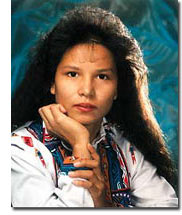 |
| SuAnne Big Crow as a high school senior in 1991, the year before she died |
The entry hall had fluorescent lights above and a banner that said WELCOME TO HAPPYTOWN, USA. The images in the hall were a temporarily confusing combination of Oglala pride and 1950s-revival style. The words for "Boys" and "Girls" on the restroom doors on my left were in Sioux. On a table in a corner was a highly polished pair of brown-and-white saddle shoes. Above them hung the flag of the Oglala nation, and next to the flag was a large framed portrait of a young Elvis Presley -- a more Indian-looking Elvis, it seemed to me, with a darker complexion and blacker, straighter hair. Framed photographs of a teenage girl smiling in a basketball warm-up jacket, making a shot in a basketball game, looking serious in a formal dress next to a boy in a tuxedo, added the aura of a shrine.
The hall led on the left to a caf� in a big room with a lunch counter and tables and booths. The back end of a 1955 Packard affixed to one wall held potato and macaroni salads in its open trunk. A few late lunch customers were eating burgers in the booths or helping themselves to salad. A loud jukebox played fifties and sixties songs. Old-time Pepsi memorabilia decorated the walls, along with black-and-white photo portraits of John F. Kennedy and Martin Luther King Jr., and several more portraits of Elvis. Kids of junior high age and younger were hanging out -- eating ice-cream cones, playing video games.
At the end of the hallway on the right was a smaller room, with glass trophy cases along the walls. The trophies were all from the athletic career of SuAnne Big Crow. I looked at the trophies, I watched a short video playing on a VCR in the room, I read some framed news stories about SuAnne Big Crow, and a sense of discovery came over me. Here was a hero -- not a folk hero, a sports hero, a tribal hero, or an American hero but a combination of all these. I had thought that Oglala heroes existed mostly in the past. But a true Oglala hero appeared in the late 1980s, in suffering Pine Ridge, right under everyone's nose, while the rest of the world was looking the other way: SuAnne Big Crow.
Imagine that when you were a little kid you thought, as kids often do, that your father was the strongest man in the world; but when you got older, you discovered that your father actually was the world's strongest man, and you watched him win the gold medal in weight lifting in the Olympics. Or imagine that an older kid you looked up to when you were in elementary school, instead of fading in luster in the usual way as time went on, not only fulfilled every expectation you had for him but surpassed these with glorious public feats you never dreamed of. Imagine that the hopeful, innocent, unbounded fantasy you had about someone you really admired when you were a child did not meet the usual puncturing and deflation but simply continued to grow; that you kept it with the same innocence and hope, finding more justification for it every day; that the person you admired, someone as familiar to you as yourself and yet at the same time set apart, took the hope invested in her onward into the larger world without a hitch, increasing her fame and achievements and admirers geographically along the way. And imagine that against odds upon odds she won, won at everything important she tried, won so blithely as to hardly show her strength; and that she carried the hope invested in her unstoppably aloft, defying the death and fear in the world. And imagine that as she did this she somehow carried you with her, lifted you, too, above the fear and the death, and gave you and all the people around you someone to be -- a self, a freedom, a name. Warfield Moose Sr., SuAnne's teacher of Lakota studies at Pine Ridge High School, said of her, "She showed us a way to live on the earth." Such was SuAnne's stature and generosity that she was able to do that not only for her Oglala people but for those who knew her and knew of her in the state of South Dakota and beyond.
(The online version of this article appears in four parts. Click here to go to parts one, two, and four.)
Ian Frazier received the inaugural Thurber Prize for American Humor, in 1997. His article in this issue of The Atlantic is drawn from his latest book, On the Rez, to be published by Farrar, Straus & Giroux next month.
Photographs by Guy Kloppenburg.
Copyright © 1999 by The Atlantic Monthly Company. All rights reserved.
The Atlantic Monthly; December 1999; On the Rez - 99.12 (Part Three);
Volume 284, No. 6; page 53-84.