Bottle Hunt in North Africa
ByCAPTAIN HENRY L. HEYL
WE WERE a large hospital unit with many enlisted men, nurses, and doctors. Only, for the moment, we had no hospital. Also, we had no patients. It was three months after the Allied invasion and three months before the fall of Tunisia, a relatively quiet time in Morocco. We thought it was time we had a dance.
They had said to me, “Henry, you get the wine.”
I sat down on a park bench to calculate how much we should need. It came out one hundred bottles. First, one hundred empty bottles, for wine merchants demanded an empty bottle before selling a full one. C’est nécessaire absolument, monsieur, une bouteille!
An Arab hoy circulated shyly around my bench.
I smiled and gave him a stirk of Juicy Fruit gum. I asked him where I could find some empty bottles. He hopped up and down on his bare feel and signaled to me to come with him.
He led me from the light and shade of a sunny afternoon into a dark alley. Suddenly he darted away tow ard an arched doorway where he crouched quickly, as if he were playing squat tag. His tattered gray robe crumpled about him. Them quickly and dramatically he stood up and aside — and there were three empty wine bottles. He was proud as a chicken that has just laid a handsome egg. I gave him the whole package of Juicy Fruit. He danced off up the street, and the beautiful gum was the theme of his dance.
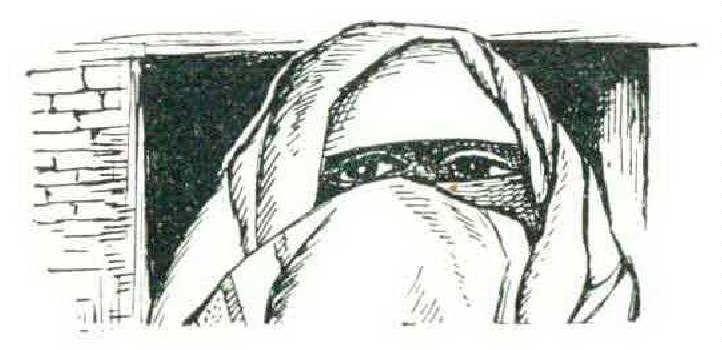
I bought a grass basket, made of purple and green stripes, to carry my bottles. I winked at an Arab veil. After all, it had winked first.
Soon I was staring at a small window full of empty wine bottles; but the unhappy Arab inside wouldn’t sell me any. He sold vinegar and looked as if he drank it. I bought five bottles. When I was out of sight I looked both ways, and quickly emptied the vinegar into the street. I had eight empty bottles.
Le Petit Poulet is a good place for lunch.
“François,” I said to the waiter, “where can I get some empty wine bottles?”
“Ah, monsieur,“ he said, ”c’est difficile!“ Then he added confidentially, “Restez ici, s’il vous plaît.”
Five minutes later he emerged cautiously from the kitchen, his soiled while coat bulging on one side. He bowed over me as if to serve me and slid two empty bottles into my lap. I slipped a package of Luckies into his passing hands. He grinned.
All this time a quiet, middle-aged Frenchman had been eating opposite me. Finally he asked, in French, “ You want bottles?”
“Yes,” I said.
“It is difficult,” he said. I agreed.
He cleaned his horn-rimmed glasses. “ Why don’t you gel a barrel? A barrel,” he said, “is difficult to find, like bottles, but it holds very much more wine.”
But in six stores there were no barrels.
Along the street came a happy horse pulling a wagon full of wine barrels. I waved to the driver to stop. He climbed down to hear me better. Certainly he knew where I could find barrels; he w rote an address on a scrap of paper. But certainly! I gave him five francs. He turned red and quickly gave it back to me. He stood very straight in his faded blue trousers and dirty shirt. “Mon Capitaine,” he said, “you are an American. Me, I am a Frenchman. C’est la même chose — the same thing. À la victoire, Capitaine!“ and he climbed up on the barrels and cracked his whip.
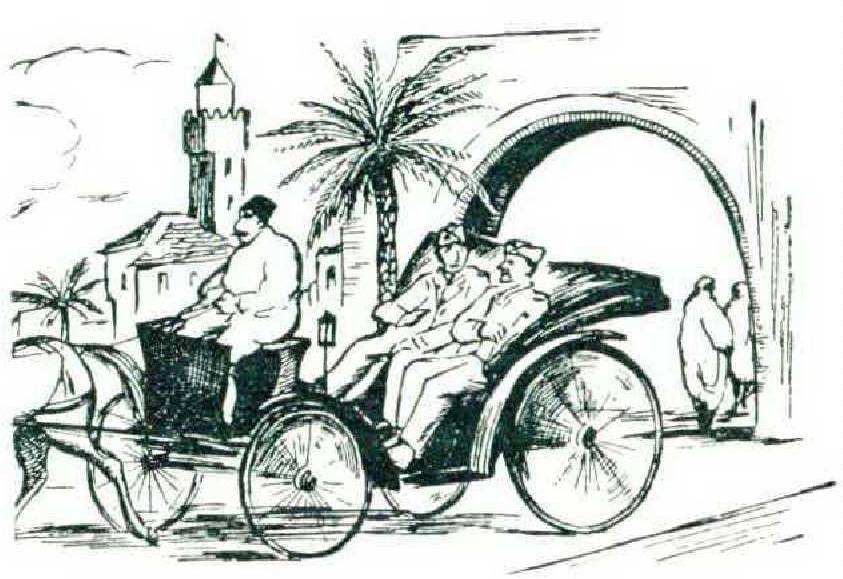
I hailed a taxi, an open carriage with the spicy odor of a livery stable. It was a nice carriage but I was a little embarrassed, so I was glad to see my friend the Major on the sidewalk. He felt like hunting for barrels and climbed in beside me.
The driver was an Arab and his own language was all he spoke. I told him the address in French; I showed him the address on the paper. He nodded his hooded head. Then he confided the information to his horses in a series of loud, painful grunts.
We clop-clopped at a brisk trot straight into the middle of a busy intersection and there we stopped. Jeeps honked, bicycles collapsed. The snappy
French gendarme directing traffic could easily have stepped from his box right into the carriage. “Pardon, Capitaine?” he said. I asked him the way to the address. He gave the driver quick staccato directions in Arabic. The driver saluted the gendarme. The gendarme saluted me. I saluted the gendarme. “Plaisir, Capitaine,“ he said.
Casa Accra, barrel makers, had many barrels. I told the fat French manager our problem. He did not say, “It is very difficult.” He picked out one large barrel and three small barrels and called to a man in a leather apron who rinsed them out with black juice.
“What’s that?” I asked.
“Water!” he said, and laughed. Then he rinsed them out with yellow juice.
“What’s that?” the Major asked.
“Sulphur,” he said. We were learning a great deal.
Then they loaded us into our carriage — one Arab, one major, four barrels, ten bottles, and a captain.
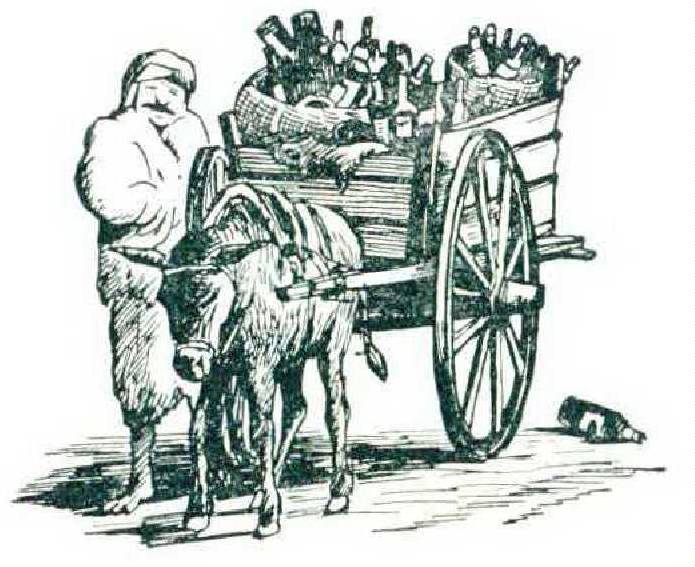
On the way home we overtook a donkey cart loaded with empty bottles. Suddenly one bottle fell off. It landed on a little spot of grass. I said to our driver, “Stop!” Quickly I jumped out and picked up the bottle.
“Eleven bottles,” the Major chuckled.
2
An organization called the French Commission handles the rationing of native produce. The girl at the desk smiled. Her face had seen more of the world than mine, and her hair was just a little too blonde. We both knew these things, sizing each other up. “Certainement!“ she said. “Monsieur Heriot will see you. Monsieur Heriot is the monsieur in charge of wine permits.”
At first, all I could see of Monsieur Heriot’s head was mottled skin sparsely overlaid with listless gray hairs. Then he straightened up slowly and looked at me out of dull, tired eyes.
So I told him about our dance and our need for wine. Then for the first time he smiled. I had spoken of the dance as “ une petite affaire.” “You mean ‘ une petite Occasion,’ monsieur,” he said. “A little affair,” he chuckled, “it is something different!” There was a burst of laughter from the girl in the doorway.
“How many at your dance, please?” He figured carefully and began to fill out blanks. “What kind of wine?” he asked. He didn’t seem nearly so tired. His pen scratched. He rubbed his hands together. “I have not heard of a dance since two years!” he said.
“You must come,” I said, “ — and bring Mademoiselle, là-bas,”
“Capitaine!” he exclaimed. “Oh!" said the empty doorway behind me. “Marie,” he called, “you have heard?” Marie returned red-faced and excited. “Capitaine,” he grinned, “Mademoiselle and I, we tell you — how you say it? — O.K.!”
A few days later the Major went with me in a truck to get the wine. There were barrels all around us in Monsieur Arnault’s cellar. Fat gray tuns as
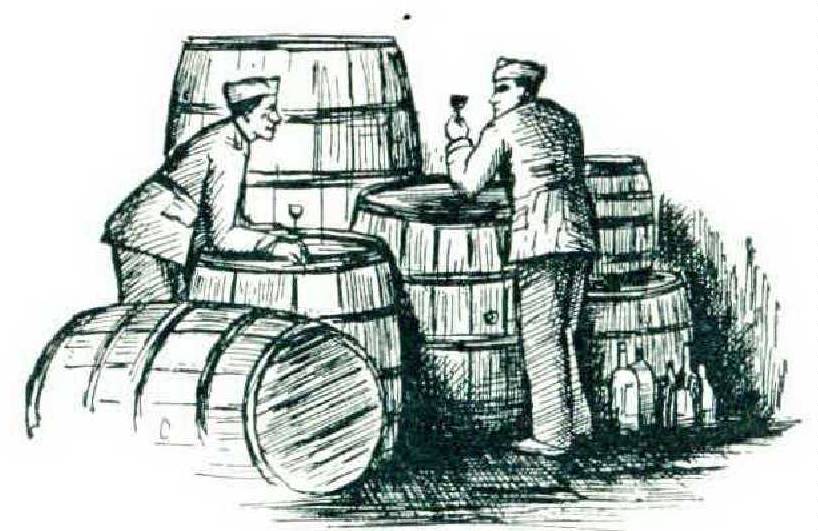
big as dining-room tables. Barrels six feet high casting deep shadows where the sun shot in through the door.
“Some brandy, mon Commandant?” The Major accepted the glass Monsieur Arnault offered, and swallowed — quite a large swallow. His face grew purple. He leaned on a barrel and coughed softly, as though the whole coughing mechanism had been burned out. Then he handed me the glass. “Try it, Henry,” he breathed.
I let the liquid meet my tight lips, and felt the outer layer of skin curl back. “ Merveilleuse!” I murmured.
“It is eau de vie,” announced Monsieur Arnault proudly. “It is made only here in Morocco.”
“How fortunate!” gasped the Major.
We decided on red wine. An old Arab filled our barrels from a great tun. He picked up a piece of rubber hose from the floor and passed one end into the tun. The other end he stuck in his mouth and sucked hard. Suddenly his mouth and grisly chin overflowed with wine. He popped the hose into our beautiful barrel. And that was that. The Major and I turned pale, the wine gurgled, and the Arab shuffled off to get the next barrel.
Later, at the office of Monsieur Dochet, we tasted old wanes and Moroccan champagne. This wine merchant wore a full beard and an immaculate rough tweed suit. His place was as neat as a bank. He opened a new bottle and poured the Major a small glass.
“It is the eau de vie,” he said, “made only in Morocco!” We retreated in near-panic.
But there was no avoiding this monsieur. “ Try it!” he commanded. The Major slowly raised the glass to his lips. Then he licked his lips, glanced quickly at me, and tossed it down. His eyes sparkled. I sampled the brandy, and it was very different, this eau de vie!
“We will take twenty bottles!” I cried, producing our permit.
Monsieur was genial and hearty. “Very good, Capitaine,” he said, adding slyly: “You have the empty bottles, no?”
“Oh, yes,” I said, pointing to them. He counted. “But there are only eleven, Capitaine,“ he said.
I smiled my best smile and gave him a pack of Camels. The Major grinned and gave him a Philip Morris. Monsieur grinned. We were old friends. Then he spoke to an Arab boy who brought eleven bottles of eau de vie.
“It is correct, Capitaine,” asked Monsieur smiling, “you give me eleven bottles, I give you eleven, yes?”
There was no way around him.
The Major and I felt too happy to ride in a truck. We sent our driver ahead with the wine, while we hired an open carriage. In this we jogged toward home like two princes.
As we reached the outskirts of the city, we suddenly came upon a Senegalese band rehearsing in a field — about forty black natives and a French leader. The men wore red pantaloons, yellow shirts, and blue caps. We stopped to listen. So did others: two giggling girls, three Arab farmers, a couple of donkeys, a bicycle, and a camel.
The band lender was intense and fiery. He crossed the street to get the effect, of his band at a distance. Then he saw us. He stiffened, and shouted an order at his men. They came to rigid attention. He raised his baton, brought it down with a flourish, and blasting across to us came “The Stars and Stripes Forever.”
For a moment we felt we should stand. We compromised by saluting the apoplectic little leader when he had brought them through a triumphant finale. The band started a native march as we moved off. But in our heads it mixed with “The Stars and Stripes Forever,” the four barrels of wine, and the eleven bottles of eau de vie, made only in Morocco.