The Smile on the Face of the Mare
ByWALTER BINGER
OUR early cubbing hunts in Connecticut start at half past five in the morning. For me they start at four. If it takes me thirty minutes to walk my horse to the meet, I must leave at five and my horse must be fed at four. But I have no groom, and my elderly neighbor, the farmer who looks after my horse, cannot arise so early, nor can I. Why, after all, thought I, does it take a man to put grain into a bin? The answer was obvious: it does not; a machine can do it better.
Obviously two mechanisms were required for my automatic feeder: a timepiece and a release for the oats. After considering various methods of release, such as the opening of small doors, I decided that the simplest way of starting the feed on its downward path was by upsetting it from a bucket. There was nothing mysterious about the timepiece either; merely a clock made for the purpose of opening furnace doors.
This it accomplishes by holding a weight, suspended from a hook at the back of the clock, which falls off when the hook turns upside down as the alarm goes off. When Archimedes said: “Give me a fulcrum for my lever and I shall move the world,”he might as well have said, “Give me a hook on which to hang a pulley,” for a falling weight drawing a chain through a pulley will give your “world” the same yank upwards as the end of Archimedes’ crowbar.
So the bucket was filled with oats while a toy pail, with enough pebbles in it to constitute an effective upsetting force, was the weight. The clock was started and the alarm wound by turning the stem which ends in the hook; and on this hook the weight was hung. And so to bed.
When it became known that my horse was being fed mechanically I had to answer many questions. “Who wakes the horse?” “How does she get her shower?” But the most, difficult and the one my family has always maintained I have never satisfactorily answered is: “How do you know that the horse has eaten the oats?” They have always twitted me because I simply affirm that she must have. According to them, that is jumping at conclusions. All the knowledge I have about the feed, say they, is that it is no longer in the pail.
But I counter with the argument that the only way the poet knew — and knew with such certainty that he was willing to publish the fact — that when “they came back from the ride” it was “with the lady inside,” was that there was a “smile on the face of the tiger.”
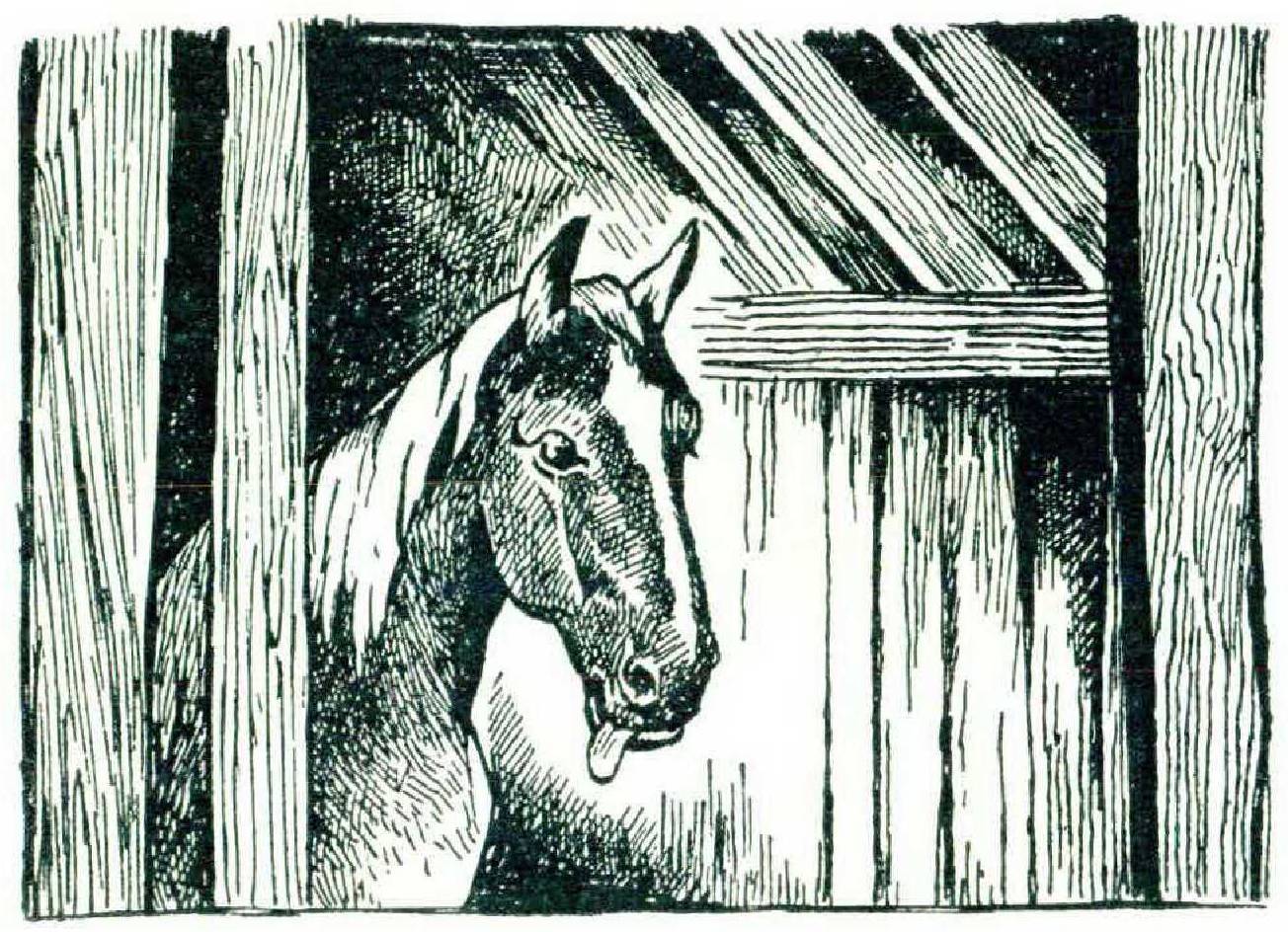
I can always detect a smile on the face of the mare.