"They Made Me What I Am Today"
By NEWMAN LEVY
IDEOLOGICALLY,at the age of eight, I was still untouched. Then Horatio Alger’s books came into my life, and my views on politics, sociology, and economics began to take form. I had discovered Literature. I sometimes think of the futility of parents’ attempting to impose their tastes upon their children. Heywood Broun used to tell how his infant son Woody would burst into tears every time he looked at the picture of Lenin that hung in the Broun home. Finally Heywood told him one day that it was a portrait of Nicholas Murray Butler. The child immediately quieted down, and thereafter everything was serene.
I have a similar difficulty in trying to educate my daughter to my standards. Many a time when I feel like listening to Sammy Kaye or Jimmy Dorsey on the victrola, she insists upon playing a Brandenburg Concerto or a Beethoven Quartet.
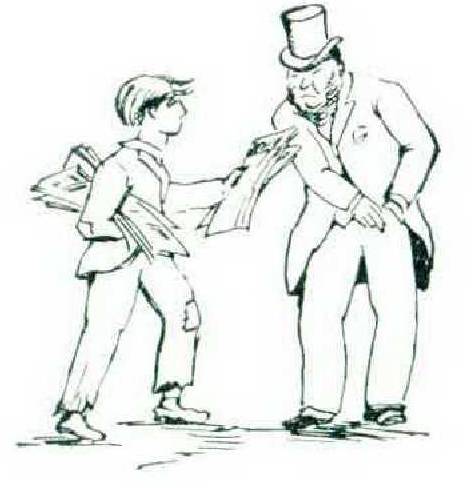
At any rate, Alger was my own discovery. I learned from him that in the world in which I lived there were ragged but noble-minded heroes who sold newspapers, smashed baggage, and played the violin on the Weehawken Ferry. There were also men called Squires — sour-faced, crusty old reprobates, who frequently concealed beneath their stern exteriors hearts of gold. These squires invariably had lovely golden-haired daughters who had a disconcerting habit of getting lost or becoming involved with runaway horses. The secret of success, I learned, was to practice thrift and industry and to keep your eyes open for lost golden-haired daughters of wealthy squires.
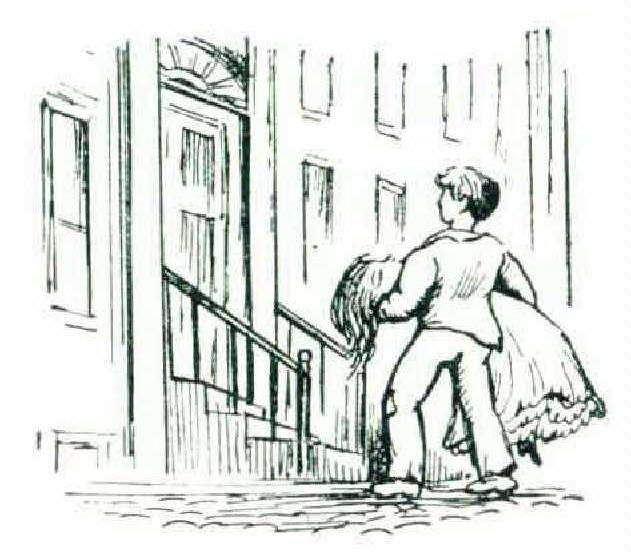
Our hero, his face bright and shining with ambition after a night at the Newsboys’ Lodging House on Chatham Square, would be playing his fiddle, peddling his newspapers, or smashing his baggage, as the case might be, when lo, he would be startled by the sight of a beautiful golden-haired little girl weeping bitterly in front of the World Building or being dragged by a team of infuriated black horses careering wildly down Park Row. Our hero, without thought of his own safety, would unhesitatingly dash forward and dry the tears of the weeping child, or else leap at the bridles of the enraged steeds and bring the animals under control. In either event, having retrieved the young lady, he would then return her to her anguished father who dwelt in a brownstone mansion on Madison Avenue. The old man’s flinty heart would melt, and he would promptly take the young man into his countinghouse at a munificent salary (I had a curious impression that a countinghouse was a place where people sat around and counted — something like our arithmetic class). Success, wealth, and presumably matrimony thereupon followed.
That is approximately the formula of the Alger books. It is a success-story pattern, very much like the tale of the young man who amassed a hundred thousand dollars by dint of thrift, industry, self-denial, and an aunt who died and left him ninetynine thousand, eight hundred and seventy-five dollars and forty-four cents. The Alger boys had no rich aunts, but they did very well by finding blondes and stopping runaways.
Much time during my early youth was spent in looking for lost golden-haired daughters of wealthy squires — a habit, I may say, that has never left me. My clothes were not ragged, but I believed that I might be able to overcome that handicap if I acquired the other virtues of an Alger hero. I was confident that, given half a chance, I could melt the heart of the flintiest squire. I could not play the violin so well as Phil the Fiddler — in fact I could not play it at all; but at the age of nine I was able to do a pretty good job with Für Elise on the piano.
Thus I grew into adolescence with a smug, complacent faith in laissez faire, in the best of all possible worlds, in the inevitability of rags-to-riches, and with a fuzzy social outlook that could have qualified me, at the age of twelve, as a Chamber of Commerce speaker or an Association of Manufacturers columnist. I do not recall whether we are told that George F. Babbitt grew up on Alger, but I am quite certain that he did. He gives every indication of having been exposed, as we all were, to the blight.
My college contemporaries have done all right according to Horatio Alger standards. I see some of them occasionally when they drop into my office to talk over old times and try to sell me a twenty-year endowment policy. They are still the same old fun-loving Jones, Smith, and Henderson of yore. They are also the generation that grew up (chronologically) before the last war, and constitutes the leadership of today.
The outlook for the future seems brighter. The young boys of my acquaintance all read Superman.