Gypsy Fiddle
Violinist and writer, JOSEPH WECHSBERG converted his experiences in a ship’s orchestra into the thoroughly diverting book, Looking for a Bluebird. He is an American via Czechoslovakia and is now traveling in Europe, whence he has promised theAtlantic an account of tourisme in Switzerland.
MUSIC
by JOSEPH WECHSBERG
ACOORDING to a Hungarian proverb, all a man needs to get drunk is a glass of water and a gypsy fiddler. A real gypsy. Most of the primases (leaders) that you hear these days in the night clubs of New York, Rio, and Paris won’t make you even tipsy unless you have had a lot of expensive vintage champagne to go with the music.
It’s not always easy to tell an authentic gypsy fiddler from a phony. Some impostors fool you with trills, ornamentations, rubati, and caprices in the minor key that sound almost like the real thing. They play intervals less than a half tone and make sudden transitions, from C to E major or A flat major, which are characteristic of gypsy old-timers. I remember one so-called tzigane who played in a little boîte off Montmartre’s Rue Lepic, when I was a musician in Paris, in the late twenties. This fellow Ferenc pretended to be a gypsy primas from southern Hungary, although everybody around the musicians’ café on Place Pigalle knew he was really a Pole who had transformed himself into a gypsy because that way he made more money. Playing à la tzigane meant going from table to table and sticking one’s bow through the curtains of a chambre séparée, until the clients gave you a large tip to get rid of you.
Ferenc had developed the ability to snap up all bills from fifty francs up with his right fore and middle fingers, while he performed a sort of pizzicato with his left hand. Smaller tips he ignored coldly and kept on playing and annoying the customers. Naturally, he made considerably more money that way than most of us playing in cinemas or music halls.
But he got rich and careless and put up a sign:
FERENC AND HIS GYPSY BAND FORMERLY WITH
HIS MAJESTY’S HUNGARIAN COURT ORCHESTRA
That, it appeared soon, was a grave mistake. Ferenc should have known that there had never been a Court Orchestra, because in Budapest there was no Court.
I wasn’t present at Ferenc’s downfall but heard the story from a reliable friend and eyewitness who spent one evening at the boîte when, around midnight, a group of sinister men came in. That was not unusual: Paris was crowded with anarchists, nihilists, and followers of radical political thought. The sinister men studied the Court Orchestra sign as if they had some trouble in reading it, ordered some wine, and began to watch Ferenc’s performance. When he came toward their table, they asked him to play an old czardas by Racs Pali, who had been the King of the Gypsies eighty years ago. Ferenc retorted with a watered-down version of a rather westernized piece of gypsy music, the “Gypsy Airs” (Zigeunerweisen) by Pablo de Sarasate. The sinister men became violently enraged, beat up Ferenc, and chased away his musicians. Then they mounted the platform, took up the instruments, and began to play themselves. They played so well that the proprietor, a real Hungarian, broke out into sobs, and instead of having the intruders arrested, hired them on the spot.
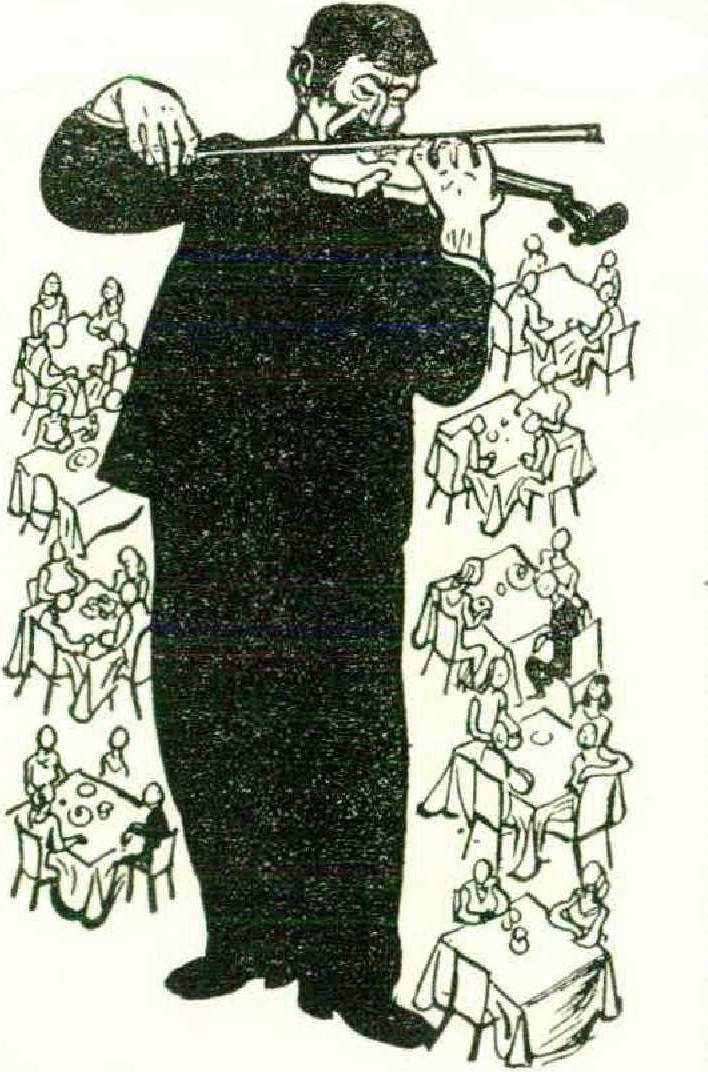
I went to the boîte a few nights later. On the platform I saw seven black-haired, mustachioed fellows with high cheekbones and yellowish complexions. There were two violins, a viola da gamba, a cello, a tambouratch (a big bass guitar), and a zither that was beaten with hammers. They looked like alumni of the more notorious Balkan prisons. They sat there quiet, intent, almost motionless, watching their leader. Then the primas got up and, by way of tuning, gave them the D. That impressed me greatly. The phony Ferenc had always tuned first the A, as every Western musician would do.
The primas put his fiddle up to his chin and started to play. He began with a rhapsody-like song, sad and haunting and very soft. For a while he played alone, now and then accompanied by chords of the zither. One by one, the others came in and the mood of the song changed. It became violent, primitive, wild. The structure was simple: they were doing variations on the leader’s theme. Sometimes they would fall back, while the primas would perform virtuoso trills and ornamental notes, fast scales and doubling notes. Then the orchestra would unite in a general wailing song, and the leader would play a solo on his fiddle, parlando, crying and singing and sobbing on his instrument.
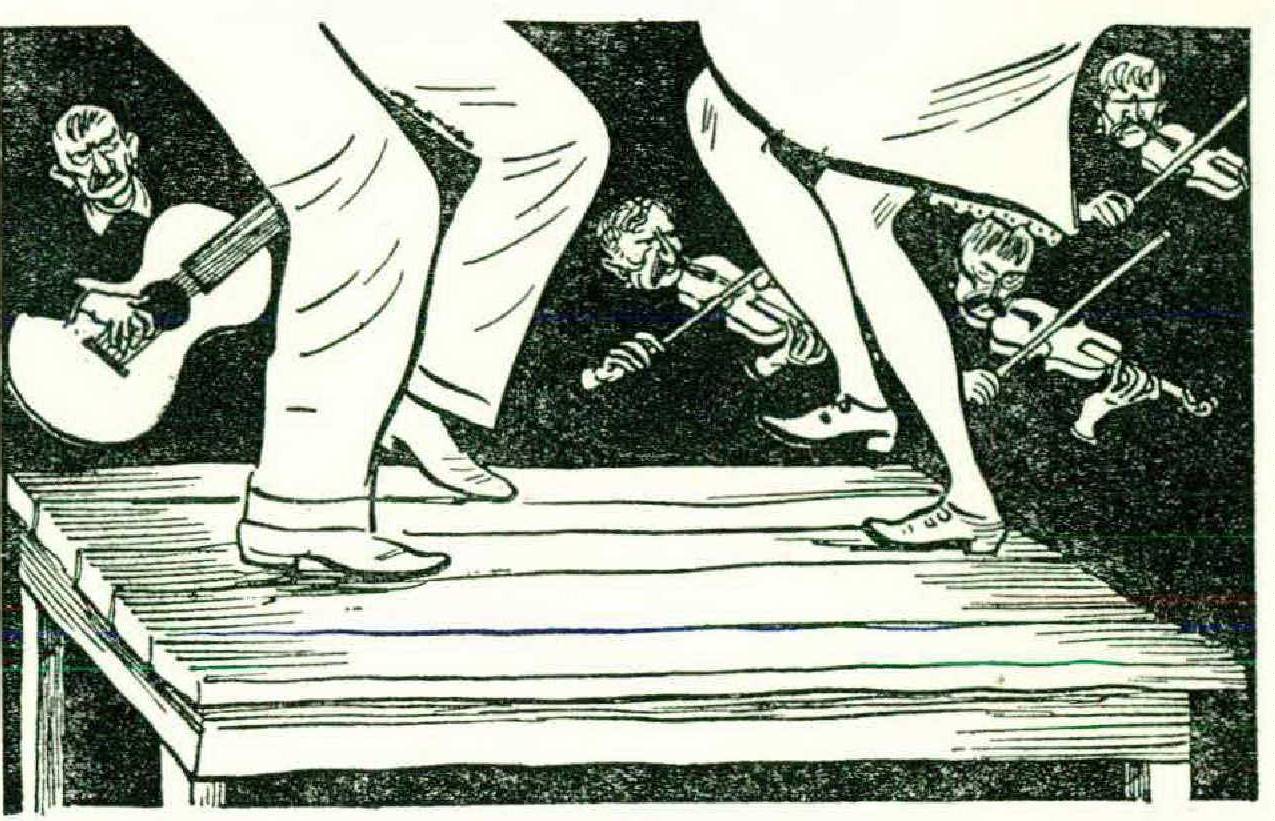
It was an extraordinary performance. The man held the bow with his whole right fist, which would have killed my old violin teacher. He played false notes and committed all kinds of terrible violin crimes: he would never have made the beginners’ class at any music school. But as he played on, something happened to him — and to the public. The people began to hum and to tap the floor, and some women began to cry. The music became louder and faster, the rhythms were more accentuated, and after some time, the entire audience was stamping its feet, shouting and singing. A man and a woman jumped on a table and began to dance the czardas, a Hungarian national dance which needs very little space and great body control to be executed.
The rest of the night is only a dim memory. Everybody was behaving in an ecstatic, intoxicated way. I think the gypsy musicians played on for hours, like the crazed addicts of a wild jam-session. When they finally ended, with a long, sad, lingering outcry, most people in the audience were half-dead from exhaustion.
I went back to the boîte many times later to study the secret of their gypsies’ primitive art. It seemed so easy: the constant use of the augmented second in melodic progression; a lot of improvisations; odd harmonies and sharp rhythms. But when I tried to imitate them on my fiddle, it didn’t sound exciting — just bad. I made friends with the primas and sometimes he would let me sit on the platform and play with them for a while, but it was no use. They were not playing music: they were telling each other stories on their instruments, funny and sad stories, tales of love and hatred. Once the primas told me that they could play more than two hundred different melodies, which they had picked up on their wanderings.
“ We hear a song and play it again,” he said. “ It’s like somebody telling a story. You don’t always tell a story the same way. You make your own changes and then other people change it, and when the story comes back to you, you won’t even recognize it any more. We play lasser (slow) or friss (fast), and we count either ütch (three) or dart (four).” He always used Turkish words when he talked of his music. He liked to talk music all the time but he couldn’t read a single note: none of his men could. They had never heard of trioles or diminished sept chords but once they had heard Suppé’s “Light Cavalry” and in no time they had rearranged the piece and played their own version of it.
Sometimes he would put down his fiddle and talk about his idols, the great gypsy fiddlers: Racs Pali, who died in 1885, leaving thirty-six children, “all of them gypsy musicians”; János Bihari, who played in the “golden age of gypsy music,” at the beginning of the nineteenth century; Czinka Panna and Czermak, great composers of simple tunes.
A real gypsy plays best when he “feels” the dim lights, the perfume of beautiful women, the drinks and whispered voices. To excite others, he must be excited himself. Watching them as they suffer and rejoice and finally go beserk, I’ve always understood why so many high-class ladies deserted their high-class but boring husbands to run away with a primas. Gypsies are very exciting people, and in the Balkans they have the same glamour that surrounds toreadors in Spain and movie stars in America. What the high-class ladies don’t know, and always have to learn, is the sad fact that they will never be able to compete with a gypsy’s fiddle. Gypsies need music: they play by way of selfexpression, as Russians sing and Spaniards dance.
Being interesting but highly unstable people, gypsy musicians have had bad publicity ever since they appeared in Europe one thousand years ago. There is a popular saying that all gypsies are thieves. When I was a kid in Czechoslovakia and a gypsy band invaded the town, all the women locked up their cupboards and drawers, “because those gypsies steal everything.” Later on I spent nights in Hungary and Slovakia with gypsies at their bivouac places. They parked their haycarts at the edge of a forest — to evade the gendarmes — and then they would start to sing and play and dance around a fire. They were nice and sad and lost. They always made me think of what Franz Liszt said of them, “people that know not whence they came nor whither they go.”
They never stole anything from me.