Scrimshaw
MACKINLEY HELM is the author ofModern Mexican Painters, and of Angel Mo’ and Her Son, Roland Hayes and A Matter of Love.
by MACKINLEY HELM
FINE ARTS
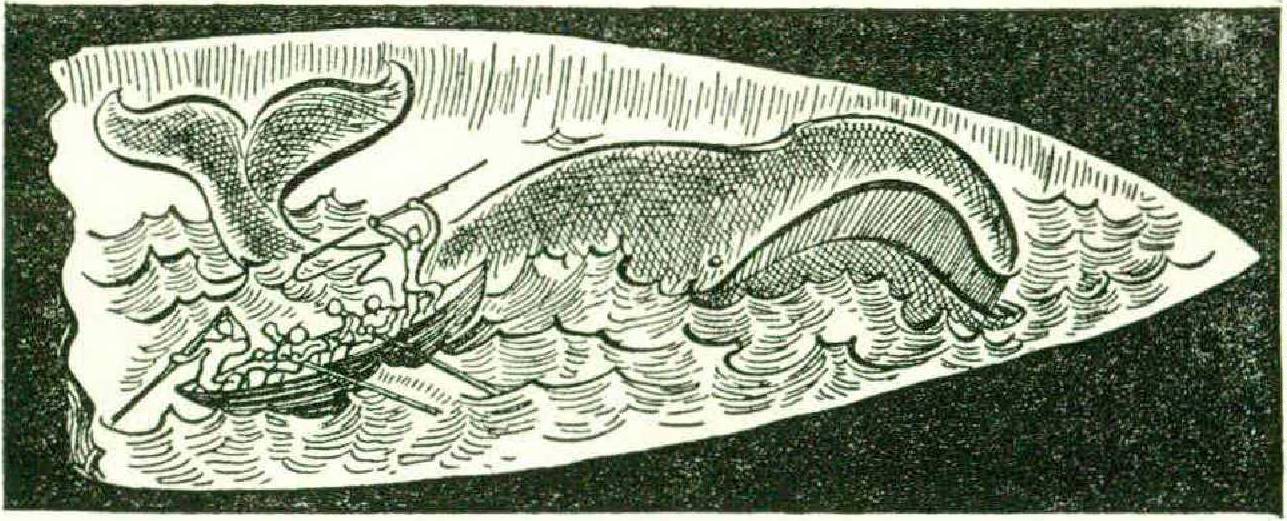
UNTIL last summer, my acquaintance with the skrimshandering business was limited. Melville’s quaint term had stuck in my mind, along with a Moby Dick line about “little boxes of dentisticallooking implements” which whalemen carried around in pursuit of the business of scrimshaw. But before I stopped in at the Peabody Museum in Salem, I had never seen any quantity of the ivory trinkets produced by skrimshanders. The Salem collection spread out an old chapter in the history of American folk art and filled me with new visions of the aesthetic aspect of whaling.
As for the name handed down with the trinkets, there is no bookish evidence to show how the bits of carved bone and whale’s teeth came to be so delightfully called — skimshander, skrimshander, scrimshont, serimshant, and finally, scrimshaw — although people have expressed curiosity ever since 1850, when a whaling enthusiast complained that the late Noah Webster had neglected the art of the whalemen. But whatever the source of its untraceable title, a piece of scrimshaw, properly speaking, is an object — a box or a busk or a pie-crust trimmer— carved from whalebone or ivory by an idle hand on a schooner.
Collectors have thought it a pity that the term should be given to the work of soldiers as well: to the pieces of engraving and carving from salvaged airplanes and branches of coral which were brought home from the lonely Pacific at the end of the war, and to powder horns trimmed with carved flags in the colonial era. Perhaps these things could be labeled scrimshaw with some justification, for soldiers in whatever war have had something in common with whalemen. The French and Indian War, with its several summers of indolence, spared time for the troops to carve Spanish horns and dye the designs with goldthread and sumac, just as in the late war the hands of bored soldiers itched to whittle with jackknives. Still, most museum curators, being historically-minded, give the term only to whale’s teeth and pieces of whalebone carved by sailors.
The decorative carving and engraving of tusks, teeth, and bones is an art as old as the hills. Complete tusks of mammoths carved with animal forms have been dug up from subterranean levels, along with whimsical torsos of nude Stone Age females and fragments of ivory engraved with pictures of huntsmen and beasts. Yet of all the materials used by the sculptors from the first Aurignacian expressionist to the ultimate modernist, none is more curious than the substance called whalebone, first put to use in Middle Age art. It comes from the whale — the right whale, the bowhead, the sperm whale — but it never was bone. It is dug out of the mouth of the mammal, where it is formed in the palate, and in its natural state grows the beard which provided the “horsehair” that covered the best of Victorian sofas. Somewhat tough in the handling, though plastic and flexible, it was prepared for the corseted bosom by boiling. Not so long ago, this uncomely growth, beard and all, brought five dollars a pound in the markets. Captains of whaling ships issued it sparingly, to keep their crews out of mischief; and between whales, so to speak, the sailors made busks to support the breasts of their sweethearts and wives.
The busk was no new invention. The bodies of both men and women had been pent up with busks in Athens and Ephesus, and later in Paris. John Donne, the Dean of St. Paul’s, celebrated the stay in his nineteenth Elegie, “To His Mistris Going to Bed,” composed, no doubt, before ordination:
Tells me from you, that now it is bed time.
Off with that happy busk, which I envie,
That still can be, and still can stand so nigh.
Nevertheless, the American busk has its own naïve place in the history of our indigenous art. It was adorned with intimate verses and original pastoral pictures of sweethearts and flowers. Unlike the jeweled busk exposed in the courts of the Bourbon monarchs, the American busk was familiarly worn inside the New England bodice. The decorations and verses were flavored by that sweet inward use.
There was, to be sure, one cynic among the sentimental, self-trained artists. A busk exhibited in the Old Dartmouth Historical Society’s whaling museum on Johnny Cake Hill in New Bedford is ornamented with a picture of the Crucifixion and a cryptic couplet: —
HARK I HEAR THE SAVIOUR CRY ELOI ELOI LAMA SABACHTHANI
which means, we are told in the Scriptures, “My God, my God, why hast Thou forsaken me?” More commonly, the poet’s intention is tender and not ironical: —
Now ‘tis intended for a woman’s brest,
This, my love, I do intend
For you to wear and not to lend.
The turning of whale’s teeth into mantelpiece ornaments came in with the revival of sperm-whale hunting in the second century of that industry’s American history. In the old days of whaling, the Nantucket whalemen took all the oil they could handle from dead whales drifting offshore. When the Christopher Hussey was blown out to sea in the year 1712, the first sperm whale was killed by an American whaler and a new form of hunting developed. Such a whale had been cast up on the coast of Norfolk nearly a hundred years before that, and Sir Thomas Browne tells how the people had gathered to admire its immensity. Sir Thomas observed with surprise that the sperm oil came from the head and not from parts “official to generation”; and that the mammal, unlike finback and sulphur-bottom, had a lower jaw with a nice set of teeth.
Since sperm oil was the most costly of whale oils and ambergris from a sperm whale’s sick colon fetched up to $500 a pound, the American whalemen gave over their comfortable coastwise cruising for the risks of deep whaling from home. The risks were considerable. “The Spermacetti Whale found by the Nantuckois,” Thomas Jefferson wrote to the French Minister, “is an active, fierce animal, and required vast address and boldness in the fishermen.” And in one of the most poignant dialogues in American letters, from a narrative of the fateful wreck of the Essex, these significant lines will be found: —
CAPTAIN: “My God! Mr. Chace, what’s the matter?” FIRST MATE: “We have been stove by a whale!”
During the War of 1812 the American output of oil dropped nearly to zero, and three years after the war there were still only a few ports from which whalers put out: Nantucket, New Bedford, Fairhaven, Sag Harbor, Hudson, and Westport. But by 1818, whaling crews from dozens of harbors were searching the Pacific for heads that held as much as $15,000 in oil. During the next forty years, with thousands of sailors from hundreds of crews enjoying long months of idleness, the whalers’ art flowered.
The earliest skrimshandered whale teeth in the harbor museums come from the year 1829, if the dates are authentic. There are five from the hand of one Frederick Myrick, with colored engravings of the whaleship Susan of Nantucket on a voyage to the Sea of Japan. Some undated teeth are possibly older. William Osgood of Salem presented to the East India Marine Society, sometime before 1831, two “sperm whales’ teeth, curiously carved,” but they cannot be identified. The museum curators will nowhere vouch for a system of dating anonymous, undated teeth.
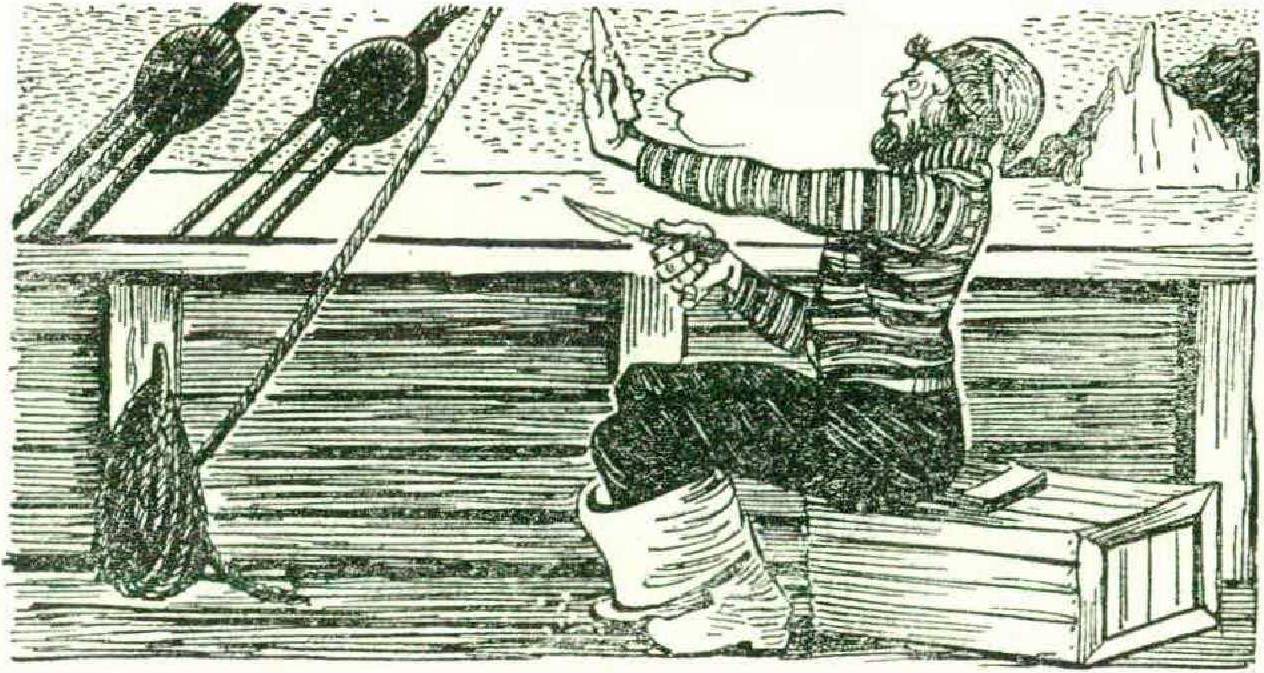
Before you could carve the tooth of a sperm whale into a mantelpiece souvenir, you had to come by it, and that was not easy. The whale did not willingly part with his teeth. You had to detach them by one or another quite nasty technique. Among the extractive procedures described to me by William H. Tripp, Curator of the Whaling Museum on Johnny Cake Hill, — and a member himself of the last old-style crew of whalemen, — the method which seemed the most restful, although it was by no means the least horrid, employed the assistance of natural process.
The lower jaw of the whale was trailed overboard until the sharks ate the flesh and the gums rotted in ocean. The ridged teeth, then conveniently drawn, were filed smooth and the ivory surfaces polished with trying-pot ashes. Then dreams of fair women were pricked on from the Godey Books, or ideal ships traced from standard patterns, and the designs were engraved with jackknife and dentistical implements.
The New Bedford Museum displays a shelf of skrimshandering tools made by hand on the whaleship Awashonks: a small hack saw; a stout keyhole saw; and files, chisels, awls, drills, calipers, needles. But as Melville observes, most of the skrimshandering business was conducted with jackknives alone; and except in removing the jagged end of the tooth, where a saw would be useful, the knife is not so unhandy — as I once discovered in smoothing the tip of a shoehorn that I had broken in unstopping a bottle. It only takes patience while the waxed pores are shaved off, sliver by sliver, like flakes of pepper.
Ishmael, who had a nice eye for art as the pages of Moby Dick abundantly show, was on the lookout across the Pacific for whale teeth carved with seascapes and ships, but he also mentions a few of the dozens of skrimshandered articles which can be seen in museums and private collections in such places as Salem, New Bedford, Cambridge, Nantucket, Mystic, and Wilmington. There are yarn reels, ditty boxes, and jagging wheels; canes, bobbins, and bodkins; clothespins, toothpicks, and napkin rings — and practically never a piece of frivolous jewelry such as Eskimos and other non-Puritans were inspired to make. The range of the work runs from the useful and plain to the useless and pictured, the ornamentation often accented with primary colors. And of all these works of skrimshanders — as Melville says, they were skrimshanders who scrimshawed — the most enchanting are the mouthwatering pie wheels, some of them as dear to the hand as the picture of pie is endearing to hold in the mind.
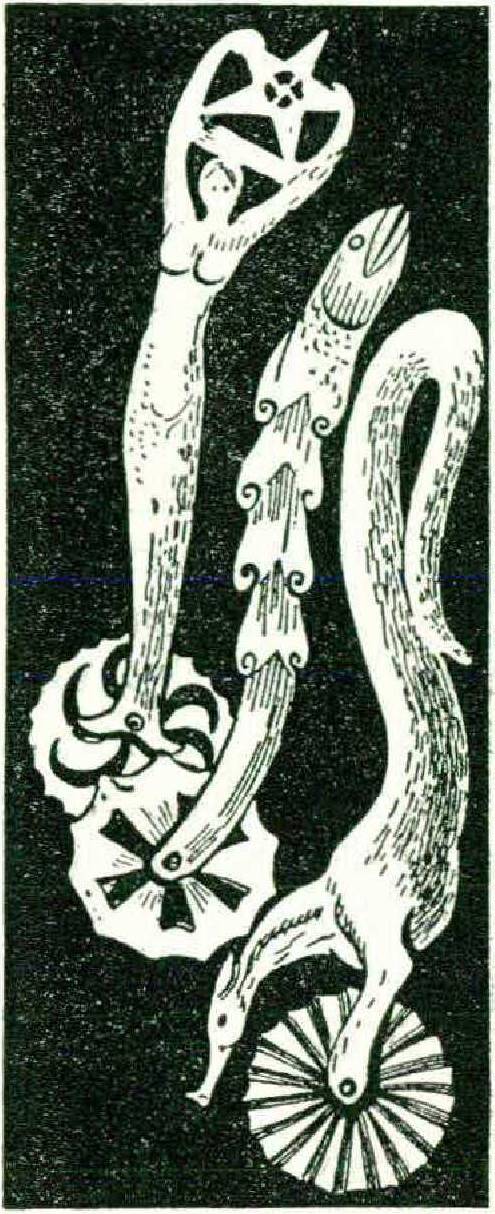
Most of the whaling scenes and ladies of fashion cut into the teeth have turned out to be bookish, and the busks, though admittedly charming, are naïve and folksy. The jagging wheels, as native a dish as the pies that they cut, were more often than not the work of talented carvers. In New Bedford, a pie wheel is set into a handle carved in the shape of a gull by some abstract Brancusi. Other handles are dowitchers, coots, and curlews, all cleanly cut and convincing; so convincing, in fact, that skeptics have wondered if the known Chinese skills of the time were not sometimes hired. There are pale Attic hands, archaic fish, mythological dogs; and all these entrancing forms of bone sculpture are hooked up to that native invention, the notched wheel used for cutting out pie crust and crimping the edges. If in the mind of the sailor the busk stood for Woman, the wheel stood for Home.
Like all good things in the story of art, scrimshaw has been subject to copying. When the Charles W. Morgan lay at New Bedford, the Portuguese sailors who kept her shipshape and entertained tourists copied trinkets in local collections and sold new pieces for old. Sometimes the collectors, whose name still is legion, have trouble in telling the forgeries; for new work can be done on old bone and ivory. But it is by no means too late to begin, with skeptical care, new collections of authentic scrimshaw, and public museums are so much the poorer if they do not possess illustrations of this branch of our native art.