Rice and Curries
Author of many cookbooks, an authority on food and drink, CROSBY GAIGE is equally well known as a theatrical producer. He is the chairman of New York’s Wine and Food Society.
by CROSBY GAIGE
FOOD
RICE has stood more use and abuse from cooks in general, and particularly English and American practitioners, than almost any other article of diet. Ladies who have perfect records as wives and mothers falter and fumble when it comes to rice. The subject is not only controversial, but extremely difficult of proper definition. At least one baffled woman of my acquaintance throws up her hands and weeps that only Orientals and some Negro cooks know how to cook rice.

My own notion is that there are at least two satisfactory ways of solving the problem, and that the main cause of failure lies in lack of knowledge of rice itself. There are certain types and varieties of rice that will be gluey no matter what you do to them, and there are other types that, with the right technique, will invariably produce the desired result.
The most expert rice manipulator of my experience is Aram Silesian of the Golden Horn Restaurant in New York. He prefers a Persian rice if he can get it. If it is not available he uses a converted rice. If he can’t get that he will use a Patna. All of these are slim in body and long in grain.
Anyone who is persistent enough with the grocer can make him carry a stock of Patna rice. This particular variety originally thrust its green stems up through the marshes of the Ganges. When the ripened kernels were harvested they were long and slender and had a characteristically sweet and nutty flavor. For some time past, our contacts with the valley of the Ganges have been sporadic, but we are lucky that seeds of Patna were brought to the lowlands of Louisiana and Texas, where they took root and flourished.
Take half a pound of Patna — one heaping measuring cup (if you have more than five to feed take a pound) — and wash and wash and wash in five or six waters, rubbing with the hands so that all the surface starch is removed. Put it in a saucepan with enough cold water to cover — two to four cups. The bottom half of a pyrex double boiler is a good utensil. A little grease rubbed on the bottom of the pot will inhibit sticking. Add one teaspoon of salt. Put over a brisk fire and bring to a boil. When the water foams to the top of the pot, remove to a lower heat. In about nine or ten minutes, test a kernel with the fingers or the teeth to see if the cooking process is nearly completed. If the kernel is getting soft but still offers a little resistance, take off the fire. Empty the rice into a colander and rinse with hot water. Place rice in a pot or casserole, bury two or three nuggets of butter in the flaky mass, cover with a towel, and put in a low oven for about fifteen minutes. This completes the cooking and allows the grains to swell. Rice should never be overcooked. The nut of my thesis is that one should learn the habits of a certain type of rice and then stick to that variety. Rice is a variable quantity.
I have a valued neighbor, Charles de Coursey Hughes, an Englishman who spent much of his business life in Hong Kong and Shanghai, By profession he is a banker, by avocation a gardener and a cook. When he gives a curry dinner it is a high occasion that must take days of planning. The end result is art in one of its more pleasant forms.
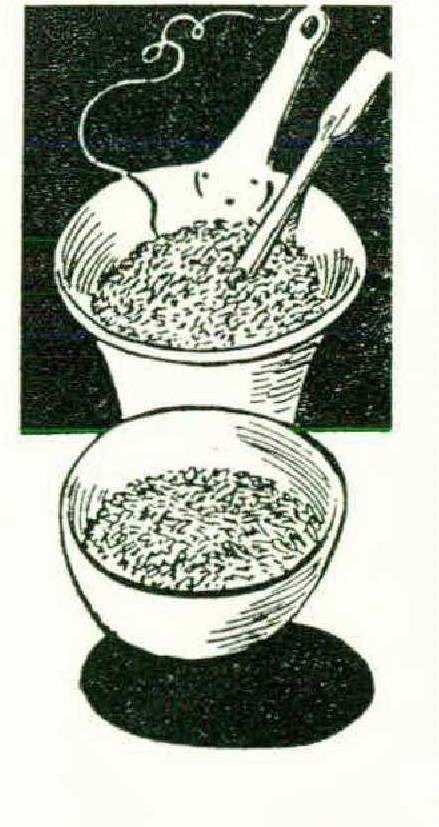
The curry proper may have as its central theme beef, chicken, lamb, or fish, swimming in a sauce that is prodigal in quantity and in savor. Bowls of steaming-hot, perfectly cooked rice will be passed first, to be heaped in white, flaky mounds on the plates. Then the curry, with its colorful and tantalizing sauce, will be generously ladled on the rice.
There are certain attendant rites and ceremonies, known in a curry artist’s parlance as sambals. These are companionate condiments or appetizers — sour or sweet or peppery or bland — to accommodate various tastes. In the house of an authentic pukka sahib, it is not supposed to be good form to serve less than nine varieties, and at the Hughes table there are usually twice that number. They are all finely chopped and presented in individual glass dishes on a large tray so that each guest may make his choice and spoon his selections onto the rim of his plate for nibbling along with the curry-freighted rice.
Here is a list of the more usual sambals: —
Chutney is an essential — Major Grey, an old favorite; Bengal Club, Tamarind, and Cashmere. There are some tasty American chutneys under the trade-marks of Crosse and Blackwell and of Raffetto.

Sweet sambals. Pineapple; sweet relish pickles; grated fresh coconut; sweet pickled onions; chopped roasted peanuts; toasted grated dry coconut; sweet red peppers; sieved hard-boiled egg yolks and egg whites separate; rings of tiny onions, French fried; India relish; hot crumbled bits of crisp fried bacon.
Sour sambals. Sour pickled cocktail onions; pickled walnuts; mustard pickles; capers.
Fish sambals. Sardines; shrimps; lobster meat; pickled mackerel.
Bombay duck is supposed to be an Oriental must. It will never be a must for me. I can take it, or I can leave it with no regret. This little tidbit has nothing to do with duck, but is a small fish called the bummalo, about the size of a smelt. These are caught in large quantities in the Indian Ocean and are dubiously preserved by drying for unsuspicious customers.
Toasted popadams are served with curries in Indian households. They are a sort of salted water biscuit made of wheat flour. Don’t worry about them, because they are hard to find in America, and only a perfectionist will cavil at their absence.
There is a lady, Mrs. Charles Clifton Moses of Bluffton, South Carolina, whose pleasant epistolary acquaintance I have made through the fact that she sometimes reads my essays in the Atlantic. She is kind enough to praise when she feels I have deserved praise. On the other hand, I have had at least one remonstrance from her, written more in sorrow than in anger, taking exception to the unorthodox presence of eggplant, tomatoes, and apple in a curry of lobster and crab meat. She lived long in the East and should know. She tempered her reproof by sending me her own recipe for a curry. I have tried it and, in recognition of its excellence, I take the liberty of passing it on to others. The only suggestion that I offer in connection with her recipe is that if you can’t find green ginger root you may substitute for it two tablespoons of the solid parts of chutney sliced into thin slivers.
CURRY Á LA MOSES
Cut three pounds of fine, tender, lean beef or lamb into one and one-half inch cubes. Brown one sliced onion in half vegetable fat and half butter — butter alone is too apt to burn. Throw the onion away. In the fat, sauté your meat until it is a golden brown on all sides. Add salt, freshly ground black pepper, one small piece of green ginger root, chopped fine, one tablespoon of curry powder. Blend well. Add enough boiling water to cover the meat, scraping up all brown in the skillet into the stew. Add the juice and rind of one lemon. Simmer gently for several hours. Just before serving, add the milk from one fresh coconut or the milk from one can of moist coconut — which is fine for this. Blend three tablespoons of butter and four level tablespoons of flour and use to thicken the sauce. End up with enough liquid over the meat to have plenty of sauce. Serve with dry rice and nine condiments to six real curry-eaters.
Here are the nine condiments listed by Mrs. Moses: —
Fresh grated coconut or moist canned coconut
Toasted dry coconut
Hard-boiled sieved egg whites
Hard-boiled sieved egg yolks
Crisp bits of fried bacon
Chopped peanuts
India relish
French fried onion rings
Major Grey’s chutney
My own practice with a curry of chicken may depart from beaten paths, but as the whole art of cookery is based on such divergencies, it has its justification.
CHICKEN CURRY WATCH HILL FARM
Split in half two plump fryers (about three and one-half pounds each), lightly dust with pepper and salt, and let sit for an hour or so. In a saucepan heat two tablespoons of butter and in it sear the pieces of chicken to close the pores but without browning the meat. Add one quart of water, two large onions, sliced, one clove of garlic, a stalk of celery, chopped, six peppercorns, and a good curl of lemon rind. Cover and cook for thirty minutes. Remove the chicken; when cool, skin and cut the white meat from the breasts and the dark meat from the second joints into small manageable pieces. The wings and drumsticks may be saved for another meal. Moisten the chicken pieces with a little stock to prevent them from drying out. Put the bones and skin back into the soup stock and simmer slowly for one hour. the chicken pieces with a little stock to prevent them from drying out. Put the bones and skin back into the soup stock and simmer slowly for one hour. Strain through cheesecloth.
The sauce is made in this way: Cover one cup of grated coconut, either fresh, or moist canned, or the excellent dehydrated coconut put up by Durkee and by Trade Winds Corporation, with two cups of rich milk and let stand for about half an hour. Strain through a cloth and save the coconut for roasting. In a saucepan melt two tablespoons of butter. Blend in three tablespoons of flour or arrowroot and one and one-half tablespoons of curry powder. (Mrs. Moses says to mix the Hour and curry powder together to prevent curry from lumping.) Cook for two or three minutes, stirring constantly. Gradually stir in two cups of hot chicken broth, two cups of the above-mentioned coconut milk, and one and one-half tablespoons of finely shredded chutney. Add the chicken meat and correct seasoning with salt and pepper. Simmer slowly for a few minutes until all ingredients are smooth and well blended. At the last moment stir in three tablespoons of cream and the juice of half a lemon. The creation is now ready for service in a casserole, or preferably in a chafing dish if you have one. This combination with plates of flaky rice and not too elaborate an assortment of condiments is one of those marriages that are made only in heaven.
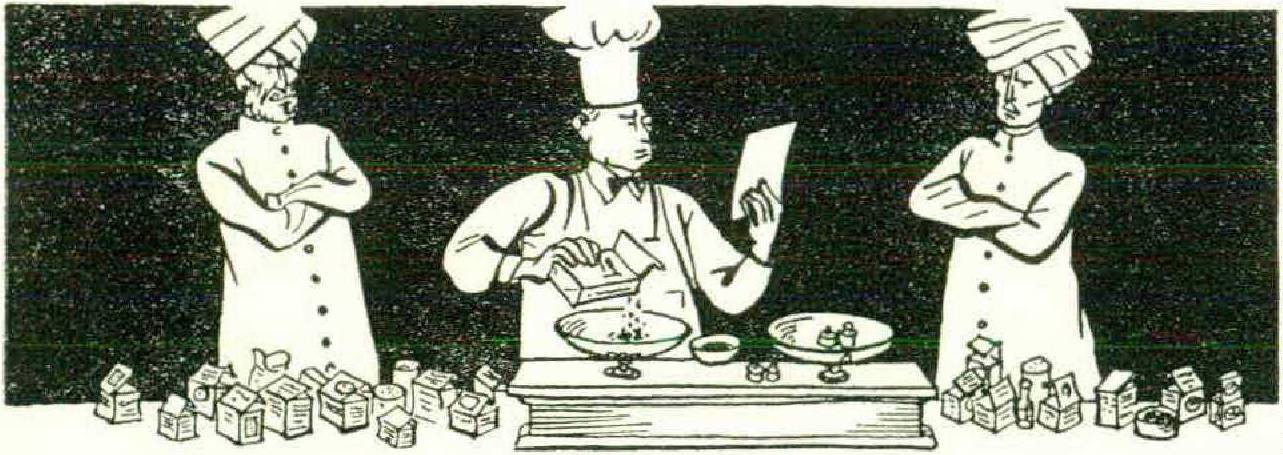
Most of the leading American spice grinders package an all-purpose curry powder that is quite satisfactory for everyday use. There is, however, an infinite range in the potencies and undertones in a curry powder. Anyone who has the time and the inner urge to become expert can mix his own and finally arrive at the perfect blend for the individual palate.
Herewith are two combinations for experimentation. It should be remembered that all ingredients must be very finely powdered and sifted before weighing, that they must be well blended, and that they should be stored in small tightly stoppered jars or wide-mouthed bottles.
A HOT CURRY POWDER
2 pounds turmeric
1 pound red chili
1 pound black pepper
4 pounds coriander seed
1 pound fenugreek
1 pound caraway seed
SIR RANALD MARTIN’S CURRY POWDER
1 pound turmeric
3/4 pound coriander seed
3 ounces ginger
2 ounces black pepper
11/2 ounces cayenne pepper
11/2 ounces cardamom seed
1/2 ounce caraway seed
1 tablespoon cloves
The powder improves with age, as time allows the various essences to blend. So it is not amiss, once you have mastered your art, to mix up a substantial batch.
A small bottle with an attractive label will make an agreeable present for a friend.