Sojourn in Haifa
pleasures and places
BY WALTER TELLER
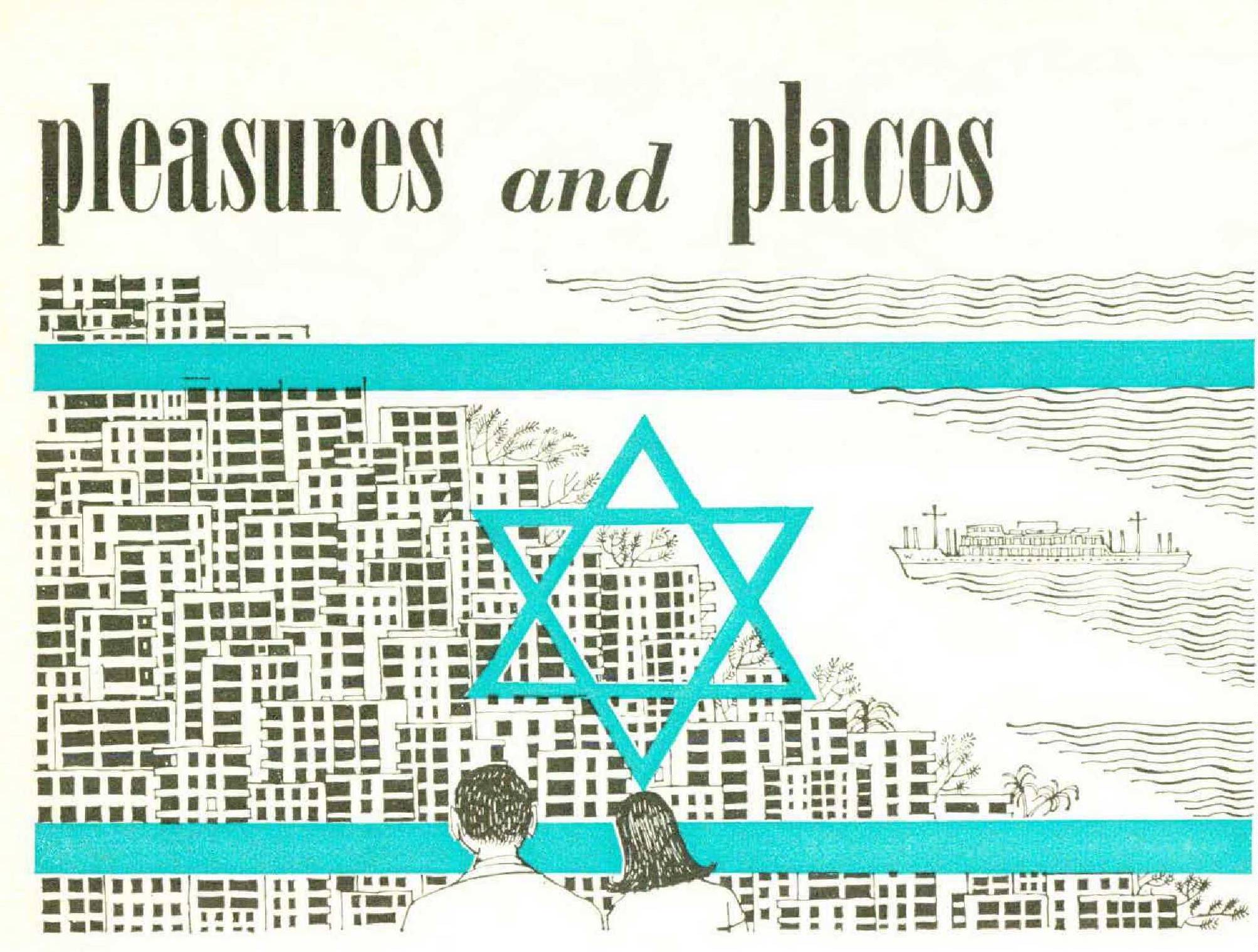
We are sailing dead into the rising sun, and you can see land. The land is the promontory called Mount Carmel on the northwest coast of Israel. As the ship stands in for the harbor a city rises along Mount Carmel’s precipitous slope. That city is Haifa, Israel’s chief port and second largest metropolis, a clustering of 200,000 souls.
I had long been curious about this new-old land, accepting it as the special phenomenon it is, but also wondering if I could not simply go there in much the same way 1 might travel to other countries, observing both similarities and differences vis-à-vis life and experience. When I spoke of this to my wife, she was enthusiastic, and more than ready to join me in the experiment.
We land on Sunday, Jane and 1. Sunday in Haifa and in all Israel is a business day. After being released from customs, we head for a bank we have heard of. The bank is located on the street called Rehov Ha’atsmaut, Independence Road, formerly Kingsway. We go there to open an account.
Perhaps the smaller the country, the redder the tape. The paper work involved in our little transaction turns out to be staggering. And finally, when we arc handed the money, it doesn’t look real. Nevertheless, it apparently is. Very real. Indeed, a serious matter, and hence a subject for joking. The joke, however, comes later.
Outside the bank, Rehov Ha’atsmaut pulses like any main artery. This part of the city, lying at the foot of Mount Carmel, is the port. With its shipping, commerce, trucking, banking, insurance, and goods from faraway places, Haifa, on this level, exhales the same gases and makes the same noises as many a contemporary city. It does so, however, with a difference. Arabs in burnouses catch our eye. We see all manner of Europeans. But where are the Kennedy, the Irish, the Black Watch, the Scots figures and faces? They are suddenly conspicuous by their absence.
At the Rehov Ha’atsmaut curb stand an uneven line of cabs, many shapes and international sizes but mostly enormous De Sotos, the kind which clogged the streets of New York in the late 1940s and early 1950s — in fact, as I later learned, the very same ones, and looking remarkably bone-weary now. To the starter at the head of the line, I announce our destination: Hotel Shulamit. Shulamit, Shulamite, we like the sound of the name, part of the reason why we selected it. The driver, however, does not know the place. Obviously, he is a newcomer in the country, and, as obviously, a Moroccan. The starter explains the route to the driver. He tells us how much the fare will be. After first collecting our bags, we begin the ascent; we are part of the latest migration or aliyah — that is, the tourist aliyah.
Up, up, up, panting in second gear, rounding the hairpin turns and the switchbacks. Moroccans — wouldn’t you know it? — drive like Greeks, or maybe Italians, or is it Mexicans? One recognizes with pleasure the clichés of travel. We are traveling high on Mount Carmel now and gazing down at the speckled and sun-bleached port and the pale blue bay far below. Haifa is a vertical city. By the time we arrive at the hotel, Jane decides she likes the way Haifa looks.
The Shulamit, as we walk in, feels all right. It’s a small hotel, actually a kind of pension, with a neutral and neat Swiss air about it, but it is not at all fat or formal. To the right of the entrance is a counter with three men sitting behind it. We approach and announce ourselves. The man nearest the door jumps up smiling. It is our host, Mr. Bloch. “Shalom, shalom,” he says, welcoming us warmly. A lean and vigorous-looking man, midway in life, Mr. Bloch appears to enjoy his work. In a short-sleeved white shirt, wearing no tie, he looks pleased with what life has brought. After signing us in, he orders up bottles of stuff called meets — that is, orange and grapefruit pop. Time for the midmorning juice break. An October day and hot as a baker’s apron.
We go to our room. It is not very large, measuring about ten feet by thirteen feet, but after sixteen days spent on board a small and full ship it seems beautiful, and it opens onto a fourby ten-foot balcony looking toward Haifa Bay. Our room has a high ceiling, chunky proportions, and a terrazzo floor. Its walls are pale blue, the curtains pale yellow, and there is a bit of pale yellow trim; also three fine built-in closets as well as a small desk. Furthermore, we have our own bathroom, small but white-tiled, clean, and functioning, and with an outside window. Jane unpacks, does some laundry, sets out our books. Suddenly we have a home. I stretch out on one of the very low beds and remember that happiness is relative.
But I am forgetting the downtown joke. Seems that not long after the war of independence, a bank was held up. Cultivated Israelis were horrified. Imagine Jews stealing from Jews and, of all places, in Israel. When Professor Bialik, the inventor of modern Hebrew, heard the news, he asked if the yeggs had been speaking in Hebrew. Yes, alas. To the pious this seemed to compound the crime. Bialik, however, did not think so. His reply was, “Good. Now we know we have a country.”
Here at the Hotel Shulamit, high on the eastern edge of Mount Carmel, in the very gemütlich German colony (Jewish, I hardly need add), a robbery would be hard to imagine;
I mean an illegal robbery. Instead, real estate values are racing ahead. This comfortable residential area, less than twenty years old, is well planned and built. There will be a problem, however, as numbers of automobiles increase. Houses do not have garages; cars camp on the streets, often under a linen duster with license number inked on. At night, covered up, they appear to be sleeping. Haifians, with their threestory buildings, seem to have solved the problem of multiple dwellings. A certain style is repeated with many variations. No row houses; each one is separate and designed. On the other hand, a certain uniformity is imposed by the limited variety of materials. There is a certain economy of means. Stone, cement, and tile, with some ironwork. The predominant color is tan. One never sees exterior wood, for wood is scarce, or, mercifully, asbestos. Streets are irregular, levels vary. There are no billboards, no posters or writing on walls. Notices are affixed to bulletin boards. As the city expands along the mountain, many parks appear; called reservations, they are actually gardens, and are delightful.
Pine is the dominant tree on Mount Carmel. From our Shulamit balcony we look north across one of the many ravines on the mountain. We see the backs of twoand threestory buildings and backyard gardens. Farther down the ravine, buildings of poured concrete are under construction. Each building is angled to take advantage of its particular setting and view; also to avoid as much interference with others as possible. There is a spirit of ingenuity as well as enterprise, of making do with little. From our window I see many rooftops and not a single television aerial.
Jane and I take breakfast at the hotel, and also one other meal, midday or evening — one’s as big as the other. This half-board arrangement costs forty-seven lirot per day for two, which is about $15.50, to which must be added 10 percent service charge. This is cheap, but then the Shulamit is no Grand Hotel. It is a pension despite its pine garden, view of Haifa Bay, the Zebulon Valley, and the mountains of Galilee. The food is definitely pension food, and kosher.
The midday and evening meals are not only similar in size and weight but virtually interchangeable. There is always soup, then meat and potatoes and vegetables — plenty of carrots. Chicken comes every day twice a day. The alternative is usually boiled beef, though sometimes a kind of Jewish-Swedish pot roast appears. The usual dessert consists of fruit, fresh or stewed.
An Israeli breakfast comprises canned juice, orange or grapefruit, or simply thin orange soda; all manner of uncooked vegetables, salad stuff: tomatoes, cucumbers, peppers; then olives, sardines, herring, and so forth; eggs and egg salad, bread, rolls, jam, coffee or tea, and cheeses (lots of cheese — in fact, a regular smorgasbord). At the Shulamit we
also have puffed rice. After several breakfasts which taste like lunch, I settle down to puffed rice (or is it wheat?), scrambled eggs, and tea. The coffee: one can only deplore it. Jane likes the vegetables very much. Breakfast is partly buffet style, or nearly so. All officers, so to speak, are German; the troops, the menial help, Moroccan. Jews, natürlich, bien entendu. The staff is large and good. It seems no one expects an American to know any foreign language. You have only to speak a few words of Hebrew, French, or German, make the effort, show them you care, and they love you; never mind that you feel like a slob, that your performance is execrable.
The Peer Café on the Central Carmel is a good place to lunch and let Haifa come to you. Sitting in a sidewalk café you get the feel of a
city. There is, after all, no substitute for seeing. Must we assume that the bums (they are sober) hanging around the café fringes are Jewish? Of course. I doubt they are missionaries.
Let no one tell you October is balmy in Haifa; it is hot. Israelis have a word for it; khamsin, hot wind from the desert. Early mornings are pleasant. By 10:30, however, the heat is intense. The khamsin wind blows and rattles. It is on your shoulders, bends your back a little. Cooler air comes with evening. This is not a city that you can walk through; it’s too steep for that. Driving is the way to get around, but the pattern of streets is as circular and crazy as that in Venice, and as in Venice, the streets change names.
Jane says it is time we begin to see guidebook things, not that we mean to see very many. As every tourist knows, one has been had too often that way. But more than that, I’m the sort of tourist who wants to see people as well as stones. Maybe I just have no proper traveling conscience, am not sufficiently avid for culture.
On the southwest slope of Mount Carmel — Western Carmel, it’s called —Moroccan and Levantine Jews are finding new homes in new bui dings, buildings they hardly know how to live in as yet. Never before have they been confronted with electricity, plumbing, and, generally speaking, Western standards of living. In the cool of a late afternoon, Jane and I drove over Western Carmel, over newly paved roads cut into the mountain. We drove down Hayam Road and came back by Road de France. This brand-new, unfinished, proletarian, Frenchspeaking section contrasts amazingly with the older, bourgeois, and comfortable German section in which we are living. If a Jew is a Jew, a North African will never be a European. Culture is different; manners differ, and so does the color of skins. How easy it is when you’re only reading about it to sentimentalize over the Jewishness of everything Jewish. Israelis we meet are not doing it. Indeed, they are fully aware of differing social and cultural strata. The one thing Jewishness qualifies one for in Israel is citizenship and state help in getting started. Of course, in the light of recent history that is a very great deal.
I doubt that there has ever been a classless society, and certainly this isn’t one. There are the workingclass people and there are those getting rich. Twenty years ago, on the higher levels of Mount Carmel, in any of the better parts of town one could buy a homesite, a quarter acre of land, for $250. But as the population has multiplied, so have the prices. The same ground today would cost many thousands. A short haul to eastward, property values have tripled in the past six months. Land values here have been moving faster than Xerox. At the east end of the town, where Mount Carmel rises still higher, where new roads intersect and a new Sonol gas station is being built, where splendid new homes are under construction, the government called a temporary halt to building. The way things are going, Mount Carmel will soon be entirely tamed and covered. Part of the limestone wilderness must be saved; it must be preserved in a kind of national park.
Today, however, just beyond the edge of the city one still can see what Haifa is made of, a hard land where every stone looks worn, trod on, turned over, or maybe cast, many times. There is no place to set down foot where foot was not set down before. Would you guess if you hadn’t been told that of all the world’s lands this would be called holy? Promised or unpromised, this land is hard, and so is the water. From the point where the national park, or whatever, will be, one gets a splendid view of the harbor, through which many thousands were smuggled and funneled in. That harbor is small. Down in the Zebulon Valley, one can see the apparatus of the oil refinery, and the tank farm beyond. And that little bit of a creek, the merest rivulet, is the Qishon River. Read its bloody history in the Bible, then forget fixed ideas. Scratch any easy preconceptions; this high Carmel ground is rough. It makes your feet hurt to look at it. And that high-flying, free-wheeling bird — hawk, eagle, or vulture — what does it live on?
Maybe it’s the work done on the land in recent years which approaches the holy. In any case, it’s intelligent. The planning, I repeat, is superb, the landscaping brilliant. Some say that Abba Houshi, the liberal three-time mayor, will bury the city in trees. Haifa streets are lined with trees, trees for islands and traffic dividers. When you build in Haifa you plant a tree for every tree you remove.
The hot weather holds, about ninety degrees and humid. Hot winds, however, have died. The true word concerning the weather has not been generally published. Israel, we are learning, is really a two-season land: hot and sunny in summer, generally mild and wet in winter. Trying days may come between seasons, or flowers may burst into bloom. It is overcast today, the seventh day, Shabbat. The town is shut tight. One might say it feels like Sunday minus the papers. A sign in the dining room today requests no writing or smoking. I pay it no nevermind. First, I find it a personal intrusion, a matter in which no pension or state has a right to legislate or even request; and second, I regard writing and smoking among the good things, the blessings of life, altogether suitable ways to praise the Lord and the day of rest, Shabbat.
I pause to light a pipe and to make a few further notes. Actually, the day of rest began yesterday, with the Friday afternoon siesta. Stores and businesses did not make the usual afternoon reopenings. By five o’clock almost all men were wearing headgear, anything from a more or less standard fedora to the standard yarmulke. Men who had gone bareheaded all week were going covered now. Many were dressed up a little. Men and boys seemed to be bound for shul, for the Friday evening service. The women were obviously home setting up Shabbat dinners.
There we were, Jane and I, in our wanderings, and hatless. We looked in on an unfinished synagogue, well designed, simply built, not in the old Moorish or Byzantine style but Israeli modern, a rather international, warm-country style, Mediterranean or Californian.
Once you get the hang of Cape Carmel, this spiny ridge whose northeast face rises from Haifa Bay, its southwest from the Mediterranean; once you examine unfinished sections of the city, walk among the stones and dust of the raw material, pick up a handful of dust — I cannot call it soil — it is hardly possible to exaggerate what has been accomplished.
In a park called the Mothers’ Garden we saw birds we did not recognize, Israeli birds, nice little black and white chaps, rather slim. Jane asked me, “Are they Jewish juncos?” In the Mothers’ Garden, L-shaped benches are placed in individually designed and private locations, not just strung along walks. You can sit and look into a garden within a garden instead of at passersby. Here and there stands a good job of sculpture in stone, quietly situated, unwritten on, uninitialed, and not daubed with paint. There is no unmistakable evidence of dogs. In fact, we haven’t seen many dogs. An Irish setter came by. Jane said the dog looked Jewish. I asked why. “Because,” said she, “he toed out.”
The Ron Café, we allow, is a fine place to lunch. One o’clock, a bit later, Sunday, and children are going home from school, carrying their briefcases on their backs, rucksack style. School hours, six days a week, run from about 7:30 to 1:30. The girls from this particular school wear brown cotton pleated skirts and white or pale yellow shirts. The boys are dressed in blue shorts and white shirts. Marvelous-looking tanned children, clean, kempt, well mannered, well shaped, and sturdy, dozens and dozens, they walk up from a school farther down the slope. Seeing these children — and Mount Carmel is alive with children — I feel there are more children here than adults. And it’s the children who finally tell you about the country.