The No-Sweat Garden Guide for Spring
W. F. MIKSCH is a free-lance writer living in Newtown, Connecticut, and has contributed many fight pieces to Accent on Living.
When old Jack Frost lets go his icy grip on the suburbs and the first gay crocuses poke through (provided we didn’t forget to plant them last fall, and if we did, the bulbs must still be in that old shoe box downstairs), then we know it is time to think about spring gardening chores.
By the time some gardeners get done thinking about them, spring has given way to summer — and that’s just what they hoped would happen. These are the people with crabgrass. Others don’t stop to think; flailing away with spades and dibbles, they go at the job as if Mother Nature were Captain Bligh.
These are the people without crabgrass, and without much else in life either.
A more sensible approach to spring chores is my own, outlined step by step below. It takes little thinking and practically no effort at all.
Uncovering the Compost Pile. Many gardeners will put this task at the very end of the list, preferring to do almost anything else. Indeed, a few have been known to move away, leaving the compost pile behind them. This, however, is not the proper attitude. If the gardener felt a need for compost when he began the pile last year, then that need must still persist. (If he was only looking for an easy way to get rid of garbage, that is something else again, and his interest in disturbing the pile now will understandably have lessened.)
For uncovering my compost, I personally prefer a fork with a very long handle: twenty-four to thirty feet is almost too short, and I am no more squeamish than the next fellow. Since I do not have such a fork, I shall have to get one before tackling my own pile, and the gardening enthusiast may wish to do the same. I understand there is a firm in Hong Kong which specializes in long lengths of bamboo, ideal for such handles. I shall try to find out their name and write them. Meanwhile, we leave the compost pile sitting there and go on to our next chore.
General Yard Cleanup. As winter snows recede, it is astonishing to see what they have left behind on the lawn. I doubt that the great glacier of the Ice Age ever deposited a stranger conglomerate. No matter that the lawn was debris-free last fall and that the family spent practically all winter indoors; the midden which mysteriously turns up each spring suggests that our grounds have been the cold-weather campsite of Ma and Pa Kettle.
Surely none of this junk was ever numbered among our lares and penates despite the fact that an old tennis shoe curled up under the rhododendron happens to be my exact size and looks vaguely familiar. Anyway, this shoe and such other litter as plastic dishpans, odd lengths of logging chain, velocipede wheels, coffeepot lids, ship timbers, beer cans, and empty cement bags are easily gathered up, and since we wisely have postponed uncovering that compost pile, they may be added to it. Some chemical action may dispose of them there; one never knows.
Natural jetsam, including tree branches and the new crop of rocks which grew up in the lawn (winter is the time rocks grow fastest), should be raked up. For this we will need a rake, a stout pair of gardening gloves, and the garden cart. I assume that, like myself, all good gardeners carefully cleaned and stored such equipment last fall, so that now it is ready at hand. Very well, then, where is the rake? Never mind the gloves. We know where the gloves went; the dog ran off with them that day last November when we were burning leaves. Oh, no, the dog didn’t hide the rake, too! Well, it doesn’t matter, because the garden cart is missing anyhow.
Without the proper tools, there is no use continuing general yard cleanup, so we turn eagerly to our next task.
Feeding the Lawn. Lawns may be fed in spring or fall. Many gardeners prefer to hold off feeding until fall and then hold off again until spring, and so on. There is some excuse for this since lawns never get to look seriously starved until midsummer, and that is not the time to feed them. However, if a householder’s lawn has gone unfed for some time (years and years), he should resolve to give it a treat this spring.
For my own lawn, I always intend to feed it with a 5-10-5 fertilizer (that is, 5 parts of nitrogen, 10 parts ol potassium, I believe, and 5 parts of something else). But another householder’s lawn may require an entirely different formula. He can easily find this out by contacting his state department of agriculture, which often has an office (or will open one) in a nearby town that will send around a qualified man to test the soil. Since it may be late summer before the qualified man arrives, the householder again may have to delay lawn feeding until fall or even thereafter. This is small cause for worry since there are still other spring chores left to do.
Remove Plant Wrappings, Mulches. As the soil warms, it is important that all wrappings, burlap screens, and mulches which were put around less hardy shrubs last fall to protect against winter freezing be removed. In most cases, this is not as much of a job as it sounds, for a close inspection of these shrubs reveals that they already have shed their wrappings and mulches. Either their wrappings and mulches blew away or, as is still more likely, they were never wrapped or mulched in the first place. Naturally, such shrubs may appear somewhat dead, but one should not despair. By late summer, the shrub fancier may be pleasantly surprised to find that here and there one has survived. While awaiting such miracles, let us turn to our final labor of spring.
Readying the Patio for Summer Fun. At winter’s end and for some time thereafter, the patio (or outdoor living area) is a depressing sight. But surely the promise it holds out for a gay and festive summertide should put us in a jolly frame of mind as we try to get it back in shape again.
First, let us inspect the patio surface. Flagstone tiles may have loosened and buckled, bricks heaved up, or all the sand worked out of the concrete. Very well. Next on our checklist is the picnic table. This no doubt has warped, peeled, and lost all the knots out of its knotholes. So much for the picnic table.
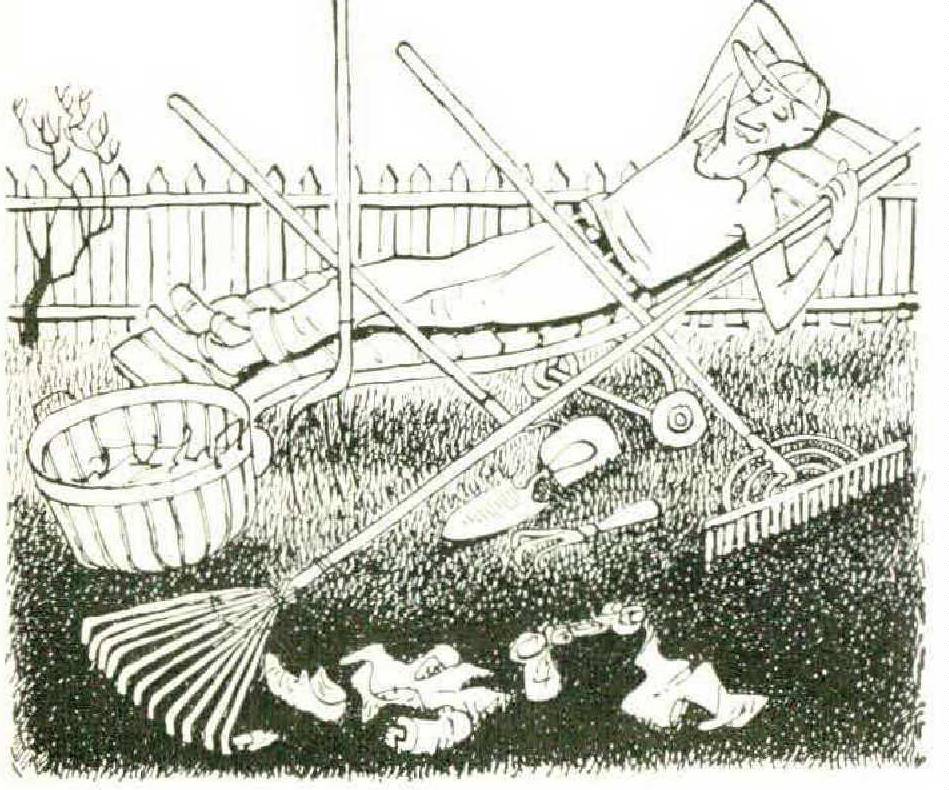
Then comes the fun part of hauling out the patio furnishings (folding chairs, pole torches, gay umbrella, and so on), which we stored away in the basement directly after Labor Day. This job is more than half done before we start because it turns out that we only thought we
stored them away in the basement. Everything is right here within reach in this neat pile on top of the Christian Dior rosebush. And all winter long we imagined it was just a big drift of snow.
Well, the chairs seem to unfold most of the way, but let’s not bother that umbrella. It appears rather brittle and not nearly so gay anymore. We’ll put it aside for a sunny day, and try brushing the rust off these torches. This will just take a moment, as rust can be very stubborn.
Now only one thing more is needed to dress the patio, the portable barbecue grill, and that will be in the garage. . . . No? Alongside the garage? Out in the driveway? We just didn’t look right the first time. It is in the garage. Over there in the corner. In back of the power mower. Under that tangle of garden hose. With that old tarp on top and all those fireplace logs covering it —
That’s where the portable barbecue grill is, and that’s where it stays until the Fourth of July cookout. Spring chores have to stop somewhere.