
When 10 of Brooke Nasser’s students turned in the exact same incorrect answer on a worksheet in November 2022, Nasser, who teaches high-school English in Kapolei, Hawai’i, was flummoxed. But she quickly put it together: Her students were experimenting with generative AI. She was excited, even if they weren’t using it the right way.
Google searches for “AI education” have more than tripled since fall 2022, when generative AI tools began making headlines. The issue is playing out in classrooms first, as educators have been reckoning with a big question: What’s the role of AI in education? Some teachers, like Nasser, have integrated lessons about how to use it into their classes; some districts have banned it entirely. Students have strong opinions about how to use the technology too. Is it an alluring temptation to take a shortcut, a tool for stepping into their future, or both?
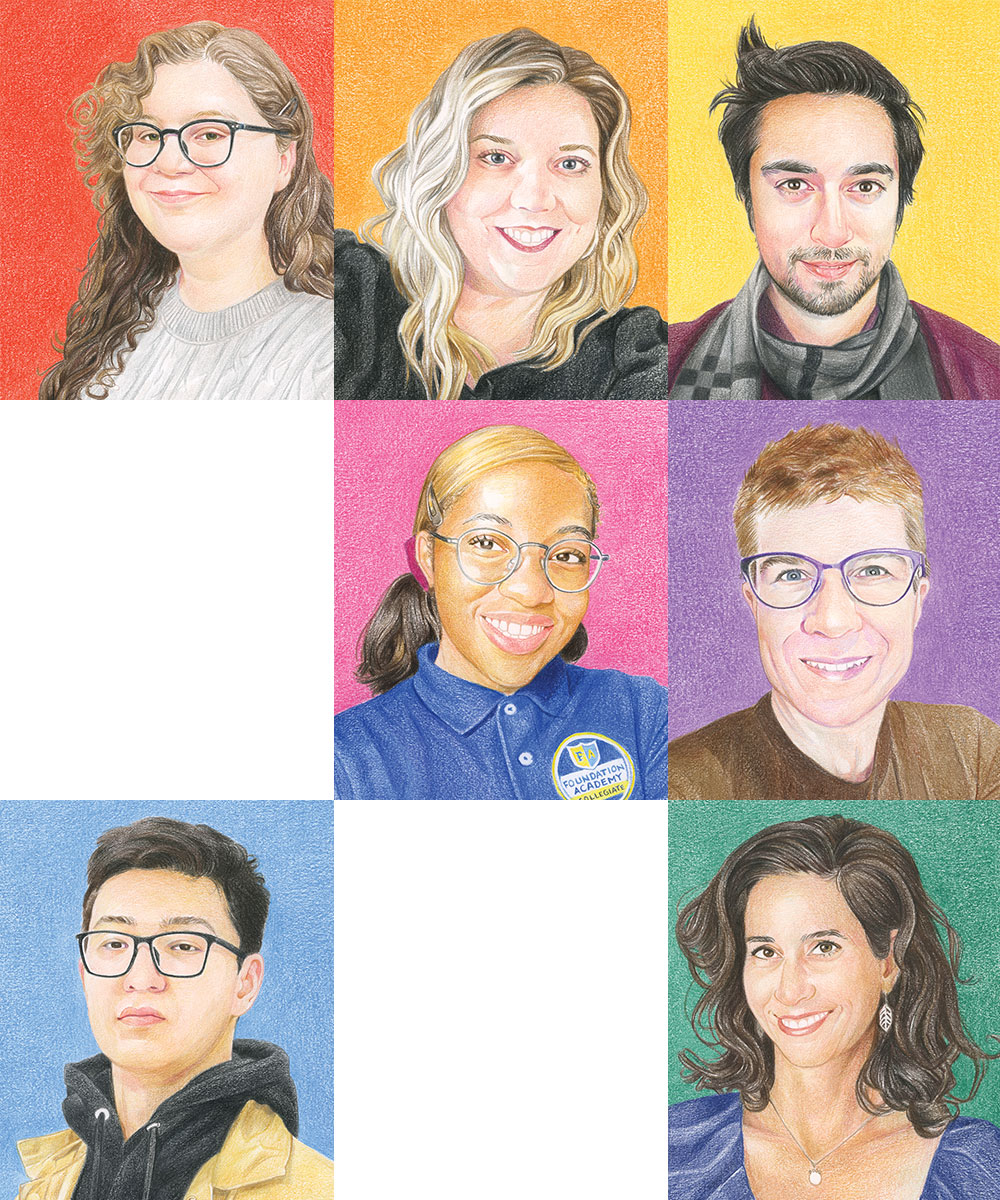
AI has the potential to reshape and personalize education, advancing how we teach and learn—but it could also broaden existing inequalities. We wanted to hear from the experts, so we turned to high-school students, teachers, and an administrator from vastly different districts across the United States for their perspectives.

Patrick Guillen
High School English Teacher
Orland High School
ORLAND, CALIFORNIA
I teach in a rural district. A lot of our kids go on to work in agriculture, mostly in the almond orchards. I see AI as one of the ways that they can access broader opportunities. It can be a socioeconomic equalizer: If you learn how to use these tools, you can build the creative thought and critical thinking to be able to create things yourself.
Last year, when I started to see what people were doing with AI, I tried using it for my own work, as I created worksheets and lesson plans. I experienced how simple it was to use those tools and I realized that our kids needed to know how to use this, or else they’d be at a disadvantage. I told our district administrators that we needed to get out in front of this.
I found that many educators who hadn’t used the tool were scared of it, because they didn’t really understand what it did. They worried that it was the end of essays or the end of us teaching kids. The fearful reaction is normal, since you have to upend how you’re thinking about teaching in some ways. But teachers are used to adjusting to new things: We just made it through COVID-19! I encouraged other teachers to mess around with it themselves so that they could see how it works.
During some of our professional development days this year, I asked if I could lead a training on how to use different AI tools in ways that are beneficial for us. I gave a rundown on how to use generative AI to educators at our high school and our middle school. I also showed them how AI voice modifiers and image creators work. We’re going to see AI-generated work from some of our students, so what does it look like? What are the stylistic flairs that it shows? What tools can you use to identify it?
I see AI as a calculator for words: We need to teach the kids how to use the tools. This year, I started my English classes off with handwritten in-class essays so that I could see a baseline of what their writing skills are. I have regular conversations with them about how they need to build a base of being able to think critically, reason, and write. AI tools can help us do that, but I try to stress to my students that it’s about the process, not the product. How can we use AI to improve the drafts we’ve written? How do we become more effective and efficient? We need to use this not as a crutch, but as a way to make ourselves better.

Siobhan Faughnan
High School Senior
Leesburg High School
LEESBURG, FLORIDA
Since I was in eighth grade, I’ve always taken at least one class online. My freshman year was 100 percent online because of the pandemic. But otherwise, it’s been because I want to get ahead or take classes that they don’t offer at my school, which is low-income. I learn a lot of my coursework through online classes or by teaching myself.
That’s a situation where AI can be helpful: for students who want to go above and beyond the course material. I’ve used AI that way, like in a math class when the teacher basically just gave us notes and we had to learn on our own.
If you go into the experience doing as much work yourself as you can and use it to learn the rest, then AI is a tool. But I think of it like a balancing board: You have to be careful, and you have to trust students not to use it in a way that’ll hurt their own education.
I’ve been wary about using AI very much because it’s hard to know when you’re crossing the line. I’m in the yearbook class, and last spring, we all had to come up with options for the theme for this year’s yearbook. Afterward, I asked ChatGPT to come up with title phrases that had puns or metaphors for the theme I wanted. In my presentation, I ended up using one of them: “Glowing Up Together.” I had the teacher’s permission to use AI for the assignment, so I knew it was okay, but I was still thinking, Am I cheating right now? I’d like it if there were more clear-cut rules about it.

Sallie Holloway
Director of Artificial Intelligence and Computer Science
Gwinnett County Public Schools
GWINNETT COUNTY, GEORGIA
We have a history of being an innovative school district through STEM and career development programs, so when we decided to open a new school in 2019, we decided to focus it around AI. At the same time, the district was introducing a “computer science for all” initiative for K–12, and we thought that an ability to use AI is something every kid needs to have. We started one high school devoted to AI as a pilot and quickly expanded to refocus some K–8 schools around it, too.
We frame our mission as developing literacy among our students so that they can be ethical, informed users of AI in the real world. Everything is taught through the lens of an “AI ready” framework: programming, ethics, data science, creative problem-solving, math reasoning, and AI applications.
We’re still teaching our same content but upgrading the relevancy for our students. For example, a high-school history teacher talked about the 2014 snowpocalypse in Atlanta and asked students to use AI tools to analyze traffic and weather data and discuss what would have happened if we had been able to get better data faster. How would that have affected the response in the city? Students can see the relevancy in what they’re doing, so they’re able to really think about their futures.
Of course, part of our work means pulling back the veil on these tools for students: What holes can you poke in what the AI came up with? Why is it valuable to do this work yourself? How can you use AI as a brainstorm partner? When you give clear guidance, it helps students learn how to be responsible users and takes away some of the desire to use the tool to cheat.
We often use the analogy of “swim, snorkel, scuba.” All of our students have to be able to swim: They need to know what AI is because it’s part of our society at this point. We hope that all of our students are snorkelers: proficient, responsible, ethical users of AI. There’s also a group of students who are scuba divers, who may want to pursue a career in developing AI. For those students, we have an additional three-course pathway that’s a deep dive into AI as a profession.
The implementation of AI readiness in our district has been very grassroots. There was no kit that we could pick up and say, “Hey, let’s go do this.” It entailed a lot of risk taking, which can be intimidating for educators because they’re already doing so many things. But once they had this experience with kids, they could see why it was valuable.
I often think about something that one of my colleagues said: “It seems like a big risk for schools to take on teaching AI, but it’s a bigger risk not to do it, because then you’re likely not preparing kids for our future.” It’s a perspective shift, but we really need to be rethinking what we’re teaching and what skills kids need to have in the long term.

Jedidah Worrell
High School Senior
Foundation Academy Collegiate
TRENTON, NEW JERSEY
I make art, and that’s how I first learned about AI. I follow a lot of art pages on Instagram, and last year, I started to see this shift from laughing at AI-created art to seeing it as a threat to artists’ jobs and livelihoods. But I think that reaction is overblown, and I think that’s true in education, too.
My teacher was the one who introduced us to AI tools, surprisingly. He said that he used it to generate answers for multiple-choice questions on our tests but that we shouldn’t use it. But you know that if you tell someone not to do something, they’ll try it. My history class last year required a lot of reading, so my friend and I sometimes plugged the articles into AI and had it rig up a summary of what was in the text. For some assignments, we really had to read the text because we needed to find supporting evidence, but we used AI for smaller stuff that was lower stakes.
People are talking about AI because it’s a new tool, but the biggest issue in education isn’t AI. It’s how we’re being taught in a post-pandemic world. So much education was lost during the pandemic, and so many students aren’t at the grade level where they should be. There’s a lot of scaremongering that AI will take over education, but that’s not what’s going on. AI isn’t going to bring down education, but it’s also not going to solve it.
The big promise of AI is that it’ll make learning more efficient, but we shouldn’t be striving for efficiency. We should be thinking about how to make students curious and driven instead. A lot of my classmates don’t feel motivated or encouraged to learn and explore in their education lately—some of that is because of the pandemic, and some of that is because schools are severely underfunded and understaffed. Together, this means that it’s harder for students to find the drive to pursue an education out of a genuine want to explore. These tools help students do the work more quickly, but it doesn’t make us care about it. We should be figuring out how to make it more fun to learn.

Elizabeth Tanner
High School English Teacher
Westwood High School
MESA, ARIZONA
I started using Quill, an interactive reading and writing tool, with my students about five or six years ago. [Ed. note: Quill is a Google.org grantee.] At the beginning of each school year, each student does a diagnostic test, and based on that, Quill recommends different skills that they should work on. Then, in my classroom, we have Grammar Wednesdays every week, where students work on their assigned Quill activities. It’s an individual process for them, which allows me to walk the room and check on their progress.
The feedback that the students get from Quill is critical because it helps them see how to improve and helps me know what to address, both for an individual student and for the class. If multiple students are struggling with conjunctions, for example, then I know I need to do a larger review.
But for AI to be helpful in education, the feedback needs to move in both directions: Students and teachers need to advise the development of these tools. For students, giving feedback is essential because it enables them to feel like they’re part of a solution. And engineers need to remember that teachers have expertise, and we can help improve the tools.
That’s why I’m on the teacher advisory committee for Quill. I tell the company about how I use the tool and how to improve it. By participating in Quill’s development, I’m making it better for students and educators. I’m also being trained on how to use it most effectively.
AI can accentuate teaching, but it can’t replace it. We still need the hands-on expertise that teachers bring.

Bekzod Mamasoliyev
High School Senior
New Utrecht High School
BROOKLYN, NEW YORK
I’m in the Academy of Business and Technology at my high school, and at the end of last year, one of our teachers showed us how to use AI for an assignment. We were making sticker prototypes for a client, so we used AI to research the client and get ideas of what to create. Then we used Adobe Illustrator to create the stickers and printed them out. We had to include what we asked the AI and what answers it gave us, to show that we were using AI as a tool instead of using it to do the work for us. The tools were confusing at first, but as I got used to it, I got more ideas of what to create.
Other teachers have said that if you use AI, you’re going to get in trouble. I think it should depend on how students use it: If they use AI to write the assignment rather than to comprehend the gist of it, then they should be punished, because that hurts the student’s potential to learn and to eventually apply their skills in the outside world. If they use it as a study tool to understand what the assignment was about or to get a suggestion from the AI about how to improve their own work, then they should be allowed to use it.
I’ve used AI that way, to help me learn a concept. In AP Statistics class, I was confused about the differences between two types of random samples. I read the textbook, but it wasn’t very clear, so I asked AI some questions to help me understand. That’s a way that AI can really help students. For example, when a student has questions about a homework assignment, they can address their own confusions rather than waiting until the next day to be able to ask the teacher for help.

Brooke Nasser
High School English Teacher
Kapolei High School
KAPOLEI, HAWAI’I
I had heard whispers of AI rippling through education, but I wasn’t thinking about it as something that students were using in my classroom. Then, in late November of last year, when I was teaching at a different high school, I got all of these identical worksheets back for an assignment about Beloved by Toni Morrison. I saw that 10 students had the same wrong answer. It misattributed an event to the wrong character, which I knew all of those students couldn’t have gotten wrong, because we had read the book out loud together in class. At first I thought, Did nine people copy one person’s wrong answer? But then I realized they used generative AI. At the time, I wasn’t discouraged—I found it so interesting that they were using it.
After that, I designed a class lesson around AI tools. I taught it again this fall, and I already had to change it significantly from what I taught in the spring. That’s how dramatically this is all changing.
For the lesson, I give the students three different essay drafts about coastal erosion. I ask them to pick out three pieces of evidence to justify whether each essay was written by a student, a teacher, or AI. The big reveal is that all three of the essays were written by AI, in response to slightly different prompts.
That exercise serves as a jumping-off point for a discussion of how we can ethically use AI to help us in the classroom. For the most part, the students understand that it’s helpful but not ethical to just take someone else’s idea. But what I really want them to realize is that they each have a unique perspective and AI doesn’t. At the end of the day, I want to see my students’ singular perspectives, and cheating takes that away, no matter what source they use. AI doesn’t change the problem, it just presents a new tool for students to exploit the issue.
Yes, AI can streamline the process for students by eliminating the mundane, rote work and pushing students to more sophisticated writing, the same way that calculators do for math. But students have to master the basics first. You don’t give calculators to second graders; they need to learn addition and subtraction first. AI might be really helpful in education at higher levels, but for students at the high-school level and lower, it can prevent them from mastering the basics.
It points back to the main issue that I see in education: How do we motivate students to care about deeper learning and creating quality work that is uniquely their own, at all levels? How do you develop the discipline to work hard at something you don’t love? I don’t have the answers. Although, if I can figure that out, then I’ll become the best teacher that ever lived.
These interviews have been edited and condensed for clarity.