
Previously in Corby's Table:

"Revelations of Greece" (December 20, 2000)
Corby Kummer on Aglaia Kremezi's revelatory new Foods of the Greek Islands, a book that offers "a short course in how Greeks cook for themselves."

"Confessions of a Cookie Eater" (October 4, 2000)
Corby Kummer makes a shameless plea to readers of Nick Malgieri's new Cookies Unlimited.

"The Bygone World of the Bialy" (August 31, 2000)
Corby Kummer on Mimi Sheraton's The Bialy Eaters, a food critic's account of her seven-year, still-incomplete search for the origin of the distinctive little onion roll that is often mistaken for a bagel.

"The Chowder King" (July 26, 2000)
Corby Kummer on Jasper White's 50 Chowders, the latest from Boston's master seafood chef.

"Simply Summer" (June 22, 2000)
Corby Kummer satisfies his fresh-herb lust with a new book by Lisa Cowden, Ladle, Leaf, & Loaf.

"Tuscany, Reluctantly" (April 26, 2000)
Corby Kummer is tired of Tuscany, but he likes Pino Luongo's new cookbook, Simply Tuscan.

"Matzoh Makeover" (March 22, 2000)
Corby Kummer on Jayne Cohen's The Gefilte Variations, a new cookbook offering multiple versions of Jewish holiday classics.

"Ham and Beans to the Rescue" (February 16, 2000)
Weary of the Boston winter, Corby Kummer serves up "one of history's great couplings."

"How to Cook (and How It Should Look)" (January 20, 2000)
Corby Kummer on James Peterson's Essentials of Cooking, a kitchen primer that should fascinate beginners and old pros alike.

More by Corby Kummer in Atlantic Unbound

Atlantic Unbound | January 31, 2001
 
Corby's Table
 
Napa Valley Blend

.....

Spring Garlic and Potato Soup
Chinese Egg Noodles with Gulf Shrimp
Warm Scallop Salad


Terra  love the Napa Valley yet dislike anything precious, trendy, or self-congratulatory. These seemingly incompatible ideas can peacefully coexist at Terra, which I have long thought of as the best restaurant for many, many miles around in a restaurant-packed area. Terra occupies one of those handsome fieldstone buildings that speak of California's heritage and that most wineries and restaurants would dearly love to own, and it's in the heart of St. Helena, the Napa Valley's prettiest town. One of its owners, Lissa Doumani, is part of Napa's recent heritage: her family owned Stags' Leap winery. She grew up surrounded by winemakers and listening to conversations about harvests and meals.

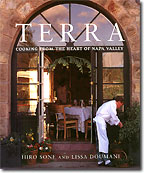
Hiro Sone also grew up surrounded by people who cared about food—in a rice-growing village in rural Japan. He trained as a chef with elite French teachers who in the seventies, when Sone was coming of age, were gods in Japan: Paul Bocuse, Pierre Troisgros, and Joel Robuchon. Sone and Doumani met in 1983 in the Los Angeles kitchen of Wolfgang Puck's Spago when it was redefining California and American cuisine (and when the ambitious, successful, and much-loved Puck was training chefs for a Spago branch in Tokyo). Doumani was an apprentice pastry chef who—as she writes in a charming introduction to the couple's new cookbook, Terra: Cooking From the Heart of Napa Valley—quickly learned two fundamental rules of professional kitchen life: "Chocolate can diffuse almost any flare-up. And people like what they like—whether it's ketchup omelets, Tab, or iceberg lettuce, so give them what they want within reason."

At Terra, which they opened in 1988, Doumani and Sone manage to straddle the divide between their own backgrounds and those of their guests' with grace and good humor. Those qualities along with an unforced elegance define the high-ceilinged restaurant, with arched French windows and iron lanterns outside. The food, Doumani tells guests, is "southern French and northern Italian in style with a Japanese sensibility."

What is that? The menu reveals generally recognizable dishes, like fried rock shrimp with chive-mustard sauce, a signature dish; bone-marrow risotto; Japanese eggplant salad; panzanella with feta cheese; and baked mussels in garlic-parsley butter. The French training and sympathy for Italian rustic dishes comes through, along with elements of Sone's native food, for instance ponzu sauce with oysters or shiso broth with Chilean sea bass and shrimp dumplings. But Terra has never served fusion food or aimed to be a pioneer in that usually misbegotten category. Classic Western cuisine is the backbone, and Sone takes full advantage of the Mediterranean-like climate in which he's so lucky to work.

One recipe in the book will awaken spring appetites, as Doumani says: spring garlic and potato soup with morel mushroom croutons. Although Sone calls for chicken stock, I think that half stock (including vegetable stock) and half water will showcase even better the delicate and lovely flavor of the spongy, prized spring mushrooms, here luxuriously served over toast, the way chefs generally choose to present beautiful wild mushrooms. And spring garlic, often available at greengrocers (leek and garlic can be substituted as winter turns into spring), can help convert garlic-phobes with its gentler bite.

I'm drawn to a moderately complicated recipe for shrimp sautéed with shiitake mushrooms, now available fresh year-round, and a Thai curry-spiked lime-soy mixture with the strong flavors of ginger, garlic, and toasted sesame oil all in very modest doses. This features two of my favorite Chinatown ingredients: Chinese egg noodles and prettily curling pea tendrils, which look like they should be framing a Matisse drawing and are often available in Chinese and other groceries. They are a sturdy but springlike green with a fresh season that runs much longer than peas themselves.

Finally, a warm scallop salad with lemon-coriander vinaigrette highlights a late-winter luxury ingredient, sea scallops, with a simple but pungent mixture of fresh coriander seeds, lemon juice, and chives, with delicate chervil as a garnish. It's the sort of bright, pretty, fresh course Sone offers as a starter but I would serve as a main course. And he sensibly urges you to look for pinkish, translucent scallops as opposed to bright white ones, which have been dipped in a phosphate solution.

Desserts at Terra are the fabulous creations of Doumani, and you'll have to buy the book, filled with lush color pictures of the restaurant and its dishes, for the recipes. She's not kidding when she says, "We're not going to pretend that the recipes in this book are simple." But anyone with any pastry experience will want to try chocolate truffle cake with espresso ice cream, and lemon creme brulée. I myself want to make the "sunshine cake," a wonderfully old-fashioned yellow cake, with cashew brittle and peach compote. It will help bring memories of late-afternoon St. Helena light to dark late-winter Boston.

Corby Kummer


Excerpts from Terra: Cooking from the Heart of Napa Valley, by Hiro Sone and Lissa Doumani


Spring Garlic and Potato Soup with Morel Mushroom Croutons

There are certain foods that awaken us to the arrival of a new season. Morels and spring garlic are two of them, and this spring soup brings out the best in both. If it's not spring try the version with leek and garlic, and experiment with other kinds of wild mushrooms. You'll have an entirely different soup—one that tastes more like a hot Vichyssoise—but that's the beauty of seasonal cooking.

Serves 4


Soup

2 tablespoons unsalted butter

1 cup coarsely sliced spring garlic, including the green stem, or 1 cup sliced leek and 1 clove garlic

1 russet potato (about 1 pound), peeled and sliced 1/4 inch thick

Salt and freshly ground white pepper to taste

3 cups chicken stock

1 cup heavy cream
Morel Croutons

4 baguette slices, 1/4 inch thick and 3 inches long

2 tablespoons unsalted butter

1 tablespoon minced shallot

1 ounce morels, cleaned and halved if larger than l/2 inch in diameter

2 tablespoons brown chicken stock or chicken stock

1 teaspoon chopped fresh flat-leaf parsley

Salt and freshly ground black pepper to taste
To make the soup, melt the butter in a large saucepan over medium heat, add the spring garlic, and sauté until soft. Add the potato and sauté until the outside of the potato is translucent, 2 to 3 minutes. Lightly season with salt and pepper, then add the chicken stock and bring to a boil. Lower the heat to a simmer and cook until the potato is very soft, about 20 minutes. Add the cream and bring to a boil. Puree in a blender until smooth. Strain through a medium-fine-mesh sieve. Rinse the pan and return the soup to the pan. Taste and adjust the seasoning. Cover to keep warm. Set aside.

To make the croutons, preheat the oven to 350°. Spread the baguette slices on a rimmed baking sheet pan and bake until golden brown, 3 to 4 minutes. Keep warm. Heat the butter and shallot in a medium sauté pan over high heat, and sauté the shallot until it starts to caramelize. Add the morels and sauté until soft, about 2 minutes. Add the stock and bring to a boil, then add the parsley and remove from heat. Season with salt and pepper.

To serve, divide the soup among 4 warmed bowls, mound the morels on the croutons, and place 1 crouton in the center of each bowl of soup. Drizzle the morel pan juices over the soup and croutons.


Chinese Egg Noodles with Gulf Shrimp, Shiitake Mushrooms, and Pea Tendrils

Pea tendrils, the shoots and leaves that appear on the top of new pea plants in the early days of spring, are tender little greens that taste like a cross between peas and spinach. They have a relatively short growing season and can be hard to find. Look for them in Asian produce markets, where they're sometimes sold under their Cantonese name, dau miu. If you can't find them, substitute spinach and a few sprigs of watercress. If fresh Chinese noodles are not available, use dried ones or fresh angel-hair pasta. And if you don't have time to make lobster or shrimp stock, you can use a rich chicken stock instead. Having said all that, we want to encourage you to try to round up all the ingredients we use for this recipe at least once. Once you do, the dish comes together very quickly, and it's an experience no one should miss.

Serves 4


Lime-Soy Mixture

1 tablespoon freshly squeezed lime juice

1 teaspoon Thai yellow curry paste

1/4 teaspoon grated peeled fresh ginger

1/4 teaspoon grated garlic

1 tablespoon soy sauce

1 teaspoon Asian (toasted) sesame oil

1/2 teaspoon sugar
10 ounces Chinese egg noodles

3 tablespoons unsalted butter

20 medium shrimp, shelled and deveined

Salt and freshly ground white pepper

8 shiitake mushrooms, cleaned, stemmed, and sliced 1/4 inch thick

1 1/2 cups lobster stock or shrimp stock

3 cups pea tendrils, loosely packed
To make the lime-soy mixture, whisk together all the ingredients in a small bowl. Set aside.

To prepare the noodles, bring a large pot of salted water to boil. Add the noodles and cook until al dente, about 2 minutes; drain.

To assemble, melt the butter in a large, preferably nonstick sauté pan or skillet over high heat until it starts to foam. Season the shrimp with salt and pepper. Add the shrimp and the shiitake mushrooms and sauté until the shrimp start to turn pink, about 2 minutes. Add the lobster stock and bring to a boil, then lower the heat to a simmer. Add 2 tablespoons of the lime-soy mixture to the shrimp and mushrooms, then add the noodles and pea tendrils and toss to combine. Simmer for 10 seconds.

To serve, divide among 4 warmed shallow bowls.

Deveining Shrimp

The intestinal "vein" should be removed from a shrimp before cooking, both for cosmetic reasons and because, especially in larger shrimp, it contains grit, which is unpleasant to eat. Not every shrimp will have one, though. To remove, using a bamboo skewer, insert the pointed end about 1/8 inch deep into a shrimp across the center of the curve. Gently pull up on the skewer, and a thin dark strand should come out. Keep pulling until it comes free of the shrimp; discard.


Warm Scallop Salad with Lemon-Coriander Vinaigrette

"Warm" is the key to this delightful dish. The scallops are just barely cooked, then dressed with a warm vinaigrette that brings out their sweetness. Because they're served almost raw, it's important that the scallops be sashimi grade and very fresh. Be careful to avoid overcooking them; they're ready when their tops have just turned white. Even if they look a little too raw, remember that the warm plate and the dressing will continue to cook them.

Serves 4


Lemon-Coriander Vinaigrette

1 teaspoon coriander seeds

1/2 cup extra virgin olive oil

1/4 cup freshly squeezed lemon juice

Salt and freshly ground white pepper to taste

1/4 cup tomato concassée (see below)

2 tablespoons minced fresh chives
1 pound large sashimi grade sea scallops, hinge muscle removed

1/3 cup chervil sprigs, for garnish
Rinse the scallops in cold water and pat dry with paper towels. Slice the scallops into 1/4-inch-thick discs. Divide the scallops among 4 chilled 8- to 10-inch rimmed plates, arranging them in a single layer starting from the center of the plate. Try to cover the entire inside surface of each plate with scallops; they should be touching slightly. Cover each plate with plastic wrap and refrigerate.

To start the vinaigrette, toast the coriander seeds in a small sauté pan or skillet over high heat for about 1 minute, or until fragrant. Transfer immediately to a bowl to stop the cooking. Let the pan cool slightly, then add the olive oil, lemon juice, coriander seeds, salt, and pepper, and whisk well. Whisk in the tomato concassée.

To serve, preheat the oven to 450°. Remove the plastic wrap from the plates. Set the plates in the oven and heat until the surface of the scallops just starts to turn opaque but the inside is still raw; this can take as little as 30 seconds, depending on your oven. Meanwhile, finish the vinaigrette by warming it in the sauté pan over medium heat, but don't let it boil. Remove from the heat and stir in the chives. Spoon the vinaigrette over the warmed scallops, scatter the chervil sprigs on top, and serve immediately.

Choosing Good Scallops

Scallops are often treated with a preservative to increase their shelf life and water content; if you find scallops sitting in a pool of milky liquid, and they're very white and firm, chances are they've been processed in this way. A good scallop, whether fresh or previously frozen, will be translucent and have a slight pinkish-orange color; it will also be soft, and not perfectly shaped.

Tomato Concassée

To make a tomato concassée from a whole peeled tomato, cut a small piece of the top and bottom from the tomato, about 1/4 inch, then cut the tomato lengthwise into quarters. Lay the wedges facing up, and with a sharp knife cut away and discard the seeds and interior flesh from the outside of the tomato. The 4 pieces of tomato should be flat, cut into strips lengthwise 1/4 inch wide, then cut across the strips to make a 1/4-inch dice.


What do you think? Discuss this article in Post & Riposte.

More by Corby Kummer in Atlantic Unbound and The Atlantic Monthly.

Corby Kummer is a senior editor at The Atlantic Monthly and the author of The Joy of Coffee.

Copyright © 2001 by The Atlantic Monthly Group. All rights reserved.
Recipes from Terra: Cooking From the Heart of Napa Valley by Hiro Sone and Lissa Doumani. Ten Speed Press: Berkeley, CA, 2000. Hardcover, 228 pages. ISBN: 1580081495 $40.00. Copyright © by Hiro Sone and Lissa Doumani.