March 1969
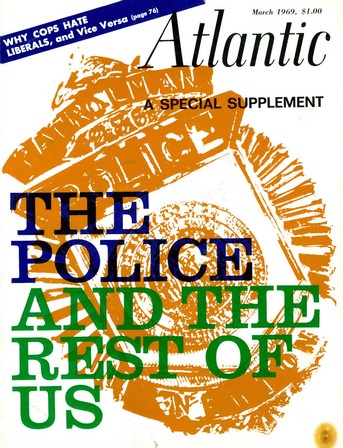
In This Issue
Explore the March 1969 print edition below. Or to discover more writing from the pages of The Atlantic, browse the full archive.
Articles
Reports and Comment: Cuba
Castro commits Cuba to an agricultural future
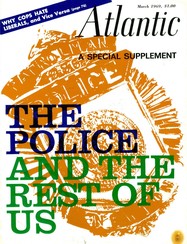
A Policeman's Lot..
"Support Your Local Police"
New York — In the next six pages, policemen take the floor. David Durk, an Amherst graduate who is a detective in the NYPD, has pounded a beat in Harlem. He speaks for himself, not for the Department. In the interviews that follow his article, Patricia Lynden has changed policemen's names. She has covered the New York police for Newsweek.
Why I'm a Cop: Interviews From a Reporter's Notebook
Requiem for the Centre Street Mafia
New York — A police commissioner who refers to his Lafcadio Hearn first editions as “my collection of Hearnia" cannot be all bad, as a former deputy commissioner makes clear in this affectionate remembrance of the band of Irish Americans who used to run the show. Mr. Dougherty is now New York bureau chief for the Los Angeles Times.
"God Help Our City"
Detroit — Nearly two years after the fearsome race riots of 1967, this city still seethes with tension. “The lines for combat are drawn,”writes William Serrin, a reporter for the Detroit Free Press. He portrays a city angrily divided and not at all certain about who controls the streets.
Trigger-Pullers
On the Vice Beat
Boston — “It’s not that we’re against anyone having a good time,”says one of Boston’s vice squad patrolmen, “but prostitutes bring the mug boys, the addicts, the robberies, the serious assaults.”Bruce McCabe is a thirty-one-year-old reporter for the Boston Herald Traveler. The names he uses are not the real ones.
Abuses of Police Power
What Makes a Better Policeman
Everyone wants a better police force, but the disturbing conclusion of most police experts is that the proper remedies are still to be tried. The author, whose recently published Varieties of Police Behavior (Harvard University Press) promises to become a classic in the field, outlines the sources of disagreement and chronicles past frustrations with reform. Professor Wilson teaches government at Harvard and is a former director of the Harvard-MIT Joint Center for Urban Studies.
The Worlds of Jean Stafford
Thinking Poetically
Cuba
A Different Drummer
The Peripatetic Reviewer
Rehabilitating Ravel
Ingmar Bergman at Fifty
Bach: Cantatas nos.18 ("Gleich Wie Der Regen") and 62 ("Nun Komm, Der Heiden Heiland")
Debussy: String Quartet in G Minor; Ravel: String Quartet in F
Electronomusic: 9 Images by John Pfeiffer
The English Poets: Arnold, Clough, Fitzgerald
Haydn: The 12 London Symphonies
Ives: Symphony no.3, "The Camp Meeting"; Schuman: New England Triptych
World's Greatest Marches
Mozart: String Quartets nos.17 in B-Flat and 19 in C
Oliver
Poulene: Suite Française; Two Marches and an Intermezzo; Music for "Les Mariés De La Tour Eiffel"; Sinfonietta
Telemann: Four Concertos
Norman Treigle: Operatic Heroes and Villains
The Quick and the Dead
Tibet
The Stranglers
La Rhubarbe
The Country House
The Women in Shakespeare's Life
Egyptian Paintings of the Mobile Kingdom
In the Time of Silent Cal
The Orange Envelope
Forfeit
Codex Vindobenensis Mexicanus I