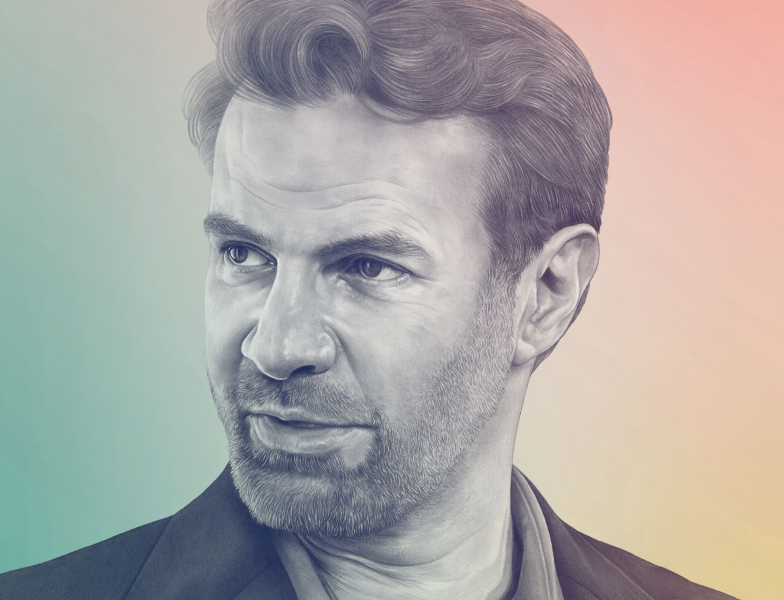

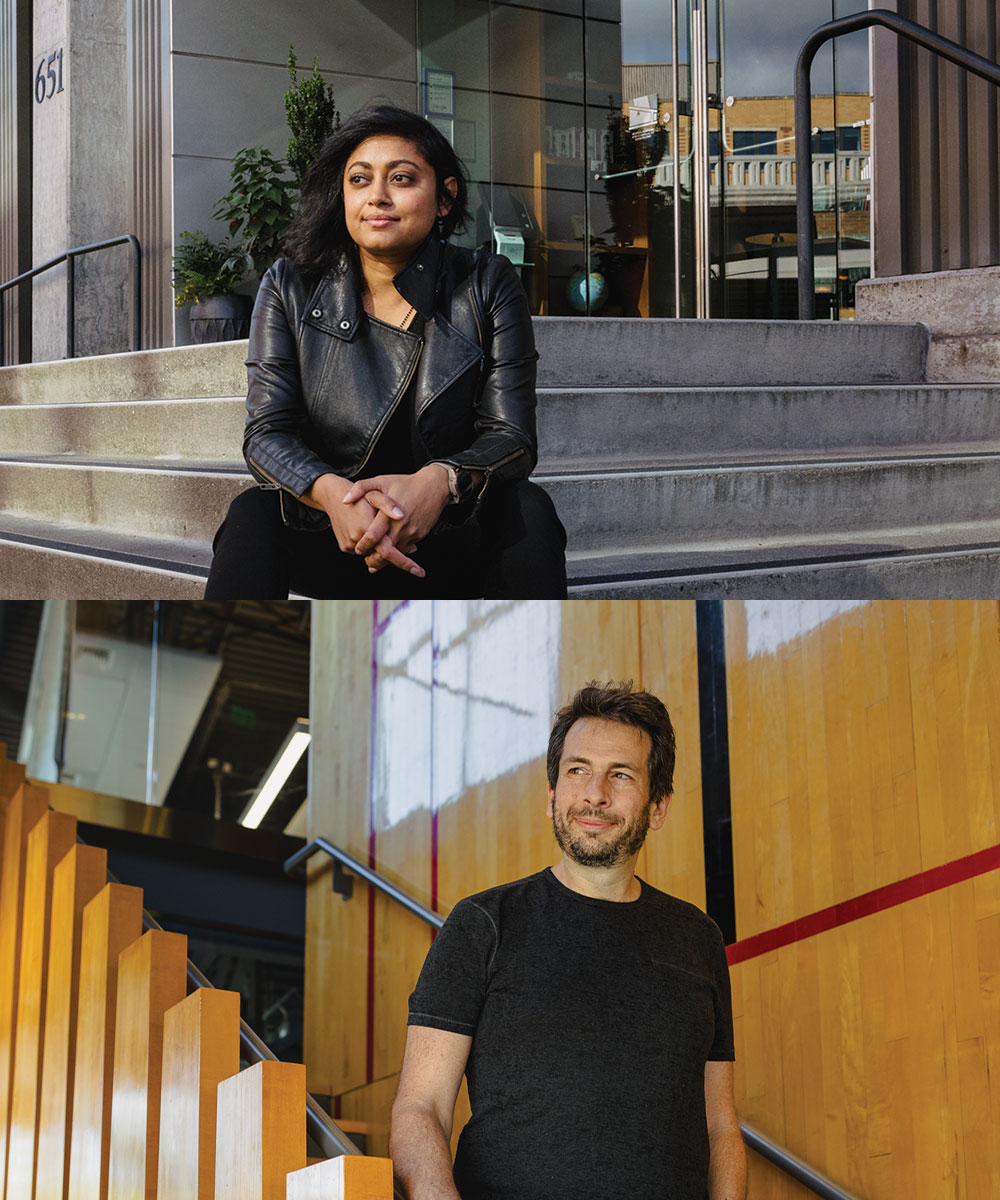
Blaise Agüera y Arcas and Mira Lane have unique perspectives on the creative possibilities of AI—and that’s in large part because they’re not just technologists; they’re also artists. In 2016, Agüera y Arcas, who works as a vice president and fellow at Google Research, founded a program called Artists + Machine Intelligence, which supports artists who produce works that incorporate machine learning. He’s also a writer and most recently authored the 2021 novella Ubi Sunt. Lane is a fine artist who works across mediums—including video, music, and ceramics—and she’s a senior director of Technology and Society at Google. Both of them agree that AI is set to revolutionize the way humans engage in creative endeavors, and that such a revolution will raise a host of complicated questions. We sat down with Lane and Agüera y Arcas to discuss.
Question As these systems become more integrated into artistic processes, what are the ethical and philosophical—or capitalistic—considerations we need to take into account? How should we think about ownership and originality, or credit and disclosures?
Mira Lane Well, some of these questions have always been around in artistry. How do you attribute songs in the right way, for example, if you’ve sampled something? Artists don’t always like to share their secrets. We’re notorious for wanting to keep those secrets to ourselves, because some of it is … There are techniques we’ve developed; sometimes we take shortcuts. For a lot of us, for me as well, AI is just part of our tool kit. Do I feel the need to disclose that an AI tool was used? No more than I feel the need to disclose any other process by which something was rendered. There are some very worthy questions we have to solve around the economics of this. But as people start incorporating AI, it gets metabolized, and you realize where some of the edges are. You saw this with generative images. There was a lot of uproar around how it was going to replace illustrators. But we found the best images are often created by people who have artistic backgrounds because they know the techniques and the language, the vocabulary. They have the ability to envision the output.
Question Are there certain formats or mediums that demand attribution?
Blaise Agüera y Arcas Yeah, maybe. But here we get into things that have less to do with art in some abstract sense than with the particular cultural traditions we’re living with, with respect to credit assignment and the cultural capital of that—and the capital capital of that. The economics. It’s a very long-tail world of rewards right now. And it’s a weird moment, especially with respect to visual art. Plutocrats have warehouses full of old master paintings. That’s just a form of capital at this point. I think looking at the AI moment is hard without considering that whole. Mira alluded to the fact that these debates aren’t new. Beastie Boys got into all these sampling wars around copyright in the 1990s. Laurence Sterne was pilloried for plagiarism in his novel Tristram Shandy in the 18th century. [James] Joyce famously obscured his tracks. He was a big obscurantist for exactly the same reasons an artist who takes a shortcut is going to not cop to that. There’s a mystery to maintain. Or consider Chihuly and his giant workshop. How much of the Chihuly glasswork is actually Chihuly, his own hands? It’s the Chihuly corporation.
Question Right. Or Richard Serra.
Agüera y Arcas Exactly. Many instances. One of the most compelling, strongest, most vigorous defenses against AI that I’ve heard was by this illustrator who does fantasy art in pencil, and it’s incredibly detailed and takes a long time. He was very frustrated about AI art, because in a few seconds you can generate things that superficially look a lot like his work—and I get that. At the same time, the same thing happened at the dawn of photography. There was this uproar from fine artists.
Question Technology itself can become a canvas for creativity, in terms of the design of it, the way we use it, and so on. Can you speak to the importance of that?
Lane These conversations can’t happen with just technologists. When you bring artists in, we start to play together. We workshop. That creative dialogue is so important. When I think about shaping technology, I think of it from that conversational standpoint. It’s not just technologists in a room. It’s bringing people in who might push the boundaries. One example is this amazing work that was done with Lupe Fiasco, the rapper: How would a rapper use something like these large language models? It’s about taking the craft of writing and exploding that out into new ways of interaction and exploration using language models. How do you build chains of related items? How do you create alliteration stemming from a topic? These types of tools—we wouldn’t have thought of these by ourselves.
Agüera y Arcas When photography was invented, it wasn’t just about making fake paintings, by the way. It changed painting and created the new genre of photography. And, maybe most important, it created movies. So there were new forms of art that suddenly became possible that were inconceivable before. I think AI is poised to do the same things—to create an explosion in types of media, including things that verge on the creation of entire universes. I mean, the mind kind of boggles.
Question But is there an extent to which AI and its creative possibilities will always be limited by its efficacy as a tool? Will it ever become a real creator versus a terrific mimic?
Agüera y Arcas There are some mechanical limitations at the moment that make it difficult to think about these things as agents or collaborators in the full sense, but I think we’re closer than I imagined we might be. To the other point you raised, as to whether they can ever produce something that isn’t just a remix or a rehash of what they’ve been exposed to during training—they can. It’s a misconception that they’re just dismembering snippets of what they’ve encountered before. That’s not true for two reasons. One is generalization, which gives you the adjacent possible. So if AI has learned the algorithm for multiplication, for example, it doesn’t need to find the auto-complete of every three-digit multiplication problem on the web. Moreover, AI also has this really interesting property called in-context learning. What that means is that it’s limited only by what can be described with language at all—so far as language can describe something, AI can describe it too. That still leaves a lot of philosophical questions about agency unsolved, but I think, at a mechanical level, it’s kind of all there.
Question Do you disagree that the production of great art requires real human experience?
Agüera y Arcas I feel like there’s something unfortunate about the extreme privileging of experience that’s happened the past few years. All of us can imagine what it would be like to feel this way or that way. I mean, that’s empathy. That’s the basic human stuff. The whole point of imagination and creativity is to be able to imagine what you have not experienced.
Question That’s a fair point. And I suppose if you’re able to make someone feel something as a result of that creation, that emotion is no less real.
Lane And it shouldn’t prevent us from enjoying it, whether it’s created through machines or humans. At the same time, I don’t see the agency yet in these machines to make me say, “Hey, it’s actually being creative.” Real art takes work. The journey of creation is part of the artwork. And language alone is a very challenging interface. We’ve spoken to many artists recently, and we’ve given them these models where language is the interface, and all of them want additional ways of interacting, because we creative people often don’t think in language, especially visual artists. I think we’ll look back at the chat interface as a very primitive one.
Question This may be a weird question, but do you trust AI’s tastes?
Agüera y Arcas Well, I mean, I do think it has taste. I think it’s bad taste. So there are two things that go into making an AI, roughly speaking. There’s the pretraining and then the fine-tuning and reinforcement learning, and design choices are being made. The fine-tuning stage is where things get really interesting. Because that’s where you say, “Okay, what is your personality going to be?” And that’s a real thing. Like, MidJourney’s art looks different from DALL-E’s. That’s the taste of the engineers who say thumbs-up to this or that. Are they qualified to be the world’s tastemakers? Obviously not. We need a much greater diversity. It’s fine for them to have their taste expressed in that model, but the idea of a few of them defining all of our tastes is horrible. I don’t care what the particulars of that taste are. Diversity is critical.
Question I’m going to phrase this question two ways. First, how do you look at technology differently than your colleagues might because you’re artists? And second, how do you look at art differently because you’re technologists?
Lane Oh, that’s interesting. I look at this technology from a very experimental point of view. It’s very easy to converge on the obvious, and so you tend to see similar solutions from a lot of the industry. As an artist, you’re more likely to say, “Why isn’t it another way?” You end up blowing out the possibilities a lot more and challenging the base assumptions. And as an artist who is also a technologist, I just don’t have a lot of fear in this space, because I’m so comfortable experimenting with these technologies. I want to be on the bleeding edge and experimenting. I’m also fortunate because I don’t make a living off my art. I know I’m in a privileged place to critique and explore.
Agüera y Arcas Those were going to be my points as well.
Lane I want to say one more thing. It’s really important for technology companies to have people who insist on bringing artists into the conversation, because you don’t see that elsewhere in a lot of big companies. You need to have people who are in positions where they can insist we have these types of programs—and can create these types of programs—to bring artists through and have them interface in meaningful ways. That’s a critical part of the dialogue.